
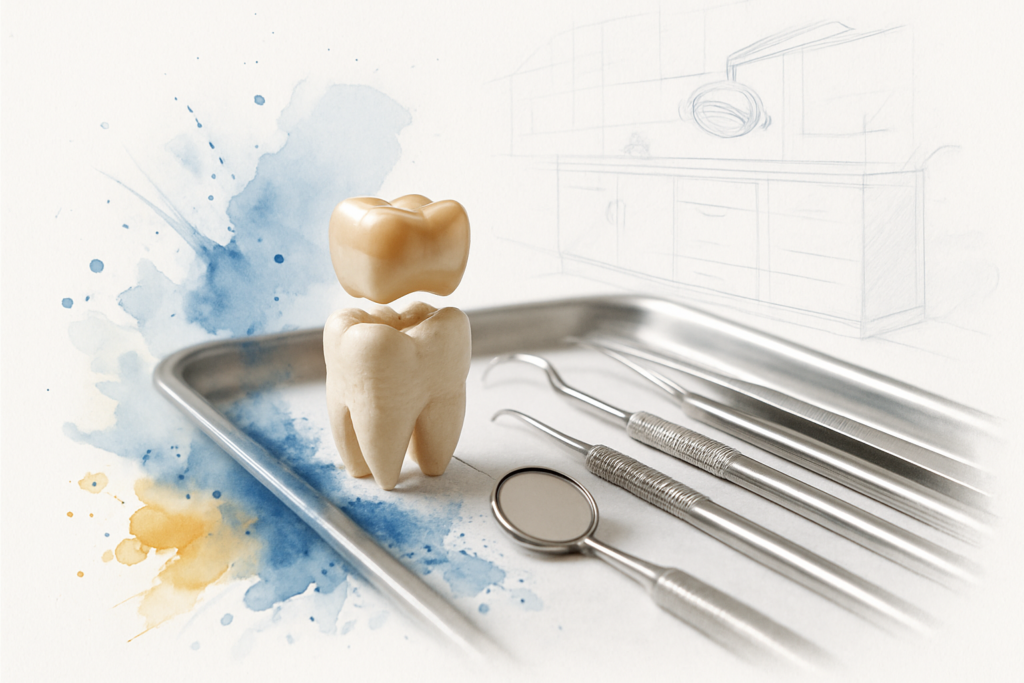
Direct Answer: A root canal removes the living tissue from inside a tooth, leaving it more brittle and prone to fracture. A crown covers that tooth and distributes bite force so it doesn’t crack under pressure.
You sat through the root canal. The pain is gone. And then your dentist tells you the next step is a crown, and suddenly the whole thing feels like it got a lot more expensive. I hear this concern regularly from patients in Renton and the surrounding South King County area, and honestly, the hesitation makes complete sense.
One patient came to us after a different dentist’s filling had chipped twice on the same tooth. Others have arrived mid-treatment, looking to finish dental work that was started elsewhere but never completed. In both situations, the same question comes up: why is a crown actually necessary, and can’t a good filling do the job?
The answer depends on the tooth, its location, and how much structure remains. I want to walk through the real reasoning here, including the situations where a crown may not be needed, so you can make an informed decision rather than just taking someone’s word for it.
What a Root Canal Actually Does to a Tooth
A root canal removes the pulp from inside the tooth, the soft tissue that contains nerves, blood vessels, and connective tissue. That process clears out an infection and saves the tooth from extraction, which is genuinely valuable. But it also changes the tooth in a way that matters long-term.
Without a living pulp, the tooth no longer receives nutrients or moisture from the inside. Over time, it becomes more brittle than a healthy tooth. The dentin, the hard layer beneath the enamel, can dry out slightly and lose some of its natural flexibility.
For front teeth, this is less of a problem. They absorb relatively light force during biting. But for back teeth, particularly molars and premolars, the forces from chewing are significant. The American Association of Endodontists notes that back teeth bear the brunt of chewing loads, and a brittle tooth wall under that kind of repeated pressure becomes a real fracture risk.
A crown solves this by covering the entire outer surface of the tooth and distributing bite force across the crown material rather than concentrating it on what may already be a weakened wall.
What Happens When a Crown Gets Delayed Too Long
After a root canal, many teeth are sent home with a temporary filling while patients wait to schedule the crown appointment. That temporary material is not designed to last, it’s meant to protect the tooth for a few weeks, not a few months.
When that window stretches out, the risk goes up. A tooth that fractures along the root, rather than just cracking at the surface, often cannot be saved at all. What started as a situation requiring a crown becomes a conversation about extraction and implant planning, which is a substantially longer and more involved process. If you’re curious about what that path looks like, this breakdown of the dental implant decision gives a clear picture.
I’m not raising this to alarm anyone. Most patients who delay a few extra weeks due to scheduling or insurance processing are fine. But patients who put the crown off for several months, especially on a molar, are taking a real structural risk that is worth understanding before making that call.
Timing also matters for insurance. Many plans reset annually on January 1, and coordinating crown placement around your benefit period can reduce out-of-pocket cost meaningfully. A patient who mentioned this approach in a review said it well: Dr. Chu’s team got the crown completed quickly enough that she could have it before her vacation, with proper coordination, the timeline can fit around your life.
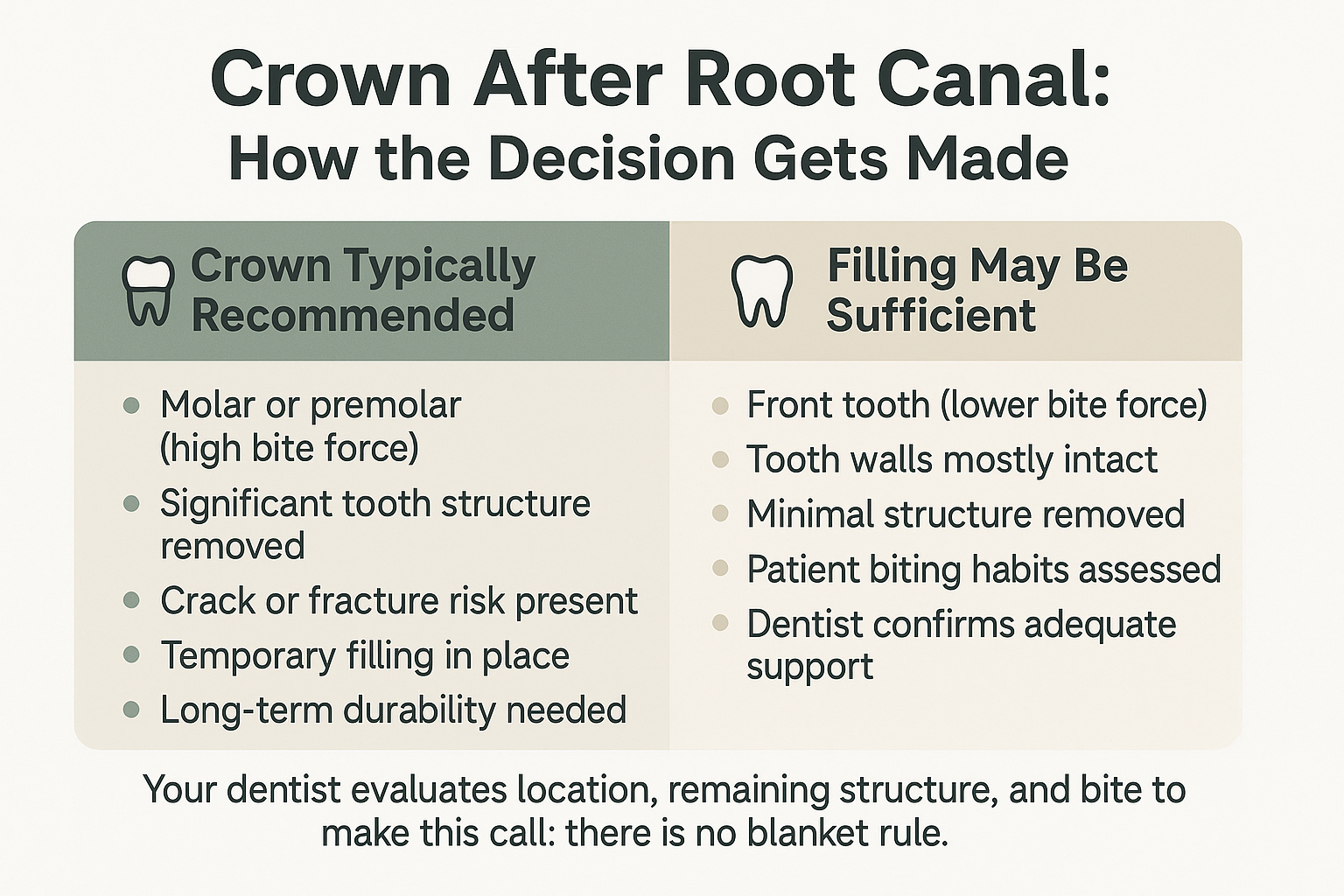
The Crown-After-Root-Canal Decision at a Glance
This infographic outlines the key factors that determine whether a crown is the right next step after root canal therapy.
When a Crown May Not Be the Right Call
This is something I think every patient deserves to hear clearly: not every root-canal-treated tooth needs a crown.
Front teeth, the incisors and canines, bear far less chewing force than back teeth. If a front tooth has had a root canal and still has most of its original wall structure intact, a well-placed composite filling can sometimes provide adequate protection. The dentist’s job is to look at:
- Which tooth was treated and where it sits in the bite
- How much structure remains after the access point was created for the root canal
- The patient’s bite pattern, whether they clench, grind, or put unusual force on certain teeth
- How the opposing teeth meet, a heavy bite contact on a specific spot changes the calculus
A dentist who recommends a crown without explaining those factors isn’t necessarily wrong, but you’re entitled to understand the reasoning. At our practice, we walk through the specifics before recommending any next step, because a recommendation that makes sense to you is one you’re actually going to follow through on.
If you’re weighing what kind of restoration fits your situation, this guide on crown versus bridge versus implant decisions covers how those choices actually get made in practice.
Crown After Root Canal: Back Teeth vs. Front Teeth
Location is one of the biggest factors in this decision. Here’s how the reasoning typically plays out by tooth type.
| Tooth Type | Bite Force Level | Crown Typically Needed? | Key Consideration |
|---|---|---|---|
| Molars (back) | High | Yes, in most cases | Highest fracture risk; crown is standard of care |
| Premolars (mid-mouth) | Moderate-High | Usually yes | Position and wall thickness both factor in |
| Canines (corner teeth) | Moderate | Often yes | Canines absorb significant lateral forces |
| Incisors (front teeth) | Low | Sometimes not | A filling may suffice if structure is mostly intact |
| Any tooth with cracking | Varies | Yes | Existing cracks escalate fracture risk significantly |
What the Crown Process Actually Looks Like
For patients who are anxious about adding another procedure, it helps to know what the actual process involves. A crown appointment typically means two visits: one to prepare the tooth and take impressions, and a second to place the permanent crown once it’s been fabricated.
The preparation visit involves reshaping the outer surface of the tooth slightly so the crown can fit securely over it. A temporary crown is placed between visits. The second appointment, placing the permanent crown, is usually shorter and more straightforward.
For patients with dental anxiety, this is something we take seriously at every step. If you’ve had difficult dental experiences before, this article on what makes a dental practice genuinely comfortable for anxious patients is worth reading before you decide where to have the work done.
As for cost, crown pricing varies based on the tooth involved, the materials used, and your insurance coverage. Many PPO plans cover a portion of crown costs, particularly when the crown is placed on a tooth that has had root canal therapy, since it’s considered restorative rather than cosmetic. This overview of how dental insurance works in Washington explains where coverage tends to apply and where it falls short, which is useful context before your consultation.
Frequently Asked Questions About Crowns After Root Canals
My tooth doesn’t hurt anymore after the root canal. Do I still really need a crown?
Yes, in most cases on back teeth. The absence of pain is the point of the root canal, it worked. But pain relief and structural protection are two different things. The tooth is now more brittle than before, and the lack of pain means you won’t get a warning signal before a fracture happens. A crown is protective, not reactive.
What happens if I just get a filling instead of a crown?
For a front tooth with most of its structure intact, a filling may hold up well. For a molar or premolar, a filling leaves the remaining tooth walls exposed to full chewing force. If a crack develops and extends into the root, the tooth typically cannot be saved, and the path forward becomes extraction and implant planning rather than a crown. That’s a significantly more involved process.
How long can I wait between the root canal and the crown appointment?
Most dentists recommend completing the crown within 4-6 weeks of the root canal. If a temporary filling is in place, that timeframe is especially important, temporary materials are not built to last. Waiting several months increases fracture risk meaningfully, particularly on back teeth.
Will my insurance cover the crown after a root canal?
Many PPO plans do cover a portion of crown placement, especially when it follows root canal therapy on the same tooth. Coverage percentages, annual maximums, and waiting periods all vary by plan. We work with most major PPO insurers, and our team can review your benefits before treatment so you understand your out-of-pocket cost ahead of time.
Can a crown placed after a root canal last long-term?
With good oral hygiene and regular checkups, a well-made crown can last 10-15 years or longer. The crown itself doesn’t decay, but the tooth structure beneath it and the gum tissue around it still require care. Cleanings, proper brushing, and protecting against grinding all extend the life of the restoration.
Have Questions About Your Next Step After a Root Canal?
If you’ve had a root canal and you’re unsure whether a crown is the right next move for your specific tooth, we’re glad to walk through it with you. Cedar Dental Group serves patients in Renton, Kent, Tukwila, Burien, Newcastle, and the broader South King County area. You can reach us at 425-430-0400 or visit cedardentalgroup.com to request a consultation, no pressure, just a clear conversation about what your tooth actually needs.
