

Direct Answer: Look past the website photos. A practice built for anxious patients shows it through transparent communication, staff behavior, and concrete comfort options — not just a tagline.
A lot of dental offices say they’re gentle. A lot of websites show the same stock photo of a smiling patient and promise a “comfortable experience.” For someone who genuinely dreads the dentist — maybe because of a painful visit years ago, or a provider who never quite explained what was happening — those words don’t mean much.
This guide is for the adults in Renton and across South King County who want to do their homework before they book. The patients who need to feel confident in a practice before they walk through the door. If that’s you, here are the things worth actually looking for — and a few red flags worth noticing.
We’ll focus on two core things that separate a practice that’s genuinely set up for anxious patients from one that just markets itself that way: how the office communicates before and during your visit, and what concrete comfort tools they actually offer.
What the Intake Process Tells You Before You Ever Sit in the Chair
The first real signal comes before your appointment. How a practice handles the intake process tells you a lot about how they’ll handle you when you’re nervous in the chair.
A practice that takes anxiety seriously will ask about it upfront — usually on the new patient forms or during the first phone call. If nobody asks whether you have any concerns or fears about dental care, that’s not a good sign. It doesn’t mean the dentist is unkind, but it does mean anxiety isn’t a priority in their workflow.
When you call to book, pay attention to how the front desk responds if you mention being nervous or having had a bad experience elsewhere. A well-trained team will:
- Acknowledge what you said without brushing past it
- Ask a follow-up question about what specifically worries you
- Offer to let you speak with the dentist before your appointment if you want
- Explain what your first visit will actually involve — step by step
If the response is a quick “don’t worry, we’re gentle” and then straight to scheduling, that’s a script, not a system. You deserve more than reassurance. You deserve a plan.
For a broader look at what separates genuinely patient-focused offices from the rest, this piece on what makes a dentist feel less intimidating covers some useful ground.

The Difference Between ‘We’re Gentle’ and Actually Having Comfort Options
Most dental practices will describe themselves as gentle. Fewer of them have built real infrastructure around managing patient anxiety. There’s a practical difference between the two.
Sedation options are one of the clearest indicators. Nitrous oxide — sometimes called laughing gas — is the most common comfort tool for mild to moderate anxiety. It works quickly, wears off in minutes, and lets most patients feel calm without being fully sedated. If a practice offers it, that tells you they’ve invested in managing the experience, not just the procedure.
Ask specifically: Does the office offer nitrous oxide? What does it cost? Is it covered by insurance? If you’re curious about what to expect on pricing, there’s a practical breakdown at Dentist Nitrous Oxide Cost: Your Guide.
Beyond sedation, look for these:
- A “stop signal” system — a clear agreement that you can pause treatment at any time by raising your hand, no questions asked
- Pre-procedure explanations — the dentist tells you what they’re about to do before they do it, every time
- Pacing control — the ability to take breaks during longer appointments without feeling like you’re inconveniencing anyone
- Noise and sensory considerations — whether the office offers headphones, blankets, or other small comforts that reduce sensory overwhelm
None of these are expensive to offer. The practices that don’t offer them usually haven’t made anxiety management a real priority.
One more thing worth asking: does the dentist do a “tell-show-do” approach? That means they explain the instrument, show it to you, and then use it. It sounds simple, but for someone who gets anxious from the unknown, it changes everything.
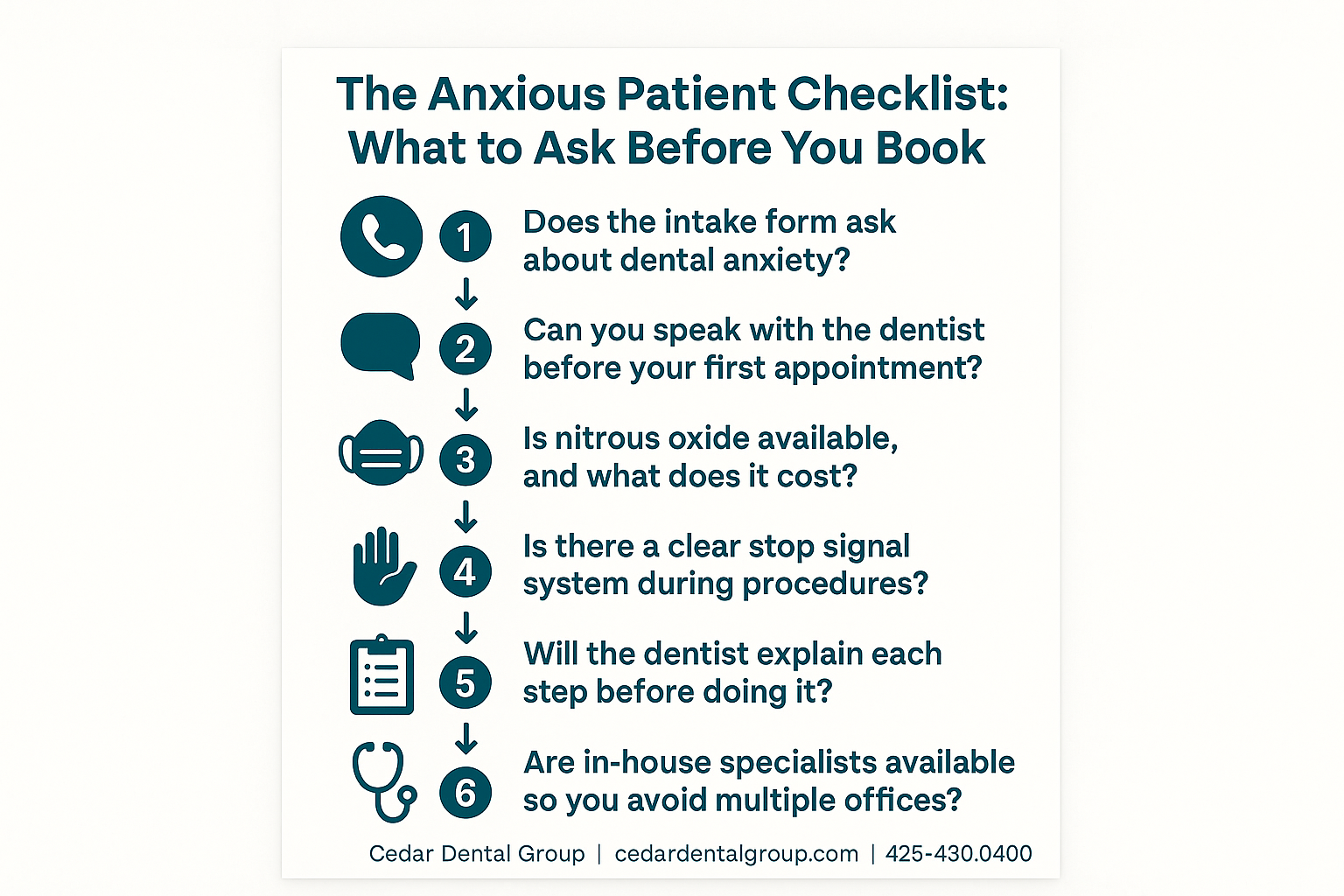
The Anxious Patient Checklist: What to Ask Before You Book
Use this checklist when evaluating any dental practice — whether you’re calling to ask questions or reading through their website.
Why In-House Specialists Matter More for Anxious Patients Than Most People Realize
This one gets overlooked, but it’s worth thinking through carefully.
Anxious patients often manage to get to their regular dental appointments — barely. The idea of then being referred out to a separate specialist, at a different office, with an unfamiliar team, for a procedure that sounds more intense? That’s where a lot of people stop following through on necessary treatment.
A practice that has specialists on-site removes that barrier entirely. You’ve already built trust with the team. You know the front desk. You know what the chairs look like and how the office smells. When something like a root canal or a gum procedure needs to happen, it happens in a place that already feels manageable.
At Cedar Dental Group, Dr. Joe Dutner handles root canal therapy in-house as the practice’s endodontist. And Dr. Jaewon Kim, a board-certified periodontist, handles advanced gum procedures — including gum grafting for recession, periodontal surgery, and bone grafting — without patients needing to be sent somewhere else.
For an anxious patient in Renton or Newcastle or Tukwila, that continuity of care is genuinely significant. You don’t have to rebuild trust from scratch at a specialist’s office across town.
If you’ve ever wondered whether your gum recession has reached the point where a procedure is necessary, this guide on how to know if gum recession is serious enough to need a graft can help you think through it without pressure.
What to Compare When Evaluating Dental Practices for Anxiety
These are the practical markers worth checking before you commit to a new practice — things you can actually verify with a phone call or a quick website review.
| What to Look For | Green Flag | Red Flag |
|---|---|---|
| Intake process | Forms ask about anxiety; staff follows up | No mention of anxiety until you’re in the chair |
| Communication style | Step-by-step explanations before treatment | Dentist starts without explaining what’s happening |
| Sedation options | Nitrous oxide available; cost explained upfront | “We’re gentle” with no specific comfort options |
| Stop signal policy | Clearly offered and respected | Never mentioned |
| Specialist access | Endodontist and periodontist on-site | Referrals to outside offices for specialty care |
| Pacing | Breaks available during long appointments | Appointments feel rushed or time-pressured |
Reading Between the Lines on a Dental Practice’s Website
Most anxious patients do significant research before calling. So it’s worth knowing how to read a dental website a little more critically.
Generic phrases like “we treat patients like family” or “a warm and welcoming environment” are the dental equivalent of a hotel describing itself as “conveniently located.” They say nothing. Look instead for specifics.
Does the site explain what a procedure actually involves — not just that it’s available? Does it mention nitrous oxide by name, or does it just say “sedation options”? Does it introduce the dentists with real credentials and areas of clinical focus, or just headshots and years in practice?
For anxious patients doing research in Renton, this guide to finding a dentist for anxiety in the area and the roundup of the best dentists for dental anxiety in Renton are both worth reading alongside this article — they get into the specifics of what local options look like and what questions to ask.
One more thing: look at how the office talks about cost. A practice that’s straightforward about fees and insurance — even on the informational pages — tends to be straightforward about everything else too. Opacity about pricing is usually opacity about process.
Frequently Asked Questions About Finding a Dental Practice for Anxious Patients
Is it okay to tell a dental office I’m anxious when I call to book?
Absolutely — and honestly, how they respond will tell you a lot. A practice that’s genuinely set up for anxious patients will welcome that information and use it to prepare for your visit. If the person who answers sounds like they’re just trying to get you on the schedule, that’s a signal worth paying attention to.
What’s the difference between a gentle dentist and a dentist who actually accommodates anxiety?
Gentleness is about technique. Accommodating anxiety is about systems. A gentle dentist tries to minimize discomfort during a procedure. A dentist who accommodates anxiety builds processes around communication, pacing, and patient control — before, during, and after treatment. You want both, but the second one matters more for anxious patients.
Does nitrous oxide actually help with dental anxiety?
For mild to moderate anxiety, yes — it’s one of the most effective and well-tolerated comfort tools available. It takes effect within a few minutes, keeps you calm and relaxed without putting you to sleep, and wears off quickly enough that most patients can drive home afterward. It does not work for everyone, and for significant anxiety, a conversation with the dentist about other options is worthwhile.
What if I need a specialist — like for a root canal or gum surgery — and I’m already anxious about regular cleanings?
This is exactly why in-house specialists matter so much for anxious patients. Being referred to an unfamiliar office for a more intense procedure is genuinely hard for people who already struggle with dental visits. If the practice has an endodontist and a periodontist on-site, you stay in a familiar environment with a team you already trust. That continuity makes a real difference in whether patients actually follow through on the care they need.
How do I know if a practice will actually respect a stop signal during treatment?
Ask directly before your appointment: “If I raise my hand during a procedure, will you stop immediately?” A confident “yes, absolutely” is what you’re looking for. You can also pay attention during the appointment itself — does the dentist pause and check in periodically, or do they keep working without acknowledging you? The first visit tells you almost everything you need to know about how a practice respects patient comfort.
Are anxious patients treated differently in terms of appointment length?
At a well-run practice, yes. Anxious patients often benefit from slightly longer appointment blocks — not because the procedure takes longer, but because pacing and pauses are built in. Some practices will note this in your chart so that every future appointment is scheduled accordingly. It’s worth asking about upfront.
Ready to Find a Practice That Takes Your Comfort Seriously?
Cedar Dental Group serves adults in Renton and across South King County — including Tukwila, Kent, Burien, and Newcastle — who want a dental home where they feel genuinely cared for, not just processed. With Dr. Chu, Dr. Dutner, and Dr. Kim all on-site, most patients can receive their full scope of care in one familiar place. If you’d like to talk through what your first visit would look like before you commit to anything, you’re welcome to call us at 425-430-0400 or visit cedardentalgroup.com to learn more.
