

Direct Answer: A dental implant is often the best long-term option after tooth loss when your jawbone is healthy enough to support it and you want a permanent, natural-feeling replacement.
Losing a tooth as an adult isn’t just a cosmetic issue. It affects how you chew, how you speak, and over time, how much jawbone you keep. The question most people ask after an extraction is simple: what do I do now?
For many adults in Renton and across South King County, a dental implant turns out to be the answer that makes the most sense long-term. But it’s not the right fit for every person or every situation — and knowing the difference matters before you commit.
This guide walks through what makes someone a strong candidate for an implant, when other options might fit better, and what the whole process actually looks like from start to finish.
What a Dental Implant Actually Is
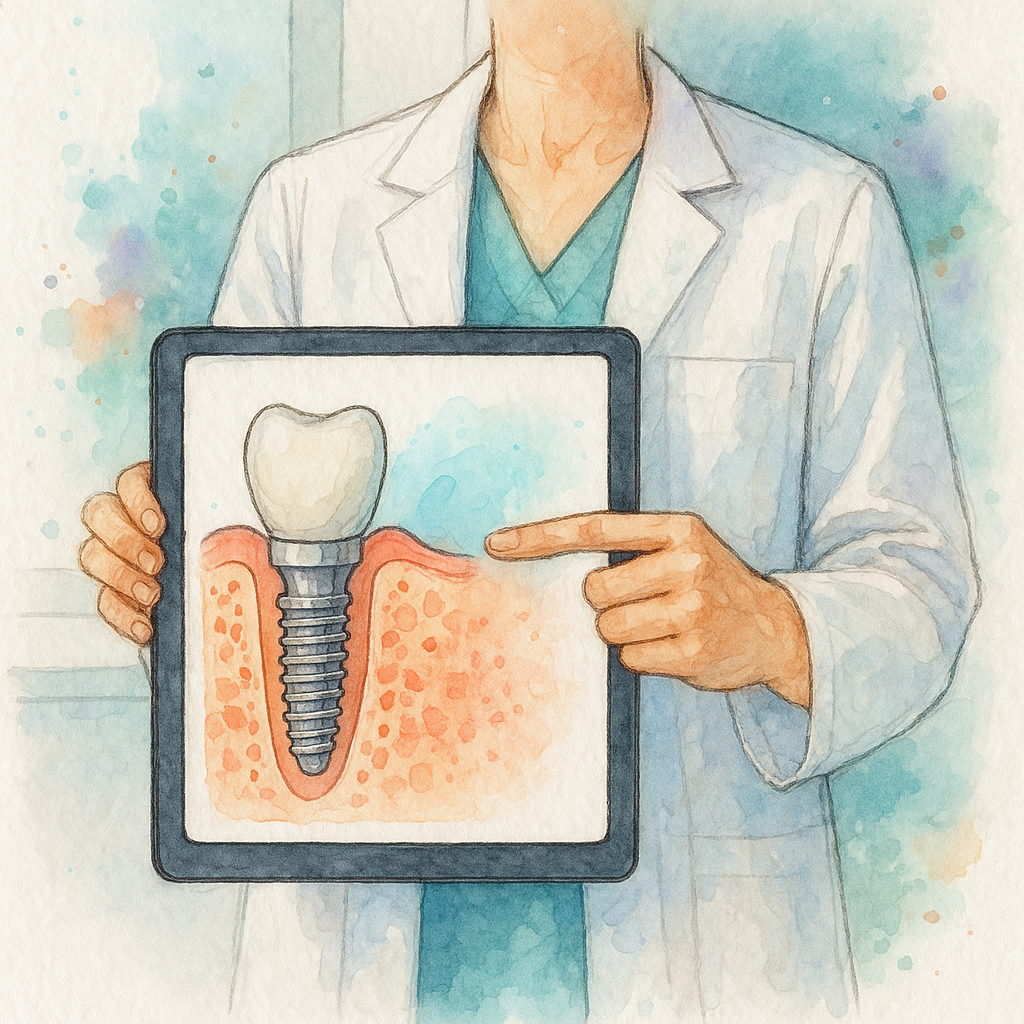
A dental implant is a small titanium post that a dentist or specialist surgically places into your jawbone. Over the next few months, the post fuses with the bone in a process called osseointegration — essentially, the bone grows around it and holds it in place like a natural root.
Once that fusion is solid, a connector piece called an abutment is attached to the post, and a dental crown is placed on top. The finished result looks, feels, and functions like a real tooth.
Unlike a bridge or a removable partial denture, an implant doesn’t depend on neighboring teeth for support. It stands on its own — which is one of the key reasons it tends to last so much longer than other tooth replacement options.
If you’re curious about how long the full process takes from placement to final crown, this breakdown of the dental implant process explains each phase in plain detail.
The Strongest Reasons to Choose an Implant Over Other Options
Not all tooth replacement options are equal. A bridge, for example, requires shaving down the two healthy teeth on either side to anchor it in place. A removable partial denture works but can shift around and requires daily removal and cleaning.
An implant avoids both of those trade-offs. Here’s what sets it apart:
- Bone preservation — When a tooth root is gone, the jawbone underneath starts to shrink within the first year. An implant stimulates the bone the same way a real root does, slowing or stopping that loss.
- No impact on adjacent teeth — Neighboring teeth stay untouched and intact.
- Durability — With good oral hygiene, implants can last 20 or more years. Some last a lifetime.
- Natural feel — Most patients report that an implant feels indistinguishable from their natural teeth within a few months.
- Easier oral hygiene — You brush and floss an implant crown just like a regular tooth. No special removal, no adhesives.
For patients in Renton who’ve already had a dental crown or bridge and want to understand how implants compare to that kind of restoration, those two approaches serve different situations and are worth discussing with your dentist directly.
Who Is a Good Candidate for a Dental Implant?
Implants don’t work for everyone right out of the gate. There are a few factors that determine whether you’re ready for placement or whether some groundwork needs to happen first.
You’re likely a strong candidate if:
- Your jawbone is dense enough to hold the implant post securely
- Your gums are healthy — no active gum disease or infection
- You don’t smoke, or you’re willing to stop during the healing period
- You have controlled chronic conditions like diabetes (uncontrolled diabetes slows healing)
- You’ve finished growing — implants aren’t placed in patients whose jaws are still developing
You may need preparation first if:
- You’ve had significant bone loss from a long-missing tooth or advanced gum disease — a bone grafting procedure may be needed to rebuild the site before an implant can be placed
- You have active gum disease — that needs to be treated and stabilized first
- You’re managing a health condition that affects healing or clotting
The good news is that many patients who weren’t initially candidates become candidates after the right preparatory treatment. A thorough evaluation is the only way to know for sure where you stand.
When Bone Grafting Comes Into the Picture
One thing that surprises a lot of patients: you can lose significant jawbone in as little as 6 to 12 months after a tooth is extracted. The longer the gap between tooth loss and implant placement, the more likely it is that bone rebuilding will be needed first.
Bone grafting is a separate surgical procedure from the implant itself. It involves placing bone material — either synthetic, from a donor source, or sometimes from your own body — into the area where bone has deteriorated. Over several months, your body incorporates that material and the site becomes dense enough to support an implant post.
This step adds time to the overall process, but it’s what makes implant placement possible in cases where it otherwise wouldn’t be. At Cedar Dental Group, Dr. Jaewon Kim — a board-certified periodontist — handles bone grafting procedures in-house, which means patients don’t need to travel to a separate specialist’s office across the Seattle metro area.
Having that level of surgical expertise available at the same Renton practice significantly simplifies what can otherwise be a fragmented treatment experience.
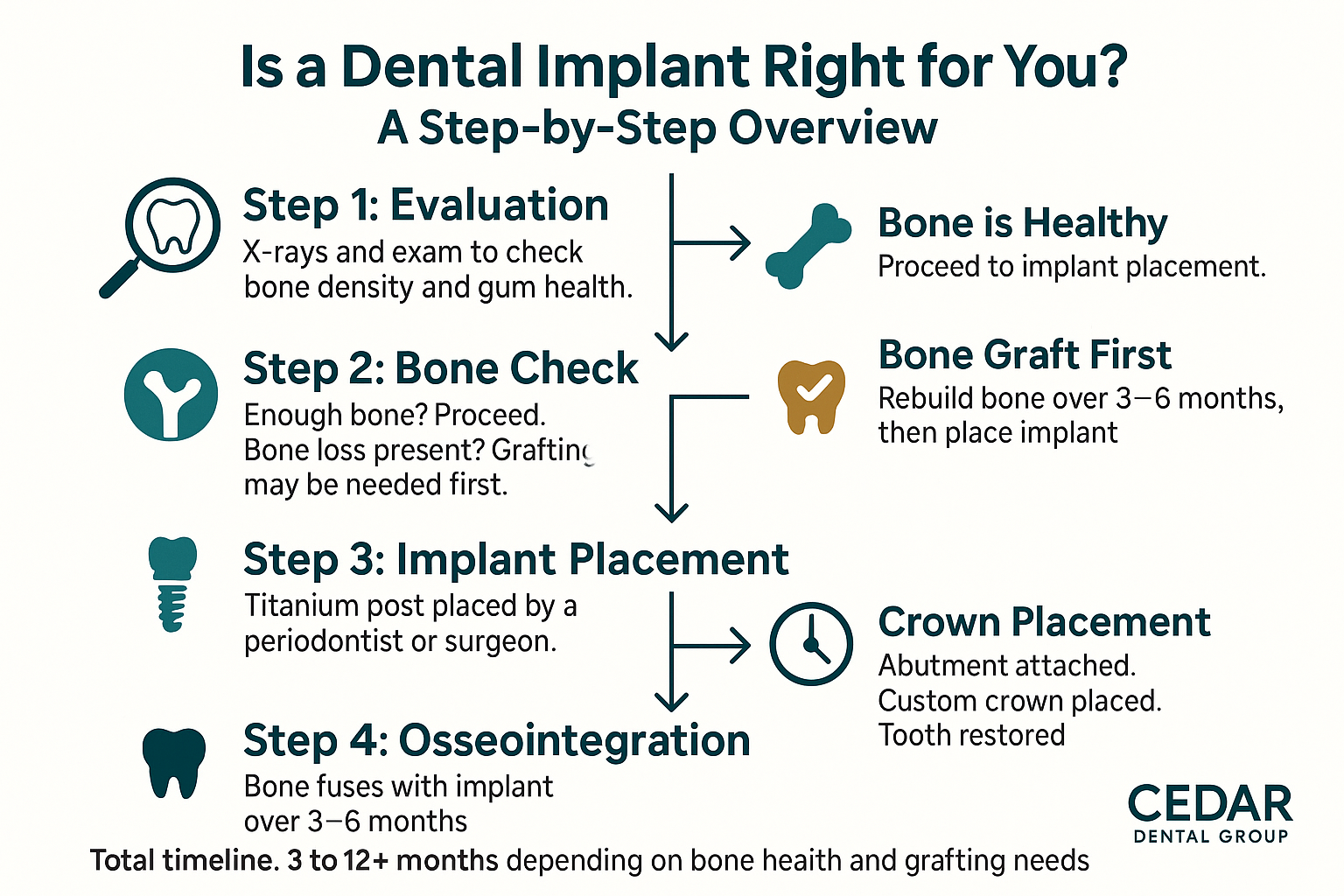
The Dental Implant Decision: A Step-by-Step Overview
This visual walks through the key decision points and phases in the implant process, from initial evaluation to final restoration.
When a Bridge or Denture Makes More Sense
An implant isn’t always the right answer — and a good dentist will tell you that honestly.
A dental bridge may be a better fit if you need to replace a tooth quickly, your budget is more limited in the short term, or the teeth on either side of the gap already need crowns anyway. In that scenario, a bridge accomplishes two goals at once. You can read more about how bridges compare to other restorations if that option is on your radar.
For patients missing multiple teeth across a full arch, an implant-supported solution like All-on-4 may be more practical than placing individual implants at every site. That’s a different conversation with a different cost and timeline. All-on-4 full-arch implants are worth understanding if you’re in that situation.
And if cost is a real barrier — which it is for many patients, given that a single implant in the greater Seattle area typically runs $3,500 to $6,000 depending on whether grafting is involved — there are ways to plan for it over time. Financing options for dental implants can make the process more accessible without compromising the quality of care.
Dental Implant vs. Bridge vs. Partial Denture: A Quick Comparison
Here’s a side-by-side look at the three most common single-tooth or small-gap replacement options to help frame the decision.
| Factor | Dental Implant | Dental Bridge | Partial Denture |
|---|---|---|---|
| Requires surgery? | Yes | No | No |
| Impacts adjacent teeth? | No | Yes — teeth are shaved down | Minimal, uses clasps |
| Preserves jawbone? | Yes | No | No |
| Average lifespan | 20+ years, often permanent | 10–15 years | 5–10 years |
| Approximate cost (Seattle area) | $3,500–$6,000+ | $2,500–$4,500 | $1,200–$2,500 |
| Insurance coverage | Partial, varies by plan | Often partially covered | Often partially covered |
| Removable? | No | No | Yes |
| Feels most like a real tooth? | Yes | Close, but fixed to adjacent teeth | Less natural feel |
What the Process Actually Feels Like as a Patient
A lot of patients hesitate on implants because they picture something painful and drawn-out. The reality is more manageable than that image suggests.
The surgical placement appointment is done under local anesthesia, so you don’t feel the procedure while it’s happening. Sedation options are available if you want additional comfort — if dental anxiety is a factor for you, this guide to comfort-focused care is worth reading before your consultation.
After placement, most patients describe mild soreness and swelling for 3 to 5 days. Over-the-counter pain relievers handle it well for most people. You’ll eat soft foods for a week or two, then return to normal.
The longer part of the process is the waiting — osseointegration takes 3 to 6 months, during which you have a temporary restoration in place and the implant is quietly doing its job under the surface. There’s no pain during this phase. You come back for check-ins, then return once healing is confirmed to have the final crown placed.
The full timeline from placement to finished crown typically runs 5 to 8 months for straightforward cases. If bone grafting is needed first, add another 3 to 6 months before that.
Why Having a Periodontist In-House Changes the Experience
Most general dental practices refer patients out for implant surgery, bone grafting, and advanced gum treatment. That means separate offices, separate records, and coordinating your own care across two or three different providers.
At Cedar Dental Group, Dr. Jaewon Kim handles the surgical side — implant placement, bone grafting, periodontal surgery — in the same Renton office where Dr. Susan Chu manages your overall dental care. That’s not standard.
Dr. Kim is a board-certified periodontist, which is a post-dental school specialty requiring additional years of surgical training with a focus on the gums, bone, and supporting structures of the teeth. Board certification adds another layer — it means he’s met a national standard of competency in his specialty beyond just completing the residency.
For patients across South King County who’ve been told they need a specialist, this setup means you’re not driving into Seattle or managing two separate care relationships. The evaluation, treatment planning, and surgical care all happen in one place.
Frequently Asked Questions About Dental Implants After Tooth Loss
How soon after losing a tooth should I get an implant?
The sooner the better, generally. Jawbone starts to shrink within 6 to 12 months of losing a tooth, and significant bone loss makes implant placement harder or requires grafting first. Getting evaluated quickly gives you the most options.
Does dental insurance cover implants?
Some plans cover a portion — often the crown, the consultation, or diagnostic imaging — but many plans still classify implants as elective and cover little to nothing. It varies widely by plan. Calling your insurance provider directly with the procedure codes from your dentist is the fastest way to find out what applies to your specific plan.
Will getting a dental implant hurt?
The placement procedure is done under local anesthesia, so you won’t feel it during the appointment. Afterward, most patients manage with over-the-counter pain relievers for 3 to 5 days. It’s typically described as more uncomfortable than painful.
What happens if I don’t replace a missing tooth at all?
Over time, the jawbone under the empty space shrinks because there’s no root stimulating it. Neighboring teeth can also drift toward the gap, changing your bite. These changes are gradual and often painless, which is why many people don’t realize the impact until years later.
Can I get an implant if I have gum disease?
Not before the gum disease is treated and stable. Active gum disease creates an environment where implants are far more likely to fail. The right sequence is to treat the gum disease first — which may involve scaling and root planing or periodontal surgery — and once your gums are healthy, evaluate implant candidacy from there.
Ready to Find Out If an Implant Is Right for You?
If you’ve lost a tooth and want a clear, honest answer about your options, the best starting point is a thorough evaluation with a dentist who can assess your bone health, gum condition, and overall oral health together. At Cedar Dental Group in Renton, Dr. Chu and Dr. Kim work as a team — general care and surgical specialty under one roof — so you get a complete picture without being sent across town. Call us at 425-430-0400 or visit cedardentalgroup.com to schedule a consultation.
