

If you have a missing tooth, you’ve probably heard about dental implants and bridges. It can be confusing to know which is the right choice. The main difference is simple: an implant replaces your entire tooth from root to crown, while a bridge fills the gap using your other teeth for support.
Think of it this way: a dental crown is just a cap for a damaged tooth that is still there. Implants and bridges, however, are for replacing a tooth that is completely gone. Making the right choice depends on your specific needs and goals for your smile.
Choosing the Right Solution for Your Smile

Losing a tooth can feel stressful, but modern dentistry offers wonderful ways to restore your smile and bring back your confidence. Here at Cedar Dental Group, we know this decision can feel big. We are here to explain everything in clear, simple terms so you feel comfortable and informed.
This guide will walk you through each option. We will compare them side-by-side on everything from the procedure and cost to the long-term effects on your health. Our goal is to give you the information you need to have a good conversation with your dentist. We believe every patient in Renton deserves a smile they feel great about, and understanding your options is the first step.
| Feature | Dental Implant | Dental Bridge |
|---|---|---|
| Purpose | Replaces an entire missing tooth, including the root. | Fills a gap by attaching to the teeth next to it. |
| Structure | A standalone tooth replacement with a titanium post. | A false tooth held in place by crowns on nearby teeth. |
| Impact | Protects your jawbone and doesn't harm other teeth. | Requires changing the shape of healthy teeth next to the gap. |
Understanding Your Tooth Replacement Options
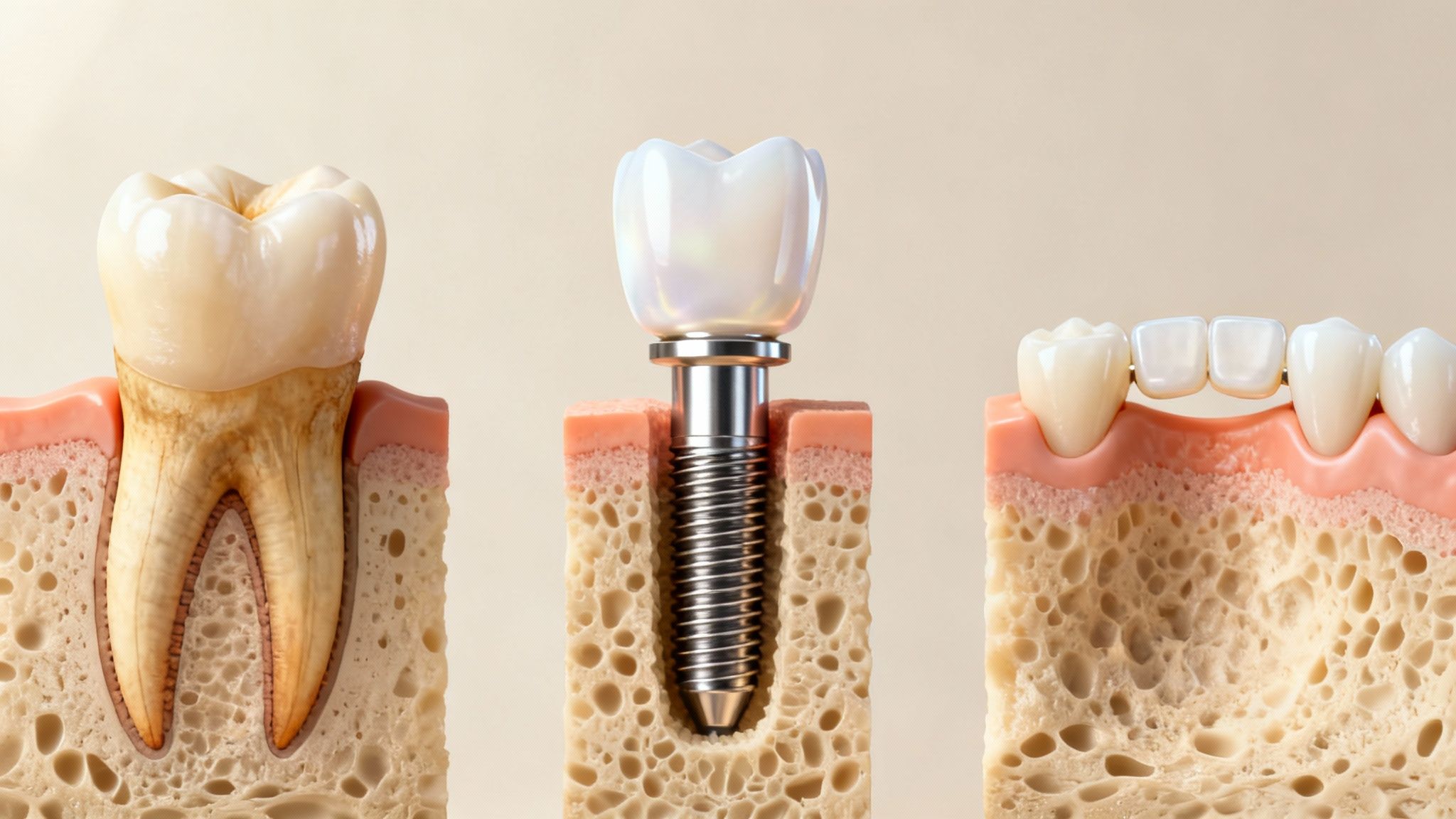
Before we compare them, let's get a clear picture of what each of these treatments are. They solve different problems, so knowing the basics is very important.
A dental implant is like building a new tooth from the ground up, and it stands on its own. We place a small titanium post into your jawbone, where it acts like a new root. Once it’s secure, we attach a custom-made crown. This gives you a strong, new tooth that doesn't rely on its neighbors.
A dental bridge works differently. It is designed to "bridge" the gap left by a missing tooth. The bridge is one piece, usually a false tooth fused between two crowns. It gets cemented onto the healthy teeth on either side of the space. This means we do have to reshape those neighbor teeth so the crowns can fit over them.
And what about a dental crown? A crown doesn’t replace a missing tooth. Instead, it’s like a custom-fit helmet for a damaged tooth that is still present. It restores the tooth's shape, strength, and function.
Understanding these key differences is the first step toward making a confident choice. For those needing a full tooth replacement, our team at Cedar Dental Group uses advanced dental implant technology to create predictable, lasting results. If you are exploring other options, you might find this a detailed comparison of dental implants and dentures helpful, too.
When you think about replacing a missing tooth, it’s not just about filling a space. It’s also about the procedure itself and the long-term health of your mouth. Dental implants and bridges use very different approaches to give you a complete smile.
A dental bridge is the faster option. We can usually complete the entire process in just two or three visits over a few weeks. A dental implant, however, is more of a long-term project. It’s a process with multiple steps that can take several months. This is because we need to give the implant time to fuse with your jawbone, which creates a very strong foundation for your new tooth.
The Long-Term Impact on Your Smile and Jaw
The biggest difference between these two choices becomes clear years later. It all comes down to how they affect your jawbone. Dental implants are the only solution that replaces the tooth root, and that is a major benefit for your oral health.
Every time you chew with an implant, it stimulates your jawbone, just like a natural tooth root. This stimulation prevents the bone loss that normally happens when a tooth is missing. By protecting your bone, you also protect your facial structure and stop nearby teeth from shifting.
A dental bridge does a great job of closing the gap, but it doesn't help the bone underneath. Since there's no root to provide that important stimulation, the jawbone under the fake tooth (called a pontic) will slowly shrink. Over time, this can create a small space under the bridge that can trap food and make cleaning harder.
To make it even clearer, let's look at a side-by-side comparison.
Feature Comparison Dental Implants vs. Dental Bridges
This table shows the key differences between an implant and a bridge, helping you see where each one excels.
| Feature | Dental Implant | Dental Bridge |
|---|---|---|
| Longevity | Can last a lifetime with proper care. | Usually needs replacement every 7-15 years. |
| Oral Health | Protects jawbone; doesn't affect other teeth. | Requires grinding down healthy teeth; can lead to bone loss. |
| Procedure | Surgical placement; process takes several months. | Non-surgical; finished in a few weeks. |
| Maintenance | Cleaned just like a natural tooth. | Needs special tools to clean under the bridge. |
Ultimately, the choice comes down to your priorities—a quick solution or a permanent one that focuses on your long-term health.
Durability and Lifespan
Another big factor is how long your new tooth will last. This is where implants have a clear advantage. Studies consistently show that implants are built to last for a very long time. They have a survival rate of around 95-98% after 10 years, and many will last a lifetime with good care (Source: Journal of the American Dental Association).
Dental bridges, in comparison, don't have the same staying power. They typically last between 7 to 15 years before they need to be replaced. You can explore more research on single-tooth replacement longevity to see the data for yourself.
Key Takeaway: While a bridge is a faster fix, a dental implant is an investment in a permanent solution that actively protects your oral health for many years to come.
This amazing durability means that even though an implant costs more at first, it often becomes the more affordable choice over a lifetime. You avoid the cost of replacing a bridge again and again. Of course, protecting that investment is important, which is why you should know how to care for dental implants.
Determining the Ideal Candidate for Each Option
Choosing how to replace a missing tooth is not a one-size-fits-all decision. It truly depends on your individual health and what you want for your smile in the long run. At Cedar Dental Group, our team will do a careful evaluation to make sure we recommend the safest and most effective option for you.
This simple chart shows how we start thinking about the right path, focusing first on the health of the teeth next to the gap.
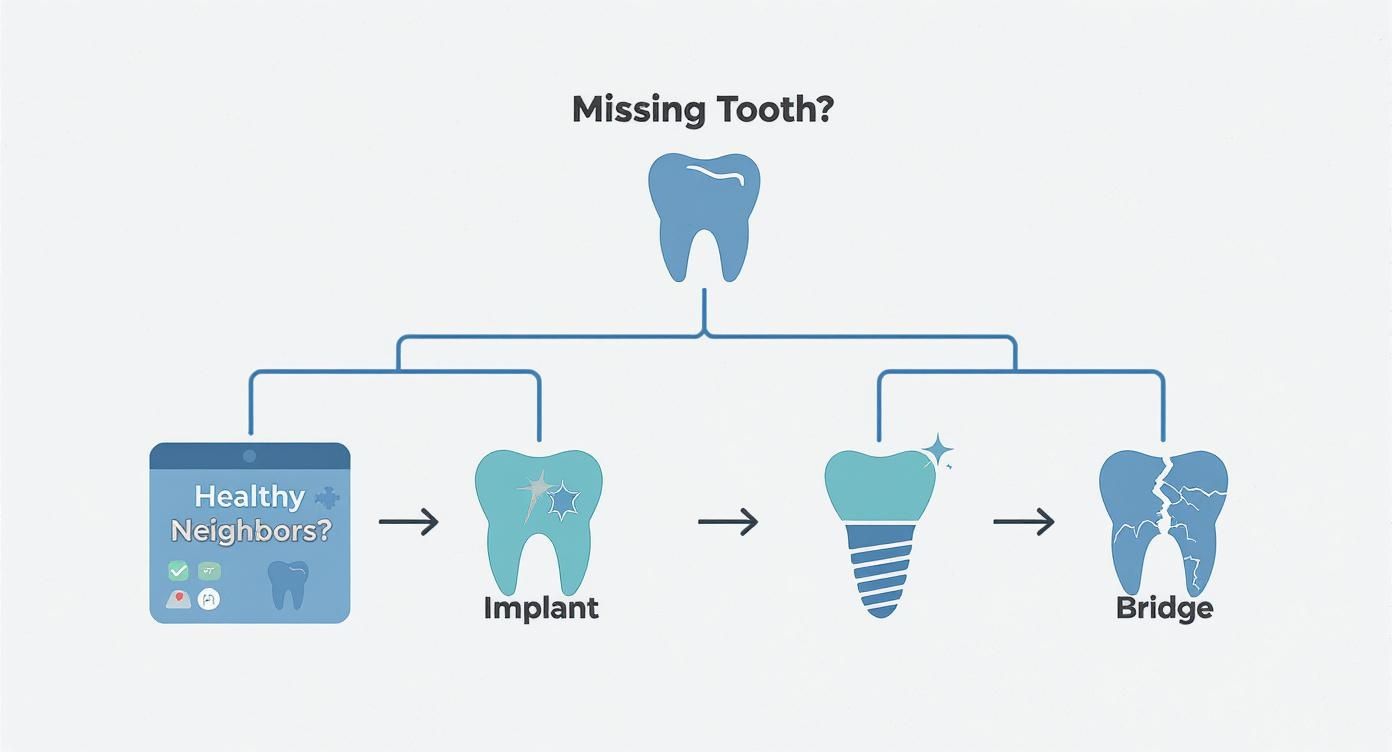
As you can see, the condition of the teeth next to the empty space is a very important factor.
Who Is a Good Candidate for Dental Implants?
A dental implant requires a surgical procedure, so it is important that you are in good overall health. The best part about an implant is how it joins directly with your jawbone. A few key things are needed for this to be successful.
Our team will look for these main requirements:
- Enough Jawbone: You need to have enough strong, healthy bone to hold the titanium post securely. If you have some bone loss, don’t worry. A bone grafting procedure can often rebuild the area and make you a great candidate.
- Healthy Gums: Your gums need to be free of gum disease. We will always treat any gum problems first to create a healthy foundation for the implant.
- Good Overall Health: Some habits or health conditions, like heavy smoking or uncontrolled diabetes, can make healing more difficult. This can affect the implant's long-term success.
An ideal implant candidate is someone looking for a permanent, standalone solution who has a healthy foundation to support it. It is the best way to protect your natural teeth and jawbone for years.
When a Dental Bridge Might Be the Better Choice
Dental bridges are excellent, reliable solutions and are often the perfect choice in certain situations. A major benefit is that a bridge does not require surgery, which can be an important factor for many patients.
We might recommend a bridge if:
- The Teeth Next to the Gap Already Need Crowns: This is a common reason. If the teeth on either side of the space already have large fillings or are damaged, they likely need crowns anyway. A bridge can solve two problems at once by restoring those teeth while also filling the gap.
- You Are Not a Candidate for Surgery: For patients with certain medical conditions or for those who simply want to avoid surgery, a bridge offers a less invasive way to get a complete smile.
- You Need to Fill the Gap Quickly: A bridge can be completed much faster than an implant. The entire process is usually finished in just a few weeks.
At Cedar Dental Group, we are committed to helping our Renton patients understand all their options. To learn more about how they work, check out our guide to dental crowns and bridges in Renton. Our goal is always to find the solution that best fits your health, budget, and lifestyle.
Cost, Insurance, and the Bottom Line: What's the Better Investment?
Let's talk about cost. It's a huge part of making a decision, and it’s important to think about both the immediate cost and the long-term value.
At first glance, a dental bridge almost always seems like the cheaper option. The upfront cost is lower, which can be very appealing. They are a proven, effective way to get your smile back.
But the initial price is just the beginning.
Thinking Beyond the Upfront Cost
This is where dental implants really start to make sense. Yes, the initial cost is higher, but they are often the more affordable choice when you look at the big picture. An implant is designed to be a permanent part of your smile. This means you are not paying to replace it every 10 years or so.
Let’s break it down:
- Dental Bridge Costs: You pay for the first bridge, but you also have to plan on replacing it every 7 to 15 years. Over your lifetime, that could mean paying for the same procedure two or even three times.
- Dental Implant Costs: This is usually a one-time expense. You are paying for a solution designed to last a lifetime. This protects you from future dental bills for that same missing tooth.
Choosing a dental implant is an investment in your future. You're getting decades of stability and breaking the cycle of repeated dental work and costs. That long-term value is a game-changer.
Making Sense of Insurance and Financing
Understanding dental insurance can be tricky, but we are here to help. Most dental plans will cover a portion of the cost for crowns and bridges, as they are considered a standard treatment. Coverage for dental implants is improving, but it can vary a lot between plans. This guide on how to compare health insurance plans is a great resource if you're trying to figure out the details.
Here at Cedar Dental Group, our team will look into your benefits to make sure you get the most out of your plan. We’ll give you a clear, honest breakdown of your costs.
We believe that financial worries shouldn't stop you from getting the care you need. That's why we offer flexible financing options to make your treatment plan fit your budget. You can learn more about our commitment to affordable dental care and see how we help our patients get the smiles they deserve.
Real Patient Scenarios: Choosing the Right Path
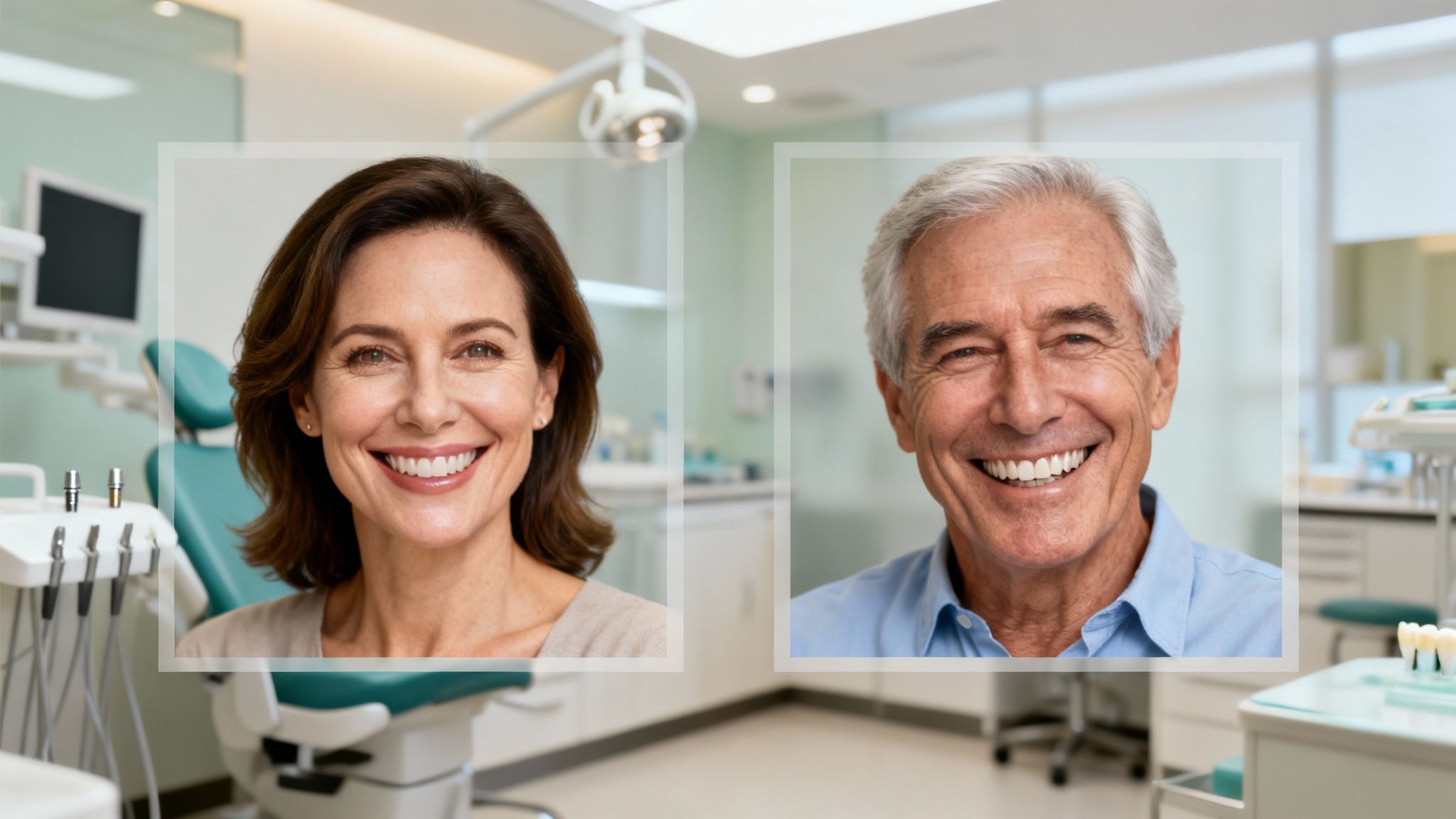
Sometimes the best way to understand the difference between implants and bridges is to look at real situations. It’s one thing to read about them, but seeing how these solutions work for people like you can make the choice much clearer.
Let's walk through two common scenarios we see here at Cedar Dental Group. These stories show how the right treatment is always based on a person's specific needs and goals.
Sarah's Story: A Single Missing Tooth
Sarah, a 45-year-old professional, came to us after losing a molar in an accident. Her main goal was to find a solution that wouldn’t affect her other teeth. The two teeth next to the gap were perfectly healthy, with no fillings or decay.
For Sarah, a dental implant was the clear winner. We were able to replace her missing tooth with a standalone solution that works just like a natural tooth. This left her healthy teeth completely untouched and will help protect her jawbone for many years. She saw it as a smart investment in her future health.
John's Story: Addressing Multiple Issues at Once
John, a 62-year-old retiree, had a different situation. He was also missing a tooth, but the teeth next to it were already weak. They had large, old fillings and were showing signs of wear. This meant they both needed crowns anyway.
In John's case, a dental bridge was the most practical solution. By designing a bridge, we could fill the gap from his missing tooth and place protective crowns on the two weak teeth at the same time. It was a great way to solve several problems with one treatment.
Key Insight: The health of the teeth next to your gap is one of the most important factors. An implant is ideal for preserving healthy teeth, while a bridge can be perfect for restoring teeth that already need help.
The preference for permanent fixes like Sarah's is a growing trend. Implants are very popular because they feel and function so much like natural teeth. Their success rates are around 95% or greater (Source: American Academy of Implant Dentistry). Patients love them because they are a long-term solution that protects jawbone health.
If you are exploring all your options for missing teeth, our expert guide to dentures vs. dental implants in Renton offers even more helpful information.
FAQs: Your Tooth Replacement Questions Answered
Here are answers to some of the most common questions we hear from our patients in Renton. We hope this helps you feel more prepared for your conversation with us.
1. Is the dental implant procedure painful?
This is the number one question we get, and the answer often brings relief. The procedure itself is not painful because we use effective local anesthesia to completely numb the area. Most patients say the recovery was much easier than they expected and compare it to a simple tooth extraction. Any discomfort is usually mild and can be managed with over-the-counter pain relievers.
2. How long do dental implants and bridges last?
A dental implant is designed to be a permanent foundation. With good care, the titanium post can last a lifetime. The crown on top may need to be replaced after 10-15 years due to normal wear. A dental bridge typically lasts between 7 and 15 years before it may need to be replaced.
3. Can a dental bridge be replaced with an implant later on?
Yes, this is definitely possible. Many patients choose to switch to an implant after having a bridge for years. We would first carefully remove the bridge and then check the health of the jawbone underneath. Sometimes a simple bone graft is needed to create a strong foundation for the new implant.
4. Which option looks more natural?
Both modern implants and high-quality porcelain bridges can look incredibly natural and blend seamlessly with your smile. However, a dental implant often has a slight edge because the crown comes directly out of your gums, just like a real tooth. This creates a very lifelike appearance.
5. How do I take care of my implant or bridge?
Good news! Taking care of your new restoration is simple. For a dental implant, you just brush and floss it like your natural teeth. For a dental bridge, you do the same, with one extra step: cleaning underneath the bridge. We'll show you how to use a floss threader or water flosser to easily keep the area clean and healthy.
Ready to Take the Next Step?
Deciding between a dental implant and a bridge is a big step, and you don’t have to make this choice alone. We hope this guide has helped you understand your options better.
The most important thing to remember is that there isn't one "best" answer for everyone. Both implants and bridges are excellent ways to restore a smile. The right choice depends on your oral health, your budget, and your long-term goals.
At Cedar Dental Group, we are here to listen and help you feel comfortable. We take the time to explain everything without confusing jargon and create a treatment plan that makes sense for you. Our goal is to do more than just fix a tooth; it's to help you get your confidence back for good.
Ready to improve your smile? Contact Cedar Dental Group in Renton, WA today to schedule your consultation.
Schedule your consultation with Cedar Dental Group in Renton, WA by visiting us at https://cedardentalgroup.com.
