
Direct Answer: No, a referral is not required. Cedar Dental Group in Renton, about ten minutes from Tukwila, has a board-certified endodontist in house, so the root canal and the crown after are handled in one office.
You are in the chair, the x-ray is up on the screen, and your dentist says the words root canal. Then comes the slip of paper with a second office’s name on it. If you are near Tukwila and wondering whether that handoff is actually required, it is not. Cedar Dental Group in Renton has a board-certified endodontist working in house, about ten minutes up the road, so the root canal and the crown that usually follows can be planned from the same chart.
A referral is still the normal experience here. Search for a root canal in South King County and most of what comes back is standalone endodontic clinics, several of them clustered around Southcenter. Standard does not mean mandatory.
This article is about the logistics of that handoff, meaning what it adds to your calendar, your paperwork and your bill. If you want the clinical side, I have already covered what changes when an endodontist does the root canal in house.
Is there a practice near Tukwila with an endodontist in house so I don’t need a referral?
Yes. Our Renton office at 280 Hardie Ave. SW sits roughly ten minutes from Tukwila and about fifteen from Kent, and our endodontist, Dr. Joe Dutner, treats patients in the same building where Dr. Susan Chu handles the crown afterward.
Here is what that covers and what to expect:
- The treatment itself: root canal therapy for a tooth with an infected, damaged or badly decayed nerve, including retreatment of a root canal done years ago somewhere else.
- The visit: an exam and x-ray first, then the treatment appointment. Most single root canals run about 60 to 90 minutes, longer for a molar with more canals.
- The crown: planned and placed at the same practice, usually a few weeks later once the tooth settles.
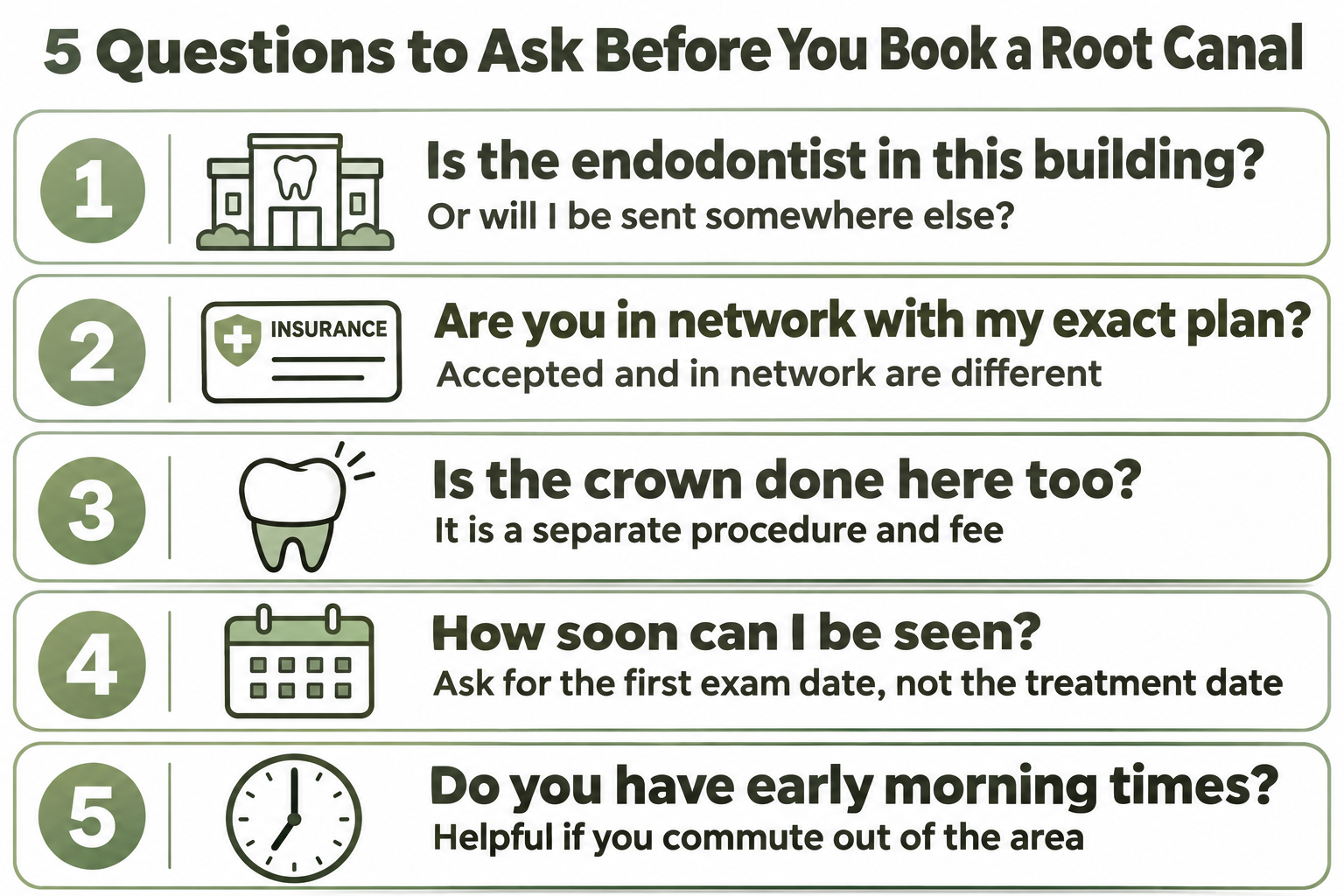
- Timing: we can often get a new patient in for the exam and x-ray within a few days, and we keep early morning appointment times, which matters if you commute north before eight.
- Insurance: we accept most major PPO plans, including Delta Dental, GEHA, Humana, UnitedHealthcare, Cigna, Regence and Premera. In network and accepted are not the same thing, so ask about your specific plan by name.
No second intake, no second set of x-rays, no second estimate from a different front desk.

What does a referral actually add to the process?
Most patients underestimate this part. The referral itself takes thirty seconds. What follows it does not.
When you are sent to a second office, here is what typically gets added:
- New patient paperwork at a practice that has never seen you, including medical history and consent forms.
- Possible repeat imaging, because the second office may want its own x-ray rather than waiting on a records transfer.
- A records request between the two offices. We field these calls constantly, in both directions, and they take time.
- A separate estimate from a different front desk, with its own fee schedule and its own network status.
- A gap of days or weeks between the referral and the available appointment.
- A trip back to your original dentist afterward, because the crown is usually done there, not at the endodontic clinic.
That is two offices, two intake processes and often three appointments minimum. I have written the same breakdown for the gum side of things in what being referred out to a periodontist adds to your timeline, and the pattern is nearly identical.
None of this means a referral is a bad call. If your dentist has a specialist they trust and you are not in a hurry, that path works fine. But you should go in knowing what you are signing up for.
Two paths for the same tooth, side by side
This is the practical difference between being referred out and having the work done in one building.
| Step | Referred to a separate clinic | Handled in one office |
|---|---|---|
| New patient paperwork | Filled out twice, once at each practice | Filled out once |
| X-rays | May be repeated at the second office | Taken once, shared across the chart |
| Cost estimate | Two estimates, two fee schedules | One estimate covering both phases |
| Wait between referral and treatment | Often days to a few weeks | Scheduled from the same calendar |
| Crown after the root canal | Usually back at the original dentist | Same practice, same records |
| Records transfer | Phone and fax between offices | Not needed |
Will I need a crown after the root canal, and is that a separate bill?
Usually yes, and yes. This is the part patients find out about late, and it is the single most common surprise I hear on the phone.
A root canal removes the nerve and cleans out the inside of the tooth. What is left is more brittle than it was, especially on a back tooth that takes real chewing force. A crown caps it so it can hold up.
The crown is a separate procedure with its own code and its own fee. It is billed separately, it may draw from a different category of your insurance benefits, and it may land in a different plan year than the root canal did.
So when you call an office, asking whether the crown is done there too is a fair scheduling question. You are not haggling. You are asking how many appointments and how many bills this tooth is going to involve.
Front teeth are sometimes an exception, and your dentist may recommend a filling instead of a crown depending on how much tooth structure is left. Ask which one applies to your tooth before you agree to anything.
Five questions to ask before you book
If you are about to call the office on that referral slip, or any office, these are the five questions that actually change your experience.
What does a root canal cost around here, and why do two quotes differ so much?
I will give you a straight answer with honest limits on it. When callers ask us for a number over the phone, we give a range, not a single price, because the answer depends heavily on which tooth it is.
In this market, quotes for the root canal itself commonly land somewhere in the $1,000 to $3,000 range, and that is before any crown. Treat that as general context, not a price. Your actual number depends on:
- Which tooth. A front tooth has one canal. A molar often has three or four, and takes longer.
- First treatment or retreatment. Reopening an old root canal is more involved than doing one the first time.
- Whether a crown follows, which is a separate fee on top.
- Your plan and network status, which can move your out of pocket share more than anything else on this list.
An exam and an x-ray are what turn a range into a real estimate you can check against your benefits. The American Dental Association’s patient resources explain the procedure itself in plain terms if you want background before that visit.
If you already have a quote from another office and the numbers do not match, that is normal, and I broke down the reasons in why two root canal estimates in Renton differ so much.
Frequently Asked Questions About Root Canal Referrals
My dentist says I need a root canal. Is there a practice near Tukwila with an endodontist in-house so I don’t need a referral?
Yes. Our Renton office is about ten minutes from Tukwila and has a board-certified endodontist in house, along with the general dentist who places the crown afterward. That means one set of paperwork, one set of x-rays, one estimate, and no waiting on a records transfer between two practices. We can usually schedule the first exam and x-ray within a few days and we offer early morning times.
Do I have to go to the office my dentist referred me to?
No. A referral is a recommendation, not a requirement. You can take the slip, or you can call a practice that handles the root canal and the crown under one roof. Your dentist can send your records either way.
Does my insurance change depending on where the root canal is done?
It can, and this is worth ten minutes of your time. The same procedure can cost you a different amount at two offices depending on network status and each practice’s fee schedule.
Ask the office to check your specific plan by name, not just whether they take your carrier. Here is how to check what your plan will pay before you sit in the chair.
How long does the whole thing take from start to finish?
The root canal appointment itself is usually 60 to 90 minutes, sometimes two visits for a complicated molar. The crown typically comes a few weeks later. Being referred out tends to stretch that timeline, mostly because of the wait for the second office’s first available slot.
I had a root canal years ago and the tooth hurts again. Is that normal?
It happens. A previously treated tooth can flare up if bacteria get back into a canal or if there was a canal that did not get fully cleaned the first time. That situation is called retreatment, and it is a different procedure than a first root canal. Here is what retreatment involves.
What if I just want a second opinion before I agree to any of it?
Completely reasonable, and we see plenty of patients who do exactly that. Bring your x-rays and the written treatment plan with the procedure codes on it, and ask the second provider to explain what they see on the image. What to bring and what to ask for a second opinion walks through it.
Weighing a referral slip for a root canal?
If you are coming from Tukwila, Kent or anywhere in South King County and would rather not repeat the whole intake process at a second office, our Renton practice keeps the endodontic care and the crown work in the same building. You are welcome to call 425-430-0400 or visit cedardentalgroup.com with questions about your plan or your timeline, whether or not you end up scheduling with us.
