

Direct Answer: Being referred to a periodontist usually adds a separate new patient exam, the surgical visit, healing checks, and a return trip to your general dentist, plus time for records to transfer between offices.
You went in for a cleaning, or maybe because your gums had been sore and bleeding when you brushed. You left with a referral slip, a name you have never heard, and a phone number for a second office across town.
That slip usually means your care is about to be split between two practices. One handles the surgical part. The other handles what comes before and after.
I want to walk you through what that actually looks like on a calendar, because this is the part patients in Renton and around South King County tell me they underestimated. Not the surgery itself, but the coordination between two front desks, two charts, and two insurance checks.
What a split-care referral means in practice
A referral is not a scheduling favor. It is a handoff, and you are the one carrying the case between buildings.
Here is what changes the moment your care lives in two places:
- You become a new patient twice, which usually means a second intake, second health history, and second exam before treatment is scheduled
- Two calendars have to line up, so the soonest opening at the specialist office is not the soonest opening at your dentist’s office
- Your records exist in two systems that do not talk to each other automatically
- Two teams each know part of your plan, and nobody is watching the whole thing unless you ask who is
That last point is the one worth sitting with. When I ask patients who is keeping track of the plan, most assume the referring dentist is. Sometimes that is true. Often the referring office does not hear anything back until the specialist sends a report after treatment is finished.
None of this means a referral is wrong. Plenty of good dentists refer surgical gum and bone work out because it is genuinely specialist territory. But you should walk in knowing the timeline stretches for reasons that have nothing to do with your mouth.
First, be sure which procedure is actually on the table
Patients collapse three very different surgeries into one worry. I hear it constantly on the phone: “I need gum surgery.” That could mean any of three things, and each has its own timeline and its own recovery.
Gum grafting treats recession. When the gumline pulls back and leaves tooth roots exposed, grafting rebuilds that tissue using your own healthy tissue to cover the root, calm sensitivity, and protect what is underneath.
Periodontal surgery, including flap or pocket reduction procedures and regenerative work, treats advanced gum disease. It is for cases where deep pockets and bone loss are past what a deep cleaning below the gumline can reach.
Bone grafting rebuilds jawbone volume. It happens either at the time of an extraction to preserve the socket, or later to give a planned implant enough bone to sit in.
Those are not interchangeable words. If your slip says bone graft and you have been reading about gum grafting recovery, you are preparing for the wrong thing.
So before you call anybody, read the slip and ask your dentist to name the procedure plainly. A reader who knows which of those three words applies asks far better questions at the specialist consult. The National Institute of Dental and Craniofacial Research has a straightforward overview of gum disease stages if you want background before that appointment.
The records handoff is the invisible delay
This is the part nobody puts on the referral slip. Our own phone line tells the story: roughly one call in eleven coming in is another office asking for a chart, an X-ray, or a periodontal chart for a shared patient.
One dental group called asking for a periodontal chart from the prior year so they could compare treatment history. That is a reasonable request. It is also a phone call, a records release, a fax or portal upload, and sometimes a week of back and forth while your appointment sits unscheduled.
A quick plain-language definition, because most patients have never been told what it is. A periodontal chart is the set of measurements a hygienist calls out during your exam, usually six points around every tooth, recording how deep the pocket is between gum and tooth in millimeters. Bleeding points and recession get noted too.
Why the older chart matters: it shows movement. A specialist who has last year’s numbers can see whether a 4 mm pocket has held steady or crept to 6 mm. A specialist starting a fresh baseline sees only today.
So here is the practical move. When the referral is handed to you, ask your dentist’s office to send your periodontal measurements and recent images ahead of the first specialist visit, and ask for a copy for yourself. That single request removes the most common scheduling delay in a split case, and it beats waiting for two front desks to sort it out on their own time.
The appointment math on a split surgical case
This is the sequence most patients do not see coming when they picture “one surgery.”
Where the extra weeks actually come from
Let me be honest about the math instead of vague about it. A split plan rarely looks like one appointment.
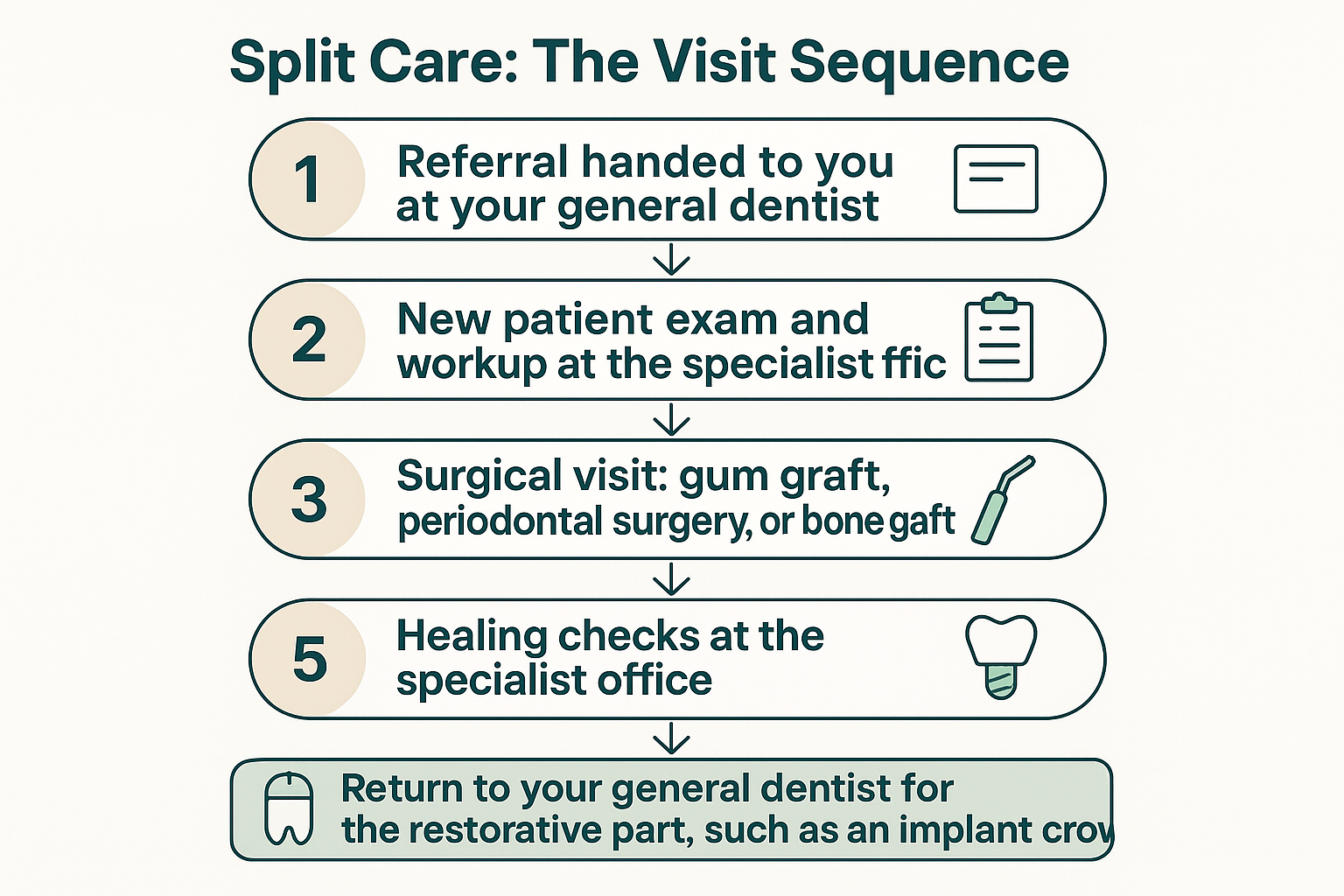
A typical sequence runs like this:
- Visit 1: the exam and workup at the specialist office, often before anything gets scheduled
- Visit 2: the surgical appointment itself
- Visits 3 and 4: healing checks, spaced out depending on the procedure
- Visit 5 and beyond: back to your general dentist for the restorative piece, such as a crown on an implant
When bone grafting is part of an implant plan, healing time sits between stages by design. Bone needs months to mature before an implant goes in, and that is not a delay anyone can compress. I wrote more about how that sequencing works in the implant timeline when a bone graft is part of the plan.
The part that adds time in a split case is not the biology. It is the queueing. Each office has its own next available surgical block, its own hygiene schedule, its own recall system. Two of those in sequence is slower than one, even when both teams are responsive.
Nobody is being careless by taking their time here. But if you are budgeting mentally for six weeks and the real answer is closer to several months, you deserve to know that on day one.
Three different procedures, three different timelines
A rough comparison of the three surgical procedures patients most often confuse. Every case is different, so treat this as orientation rather than a schedule.
| Procedure | What it treats | What usually shapes the timeline |
|---|---|---|
| Gum grafting | Gum recession and exposed tooth roots, often with sensitivity | Soft tissue healing, with follow-up checks in the weeks after surgery |
| Periodontal surgery (flap or pocket reduction, regenerative) | Advanced gum disease with deep pockets and bone loss past what deep cleaning reaches | Number of areas treated, plus ongoing periodontal maintenance visits afterward |
| Bone grafting | Lost jawbone volume, either preserving a socket at extraction or building support for a planned implant | Built-in bone maturation time before an implant can be placed |
Two offices means asking the insurance question twice
Insurance is the first thing callers bring up, usually before anything clinical. They lead with the plan by name, and Delta Dental PPO comes up most often, followed by GEHA, Humana, UnitedHealthcare, and Cigna.
A lot of callers do not know the distinction that matters most here. With a PPO, out of network benefits generally still apply, so you have options. With an HMO style plan, you are usually limited to an assigned provider, and a referral outside that network can mean little or no coverage.
When a surgical case is split across two providers, expect:
- Two benefit checks, one at each office
- Two written estimates, covering different parts of the same case
- One shared annual maximum being drawn down from both directions
That last one surprises people. If the surgical portion eats most of your yearly maximum, the restorative crown afterward may land in a new benefit year, which changes both your out of pocket and your timing.
Costs swing widely by case and by plan, so I will not pretend a number here means anything. What I will tell you is to ask each office for a written estimate and a pre-authorization before treatment starts. A pre-auth is the insurer putting in writing what they expect to cover, and it is the closest thing to a straight answer you can get in advance.
Five questions to ask the day the referral is handed to you
Ask these while you are still standing at the front desk, not two weeks later.
- Who performs the surgical portion, and who does the restoration afterward?
- Do my images and periodontal measurements travel automatically, or do I need to request them?
- Who is watching healing between visits?
- What happens if something feels wrong at week two, and which office do I call?
- Which of the three procedures is this, exactly?
Many adults arriving for this kind of care are already carrying a bad memory from a previous office. That shows up in the reviews of practices around Renton over and over, where the thing people credit is not technique but calm explanation. One patient put it simply: “Dr Chu is gentle, calm and explains everything thoroughly.”
Asking good questions early is not being difficult. It is how you find out whether the plan has an owner.
One more local note on why this comes up so often here. Patients in Renton, Kent, Tukwila, Burien, and Newcastle are frequently sent north into Seattle for surgical gum and bone work, and several area practices state on their own service pages that advanced periodontal cases may be coordinated with outside specialists. At Cedar Dental Group, Dr. Jaewon Kim is a board-certified periodontist who handles gum grafting, periodontal surgery, and bone grafting on site, which is why those cases stay on one chart and one plan. If bone grafting is part of your picture, why bone grafting comes up and what it means for your timeline goes deeper on that piece.
Frequently Asked Questions About Being Referred to a Periodontist
How many extra appointments does a referral usually add?
In most split cases, plan on a separate new patient exam and workup at the specialist office before treatment is even scheduled, then the surgical visit, then healing checks, then a return trip to your general dentist for any restorative work. That is commonly three or more visits beyond what you pictured.
Do I have to go where my dentist referred me?
No. A referral is a recommendation, not an assignment. You can ask for the records to be sent wherever you choose, and with a PPO plan you generally have room to compare options.
What is a periodontal chart, and why does the specialist want last year’s?
It is the record of pocket depth measurements taken at six points around each tooth, plus notes on bleeding and recession. Having the earlier version lets the specialist see whether things are stable or changing, instead of guessing from a single day’s snapshot.
Will my insurance cover the surgical part and the crown afterward?
It depends heavily on your plan, but the thing to watch is that both offices draw from the same annual maximum. Ask each one for a written estimate and a pre-authorization so you are not guessing, and ask whether the restorative portion is likely to fall into the next benefit year.
Is it better to have surgical gum work done in the same office as my regular dentist?
It is not automatically better clinically, but it removes coordination steps. One chart, one set of images, one team tracking healing, and no records request sitting in a fax queue while your appointment waits.
Weighing a referral for gum or bone surgery?
If you are holding a referral slip and trying to figure out how many offices your case is about to involve, we are happy to talk it through. Patients across Renton and South King County are welcome to call 425-430-0400 or visit cedardentalgroup.com to learn more or arrange a consultation. Our office sits near downtown Renton at 280 Hardie Ave. SW, which one caller mentioned they had been driving past near the Walgreens for months.
