
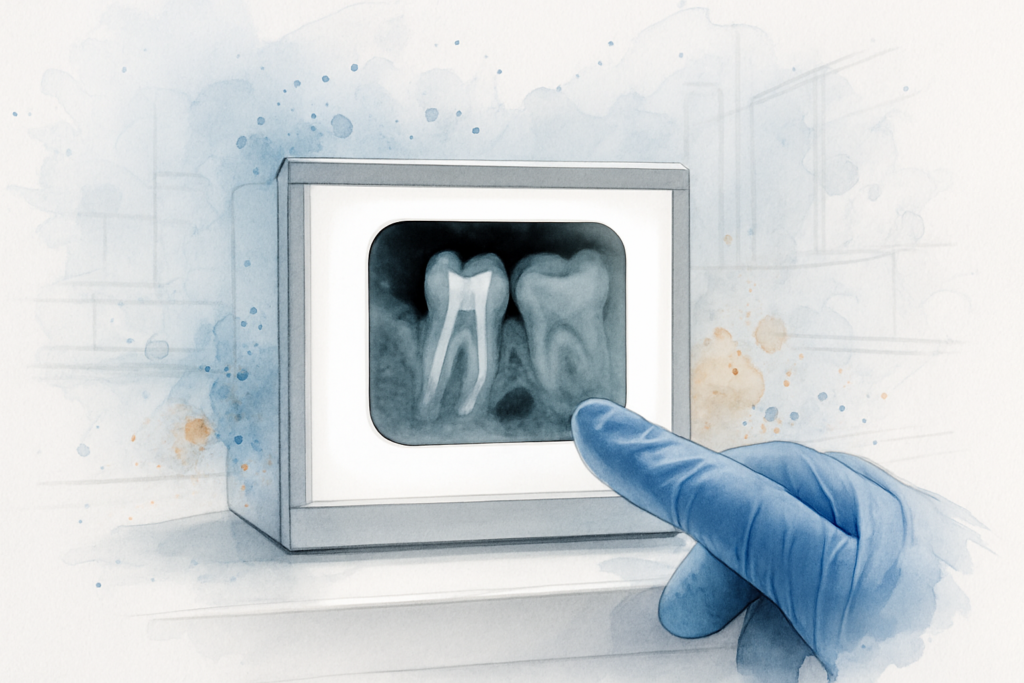
Direct Answer: Root canal retreatment means reopening a previously treated tooth, removing the old filling material, cleaning and resealing the canals, then placing a new restoration. It usually takes longer than the original procedure.
You had a root canal years ago and stopped thinking about that tooth. Now it aches on and off, or it feels fine until you bite down on something firm, or the gum above it is tender and there is a small bump that comes and goes.
Sometimes there are no symptoms at all. The tooth turns up on a routine X-ray at a cleaning, and you hear the words root canal retreatment for the first time while you are still holding the bib clip.
I talk with people in Renton and around South King County about this more often than you would guess. Below is what is actually happening inside that tooth, the three paths a dentist may lay out, and the cost and insurance details that trip people up most.
Step One Is Confirming Which Tooth Is Actually the Problem
Before anyone talks about retreatment, we have to be sure we are looking at the right tooth. People misremember which one was treated far more often than they expect.
One of our patients called convinced that an upper right tooth needed a root canal. When we pulled up his X-rays, that tooth had never had one. The pain was coming from somewhere else entirely.
That is not a memory problem. Tooth pain travels along nerve branches, so an upper tooth can ache when the source is a lower one, and a molar can throb when the neighbor is the culprit.
So the first visit is usually diagnostic, not surgical. That typically means:
- Current imaging, since older films may not show the full root anatomy
- Bite and pressure testing on several teeth, not just the suspect one
- Cold or temperature testing to see which nerves are still alive
- A look at the crown, filling, and gum tissue around the area for cracks or drainage
If you want a fuller picture of how that workup goes, we covered it in how the root canal decision actually gets made.
Why a Treated Tooth Can Flare Up Years Later
This is the part patients get stuck on. If the tooth was treated, why is it infected again? And who got it wrong?
Usually nobody. A root canal is a repair to a living structure that keeps taking daily load, and repairs on any structure can be tested over time. The common reasons a treated tooth acts up again:
- Narrow or curved canals that were difficult to reach fully the first time
- Unusual canal anatomy, like an extra canal that older imaging simply could not show
- New decay that works its way down to the sealed filling material
- A loosened or cracked crown or filling that lets bacteria back into the sealed space
A fracture in the tooth itself sits in its own category. A crack that runs into the root changes the entire conversation, because no amount of cleaning and resealing fixes a split in the structure.
The covering restoration matters more than most people realize, which is why we wrote about why a crown gets recommended after a root canal. A treated tooth with a compromised seal on top is the setup I see most often.
What Nonsurgical Retreatment Actually Involves
Nonsurgical retreatment is the most common path, and it goes back in the same way the original treatment did, through the top of the tooth.
Here is the sequence, plainly:
- The crown or filling on top is opened, and sometimes removed entirely
- The original filling material inside the canals is taken out, which is its own careful step
- The canals are examined under magnification for missed anatomy, blockages, or new infection
- Everything is cleaned and disinfected, then resealed
- A temporary filling closes the tooth until a new crown or permanent restoration goes on
I want to be honest about the time. Retreatment is usually a longer appointment than the first root canal was, because removing old material and hunting for missed anatomy takes patience that cannot be rushed.
Most people describe the appointment itself as uneventful once they are numb. Soreness for a few days after, especially when biting, is typical while the tissue around the root tip settles down.
The Two Other Paths, Kept Separate
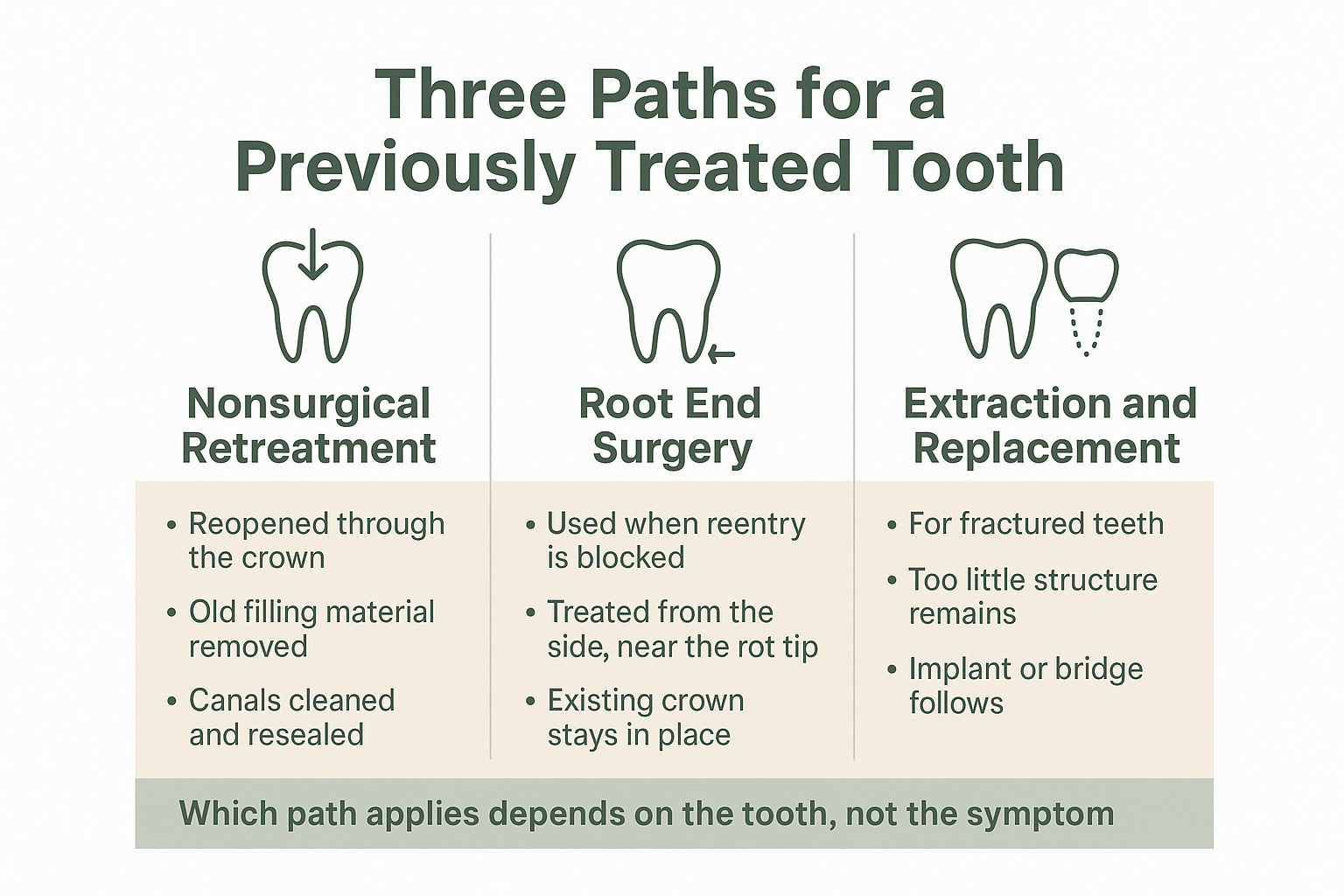
Retreatment through the crown is not always practical. There are two other options, and they are genuinely different decisions, not variations of the same one.
Surgery at the root tip. When a post, a cemented restoration, or a blockage makes reentry through the top of the tooth impractical, the infection can be addressed from the side instead. The tissue is opened near the root end, the tip is treated and sealed, and the crown on top stays where it is.
Extraction, then a replacement. If the tooth is fractured, or too little healthy structure remains to hold a restoration, saving it stops being realistic. The conversation shifts to removing it and replacing it with an implant or a bridge, which is a different timeline and a different plan.
Those are three distinct roads. A good consult should tell you which one is on the table for your tooth and why the other two are not. If you are weighing all of it, what is actually on the table besides a root canal walks through the trade-offs.
The Three Paths for a Failing Treated Tooth
A quick visual of how the three options differ, so you can follow along when a dentist explains which one applies to your tooth.
What Retreatment Costs, and What Actually Drives the Number
Cost is where most of these conversations stall. I will give you real context without pretending there is one number.
When people call our front desk asking about root canal work without insurance, the general range we quote is somewhere in the neighborhood of $1,900 to $3,000, depending on the tooth and how complex it is. That is a starting frame for conversation, not a quote for your specific tooth.
Two things surprise people. First, retreatment commonly runs higher than the original procedure because of the extra time and the removal step. The American Association of Endodontists confirms retreatment generally costs more than the initial treatment. Second, the crown afterward is a separate cost and is not folded into the retreatment fee.
One caller told us straight out that she was price shopping after a $1,000 quote from another office. That is a reasonable thing to do. Just make sure you are comparing the same work.
My honest advice: ask any office for a written pre-treatment estimate with procedure codes rather than a number over the phone. A phone number is a guess. A coded estimate is something you can hand to your insurance carrier and compare line by line.
What Moves the Price Up or Down
These are the factors that make one retreatment case cost noticeably more than another.
| Factor | Lower End | Higher End |
|---|---|---|
| Which tooth | Front tooth, single canal | Molar with three or four canals |
| Existing restoration | Simple filling on top | Crown with a cemented post to remove |
| Canal condition | Accessible, straightforward reentry | Curved, calcified, or blocked canals |
| Approach needed | Nonsurgical retreatment only | Root end surgery required |
| Restoration after | Existing crown can be reused | New crown or buildup needed |
One Insurance Detail Worth a Phone Call
This is the piece almost nobody thinks to check. Many dental plans limit how often they will pay toward work on the same tooth within a set period, so a tooth treated three years ago may be handled very differently than one treated fifteen years ago.
The plans our callers name most are Delta Dental PPO, GEHA, Humana, and UnitedHealthcare. Before you schedule anything, call your carrier and ask specifically about frequency limitations on the same tooth, and whether retreatment is covered separately from the original procedure. Two minutes on that call can change how you plan the whole thing.
The Referral Timeline Around Renton
Here is a local wrinkle that affects how fast any of this happens. Search for root canal help in this area and the results are dominated by standalone endodontic practices.
That means the usual sequence looks like this:
- An exam at your general dentist’s office
- A referral to a second office
- A transfer of records and imaging between the two
- A wait for the specialist’s next opening
For a tooth that hurts when you chew, those weeks feel long. Patients driving in from Kent, Tukwila, Burien, or Newcastle frequently get sent into Seattle for that second appointment, which adds parking, traffic, and a day off work to an already long process.
None of that changes the clinical decision. It changes the calendar. If you want the logistics side explained further, we covered it in what changes when an endodontist handles the work in-house.
If Your First Root Canal Was Rough, Say So
A fair number of people reading this are not worried about the tooth. They are worried about sitting through another root canal after a bad experience the first time.
What patients tell us makes the difference is not sedation or gadgets. It is being shown their own X-rays, having each step explained before it happens, and being asked about comfort preferences ahead of the appointment rather than during it.
One of our patients, Sherry B., put her experience this way: “I feel because of their care that they saved a tooth that I would’ve otherwise lost.”
If you panic at the sound of instruments, or you need the reason for every step before you agree to it, tell whoever you see. That information should shape the appointment, not embarrass you.
Frequently Asked Questions About Root Canal Retreatment
Does retreatment hurt more than the original root canal?
Not usually during the procedure itself, since the tooth is numb the same way. The bigger difference is time. Retreatment appointments run longer because the old filling material has to come out before anything else happens. Soreness when biting for a few days afterward is common.
My tooth does not hurt at all. Do I have to do anything?
Not on the spot. Plenty of these are found on a routine X-ray with zero symptoms, and the right move is often to get current imaging, understand what is being seen, and decide with a clear head. What I would avoid is letting it drift for years without anyone rechecking it.
Will I need a new crown after retreatment?
Often, yes. If the crown has to be cut through or removed to reach the canals, it usually cannot be reused. Budget for the restoration as a separate cost from the retreatment itself, because that is the surprise that catches most people.
How long does a retreated tooth last?
That depends on how much healthy structure remains, whether the new seal holds, and how well the restoration on top fits. Many retreated teeth serve people for years. No one can promise a number, and I would be careful with anyone who does.
Can the same office handle both the retreatment and the new crown?
Some can, some cannot. It is worth asking directly when you call, because a split between two offices means two sets of records, two schedules, and usually a longer gap between the temporary filling and the final crown.
Thinking Through a Retreatment Decision?
At our Renton office, endodontic care is handled by Dr. Joseph Dutner, a board-certified endodontist who serves as President of the American Board of Endodontics, and Dr. Susan Chu takes care of the crown or restoration afterward. That keeps a retreatment case inside one plan and one set of records instead of spread across two offices. If you want a second look at an old root canal that has started bothering you, Cedar Dental Group can be reached at 425-430-0400 or at cedardentalgroup.com.
