
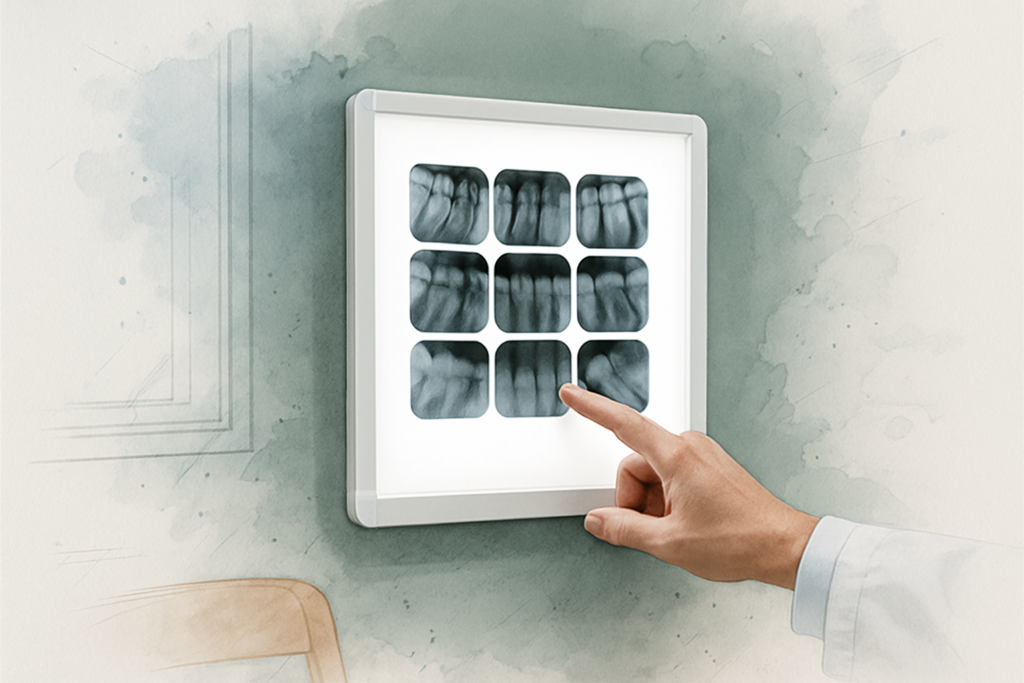
Direct Answer: Bring the written treatment plan with procedure codes, recent X-rays, and any photos. Then ask the second dentist to sort the plan into treat now, schedule soon, and watch.
You walk out of an appointment holding a printed treatment plan. There is a total at the bottom, a list of tooth numbers, and no real sense of why each line is there.
That moment sends a lot of people looking for a dental second opinion. Roughly one in twelve tracked calls to our Renton office comes from someone comparing cost on implants, crowns, or root canals, usually within days of being handed a quote somewhere else. One caller put it plainly: they were price-shopping after a $1,000 quote from another dentist.
But the honest question underneath most of those calls is not who is cheapest. It is whether the plan is the right plan. Here is how I would walk into that second visit if it were me.
Step 1: Understand what a second opinion is actually for
A second opinion is not a price check. It is a second read of the same evidence by a second set of trained eyes.
Sometimes the two plans match almost exactly. That is a useful result, not a wasted afternoon, because now you can move forward without wondering.
Sometimes the sequencing changes. A tooth that was listed as urgent turns out to be stable enough to watch for six months, or a crown gets recommended where a filling was planned because the remaining tooth structure will not hold.
The outcomes I see most often fall into three buckets:
- Confirmation of the original plan, with clearer reasoning attached
- Resequencing, where the same work happens in a different order over a longer window
- A different approach to one or two specific teeth, usually the ones where the call was close
Patients drive from Kent, Tukwila, Burien, and Newcastle for this conversation, and most of them are not trying to catch anyone out. They just want to understand what they are agreeing to before they commit several thousand dollars and a year of appointments.
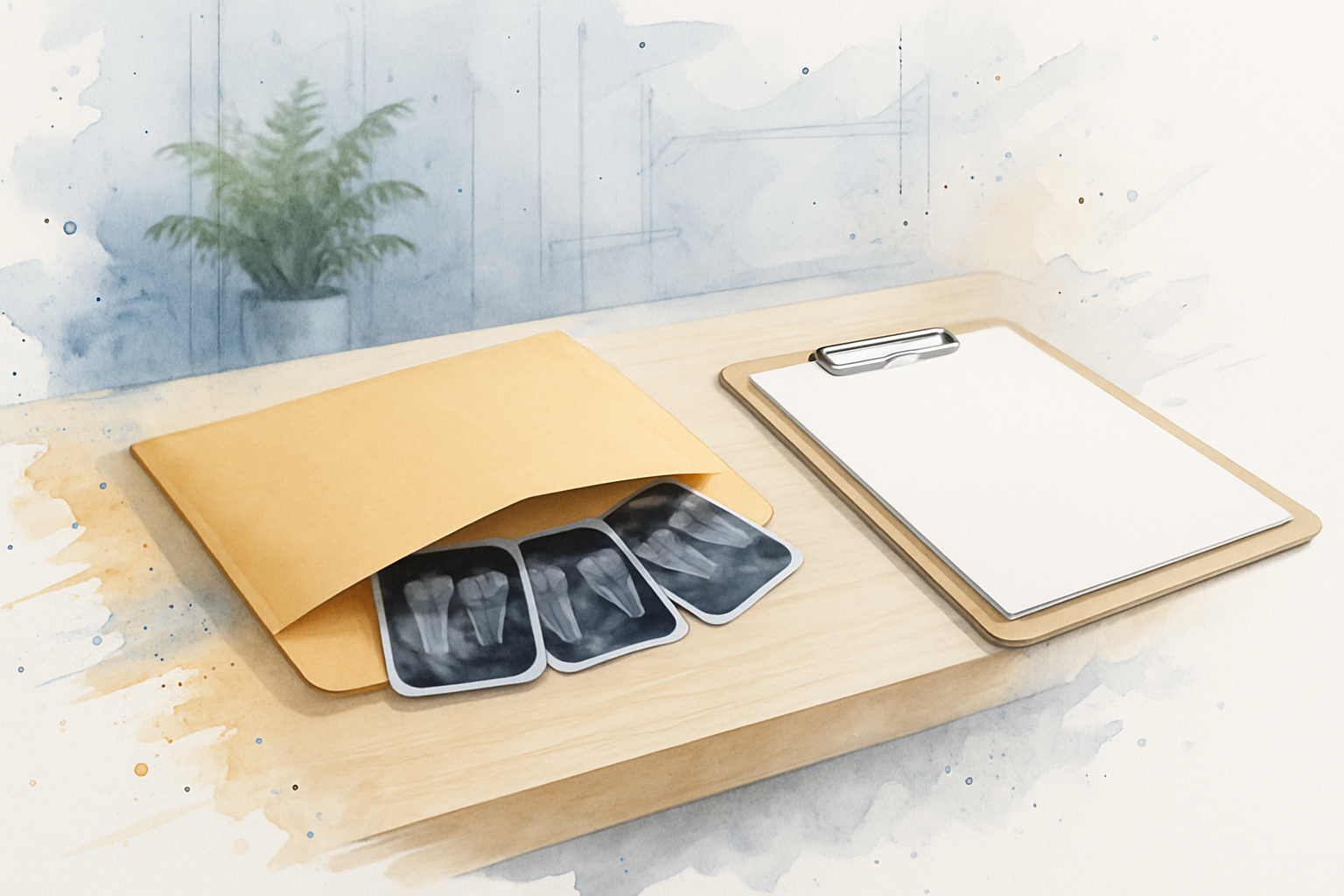
Step 2: Bring the three things that keep it from being a start-over
Showing up empty-handed turns a second opinion into a full new-patient workup. You end up paying for repeat imaging and still do not get an answer that compares to the first plan.
There are three things worth collecting first:
- The written treatment plan with procedure codes. Those five-character codes tell the second dentist exactly what was proposed, not just “a crown.”
- Recent X-rays. Bitewings, periapicals, and any panoramic image taken in the last 6-12 months are usually still current enough to read.
- Intraoral photos, if the first office took them. Photos show cracks, wear, and gum contours that X-rays do not.
Requesting records feels confrontational to a lot of people. It is not. About 9% of the calls our front desk fields are other offices asking for charts and images for shared patients, and those requests get handled the same week.
You can also request your own records directly. Ask for them by email or on a flash drive so you are carrying the actual image files, not a photo of a screen. Walking in with images in hand often means less repeat imaging at the second visit, which saves both time and money.
Your Second Opinion Checklist
Here is what to gather, why it matters, and where to get it.
| What to bring | Why it matters | How to get it |
|---|---|---|
| Written treatment plan with procedure codes | Lets the second dentist evaluate the exact proposal, tooth by tooth | Ask the first office’s front desk for a printed or emailed copy |
| X-rays from the last 6-12 months | Same evidence, no guessing, and usually no repeat imaging | Request by email or flash drive from the first office |
| Intraoral photos | Shows cracks, wear, and gumline detail that films can miss | Ask whether photos were taken at your exam |
| Your insurance card and plan details | Determines what your benefits actually pay toward each code | Card, member portal, or your HR benefits page |
| A written list of your own questions | Keeps the visit focused when you are nervous | Write it the night before, not in the waiting room |
Step 3: Ask the questions that force a real answer
The most useful question you can ask is a sorting question. Ask the dentist to divide the plan into three groups:
- What needs treatment now
- What can be scheduled in the next few months
- What is worth watching
Then follow up: what specifically changes if a watch item waits? A good answer sounds like “that crack could reach the nerve and turn a filling into a root canal,” not “you should just get it done.”
From there, go tooth by tooth on the expensive items:
- Why a crown instead of a large filling on this tooth?
- Why an extraction instead of a root canal?
- What does the tooth look like on the image that led to that call?
That last one matters more than people expect. A dentist who can turn the screen toward you and point at the dark shadow under the old filling is giving you a diagnosis you can evaluate. A dentist who cannot is giving you a recommendation you have to take on faith.
If crowns are on your plan, it also helps to know what makes a crown actually fit well before you agree to the impression appointment.
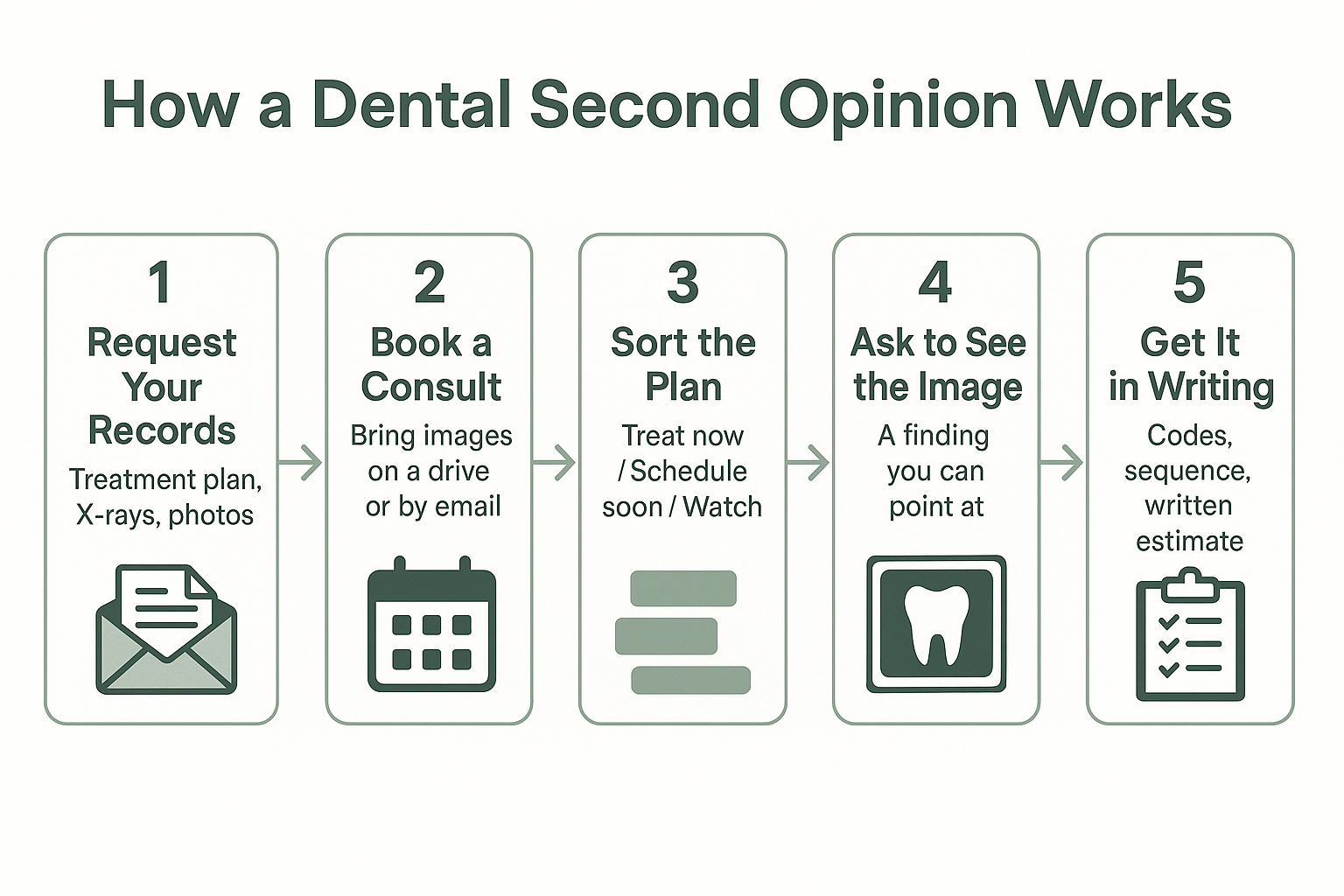
The Second Opinion Visit at a Glance
A quick view of how the visit flows, from gathering records to leaving with a written comparison.
Step 4: Read the cost difference without assuming the worst
There is no single number for a tooth. Two offices a few miles apart in Renton can price the same crown differently, and both can be reasonable.
What moves the number:
- Materials, and whether an outside dental lab is fabricating the restoration
- Who performs it, since a specialist procedure is priced differently than a general one
- How the office is contracted with your specific plan
- What else the tooth needs first, like a buildup or a graft
So a lower quote is not automatically the better deal, and a higher one is not automatically padded. Root canal and crown quotes in South King County commonly land in the low thousands depending on the tooth and who is doing the work, but the only honest number for your mouth comes from an exam and a written estimate from the office itself.
The other thing worth asking about is network status. Insurance acceptance is the single most common gating question we hear on the phone, and plenty of callers end the conversation the moment they hear a plan is out of network, without ever asking what their out-of-network PPO benefits would pay toward the visit. Sometimes the answer is most of it. If you are not sure how your plan behaves, how dental insurance works in Washington covers the parts that surprise people, and the actual breakdown of implant cost shows how the line items stack up on bigger cases.
Step 5: Let go of the idea that you are being rude
A large share of the adults in Renton who research this are people with a history of bad dental experiences. They feel like asking for records is an accusation.
It is not. A confident office forwards X-rays without friction, because the records are yours and a second read does not threaten a sound diagnosis. Hesitation to release them is itself information worth noticing.
There is professional context here too. Washington’s SB 5351, signed in May 2025 with an effective date of July 27, 2025, addresses unfair and deceptive dental insurance practices. A core piece of it is that treating dentists, in consultation with their patients, should be able to make decisions about dental care without undue interference from insurers.
Read plainly, state policy here is moving toward the patient and the treating dentist owning the decision. Getting a second perspective before you commit is a normal part of how that decision gets made.
One long-time patient described the result better than I could: “She is honest and will tell me that I don’t need something that previous dentists have pushed.” – Mike M. If dental anxiety is part of what has kept you from asking questions, how to tell if a practice is built for anxious patients is a useful read before you book anything.
Frequently Asked Questions About Getting a Dental Second Opinion
Do I have to tell my current dentist I am getting a second opinion?
No. You can request your records without explaining why, and offices exchange charts and images routinely. If you would rather not make the call yourself, the second office can usually request them on your behalf.
Will I need new X-rays at the second visit?
Often not, if yours are recent and you bring the actual image files. Images from the last 6-12 months are usually current enough to read. A dentist may still take one or two focused films if something is unclear or if a tooth has changed since the last set.
Does insurance cover a second opinion visit?
Many PPO plans cover an exam and diagnostic imaging on a set schedule, so it may fall under benefits you already have. The catch is timing, since a recent exam elsewhere may have used up that allowance for the period. Ask the office to check your specific benefits before the appointment.
What if the second opinion says the same thing as the first?
Then you have your answer and you can move forward without second-guessing it. That happens often, and I would not call it a wasted visit. Confidence in the plan is most of what makes the treatment go smoothly.
How long does a second opinion appointment take?
Usually about 45-60 minutes when you bring records with you. Most of that time is conversation, not chair work.
Thinking through a treatment plan you were handed?
One thing worth knowing about second opinions on complex work: several Renton-area practices send advanced gum surgery and root canal cases to outside specialists, which means the second opinion often comes from a general dentist who would not be the one performing the procedure. At Cedar Dental Group, a board-certified periodontist and an in-house endodontist are here in the building, so if you are questioning a periodontal surgery plan or a root canal recommendation, you can hear it from the person who would actually do the work without driving up I-405 into Seattle for the conversation. Consultations are available, and you are welcome to bring your plan and your X-rays with you. Call 425-430-0400 or visit cedardentalgroup.com when you are ready to talk it through.
