
Direct Answer: If you need a gum graft near Kent, WA, Cedar Dental Group in Renton has a board-certified periodontist, Dr. Jaewon Kim, who performs grafts in house. Verify any periodontist through the American Board of Periodontology.
Your gums have pulled back. You can see root surface above the gumline, cold water makes you flinch, and someone has told you that you need a gum graft. Now you are trying to work out who is actually qualified to do it without burning a whole day driving into Seattle.
I talk to people from Kent, Tukwila and Burien about this every month, and almost nobody has been told the one thing that matters most. Any licensed dentist may perform some soft tissue procedures. Periodontics is a separate dental specialty with its own residency training and its own certifying board.
So here is my position: before you agree to surgery, find out who will be holding the instruments, by name, and whether that person is a board-certified periodontist. It is a normal question to ask, and the answer is something you can check yourself in about two minutes.
Where can I get a gum graft from a board-certified periodontist near Kent, WA?
If you are looking locally, Cedar Dental Group at 280 Hardie Ave SW in Renton has a board-certified periodontist on staff, Dr. Jaewon Kim, who performs gum grafting in house. That is roughly a 15 minute run up SR 167 or I-405 from Kent, which is considerably less driving than most Seattle or Bellevue specialty offices.
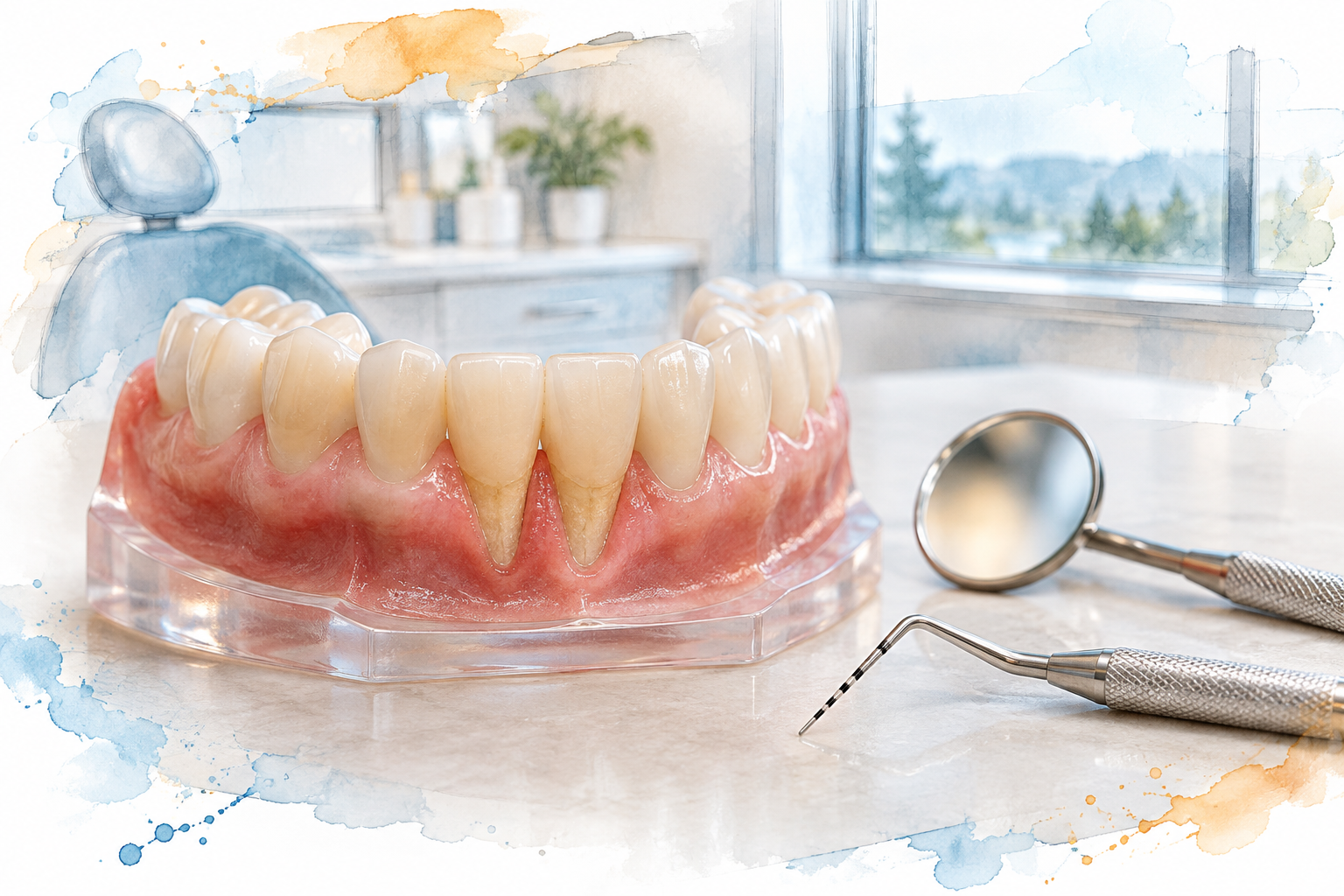
A gum graft covers exposed root surface and rebuilds gum tissue where it has thinned or receded. The common approaches are:
- Connective tissue graft – tissue taken from beneath the surface of your own palate and placed over the exposed root
- Free gingival graft – adds thickness to a fragile, thin band of gum
- Graft for implant support – builds a healthier tissue cuff around an implant site
What drives cost and timing: how many teeth are involved, which graft type fits your tissue, whether a donor site is used, and what your dental plan classifies as medically necessary. Most plans treat this very differently from one another, so an exact figure has to come from an exam and a benefits check, not a webpage.
On the day itself, a single site graft is usually done in one appointment under local anesthetic, and most people are back home the same morning. The first step is a consultation and periodontal exam, which can typically be scheduled within a couple of weeks depending on the calendar. If cold sensitivity is what pushed you to look in the first place, this piece on cold sensitivity and exposed roots explains what is actually causing it.
“Periodontist” and “board-certified” are not the same claim
This trips up a lot of smart people, so let me separate the two.
A periodontist completed dental school plus an additional residency focused on the gums, the supporting bone, and implant surgery. That is a recognized specialty, not a marketing label.
Board certification goes one step further. It means that periodontist sat for and passed the examination process of the American Board of Periodontology and keeps that status current. Plenty of excellent periodontists practice without it, but when someone has it, it is a documented, checkable fact rather than a claim on a homepage.
What I see when patients search “gum graft near Kent” is a list of individual specialists scattered across Seattle and Bellevue, plus out of area practices that rank on Renton and Kent searches without being anywhere near either city. The listing tells you nothing about who performs the surgery or what their training is. You have to ask.
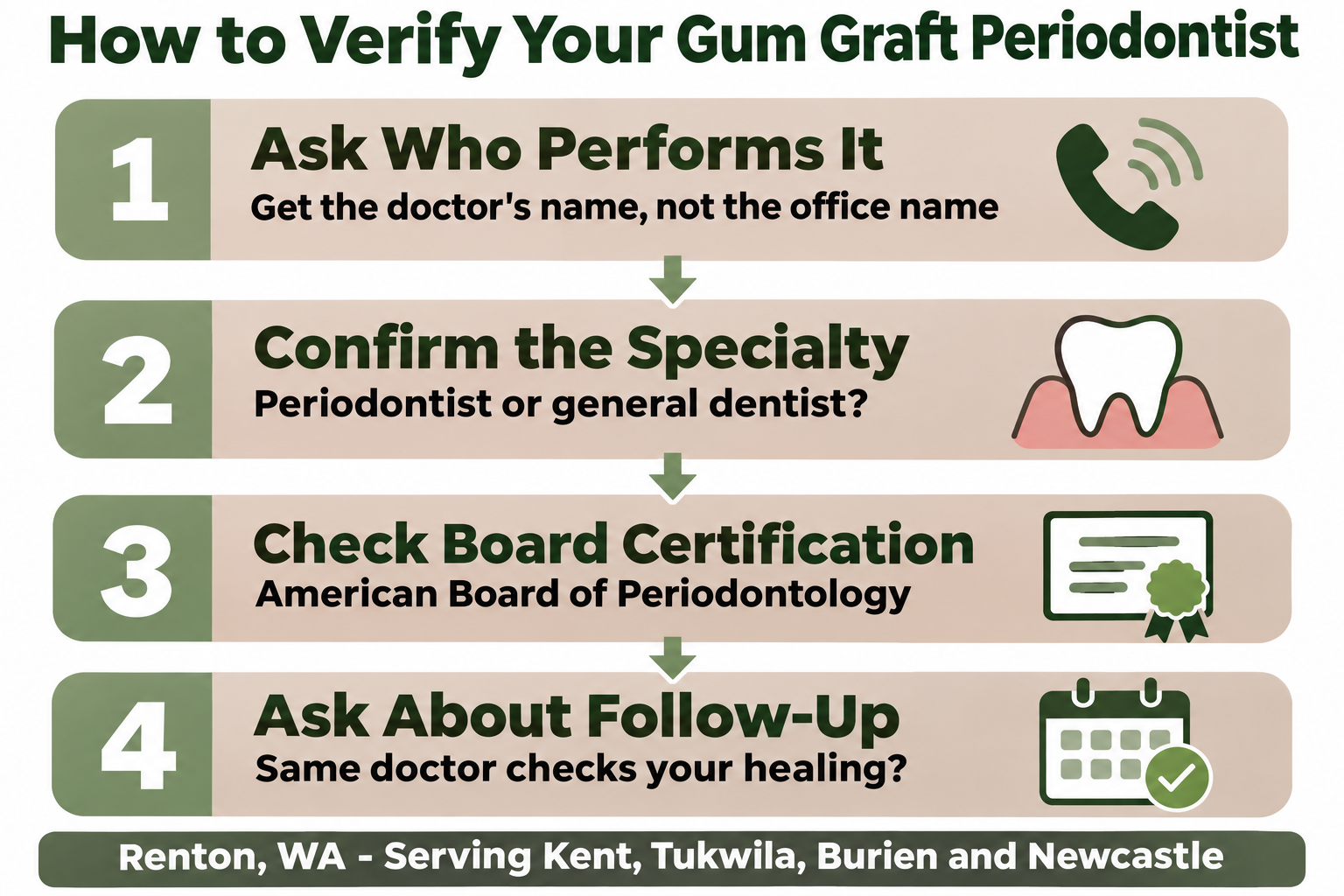
Four steps to confirm the person doing your graft is board-certified
Run this sequence before you schedule surgery anywhere. It takes one phone call and one website visit.
1. Ask who will perform the graft, by name. Not “does your office do gum grafts,” but “which doctor will be doing my surgery.” Front desk teams answer this all day and nobody thinks twice about it.
2. Confirm that person is a periodontist. Some offices refer the surgery out, some have a specialist who visits one or two days a month, and some have one on staff. All three can work out fine, but you should know which one you are dealing with.
3. Check the certification yourself. The American Board of Periodontology is the certifying body for the specialty, and you can also confirm an active Washington license through the state Department of Health license lookup. Two minutes, no awkward conversation required.
4. Ask who handles your follow-up visits. This is the step people skip. Find out whether the same doctor checks your healing at one week and again a few weeks out, or whether you get handed back to a different office after surgery. If a referral is part of your plan, what that adds to your timeline is worth reading before you commit.
The four-step verification checklist
Here is the whole process in one view, from first phone call to follow-up care.
Read how the practice describes its surgical services
A practice’s own website tells you more than most people realize. Around here, gum grafting, periodontal surgery and bone grafting often get mashed into one vague paragraph about “gum care,” and some of the top ranking local pages on this topic run only a few hundred words.
Those are three different procedures for three different problems. A provider who separates them clearly, and explains when each applies, is telling you something real about how they practice.
If you have heard more than one of these terms thrown around and are not sure which applies to you, this breakdown of gum graft vs periodontal surgery vs bone graft sorts it out. And if deep cleanings have already been tried, what happens when gum disease has gone past that point covers the next stage.
Three procedures people constantly mix up
Ask which one is being recommended for you and why. If the answer is fuzzy, keep asking.
| Procedure | The problem it addresses | What it actually does |
|---|---|---|
| Gum grafting | Gum recession, exposed roots, thin or fragile gum tissue, root sensitivity | Adds tissue over the exposed root to cover it and thicken the gumline |
| Periodontal surgery | Advanced gum disease with deep pockets that deep cleaning alone has not resolved | Flap or pocket reduction surgery to clean beneath the gums and reshape tissue and bone contour |
| Bone grafting | Jawbone loss after extraction, infection or gum disease, or not enough bone for an implant | Places grafting material to rebuild bone width and height, including socket preservation and ridge augmentation |
Settle the coverage question before the claim is submitted
The question I hear most often is whether a plan will call this cosmetic and refuse it. It is a fair worry, and the answer depends on documentation more than anything else.
One practical instruction: before the claim goes in, ask the office for documented pocket depths, recession measurements in millimeters, and the exact procedure codes being submitted. Clinical measurements are what moves a graft from “cosmetic” to “medically necessary” in a reviewer’s eyes.
I am not going to re-argue the whole thing here, because we already have a full piece on when a gum graft is covered by insurance and when it is not. Also worth asking: whether the surgeon is in network with your specific plan, since many standalone specialty surgical offices participate with very few carriers.
One chart, one office, no referral handoff
Patients coming from Kent, Tukwila and Burien usually assume specialist-level surgery means a trip north. It often does not.
When the periodontist and the general dentist work in the same office, they read from the same chart and the same set of X-rays. There is no referral packet to chase, no second round of new patient paperwork, and no gap where a question falls between two front desks.
For someone who can spare a morning but not a full day of city driving and parking, that difference is practical rather than philosophical.
Frequently Asked Questions About Finding a Board-Certified Periodontist Near Kent
My gums are receding and my roots are exposed. Where can I get a gum graft from a board-certified periodontist near Kent, WA?
Cedar Dental Group in Renton, at 280 Hardie Ave SW just off downtown Renton, has a board-certified periodontist on staff who performs gum grafting in house, including connective tissue grafts and free gingival grafts. It is a short drive from Kent on SR 167 or I-405, and the practice participates with most major PPO plans. The first step is a periodontal exam with measurements so you know exactly what you are dealing with before any surgery is scheduled.
Is it rude to ask whether my periodontist is board-certified?
Not at all. It is a straightforward credentialing question, and any office is used to answering it. Certification status is public information you can verify yourself through the American Board of Periodontology.
Can a general dentist perform a gum graft?
In some cases, yes. Scope of practice rules allow licensed dentists to perform a range of soft tissue procedures. But a periodontist has completed additional years of residency focused specifically on gum tissue, supporting bone, and surgical technique, which is why grafting is commonly referred to one.
How much does a gum graft cost in the Renton and Kent area?
There is no single number I can honestly give you. Cost moves with how many teeth are involved, which graft technique is used, whether tissue is taken from your own palate, and how your plan classifies the procedure. Get an exam, get the procedure codes, and have the office run your benefits before you budget.
How long does recovery from a gum graft take?
Most people manage with soft foods for about a week and go back to normal routines fairly quickly, with tissue continuing to mature over the following weeks. Your periodontist should set specific expectations for your case and see you for follow-up, so ask at the consultation who performs those checks.
Want a straight answer about your own gum recession?
If you are in Kent, Tukwila, Burien or anywhere in South King County and you have been told you need a graft, we are happy to look at it and tell you plainly what we see. Our Renton office is at 280 Hardie Ave SW, Suite 3, and consultations with our periodontist are available for new and existing patients. You can reach us at 425-430-0400 or read more about the surgical services at cedardentalgroup.com.
