
Direct Answer: Bone grafting is often needed before a dental implant because the jawbone at the site isn’t dense or wide enough to support one. It typically adds 4–9 months to your overall timeline, depending on what type of graft is needed.
If you came in expecting a straightforward implant conversation and left with bone grafting on your treatment plan, you’re not alone. A lot of patients in Renton describe the same experience — they feel like something was quietly added to the bill, and no one took the time to explain why.
The short answer: bone grafting isn’t an upsell. Depending on how long a tooth has been missing, how it was removed, or where the implant is being placed, the bone simply may not be in the right condition to support an implant. Estimates suggest grafting is part of up to half of all implant procedures, which makes it a routine step rather than an unusual complication.
What most patients really want to know is how it changes their timeline — and whether the estimate they got is realistic. This post walks through exactly that.
The Three Situations Where Bone Grafting Gets Recommended
Bone grafting isn’t one-size-fits-all. There are three distinct clinical scenarios where it comes up, and each one has a different healing window and purpose. Knowing which one applies to you changes how you think about the rest of your treatment plan.
1. Socket Preservation After Extraction
When a tooth is removed, the socket — the small pocket left behind in the jawbone — naturally starts to collapse. The bone around it begins to shrink almost immediately. Socket preservation grafting is placed into that socket right at the time of extraction to prevent that collapse and maintain enough bone volume for an implant later.
This is the most common grafting scenario. Healing typically takes 4–6 months before implant placement can happen.
2. Ridge Augmentation for Bone Loss
If a tooth has been missing for a while — or was lost due to severe gum disease — the ridge of bone that supported it may have already resorbed significantly. Ridge augmentation rebuilds that width and height before an implant can be placed.
This is often the scenario when a patient comes in saying they lost a tooth years ago and is now ready to replace it. Healing timelines here can run 6–9 months, sometimes longer depending on how much bone needs to be rebuilt.
3. Sinus Lift for Upper Posterior Implants
The back upper teeth sit directly below the sinus cavity. When those teeth are lost, the sinus can expand downward into the space left behind, leaving very little bone height for an implant. A sinus lift graft adds bone below the sinus floor to create enough vertical space.
This is the most involved of the three, and healing typically takes 9–12 months before the implant is placed. If you’re looking at an upper molar or premolar, this is worth asking about specifically.
For more on how the implant process fits together overall, How Long Does the Dental Implant Process Actually Take? gives a clear overview of each phase.
What Actually Affects How Long Healing Takes
The timelines above are starting points, not guarantees. Several factors can shorten or extend how long bone needs to mature before it can support an implant.
Factors that influence your specific healing window:
- Graft material used — bone graft materials vary. Some are synthetic, some are derived from processed human or animal bone. Each integrates with your own bone at a slightly different rate.
- Size of the defect — a small socket preservation graft heals faster than a large ridge augmentation.
- Overall bone health — patients with diabetes or other systemic conditions that affect healing may need more time.
- Smoking — this is one of the most significant variables. Smoking restricts blood flow to healing bone and can meaningfully extend recovery time or compromise the graft entirely.
- Compliance with post-procedure care — following post-op instructions carefully isn’t optional. How well the site is protected in the early weeks matters.
Your periodontist will evaluate these factors before giving you a timeline estimate. A 4-month window and a 9-month window reflect real clinical differences — they’re not arbitrary.
If you’re also dealing with gum recession alongside bone loss, Gum Recession: How to Tell If It’s Getting Worse — and What Stops It explains how those two issues often overlap.
Bone Grafting Timeline at a Glance
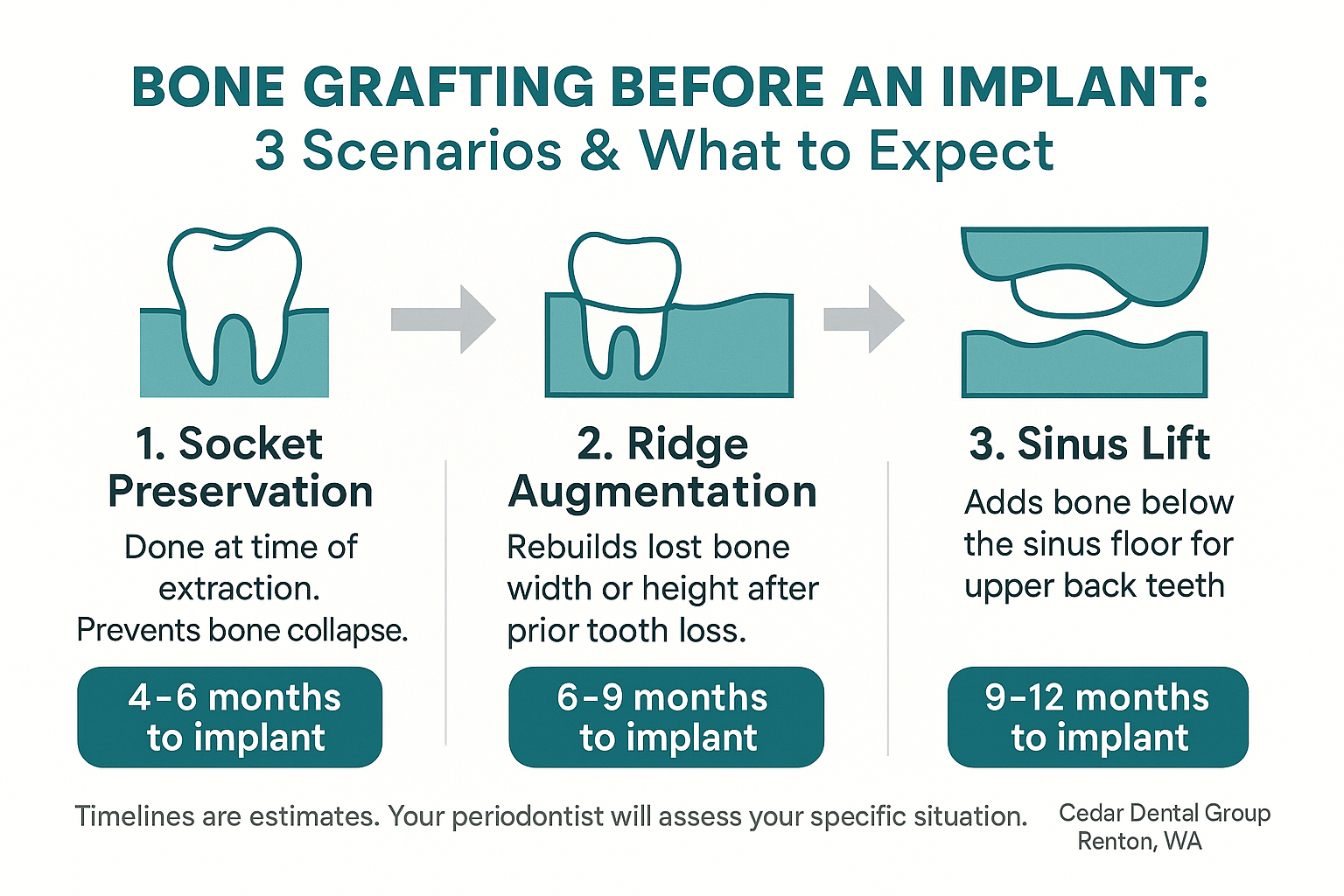
This infographic breaks down the three main grafting scenarios and their estimated healing windows before implant placement.
Bone Graft Type vs. Typical Healing Window
Here’s a quick reference for the three grafting scenarios, the conditions each addresses, and what healing generally looks like before implant placement can begin.
| Graft Type | Why It’s Needed | Typical Healing Window |
|---|---|---|
| Socket Preservation | Prevent bone collapse after extraction | 4–6 months |
| Ridge Augmentation | Rebuild bone lost after tooth loss or disease | 6–9 months |
| Sinus Lift | Add bone height below sinus for upper back implants | 9–12 months |
Why the Summer Timing Question Matters More Than People Realize
A common question we hear is whether there’s a good time of year to start this process. The honest answer is that starting sooner generally gives you more flexibility — and the calendar math is worth thinking through.
A patient who comes in for a consultation in June or July, gets grafting done, and follows a standard healing protocol is realistically looking at implant placement in late fall or early winter — assuming a socket preservation scenario with a 4–6 month window. If the situation calls for ridge augmentation or a sinus lift, the window shifts accordingly.
That matters to a lot of working adults in Renton and the surrounding South King County area who have end-of-year dental benefits they’d like to apply to the implant phase. Starting the graft in summer keeps that door open.
If you’re still weighing whether an implant is the right approach at all, When Is a Dental Implant the Right Choice After Tooth Loss? lays out the decision clearly.
What It Means That Grafting Is Done In-House
In a lot of dental practices around the Renton area, bone grafting requires a referral. The general dentist handles the restorative side — the crown that eventually goes on the implant — but the surgical work gets sent to an outside periodontist’s office. That means separate consultations, separate records, and a patient left to coordinate between providers on their own.
At Cedar Dental Group, all bone grafting is performed by Dr. Jaewon Kim, a board-certified periodontist who works in-house alongside Dr. Chu. Board certification in periodontology means Dr. Kim has completed advanced specialty training beyond dental school and has met a specific credentialing standard in periodontal and implant surgery — it’s not a designation every dentist who places grafts holds.
What that means practically: the surgical and restorative phases of your treatment are coordinated between providers who share records, communicate directly, and see the same clinical picture. There’s no translation layer between what the periodontist did and what the restorative dentist is planning. For a procedure where staging and timing matter as much as they do in implant work, that coordination is genuinely useful — not just a convenience.
For patients who also have gum disease that needs to be addressed before or alongside grafting, Dr. Kim handles that treatment as well, including scaling and root planing and periodontal surgery when needed.
Frequently Asked Questions About Bone Grafting and Implant Timelines
Does bone grafting hurt? What is recovery actually like?
Most patients describe the discomfort as similar to a tooth extraction — manageable with over-the-counter pain relievers and most intense in the first 2–3 days. The surgical site needs to be kept clean and undisturbed while it heals, and you’ll be asked to avoid hard foods and certain activities for a short period. Your provider will give you specific post-op instructions before you leave.
Will I have a gap or missing tooth during the healing period?
This is one of the most common concerns people bring up. In most cases, a temporary option can be discussed so you’re not walking around without a tooth for months. What’s available depends on the location and your specific situation — ask about this during your consultation so it’s factored into your plan from the start.
How do I know if the graft worked before moving forward with the implant?
Your periodontist will monitor healing with periodic imaging — typically an X-ray or cone beam scan — to confirm the graft has integrated and the bone has reached sufficient density and volume. The implant isn’t placed until that confirmation is in hand. There is no guesswork in the timing.
Does dental insurance cover bone grafting?
Coverage varies significantly depending on your plan. Some Delta Dental plans and other major insurers cover socket preservation or ridge augmentation partially when it’s documented as medically necessary for implant placement. Sinus lifts are covered less consistently. Your dental team can submit a pre-authorization request to give you a clearer picture before treatment begins.
What if I skip the graft — can an implant just be placed without it?
If the bone isn’t sufficient to support an implant, placing one anyway risks implant failure — the implant won’t integrate properly, or it may shift or fail over time. A grafting recommendation isn’t a precaution; it reflects a clinical assessment that the bone as-is won’t support a successful outcome. Skipping it doesn’t save time — it usually creates more problems later.
I had a tooth pulled a few years ago and never replaced it. Is it too late for an implant?
Not necessarily, but the longer a tooth has been missing, the more bone resorption has likely occurred. That doesn’t rule out an implant — it typically means ridge augmentation will be part of the picture. An evaluation with imaging will show exactly what’s there and what would be needed. Many patients in this situation do go on to get successful implants; the process just takes longer.
Ready to Get a Clear Picture of Your Timeline?
If bone grafting is on your treatment plan — or you’re just starting to research the implant process — the most useful thing you can do is get a proper evaluation with imaging so you know exactly what you’re working with. Cedar Dental Group is located in Renton at 280 Hardie Ave. SW, Suite 3, and Dr. Kim’s bone grafting and Dr. Chu’s restorative work are coordinated in the same practice. You can call us at 425-430-0400 or visit cedardentalgroup.com to schedule a consultation.
