

Direct Answer: Most dental implant cases take 3 to 9 months from the first appointment to the final crown, depending on whether bone grafting or gum treatment is needed first.
Most people researching dental implants ask the same first question: how long is this actually going to take? It’s a fair thing to want to know before you commit to a treatment plan. The honest answer is that it depends — but “it depends” doesn’t have to mean confusing.
The implant process has several distinct phases, and each one has a real, predictable timeframe. Some patients move through it in about 3 months. Others, especially those who need bone or gum work first, may be looking at closer to 9 to 12 months before they have a final tooth in place.
This guide breaks down every stage so you know what to expect — and why some phases take longer than others. If you’ve been putting off looking into implants because the process felt like a black box, this should clear it up.
The Dental Implant Process, Phase by Phase
An implant isn’t placed in one visit. The process is a sequence of stages, each waiting on the previous one to heal before the next step can begin. That’s not a flaw in the process — it’s how you end up with a tooth that’s stable and built to last.
Here’s the basic sequence most patients go through:
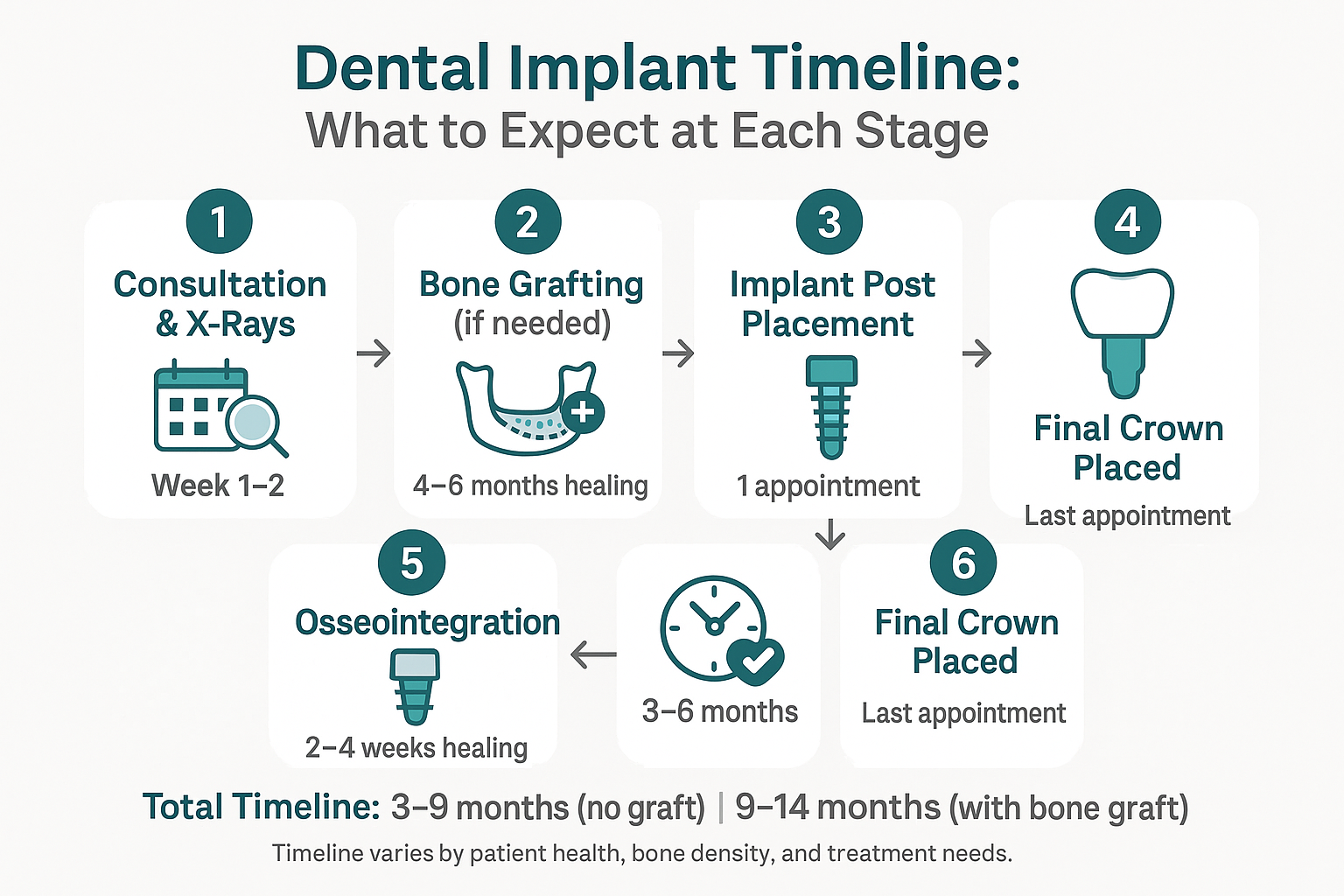
- Consultation and imaging — usually 1 appointment, takes 1–2 weeks to schedule
- Preparatory treatment (bone grafting or gum treatment, if needed) — adds 2 to 6 months depending on the procedure
- Implant post placement — a single surgical appointment
- Osseointegration (the post fusing with your jawbone) — takes 3 to 6 months
- Abutment placement — a short follow-up appointment, minor healing of 2 to 4 weeks
- Final crown placement — the last appointment; you leave with your complete tooth
If you don’t need any preparatory work, you’re looking at roughly 4 to 6 months from post placement to final crown. Add bone or gum treatment, and the timeline extends from the front end.
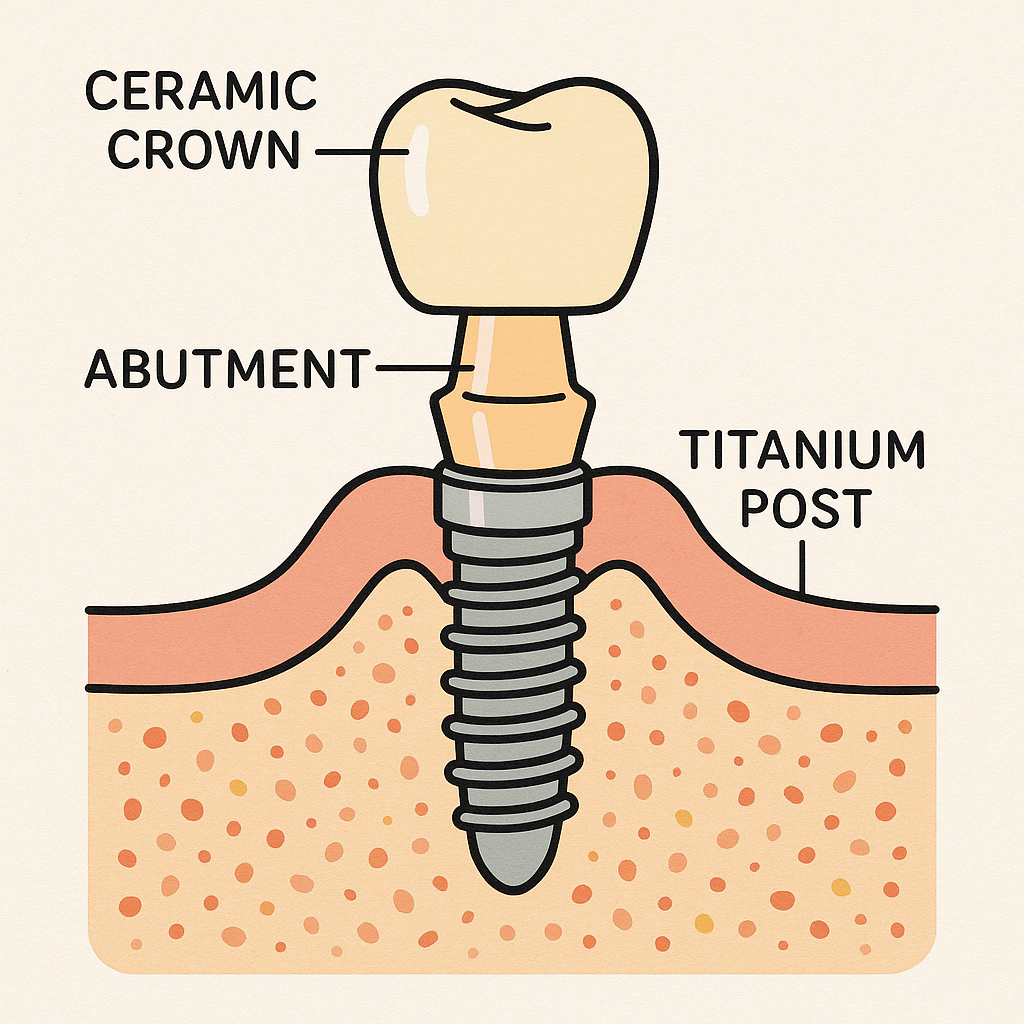
Why Bone Grafting Adds Time — and Why It’s Worth It
One of the most common reasons a patient’s timeline extends is bone grafting. If your jawbone has thinned out — usually from a missing tooth that’s been gone for a year or more — there may not be enough bone to hold an implant post securely.
Bone grafting rebuilds that foundation before the implant goes in. It’s a separate surgical procedure, typically done by a periodontist, and the graft material has to fully integrate with your existing bone before the implant post can be placed.
That healing process usually takes 4 to 6 months. It’s the biggest single time-adder in the implant process.
But here’s the important thing to understand: skipping a needed graft doesn’t speed things up — it increases the risk of implant failure. A post placed in insufficient bone can loosen or fail entirely, which means starting over. Doing it right the first time is always the faster path in the long run.
At Cedar Dental Group, Dr. Jaewon Kim — a board-certified periodontist — handles bone grafting in-house. Patients in Renton don’t have to coordinate with a separate specialist across town or wait weeks for a referral appointment. You can read more about who offers safe and comfortable bone grafting in Renton to understand what that process looks like.
What Is Osseointegration and Why Does It Take So Long?
After the implant post is placed in your jaw, nothing visible happens for a while. That’s because the real work is happening under the surface.
Osseointegration is the process where your jawbone slowly grows around and bonds to the titanium post. This is what makes an implant feel and function like a natural tooth root — it’s physically anchored to your bone, not just sitting on top of it.
This phase typically takes 3 to 6 months. For most patients, it’s the longest single wait in the process.
A few things affect how long osseointegration takes:
- Bone density — denser bone tends to integrate faster
- Overall health — conditions like diabetes or smoking can slow healing
- Location in the mouth — lower jaw implants often heal faster than upper jaw
- Whether a graft was placed — grafted bone may take slightly longer to integrate
During this phase, you’ll have a temporary restoration so you’re not walking around with a visible gap. The temporary isn’t the final tooth — it’s just there to protect the site and keep things looking normal while you heal.
The Full Dental Implant Timeline at a Glance
This infographic shows every phase of the implant process from consultation to final crown, with realistic timeframes for each stage.
Does Gum Disease Affect the Implant Timeline?
Yes — and this is something patients often don’t realize until they’re already in the consultation chair.
If you have active gum disease, it has to be treated before an implant can be placed. Placing an implant in a mouth with uncontrolled infection is one of the most common reasons implants fail. The bacteria responsible for gum disease can attack the bone and tissue around an implant just as easily as around a natural tooth.
Treating gum disease first isn’t optional — it’s a prerequisite.
Depending on how advanced the disease is, treatment might mean:
- Scaling and root planing (a deep cleaning) — typically 1–2 appointments, with a few weeks of healing time
- Periodontal surgery (flap surgery or regenerative procedures) — for more advanced cases, may add 2 to 4 months before implant placement is safe
If you’ve been told that deep cleanings aren’t keeping your gum disease under control, it may mean a surgical approach is needed. Why deep cleanings sometimes stop working for advanced gum disease explains what that means and what comes next.
The good news is that at Cedar Dental Group, Dr. Kim can handle periodontal treatment and the implant surgical work in the same practice. You’re not bouncing between providers or re-explaining your history from scratch.
Dental Implant Timeline: With vs. Without Preparatory Treatment
Here’s a side-by-side look at how the timeline differs based on what preparatory work is needed before implant placement.
| Phase | No Prep Needed | With Bone Graft or Gum Surgery |
|---|---|---|
| Consultation & imaging | 1–2 weeks | 1–2 weeks |
| Preparatory treatment | None | 2–6 months |
| Implant post placement | 1 appointment | 1 appointment |
| Osseointegration | 3–6 months | 3–6 months |
| Abutment + crown | 2–6 weeks | 2–6 weeks |
| Total estimated time | 3–9 months | 9–14 months |
What Makes Some Cases Move Faster Than Others?
Not every implant case follows the same path. Some patients finish in 3 to 4 months. Others take closer to a year. The difference usually comes down to a handful of factors your dentist will assess at your initial consultation.
Things that can shorten the timeline:
- Healthy bone volume — enough existing bone for the post to be placed without grafting
- No active gum disease — the implant site is already stable
- Good overall health — no conditions that slow healing, like uncontrolled diabetes
- Non-smoking — smokers heal more slowly and have higher complication rates
Things that extend the timeline:
- Significant bone loss — requires grafting before placement
- Active or recent gum disease — must be fully treated first
- Certain medications — some drugs affect bone density or healing speed
- Upper jaw placement — bone in the upper jaw is typically less dense, sometimes requiring more healing time
Your dentist should walk you through a realistic timeline at your first consultation — not a best-case scenario, but an honest estimate based on your actual X-rays and health history. If you’re already thinking about how to plan for the cost alongside the timeline, how to afford dental implants: a Renton patient’s guide for 2026 is a helpful next read.
What Happens at Each Appointment — and How Many Will You Have?
One of the things patients appreciate most is just knowing what the appointments actually look like before they start. Here’s a realistic breakdown:
Consultation (1 appointment)
You’ll have X-rays taken — likely a cone beam CT scan, which shows bone depth in 3D. Your dentist reviews your gum health, bone levels, and overall treatment needs. This is where your timeline gets mapped out.
Preparatory treatment (1–4 appointments, if needed)
For bone grafting or periodontal surgery, you’ll have the procedure itself plus follow-up visits to check healing. These are spaced over weeks or months.
Implant post placement (1 appointment)
The titanium post is surgically placed into the jawbone. Most patients say this is easier than they expected. Local anesthesia is used, and comfort-focused techniques keep discomfort minimal. Recovery at home usually takes a few days.
Osseointegration check (1–2 appointments)
Your dentist monitors how the post is integrating and confirms the bone is responding well before moving forward.
Abutment placement (1 appointment)
A small connector piece is attached to the post. This is a minor procedure with a short healing window.
Final crown (1 appointment)
The permanent crown is placed. It’s matched to the color and shape of your surrounding teeth. You leave with a complete, functional tooth.
Total appointments for a straightforward case: 5 to 7. With preparatory treatment: 8 to 12, spread over a longer period.
Is There a Faster Option? What to Know About Same-Day Implants
You may have seen ads for “same-day implants” or “teeth in a day.” It’s worth understanding what those actually mean before assuming they’re right for you.
Some implant systems — like All-on-4 — allow a temporary set of teeth to be attached the same day the posts are placed. This gives patients immediate function during the osseointegration period. But the bone still has to fuse to the posts over 3 to 6 months. The “same day” refers to when you get temporary teeth, not when the process is complete.
For patients replacing a full arch of teeth, this can be a meaningful quality-of-life improvement during healing. For patients replacing one or two individual teeth, traditional staged implants are still the standard approach.
If full-arch replacement is something you’re exploring, All-on-4 near me: full-arch dental implants in Renton, WA goes deeper on how that process works and who it’s right for.
And if you’re weighing implants against alternatives like bridges, crowns and bridges: a patient’s guide to dental restoration is worth reading to compare your options honestly.
Frequently Asked Questions About the Dental Implant Process
Can I get a dental implant in one day?
A single-tooth implant placed in one day is not common in standard practice. The post needs 3 to 6 months to fuse with your jawbone before a permanent crown can be attached. Some full-arch systems like All-on-4 attach a temporary set of teeth the same day, but the healing phase still takes months.
Does the dental implant process hurt?
The surgical appointments use local anesthesia, so most patients feel pressure rather than pain during the procedure. Post-surgery soreness usually peaks in the first 2 to 3 days and is manageable with over-the-counter pain relief. Most people are back to normal activity within a week.
What happens if I don’t have enough bone for an implant?
If imaging shows insufficient bone, a bone graft is typically recommended before implant placement. The graft rebuilds the jawbone volume needed to support the post. This adds 4 to 6 months to the overall timeline but is necessary for long-term stability.
Can gum disease disqualify me from getting an implant?
Active gum disease must be treated before an implant is placed — but it doesn’t permanently disqualify you. Once gum disease is controlled and the tissue is healthy, implant placement can proceed. Your periodontist will determine when the site is stable enough to move forward.
How long does a dental implant actually last once it’s done?
The titanium post can last 20 to 30 years or longer with proper care — many last a lifetime. The crown on top may need replacement after 15 to 20 years, depending on wear. Good home care and regular professional cleanings are the biggest factors in long-term success.
Ready to Find Out What Your Implant Timeline Looks Like?
The only way to get a real answer for your specific situation is to start with a consultation and proper imaging. Everyone’s bone structure, gum health, and treatment history is different — and a realistic timeline has to be built around your actual X-rays, not a general estimate. If you’re in Renton or the surrounding South King County area and want to understand what the process looks like for you specifically, Cedar Dental Group is available to help. Call us at 425-430-0400 or visit cedardentalgroup.com to schedule a consultation with Dr. Chu or Dr. Kim.
