

When your dentist says you might need a "root canal," you might think your only other choice is to pull the tooth. But that’s not the whole story. In some cases, especially if an infection is caught early, there are other ways to save a natural tooth without a traditional root canal.
Understanding Your Options Beyond a Root Canal

Hearing you need a root canal can be stressful. It’s a sign that a tooth is in serious trouble and needs help. This procedure is needed when the soft tissue inside your tooth, called the pulp, gets infected or swollen from deep decay or an injury. If left alone, you could face severe pain, a serious infection called an abscess, and even bone loss in your jaw.
Root canals are very effective, with a success rate of over 86% (Source: Journal of Endodontics). Still, it’s completely normal to wonder, "what are the alternatives to a root canal?" Learning about all your options is the best way to feel confident about your dental health decisions.
Why Your Dentist Recommended a Root Canal
A root canal aims to get rid of the infection while keeping your natural tooth. This is almost always the best outcome. Keeping your own teeth is important for a few key reasons:
- A healthy bite: It stops other teeth from shifting into the empty space, which can cause more problems down the line.
- Natural chewing: You can eat your favorite foods comfortably without getting used to an artificial tooth.
- Strong jawbone: Your natural tooth root stimulates the jawbone, keeping it strong and preventing it from shrinking.
Sometimes, you and your dentist might explore other treatments. The main alternatives are either removing the tooth and replacing it or trying a different procedure to save it. For a closer look at these choices, you can review our guide on the available options other than a root canal.
Quick Comparison of Your Main Choices
To make it simple, let's look at the basic paths you can take. This table gives you a quick overview of the most common ways to treat a serious tooth infection.
| Treatment Path | Goal | Key Difference | Best for Patients Who… |
|---|---|---|---|
| Root Canal | Save the Natural Tooth | Cleans the inside of the tooth to remove infection. | Want to keep their natural tooth with a proven solution. |
| Tooth Extraction | Remove the Source of Infection | The entire tooth is removed from its socket. | Have a tooth that's too damaged to be saved. |
| Pulp Therapy | Preserve a Living Tooth | Only removes the damaged part of the pulp. | Have an infection that hasn't spread to the entire tooth pulp. |
Comparing Your Main Treatment Pathways
When a tooth's nerve is in trouble, you have two main roads you can take. The first is to remove the damaged tooth completely and put something new in its place. The second, and often preferred, path is to find a way to save your natural tooth.
One approach is all about removing the source of the problem—the tooth itself. The other is about preserving what you were born with, which has its own powerful benefits.
The Two Core Philosophies
Let's look at the "remove and replace" strategy first. This is usually the best choice when a tooth is too damaged to fix, perhaps from a bad crack or severe decay. Taking the tooth out gives you a fresh start and is a sure way to stop a serious infection.
On the other hand, the goal of the "save the tooth" path is to keep your natural tooth right where it is. Procedures like vital pulp therapy are designed to clear the infection while leaving the tooth intact. If the tooth is still strong, this is almost always the route we'll explore first.
At Cedar Dental Group, our first goal is always to preserve your natural smile. Keeping your original teeth helps maintain your bite alignment, supports jawbone health, and ensures you can chew and speak comfortably.
To give you a better idea of what to expect, this chart shows the typical recovery times for the most common procedures.
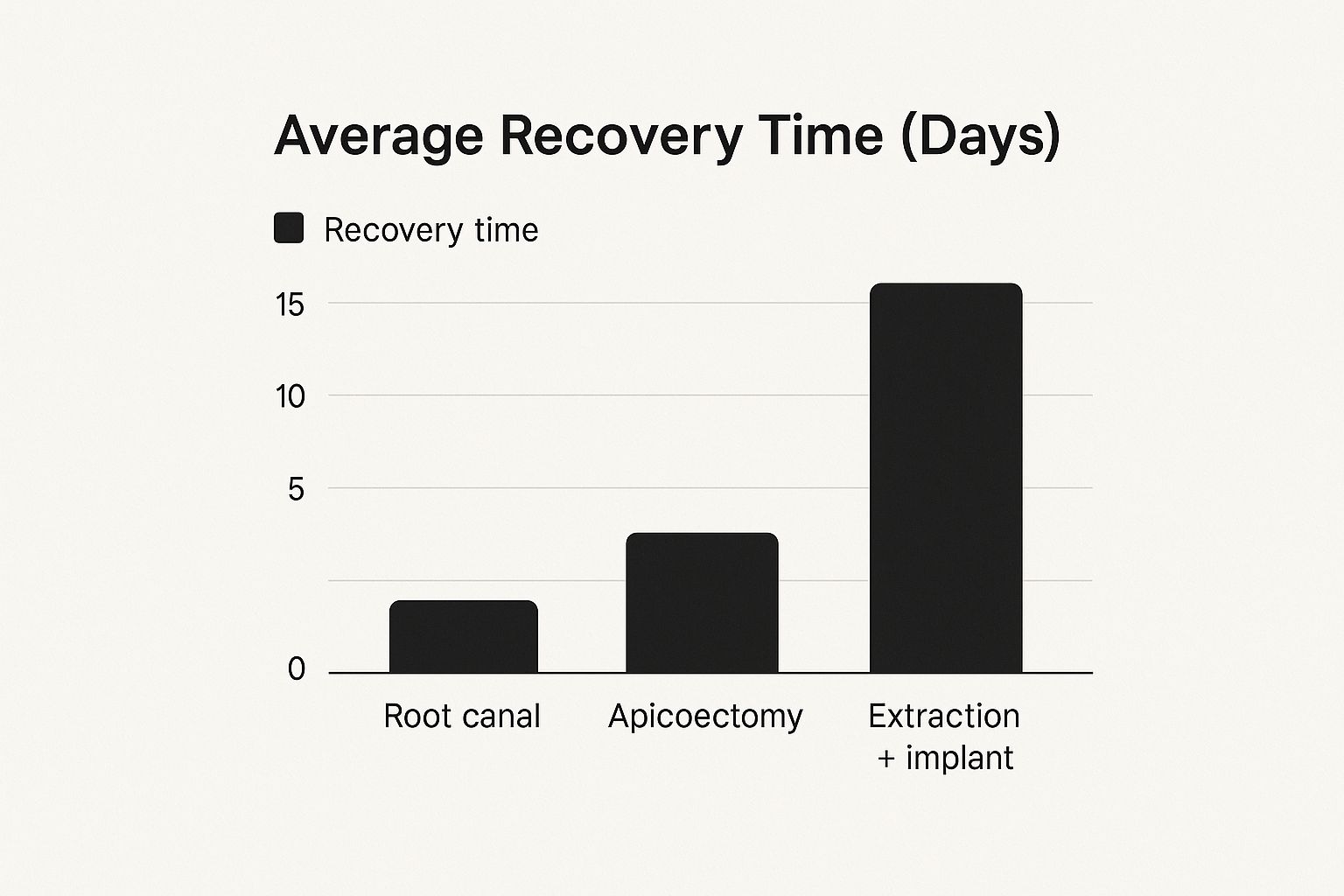
As you can see, procedures that save your tooth generally have less downtime. Removing a tooth and then waiting for an implant to be placed and heal is a more involved and longer process.
At-a-Glance Comparison of Root Canal Alternative Pathways
Choosing between these two paths depends on the health of the tooth and what you're most comfortable with. This table breaks down the two main approaches simply.
This table summarizes the two main approaches to handling a deeply infected tooth instead of a traditional root canal, helping you understand the core philosophy behind each option.
| Treatment Pathway | Core Goal | Primary Options | Best Suited For Patients Who… |
|---|---|---|---|
| Remove & Replace | Eliminate the infection source and restore function with an artificial tooth. | Tooth Extraction followed by a Dental Implant or a Dental Bridge. | Have a tooth that is fractured, severely decayed, or too weak to be restored. |
| Save the Tooth | Preserve the natural tooth by treating the infection. | Apicoectomy (Root-End Surgery) or Vital Pulp Therapy. | Have a strong tooth where the infection can be treated directly. |
Thinking about the future is key here. Dental implants are a very durable way to replace a missing tooth and can last a lifetime with good care. We cover this in our guide on dental implants for seniors, which has great information for patients of any age.
Deciding to pull a tooth is a big step. The main benefit is that the source of the infection is gone for good. The downside is the gap it leaves, which needs to be filled to keep other teeth from shifting. Thankfully, dental implants have a great track record, with studies showing success rates over 90% after nearly seven years (Source: Journal of Oral & Maxillofacial Research).
Of course, saving the tooth means you can skip the surgery needed for an implant. You also don't have to alter healthy neighboring teeth for a bridge. Keeping your natural root is the best thing for your jawbone health. The trade-off is that these tooth-saving procedures are delicate and only possible in specific situations.
In the next sections, we'll dive into the details of each of these alternatives.
Removing and Replacing a Compromised Tooth

Sometimes, the most straightforward way to handle a deeply infected tooth is to remove it. An extraction is often the most practical choice when a root canal isn't the best option. It gives you a clean slate and stops the infection immediately.
But taking the tooth out is only the first step. The next important step is to fill the gap it leaves behind. Modern dentistry offers fantastic ways to restore your smile’s look and function, helping you avoid long-term problems.
The Modern Tooth Extraction Process
I know the thought of having a tooth pulled can sound scary, but modern techniques have made it a much more comfortable experience. At Cedar Dental Group, your comfort is our top priority. We use effective local anesthetics to numb the area completely, so you won’t feel any pain during the procedure.
Our approach is gentle and precise. We work to preserve as much of the surrounding bone and gum tissue as possible. This helps you feel comfortable on the day of your visit and creates a healthier foundation for your replacement tooth.
Dental Implants: A Permanent Solution
Once the damaged tooth is gone, a dental implant is considered the best replacement option by most dentists. An implant is a small post, usually made of body-safe titanium, that we surgically place into your jawbone. Think of it as an artificial tooth root.
Over the next few months, your jawbone naturally bonds with the implant. This process creates a very strong and stable base for a custom-made dental crown that will look and feel just like your other teeth.
The biggest advantage of a dental implant is its ability to keep your jawbone healthy. The implant post gives your jaw the stimulation it needs to stay strong, preventing the bone loss that always happens when a tooth is missing.
Because an implant is a standalone solution, it doesn't affect your healthy neighboring teeth at all. The final result is a replacement that works just like a natural tooth.
Dental Bridges: A Faster Alternative
Another common choice is a dental bridge. A bridge "bridges" the gap left by a missing tooth by using the nearby teeth for support. We place crowns on the two teeth on either side of the gap, and an artificial tooth is attached between them, filling the space.
Bridges are a reliable and great-looking solution. They are also typically faster than implants because there is no surgery or long healing period required. For patients who aren't good candidates for surgery or who want their smile restored more quickly, a bridge can be a wonderful choice.
Comparing Implants and Bridges Head-to-Head
So, how do you decide between an implant and a bridge? It really comes down to your unique situation, your health, and your long-term goals. Here’s a quick breakdown of the key differences:
| Feature | Dental Implant | Dental Bridge |
|---|---|---|
| Durability | Can last a lifetime with proper care. | Typically lasts 5–15 years before needing replacement. |
| Jawbone Health | Preserves bone by stimulating the jaw. | Does not prevent bone loss beneath the missing tooth. |
| Adjacent Teeth | Does not involve or alter healthy neighboring teeth. | Requires preparing adjacent teeth for crowns. |
| Timeline | Longer process (several months) due to healing. | Faster process (usually a few weeks). |
| Maintenance | Cared for just like a natural tooth (brushing/flossing). | Requires special tools to clean underneath the bridge. |
Ultimately, both implants and bridges are part of restorative dentistry—a field focused on bringing your smile back to full health and function. You can explore more about what is restorative dentistry in our detailed guide.
Which Replacement Option Is Right for You?
Choosing the right path forward is a conversation you'll have with your dentist. Several important factors will be considered.
- For a single missing tooth: A dental implant is almost always the best choice. It avoids altering healthy teeth and provides the best long-term outcome for jawbone health.
- For a patient who cannot undergo surgery: A dental bridge is a practical and effective solution. It restores your smile beautifully without the surgical step an implant requires.
- For multiple missing teeth in a row: While a series of individual implants is one option, an implant-supported bridge can also be an incredibly stable and functional solution.
When you're weighing alternatives to a root canal, the "remove and replace" strategy has a proven track record. Implants, in particular, have shown very high success rates. One major study reported an implant survival rate of about 90.9% over an average of 6.8 years (Source: Journal of Oral & Maxillofacial Research), which is even higher than the 86% success rate for initial root canals.
Here at Cedar Dental Group in Renton, WA, we'll walk you through every detail of each option. Our goal is to give you the clarity and confidence you need to choose the best path forward for your smile.
Advanced Procedures to Save Your Natural Tooth
While removing and replacing a problem tooth is always an option, it's not the only alternative to a traditional root canal. At Cedar Dental Group, our first priority is to save your natural tooth whenever we can. Thankfully, advanced procedures exist that are less involved than a full root canal, especially when the tooth's nerve—the pulp—can still be saved.
These special techniques focus on preserving the living tissue inside your tooth. Keeping the pulp healthy and alive means the tooth keeps its natural strength and defense system.
What Is Vital Pulp Therapy?
One of the most promising alternatives is vital pulp therapy. You can think of it as a more targeted, less aggressive approach. Instead of removing the entire tooth pulp, this procedure only removes the inflamed or damaged part. This gives the healthy pulp underneath a chance to heal and survive.
This treatment works best when a cavity or crack has just reached the pulp, but the infection hasn't had time to kill the whole nerve. The goal is to cover the exposed, healthy pulp with a special medicated material. This encourages the tooth to form its own natural protective barrier and, most importantly, stay alive.
Vital pulp therapy is a fantastic option for patients who:
- Have an injury or decay that has only just exposed the pulp.
- Are not showing signs of a widespread, irreversible infection.
- Want to preserve as much of their natural tooth structure as possible.
The success of this procedure really depends on catching the problem early. The sooner we can protect the exposed pulp, the better the odds of saving the tooth without more drastic measures.
Understanding Apicoectomy: A Root-End Surgery
Another highly specialized procedure is the apicoectomy, also called root-end surgery. This is a very precise treatment that tackles the infection from the outside of the tooth, rather than the inside like a root canal. We often use this when a previous root canal has failed, but the tooth itself is still strong and worth saving.
During an apicoectomy, the dentist makes a tiny incision in the gum to reach the very tip of the tooth's root. They remove the end of the root, clean out any infected tissue, and seal the root's end with a small filling.
An apicoectomy is a micro-surgical procedure that lets us clean and seal the root tip directly. This is often where a persistent infection hides, especially when a traditional root canal couldn't quite reach it.
This isn't a common procedure; it’s saved for very specific situations. It’s a great choice if there’s a cyst at the root tip or if the root's canals are blocked, making a standard root canal impossible.
When Are These Procedures the Right Choice?
Figuring out if you're a candidate for vital pulp therapy or an apicoectomy requires a thorough exam and digital X-rays. These advanced alternatives to a root canal aren't the right fit for every toothache.
The decision comes down to a few key factors:
- The extent of the infection: Is the pulp already too damaged to save?
- The tooth's structure: Is there enough healthy tooth left to support a restoration?
- The location of the infection: Is the problem only at the root tip, making an apicoectomy a logical choice?
While these procedures are excellent ways to save a tooth, they have specific uses. If a tooth is just too far gone, the best long-term solution might be to remove it. To get a better sense of what's possible, you can learn more about our state-of-the-art dental implants in Renton.
At Cedar Dental Group, we’ll walk you through every option. Our job is to give you the information you need to make a confident choice that feels right for your health and peace of mind.
Understanding Holistic and Biological Dentistry
More and more, people are seeing their oral health as a key part of their overall well-being. This is the main idea behind holistic or biological dentistry—an approach that looks for connections between your mouth and the health of your entire body.
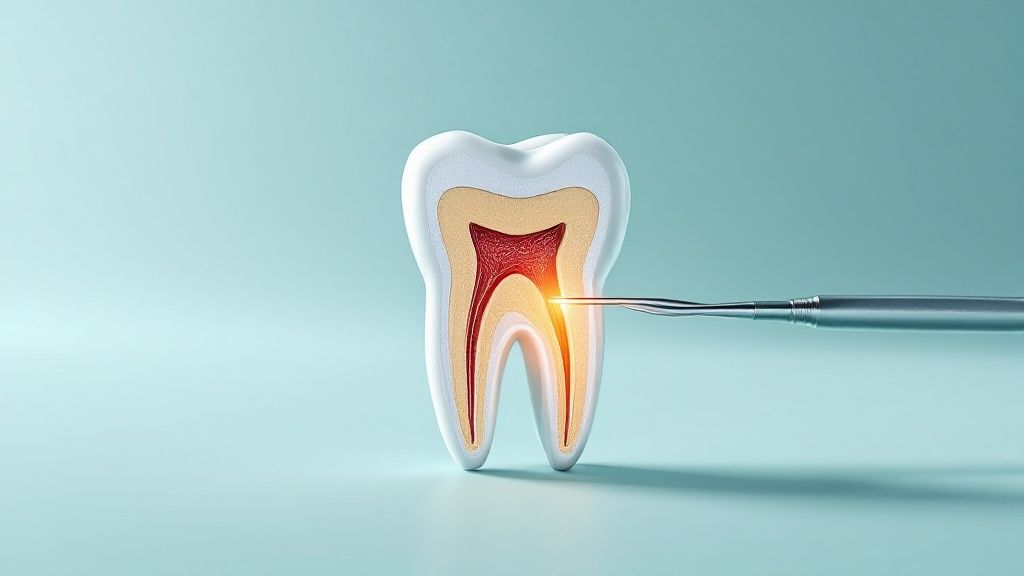
When dealing with an infected tooth, this philosophy leads dentists toward using body-friendly materials and the least invasive techniques. The goal isn't just to fix the tooth but to resolve the infection in a way that supports your body's natural ability to heal.
Core Principles of a Holistic Approach
Biological dentistry is guided by a few key ideas. One is a commitment to avoiding materials known to cause sensitivity in some people. There's also a strong focus on saving as much of your natural tooth structure as possible.
Instead of just treating the symptom—the infected tooth—a holistic dentist might talk about other factors like your diet and immune health. The belief is that a healthier body is better able to fight off infection and heal properly.
Ozone Therapy in Dentistry
One technique you'll hear about in biological dentistry is Ozone Therapy. Ozone, a super-charged form of oxygen, is a powerful natural disinfectant. In a dental office, it can be used as a gas or liquid to sterilize the tiny canals inside a tooth’s root.
The goal is to kill bacteria, viruses, and fungi without relying only on harsh chemicals. Those who use this method believe it reduces inflammation and helps the surrounding tissues heal more effectively.
The Role of Advanced Laser Disinfection
Another tool in the modern holistic toolbox is dental laser technology. Lasers give dentists a way to clean and disinfect the root canal system with incredible precision. The focused light energy is very good at destroying bacteria tucked away deep inside the tooth—places where traditional tools sometimes can't reach.
Let's break down how these two methods work:
| Technique | Primary Goal | How It Works |
|---|---|---|
| Ozone Therapy | Natural sterilization | Uses activated oxygen to kill bacteria and fungi. |
| Laser Disinfection | Precise cleaning | Uses light energy to destroy bacteria and infected tissue. |
It's important to understand that these techniques are most often used to improve standard root canal procedures, not as complete replacements. While they are gaining popularity, many in the wider dental community still consider them emerging technologies.
A Balanced View on Holistic Alternatives
Biological dentistry offers interesting options for anyone seeking a more natural path to dental health. The focus on preserving the tooth with tools like ozone and lasers is exciting, especially since traditional root canals are very common—affecting 8.2% of all teeth globally. You can read the full research about these findings to learn more.
However, it's important to look at these treatments with a clear, balanced view. While promising, many holistic techniques do not have the decades of long-term research that traditional root canals do. At Cedar Dental Group, our commitment is to evidence-based care. We are always ready to discuss all scientifically supported options with you, making sure you have a clear understanding of the benefits and limits of every choice.
How to Choose the Right Path for Your Health
Deciding on the best course of action for your dental health is a conversation, not a command. It’s a partnership between you and your dentist. When you’re looking at alternatives to a root canal, the "best" choice is always the one that fits your unique health situation, your budget, and your comfort level.
Here at Cedar Dental Group, we want to give you the right questions to ask so you can have that conversation with confidence. The right treatment really comes down to a few key things: the long-term outlook for the tooth, your overall oral health, and the treatment timeline.
Key Factors to Discuss with Your Dentist
Before you make a final decision, it’s a good idea to talk through these points with your dentist. This helps you see the full picture.
-
Long-Term Tooth Health: What are the real odds of this treatment lasting for years? Is the tooth strong enough to support a crown after the procedure?
-
Overall Oral Health: How will this choice impact the teeth next to it or your jawbone? A dental implant, for example, is great for preserving bone, but a bridge requires altering healthy adjacent teeth.
-
Treatment Timeline: How many appointments will it take, and what is the total recovery time? A bridge is usually a much quicker process than an implant, which needs several months to bond with your jawbone.
-
Your Budget: What is the upfront cost versus the long-term investment? When comparing a bridge to an implant, you have to consider that a bridge might need to be replaced later on, adding to the lifetime cost.
The best results always come when you feel heard, understood, and fully informed. It’s your health, and your treatment plan should feel right for you.
Of course, the best way to avoid these big decisions is through proactive care. Taking a few minutes to learn about what is preventive dental care can make all the difference in keeping your smile healthy for a lifetime. At Cedar Dental Group, our entire approach is built around patient-first care, making sure you feel completely confident in the path you choose.
FAQs: Exploring Alternatives to Root Canals
Facing a major dental decision often comes with questions. That’s a good thing! We’ve gathered answers to some of the most common questions we hear from patients in Renton, WA, to help you feel more confident about your next steps.
1. Is pulling a tooth always cheaper than a root canal?
Initially, yes. The upfront cost of a simple tooth extraction is lower than a root canal. However, it's important to think long-term. Leaving a gap can cause other teeth to shift, leading to bite problems. The cost to replace the missing tooth later with a dental implant or bridge often ends up being more than the original root canal and crown.
2. How do I know if I am a good candidate for a dental implant?
A good candidate for a dental implant needs enough healthy jawbone to support the implant post. Your overall health also matters. Conditions like uncontrolled diabetes or heavy smoking can affect healing and the implant's success. Your dentist will use digital X-rays to get a precise look at your bone structure and determine if an implant is a safe option for you.
3. What happens if I do nothing about my infected tooth?
Ignoring an infected tooth is not a good idea. The infection won't go away on its own. It can spread from the tooth's root into your jawbone, often creating a painful abscess. From there, the infection can enter your bloodstream and lead to serious health issues. You will likely face more pain and eventually lose the tooth anyway. We never recommend leaving a known dental infection untreated.
4. Can a tooth heal itself without a root canal?
In very rare cases, if the pulp is only slightly irritated and the cause (like a shallow cavity) is removed quickly, the tooth might recover. However, once the pulp is infected with bacteria, it cannot heal on its own. At that point, treatment like a root canal or extraction is necessary to remove the infection and prevent it from spreading.
5. Are holistic alternatives like ozone therapy covered by dental insurance?
Coverage for holistic treatments varies widely by insurance plan. Many insurance companies still consider treatments like ozone therapy to be "experimental" and may not cover the cost. Before moving forward with any alternative treatment, it's very important to contact your dental insurance provider directly to ask about your specific policy's coverage.
Ready to explore your options with a team that puts your comfort and health first? The friendly professionals at Cedar Dental Group are here to provide clear, compassionate guidance. Contact us today to schedule your consultation in Renton, WA.
