

Direct Answer: If tooth pain has lasted more than three days, comes with swelling, gets worse when you bite, or is accompanied by a fever, call your dentist now — don’t wait for it to resolve on its own.
If you’re reading this at midnight because a molar has been throbbing for three days straight — or you’ve stopped chewing on one side entirely because the pain has you scared to eat — I want you to know that what you’re feeling is one of the most common things we hear at our practice. We get form submissions almost every week that describe exactly this: a week of tooth pain on one side, headaches, trouble eating, barely sleeping. These aren’t minor inconveniences. They’re signals worth paying attention to.
The question most patients are really asking isn’t “what’s wrong with my tooth.” It’s “is this an emergency or can it wait until next week?” That’s the gap this article is meant to close. I’ll give you a clear framework for reading your own symptoms — not to replace an exam, but so you can stop guessing and feel more confident about what step to take next.
I’ll also cover what you can actually do right now to manage discomfort while you wait, and when waiting stops being the right call.
The Four Symptoms That Mean Call Now, Not Later
Tooth pain on its own isn’t always an emergency. But certain symptoms paired with pain change the picture entirely. Here’s what I look for when a patient describes what they’re going through:
- Pain lasting three or more days — A toothache that lingers past the three-day mark is your mouth telling you something isn’t resolving on its own. An untreated infection doesn’t pause; it progresses.
- Swelling near your jaw, cheek, or under your chin — This is the one I take most seriously. Swelling in these areas can signal that an infection has moved beyond the tooth and into surrounding tissue. That’s not a wait-and-see situation.
- Pain that gets worse every time you bite down — Sensitivity that’s building instead of fading, especially on biting, often points to a cracked tooth, a failing filling, or infection at the root tip. The longer it goes, the harder treatment gets.
- Fever alongside tooth pain — A fever tells you your immune system is working hard against something systemic. Tooth-related infections can spread, and fever is a sign that’s already started to happen.
One patient reached out describing upper left pain with headaches and difficulty eating on that side. That combination — pain, referred headache, and trouble chewing — is consistent with something pressing on a nerve or a spreading infection. That patient needed to be seen the same day, not the following week.
The American Dental Association defines dental emergencies as situations involving uncontrolled bleeding, severe pain, or swelling — and swelling near the jaw falls squarely in that category.

What You Can Manage at Home — and What That Actually Means
There’s a difference between managing pain and managing a problem. Over-the-counter relief can absolutely help you get through to your appointment. But it’s important to understand what it’s doing — and what it isn’t.
Ibuprofen (like Advil) works better than acetaminophen for dental pain because it reduces inflammation, not just discomfort signals. If you can take it safely based on your other health conditions, it’s the better short-term choice. Do not place aspirin directly on the tooth or gum — that’s an old myth that causes more tissue irritation than relief.
A cold compress held against the outside of your cheek for 20 minutes at a time can help with swelling and take the edge off the pain. Avoid heat — heat increases blood flow to the area and can make swelling worse.
If you have a chipped or broken temporary crown that isn’t painful and is still seated, you can usually wait a short time to be seen. Keep it clean, avoid chewing on that side, and don’t use that tooth to bite into anything hard. If the crown comes fully off or you start feeling pain, that moves it to the call-us-today column.
What home care cannot do is treat an infection. If bacteria have reached the pulp of a tooth or spread into surrounding tissue, no amount of ibuprofen changes what needs to happen next. That’s where patients sometimes get into trouble — the pain quiets down for a day and they think the problem resolved. An infection that goes quiet without treatment hasn’t gone away; it’s often just spreading more slowly. You can read more about how those decisions get made in our article on root canal or something else — how the decision actually gets made.
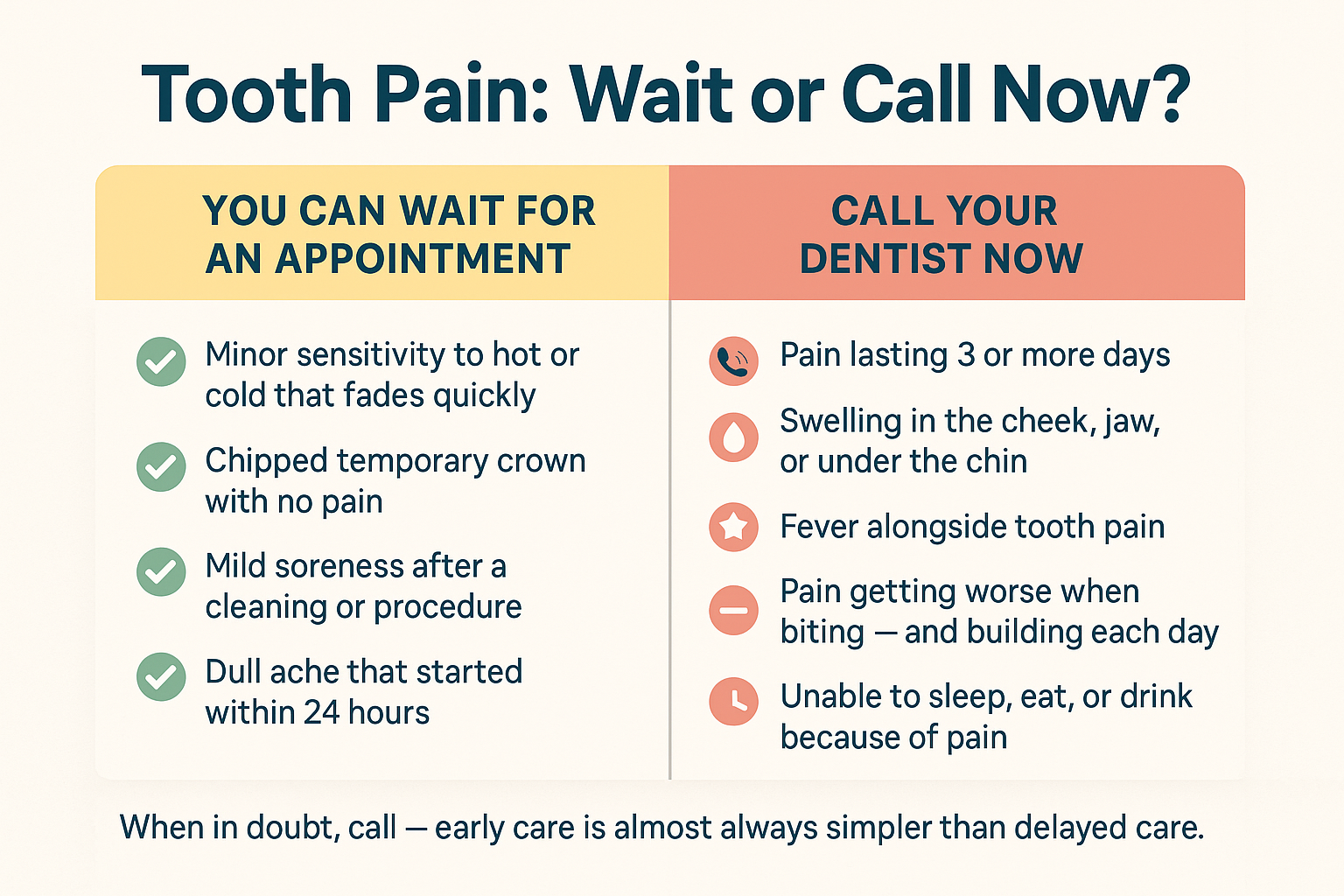
Quick Reference: Wait or Call Now?
Use this as a fast triage guide for the most common tooth pain situations. If you’re unsure, calling is always the right move.
When Fear Is Making the Decision — Not You
I want to speak directly to a group of patients I hear from often: people who know something is wrong but have stopped going to the dentist because of fear, a bad past experience, or both.
We recently heard from someone who had moved from the Tacoma area and described fillings that were slowly failing — and said they’d just stopped chewing on that side because the fear of going to the dentist felt worse than the pain itself. That is one of the hardest situations to be in. The anxiety is real, and it doesn’t help that dental pain often compounds it — every throb feels like a reminder of something you’re dreading.
But here’s what I want you to know: waiting doesn’t make that next appointment easier. A tooth that needs a filling today may need a root canal in three months. And a tooth that needs a root canal today may be unrestorable after much longer. The treatment gap is real, and it almost always works against the patient — not in terms of judgment, but in terms of clinical options.
We work with anxious patients constantly at Cedar Dental Group. Dr. Chu founded this practice around the idea that trust and transparency have to come first — that patients who understand what’s happening and feel heard make better decisions and have better experiences. If you’ve read reviews from patients who came in scared and left feeling relieved, that’s not an accident. It’s intentional. If you’ve avoided the dentist for years and aren’t sure what to expect, our article on what to expect when you haven’t been to the dentist in years walks through exactly that.
And if dental anxiety is a real barrier for you, we’ve written specifically about how to find a dentist that’s actually built for anxious patients — including what to look for and what questions to ask before you ever sit in the chair.
Common Tooth Pain Situations at a Glance
This isn’t a diagnosis — it’s a reference to help you read your own situation and decide how quickly to act.
| Symptom or Situation | What It Often Indicates | Suggested Next Step |
|---|---|---|
| Molar pain for 1+ week | Possible deep decay, infection, or cracked tooth | Call now — don’t wait for the next available week |
| Pain when biting, getting worse each day | Possible cracked tooth or abscess at root tip | Call now — worsening biting pain rarely resolves alone |
| Cheek or jaw swelling with pain | Spreading infection, possible abscess | Call immediately — same-day care needed |
| Fever alongside tooth pain | Systemic involvement of infection | Call immediately — may need antibiotics and dental treatment together |
| Chipped temporary crown, no pain | Crown is still protecting the tooth | Call within 1-2 days — manageable but shouldn’t be ignored long |
| Cold sensitivity that fades in a few seconds | Early enamel wear or minor recession | Schedule a routine appointment — monitor for changes |
| Soreness after a filling or cleaning | Normal post-procedure inflammation | Wait 48-72 hours; call if it gets worse instead of better |
What Happens When You Come In for Tooth Pain
Patients sometimes avoid calling because they’re not sure what they’re walking into. So let me be straightforward about what an evaluation for tooth pain usually looks like.
We’ll take a targeted X-ray of the area you’re describing. That image tells us a lot — whether there’s infection at the root tip, how much decay is present, whether the bone looks healthy, and whether the tooth is restorable. Dr. Chu will examine the area and may test the tooth’s response to temperature or light pressure to get a clearer picture of what’s happening.
From there, the conversation is honest and specific: what’s causing this, what the options are, and what we recommend and why. No one is going to push you into treatment you don’t understand. If the situation points toward something beyond a standard filling — for instance, if the infection has reached the pulp of the tooth — Dr. Joe Dutner, our in-house endodontist, handles root canal therapy right here in the same practice. You don’t get sent to a separate specialist weeks later. That continuity matters when you’re already in pain.
If your pain has you wondering whether the tooth might need to come out entirely, or whether an implant might eventually be part of the picture, our articles on when a dental implant is the right choice after tooth loss and crown vs. bridge vs. implant — how patients actually make this decision can give you a solid foundation before that conversation happens.
Frequently Asked Questions About Tooth Pain
My tooth stopped hurting on its own — does that mean it’s better?
Not necessarily, and this is one of the most common things I want patients to understand. When a tooth that was severely painful suddenly goes quiet, it can mean the nerve inside the tooth has died — not that the infection resolved. A dead nerve can’t send pain signals, but the infection itself may still be active and spreading. If your tooth pain stopped abruptly after several days of significant pain, still call your dentist and describe what happened.
Can a tooth infection go away without treatment?
Dental infections do not resolve on their own. Antibiotics can reduce the spread of infection and bring down a fever, but they don’t treat the source — the tooth itself still needs to be addressed. Antibiotics are a bridge, not a solution. If a provider prescribes antibiotics for tooth pain, a follow-up dental appointment is always the necessary next step.
I have a molar that’s been hurting for about a week. Is that a root canal situation?
It might be, but not necessarily. A week of molar pain is absolutely a reason to come in — it’s past the point where waiting makes sense. The X-ray and exam will tell us whether the issue is decay that’s reached the pulp, a crack, or something else. If it does turn out to need root canal therapy, our in-house endodontist, Dr. Dutner, can handle that here without a separate referral. You can read more about how that decision gets made in our article on root canal or something else.
I haven’t been to the dentist in years and I’m scared. What if the news is really bad?
I hear this often, and I want to be honest: the news might require some real treatment. But knowing that is always better than not knowing. Every week of delay typically narrows the options available. Most patients who’ve avoided care for years find that the appointment itself is far less overwhelming than the anticipation. And we approach those conversations with patience, not judgment — our goal is to help you understand what’s happening and decide what to do about it at your own pace.
What’s the difference between a toothache and a dental abscess?
A toothache is a general term for any pain coming from or near a tooth. An abscess is a specific condition — a pocket of infection, usually at the root tip or in the gum tissue, caused by bacteria that have reached areas they shouldn’t be. Abscesses often cause throbbing pain, swelling, and sometimes a visible bump on the gum. They always need treatment. If you have swelling alongside your pain, treat that as a call-now situation.
My filling feels like it’s falling out and I’ve been avoiding chewing on that side. What should I do?
Call and get it looked at — soon, but not in a panic if there’s no pain. A compromised or missing filling exposes the tooth underneath and can allow decay to progress quickly. Avoiding that side of your mouth is a reasonable short-term coping strategy, but it’s not a long-term plan. The longer a tooth sits unprotected, the more likely a simple filling repair becomes something more involved.
Ready to Stop Guessing and Get an Answer?
If you’ve been dealing with tooth pain for more than a few days — or you’ve been putting off care because the anxiety of calling feels bigger than the pain itself — Cedar Dental Group is here and accepting new patients in Renton and the surrounding South King County area. You can reach us at 425-430-0400 or visit cedardentalgroup.com to request an appointment. A real conversation about what’s happening in your mouth is always the right first step.
