
Direct Answer: Bonding works best for small chips, gaps, and minor discoloration. Veneers are better for larger shape changes or significant staining that bonding can’t fully correct.
A lot of patients I see come in with their mind already made up. “I want veneers” is something I hear regularly — and sometimes that’s exactly right. But more often than not, what they’re describing — a small chip on a front tooth, a gap they’ve always hated, some yellowing that whitening hasn’t touched — is something bonding could address just as well, often in a single appointment and at a fraction of the cost.
I’m not saying veneers are the wrong answer. They’re an excellent option for the right situation. But I think a lot of people come in having done research on the more visible, more talked-about option without realizing there’s a simpler path to the same outcome. And part of my job is helping patients figure out which road actually fits where they’re trying to go.
This post is for the person who’s done some searching, has a specific thing they want to fix, and wants to understand the real difference between these two options before they sit down in a chair. I’ll walk through what each one actually involves, when one clearly makes more sense than the other, and how a broken or damaged tooth changes the conversation entirely.
What Bonding Actually Is — and What It’s Good For
Dental bonding uses a tooth-colored composite resin — the same material used in modern fillings — applied directly to the surface of your tooth and shaped by hand. It bonds to the existing tooth, gets hardened with a curing light, and is then polished to blend in. Most of the time, this happens in one appointment with no removal of tooth structure.
That last part matters more than people realize. Because nothing permanent is removed from your tooth, bonding is considered reversible in a way that veneers are not. If your situation changes, or if you decide later you want veneers instead, that option is still available.
Bonding works best for:
– Small chips on a front tooth from an accident or wear
– Gaps between teeth (called diastemas) that are narrow enough for resin to close
– Mild discoloration or staining that sits on or just under the surface
– Minor shape changes — making a slightly short or pointed tooth look more even
– Exposed root surfaces where the tooth looks longer than it should
Where bonding has limits: it’s more susceptible to staining over time than porcelain, and it’s not as strong under heavy biting pressure. Most bonding lasts 5 to 10 years before it needs touching up or replacing, depending on where it’s placed and how you bite. The American Dental Association recognizes bonding as a well-established cosmetic procedure with a strong track record in appropriate cases.
What Veneers Involve — and Why That Changes the Math
Porcelain veneers are thin shells — typically about 0.5 mm thick — that are permanently bonded to the front surface of your teeth. They’re fabricated off-site in a dental lab based on impressions or digital scans taken at your appointment.
Because the veneer needs to sit flush and look natural, a small amount of enamel is permanently removed from the front of the tooth before placement. That’s the trade-off with veneers: they produce a result that bonding often can’t match in terms of color consistency, durability, and coverage — but you’re committing to them for life. Once enamel is removed, it doesn’t grow back, which means that tooth will always need some kind of covering going forward.
The process typically requires at least two appointments: one to prepare the teeth and take impressions, and a second a few weeks later to place the finished veneers. Some practices offer same-day options with in-office milling, but traditional lab-fabricated veneers involve that waiting period.
Veneers make the most sense when:
– Multiple front teeth need to look consistent and even
– Staining is severe or intrinsic — meaning it goes deeper than the surface and whitening or bonding can’t correct it
– There’s significant wear or size change across several teeth
– A patient wants a long-term result with minimal maintenance (porcelain resists staining much better than composite resin)
Cost is a real factor here. Bonding and veneers sit at very different price points, and that gap matters when you’re looking at multiple teeth. I always tell patients to get a full picture of what each option would involve for their specific situation — not just per tooth, but in terms of total treatment scope.
Bonding vs. Veneers: A Side-by-Side Look
Here’s a quick comparison of how these two options differ across the factors patients ask about most.
| Factor | Dental Bonding | Porcelain Veneers |
|---|---|---|
| Appointments needed | Usually 1 | Typically 2 or more |
| Tooth alteration | Little to none | Permanent enamel removal |
| Reversibility | Yes | No |
| Stain resistance | Moderate — resin stains over time | High — porcelain resists staining well |
| Durability | 5–10 years typical | 10–20 years with proper care |
| Best use case | Single tooth, small chip, gap, minor discoloration | Multiple teeth, severe staining, significant shape change |
| Relative cost | Lower — especially for 1–2 teeth | Higher — especially across multiple teeth |
How to Figure Out Which Option Fits Your Situation
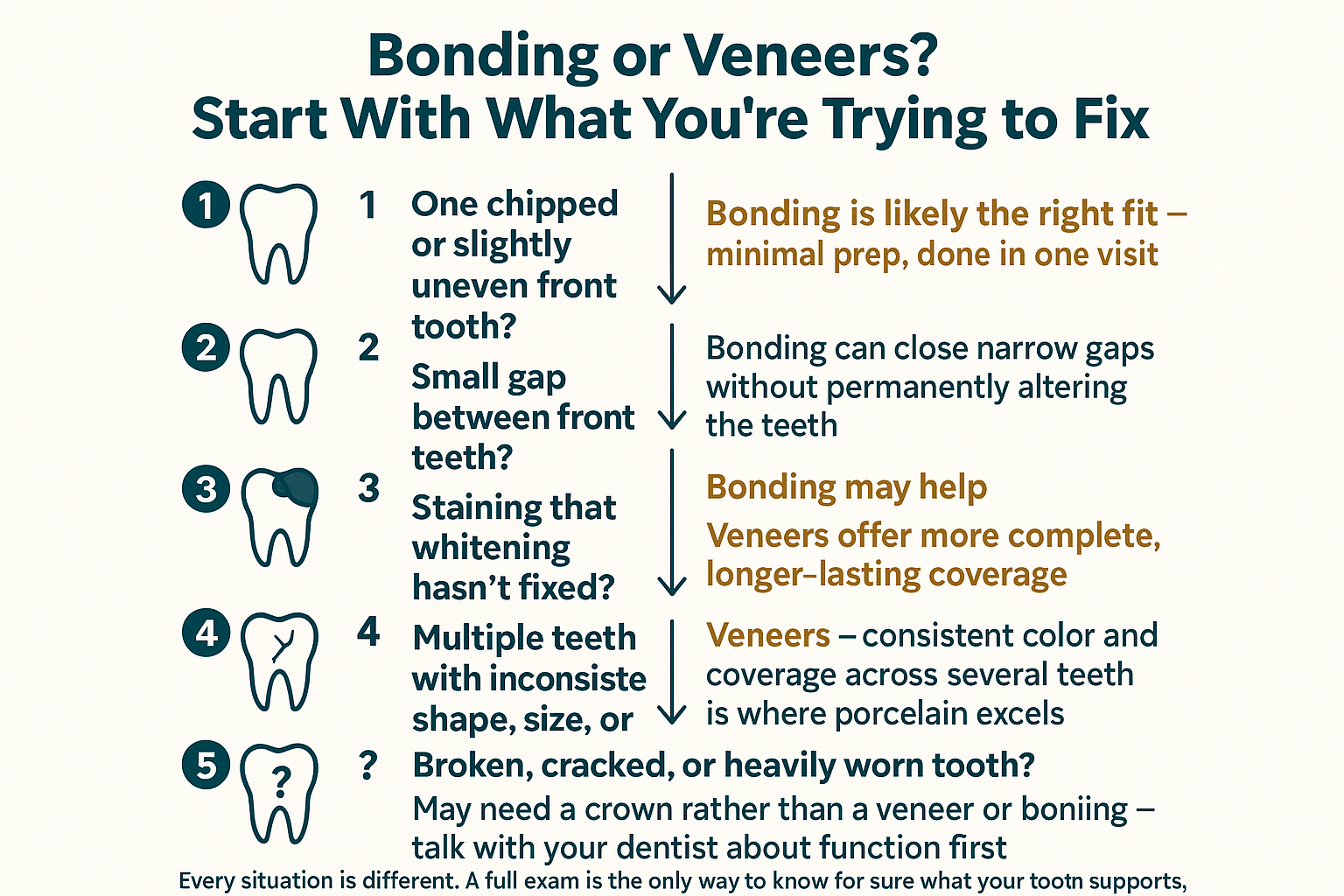
This decision tree walks through the most common cosmetic concerns and which option tends to fit each one best.
When It’s Not Really a Cosmetic Decision Anymore
This is the part that surprises some patients. Every so often, someone comes in describing what they think is a cosmetic problem — a broken tooth, something that “looks bad” — and after an exam it turns out the tooth has structural damage that goes beyond what bonding or a veneer can handle.
We had a patient reach out recently describing a broken tooth and asking about “implant or veneer replacement” in the same message. That’s a really common conflation, and it’s not the patient’s fault — these terms get mixed together online constantly. But a veneer sits on top of a healthy tooth structure. If the tooth underneath is broken, severely decayed, or structurally compromised, a veneer isn’t the right tool. A crown might be — or if the tooth can’t be saved, that’s when an implant conversation starts.
I think about this overlap a lot because it’s where cosmetic goals and restorative needs meet. A chipped or worn tooth can have both an aesthetic problem and a functional one. When Dr. Chu evaluates a tooth like that, she’s looking at both — what will make it look right and what will make it hold up long-term. If you’re curious about how that kind of decision actually plays out, the crown vs. bridge vs. implant decision guide walks through that thinking in detail.
The short version: if a tooth is broken or damaged — not just discolored or chipped at the edge — get a full exam before assuming any cosmetic fix is the right one.
What to Expect at Your First Cosmetic Consultation
I want to demystify this part because it’s where a lot of patients feel uncertain. A cosmetic consultation with Dr. Chu isn’t about being sold a treatment plan. It’s a conversation about what you’re seeing in the mirror, what’s bothering you, and what’s actually possible given your tooth structure.
She’ll look at:
– The extent of the change you want — is it one tooth or several?
– The condition of your existing enamel — bonding and veneers both require a stable surface to adhere to
– Your bite pattern — how your teeth come together matters, especially for front teeth that take lateral pressure
– Color matching — bonding is blended chairside; veneers are color-matched to your surrounding teeth through the lab process
If you’ve been a while since your last dental visit, that appointment will likely include a cleaning and exam first. That’s not a hurdle — it’s actually important, because cosmetic work on a tooth that has underlying decay or gum issues won’t hold up the way it should. If it’s been a few years, the what to expect after a long gap from the dentist post is worth reading before you come in.
The goal is for you to leave that first visit with a clear picture of what’s possible, what it involves, and what it will cost — with no pressure to decide anything on the spot.
Frequently Asked Questions About Veneers and Bonding
Can bonding fix the same tooth that veneers would — or are they truly different options?
For mild to moderate cosmetic concerns, bonding and veneers can sometimes address the same problem. The difference is in durability, appearance, and how much tooth alteration is involved. Bonding is faster and less invasive; veneers offer a longer-lasting result with better stain resistance. Which one is appropriate depends on the size of the change you want and the condition of the tooth underneath.
Does bonding look natural?
Yes — when it’s done well. The composite resin is color-matched to your existing teeth and polished to a natural finish. For small repairs, it can be essentially invisible. On larger surface areas, porcelain veneers tend to look more consistent over time because the material doesn’t absorb staining the way resin does.
I have a broken tooth — can a veneer fix it?
It depends on how much of the tooth is intact. Veneers bond to a healthy tooth surface, so if the tooth is significantly broken, decayed, or structurally weakened, a veneer may not be the right solution. A crown is often the better option for a structurally compromised tooth. In some cases, if the tooth can’t be saved at all, that’s when an implant may come into the conversation. The dental implant cost breakdown can help you understand what that path involves if it’s relevant to your situation.
How much do veneers cost compared to bonding in the Renton area?
Costs vary depending on the number of teeth being treated, the complexity of the case, and whether you need preparatory work done first. Generally speaking, bonding is considerably less expensive per tooth than porcelain veneers, though veneers tend to last longer. For an accurate estimate specific to your situation, a consultation is the only way to get real numbers — what you read online is typically a wide range that doesn’t account for individual tooth conditions or lab fees.
Will my insurance cover bonding or veneers?
Most dental insurance plans treat veneers and cosmetic bonding as elective procedures and do not cover them. However, if bonding is being used to repair a chipped or broken tooth — which has a functional as well as cosmetic component — some plans may cover part of it. It’s worth asking the front desk to check your specific benefits before your appointment. The teeth whitening insurance guide gives some useful context on how insurers generally classify cosmetic dental work.
Can I get bonding done the same day as my exam?
Sometimes, yes. For straightforward single-tooth cases, bonding can often be completed in the same appointment. But it depends on what the exam finds. If there’s decay, gum concerns, or other issues that need to be addressed first, those come before any cosmetic work. Dr. Chu will give you a clear picture of the timeline at your first visit.
Ready to Get a Clear Answer for Your Specific Situation?
If you’re in the Renton area and trying to figure out whether bonding or veneers makes sense for what you’re looking at, the best next step is a straightforward conversation — not a commitment. Cedar Dental Group welcomes patients from across South King County, including Kent, Tukwila, Newcastle, and Burien, who want an honest look at their options before making any decisions. Call us at 425-430-0400 or visit cedardentalgroup.com to schedule a consultation with Dr. Chu.
