
Direct Answer: A routine cleaning treats gums that are healthy. Periodontal therapy treats pockets that have deepened. Your x-rays and gum measurements at the first exam decide which one is appropriate.
Almost every new patient request we get in Renton asks for the same thing: a cleaning. Some people add that it has been four years, or seven months, or longer than they want to say out loud.
Then the exam happens, and the plan on the screen does not match the appointment they booked. Instead of one cleaning today, they are hearing about two longer visits and a different procedure with a different name.
That gap is confusing, and it is fair to ask who decided and why. So this is the whole answer: how regular cleaning vs deep cleaning at your first visit gets sorted out, what the numbers mean, and what it does to your schedule and your bill.
Regular Cleaning vs Deep Cleaning at Your First Visit: Two Different Procedures
These are not the same service done at two speeds. They treat different conditions.
A routine cleaning removes plaque and tartar from above the gumline and just below it, on gums that are healthy and attached where they should be. It is a preventive appointment, usually one visit, usually under an hour.
Periodontal therapy, which most people call a deep cleaning, removes tartar and bacteria from inside pockets that have deepened between the gum and the root. It is treatment for an active condition, not maintenance.
The practical differences that affect you:
- Different procedure codes. Routine cleanings are usually coded as a prophylaxis. Deep cleaning is usually coded as scaling and root planing, billed by quadrant.
- Different appointment lengths. One short visit versus longer visits, often split in two.
- Different insurance categories. Preventive versus basic or major.
- Different follow-up. Routine cleanings return every six months. After periodontal therapy, the interval is often shorter.
One more thing worth saying plainly. Polishing over deepened pockets feels like a cleaning, but it does not reach the tartar sitting down on the root surface. That is why we do not simply do the shorter appointment on request.
Why X-Rays and Measurements Come First
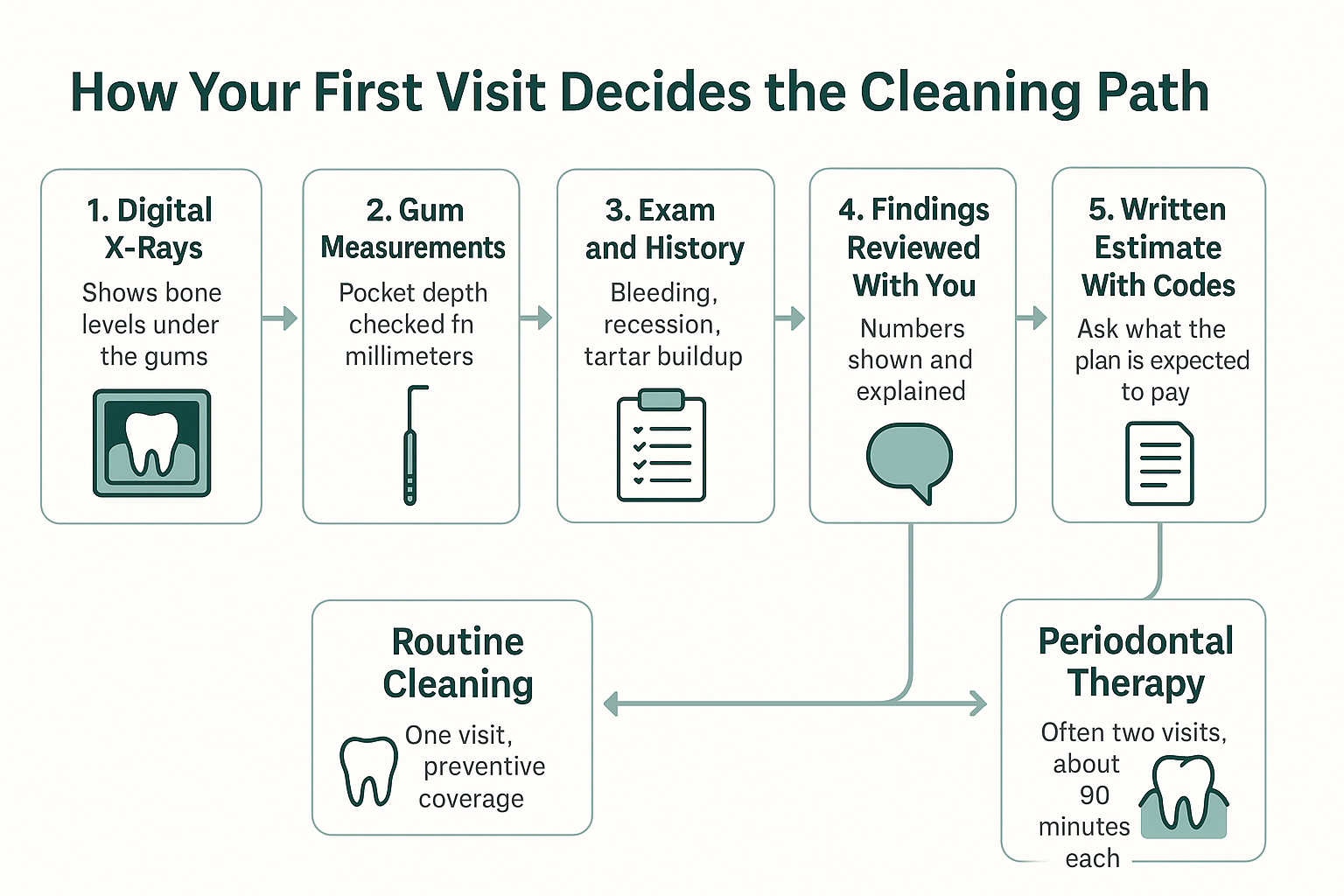
This is the part that keeps the decision honest. We take digital x-rays and measure your gums before anyone touches a scaler, because those two pieces of information decide the path.
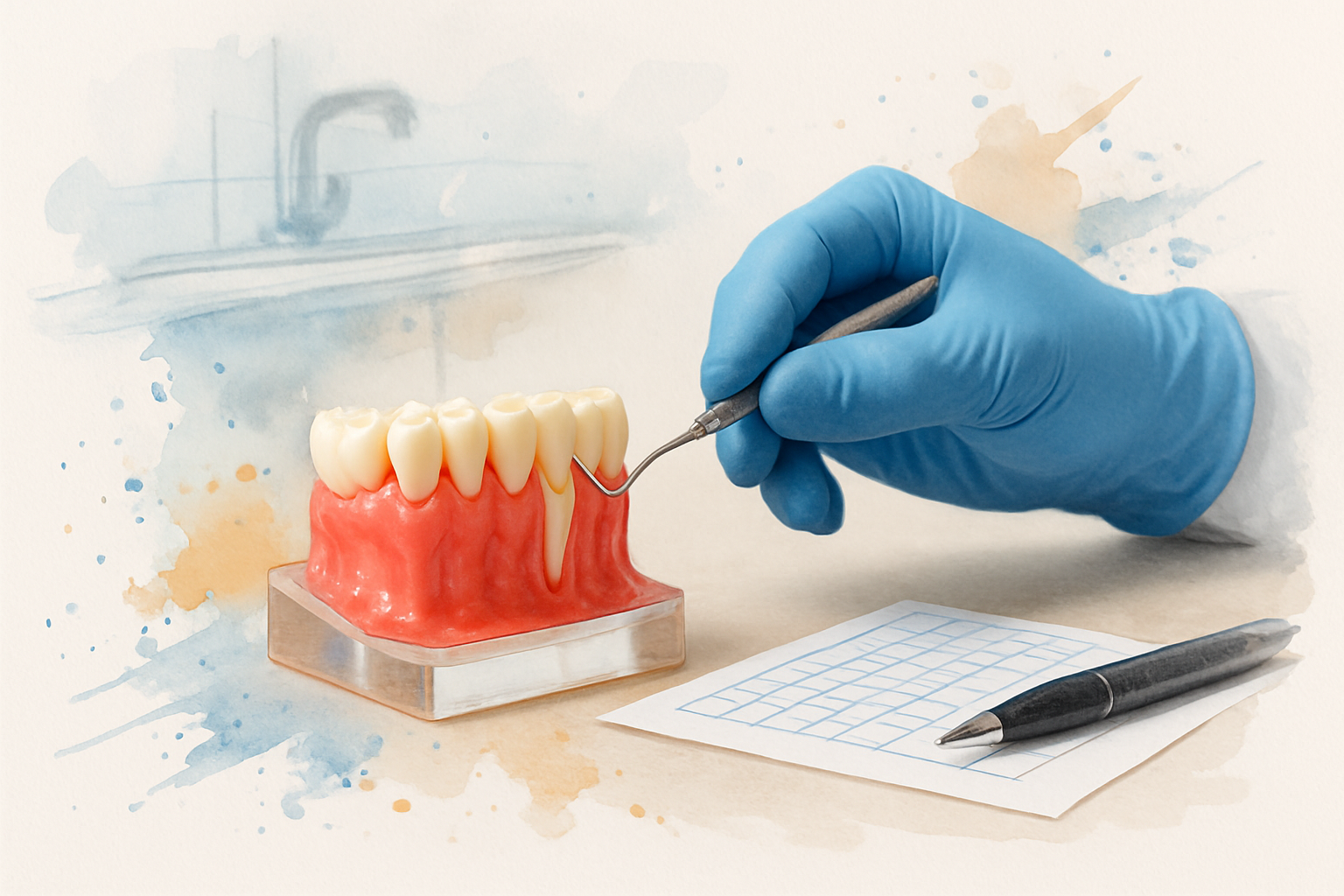
We use a thin probe with markings on it and check the depth around each tooth in millimeters. Healthy pockets generally read in the 1 to 3 mm range. As readings climb into the 4 mm and higher territory, with bleeding, recession, or bone loss showing on the x-ray, a routine cleaning is no longer the right tool.
What goes into the call:
- Pocket depth at multiple points per tooth
- Bleeding when the area is probed
- Bone levels visible on your x-rays
- Recession and how much root is exposed
- How much hard tartar is built up below the gumline
The measurements are written down, and you can ask to see them. If you want the full walk-through of what each number means, we covered that in what gets measured at a periodontal exam.
Gum disease is common in adults, and the National Institute of Dental and Craniofacial Research has a plain-language overview if you want to read outside of a dental office. Nobody is guessing, and nobody is adding treatment because the chart looked empty.
Side by Side: Routine Cleaning and Periodontal Therapy
Here is how the two paths compare on the things patients actually ask about at the front desk.
| What to compare | Routine cleaning | Periodontal therapy (deep cleaning) |
|---|---|---|
| What it treats | Healthy gums with surface plaque and tartar | Deepened pockets with tartar and bacteria below the gumline |
| Typical pocket readings | About 1 to 3 mm, no bone loss | 4 mm and up, often with bleeding or bone loss |
| Visits | Usually one | Often two, sometimes more depending on how many areas are involved |
| Appointment length | Roughly 45 to 60 minutes | Frequently around 90 minutes per visit |
| Numbing | Rarely needed | Local anesthetic is common, by area |
| Insurance category | Usually preventive | Usually basic or major, with coinsurance |
| What comes next | Recall in about six months | Shorter maintenance interval, often every three to four months |
How the Decision Gets Made in One Visit
This is the actual order of operations at a first exam, from check-in to a plan you can see on paper.
The Scheduling Part That Surprises People Most
This is the piece I wish more people heard before they arrived. When periodontal therapy is the right path, the cleaning you hoped to finish today usually becomes two appointments on the calendar, often around 90 minutes each, with one side of the mouth treated at a time.
That is not a stall tactic. Numbing one half of your mouth at a time keeps you comfortable and lets us work thoroughly without a three hour marathon in the chair.
And the pacing is adjustable. We have had patients with those two long visits booked who needed to push them out for unrelated health reasons, and that is a normal conversation, not a problem.
If timing or comfort is the sticking point, things we can shift include:
- Splitting into smaller sections rather than two long blocks
- Morning appointments for people who would rather not sit through a whole workday first
- Breaks during treatment, blankets, and clear narration of what comes next
- Spacing visits further apart when work travel or a commute from Kent, Tukwila, or Newcastle makes back to back weeks hard
One patient wrote that she used to feel anxious about the dentist and that this team “completely changed my perspective.” A long appointment handled at a pace you agreed to is a very different experience from one sprung on you.
Coverage: Where the Unexpected Bill Comes From
A fair number of people who write to us already suspect the answer. One described needing a cleaning, probably a deep cleaning, and explained that years had passed because there was no insurance. A long gap is common, and the first visit is mostly information gathering.
Where people get caught off guard is the billing. Most PPO plans we see in South King County, including Delta Dental, Regence, Premera, and GEHA, treat routine cleanings as preventive and often cover them at or near full benefit. Periodontal therapy usually falls under basic or major services, which means coinsurance, a deductible in some cases, and it counts against your annual maximum.
So someone who walked in expecting a covered cleaning can walk out with a balance they did not plan for. Plan designs vary widely, so I will not pretend to quote your number.
Two requests prevent most billing surprises, and you can make them at any office:
- Ask for a written estimate with the procedure codes before treatment starts.
- Ask what portion the plan is expected to pay, and whether the office can submit a pre-determination first.
Cost itself is driven by how many quadrants need treatment, whether anesthetic is used, and how often you come back afterward. If your interval shifts, periodontal maintenance every three months is coded and billed differently again, which is worth asking about in the same conversation.
Frequently Asked Questions About Cleanings and Deep Cleanings
Can I just get the regular cleaning I booked and deal with the rest later?
You can decline any treatment, always. But I want to be straight with you about what a routine cleaning does and does not reach. If your readings show deepened pockets, polishing the surfaces will feel fresh and leave the tartar on the root untouched. Many people choose to start with one quadrant and go from there, which is a reasonable middle ground.
How long does the first appointment take if I have not been in for years?
Plan on about an hour for x-rays, measurements, and the exam, plus time to review findings with you. Whether a cleaning happens that same day depends on what the measurements show.
Is a deep cleaning painful?
We use local anesthetic for the areas being treated, so the appointment itself is usually comfortable. Afterward, gums can feel tender and teeth may be sensitive to cold for a few days. What a deep cleaning actually involves walks through the recovery in more detail.
What if the deep cleaning is not enough?
Sometimes pockets do not close all the way, especially in a few stubborn spots. That is when a periodontist re-measures and talks through options. Dr. Kim is board certified in periodontology and handles that evaluation in the same building, so nobody gets sent across Seattle for a second opinion. We wrote about that fork in gum surgery vs. deep cleaning.
Who actually makes the call, the hygienist or the dentist?
The hygienist takes the measurements, and the dentist reviews them along with your x-rays before anything is finalized. When the picture is more involved, our periodontist reads them too. It is a chart-based decision, and you get to see the chart.
Want to know which category you fall into?
A first exam with x-rays and gum measurements is the only way to answer that, and knowing the answer is what makes the cost and the schedule predictable. Our Renton office sits near downtown on Hardie Ave. SW, with a board-certified periodontist and an in-house endodontist on staff, so the measurements get read and either path gets handled in the same building. If you would like to start with an exam, you can reach us at 425-430-0400 or read more at cedardentalgroup.com.
