
Direct Answer: For adults in their 50s and 60s, implants preserve jawbone and function more like natural teeth, while dentures cost less upfront but don’t stop ongoing bone loss. The right choice depends on your bone volume, budget, and how many teeth you’re replacing.
A lot of patients who come to us at mid-life aren’t asking about a single tooth. They’re dealing with multiple missing or failing teeth and trying to figure out the right path before committing to something expensive and permanent. The question usually sounds like: “Am I a denture person, or should I do implants?”
Washington state health survey data consistently shows that significant tooth loss is the most commonly self-reported oral health issue among adults over 55. That tracks with what we see in Renton and the surrounding South King County area. People in their late 50s and early 60s are often facing a decision they didn’t expect to face this soon, and they want real information, not a sales pitch.
I want to give you the honest version of this comparison, including the option most people don’t know exists, and the long-term factors that actually matter when you’re making this choice in your 50s or 60s.
What Each Option Actually Does in Your Mouth
The functional difference between implants and dentures goes deeper than most people realize, and it starts with what happens to your jawbone after teeth are lost.
When a tooth root is gone, the jawbone beneath it gradually shrinks. This process, called bone resorption, happens because the bone no longer receives the stimulation it needs from biting and chewing. A traditional denture rests on top of the gum tissue. It replaces the visible teeth but does nothing to interrupt this resorption. Over months and years, the bone continues to change, which is part of why dentures that fit well at first can feel loose or uncomfortable later.
An implant is placed directly into the jawbone and integrates with it over time, functioning like a tooth root. That ongoing stimulation helps maintain bone volume. For someone in their late 50s making this choice today, that difference compounds over the following decades in ways that affect facial structure, chewing ability, and whether future dental work becomes more complicated.
There’s also the daily experience to consider:
- Dentures are removable and cleaned outside the mouth
- They rely on suction, adhesive, or clasps (for partials) to stay in place
- Certain foods, especially hard or sticky ones, become more difficult
- Implants are fixed in place and cleaned like natural teeth
- Chewing force and bite stability with implants is significantly closer to what you had with natural teeth
Neither option is wrong. But they are genuinely different in how they feel and function day to day, and that’s worth understanding before you decide. You can also read more about how the timing of the implant process affects your options, since bone availability at the time of treatment matters a great deal.
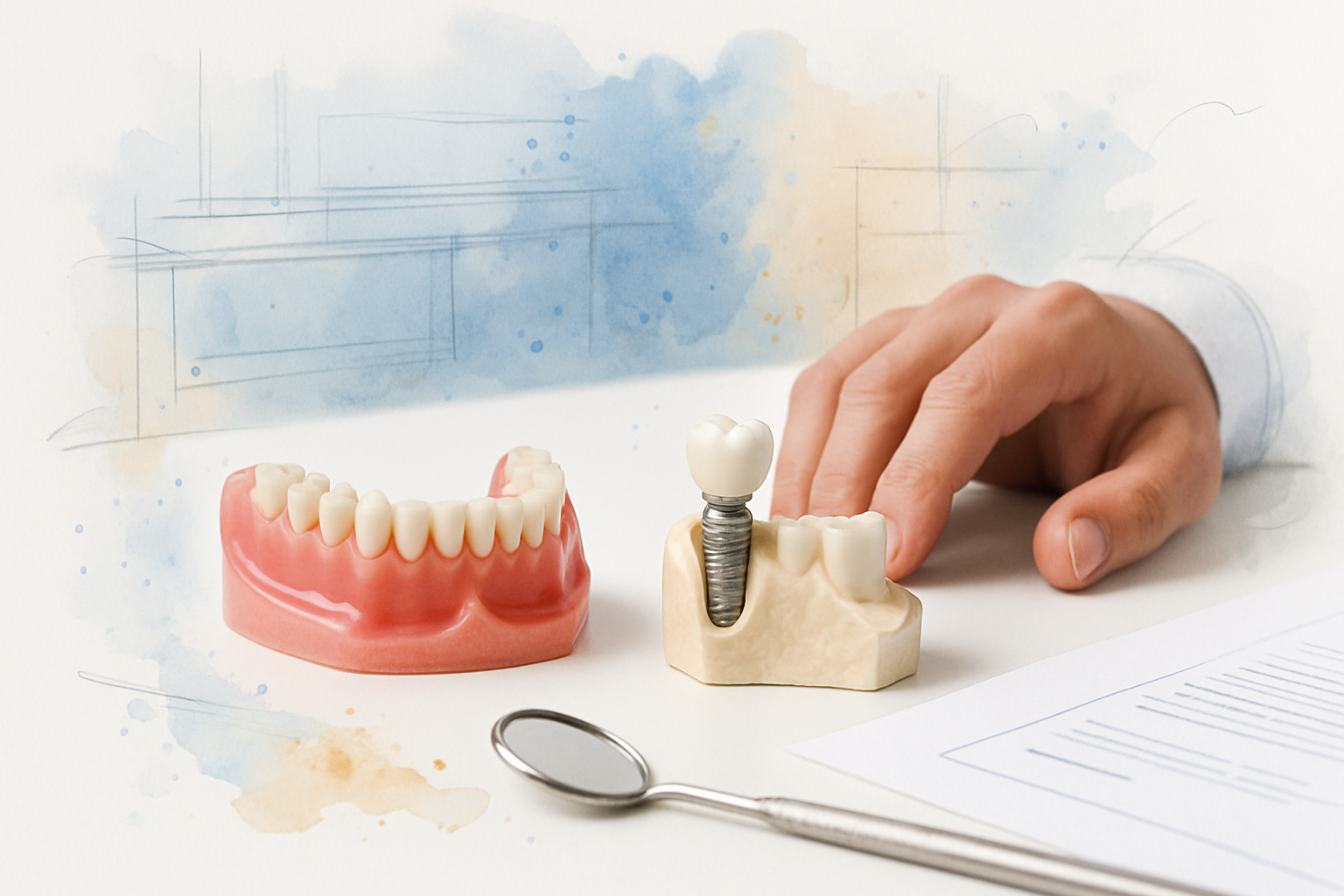
The Cost Comparison Most People Get Wrong
Cost is one of the most common questions patients bring up when they’re weighing these two options. And it’s a fair question, especially for patients in South King County who are being thoughtful about a major investment.
The honest answer is that the upfront cost and the long-term cost often tell different stories.
Dentures typically have a lower starting price, and most PPO dental plans cover them at a higher percentage than implants. Implants are frequently classified as elective restorative treatment, which means insurance may cover little or none of the cost depending on your specific plan. That gap can feel significant when you’re looking at the initial quote.
But the multi-year picture looks different when you factor in:
- Denture relining, which is often needed as the underlying bone changes shape
- Repairs, since dentures can crack or break
- Replacement, since most dentures are designed for a lifespan of roughly 5-8 years before they need to be remade
- The ongoing bone loss that dentures do not prevent, which can eventually complicate any future restorative work including implants
Implants, when they integrate successfully, are designed to last significantly longer, and they don’t require the same ongoing maintenance cycle. The total cost over 15-20 years may be closer than the initial numbers suggest.
I always encourage patients to look at how their specific PPO plan handles both options before drawing conclusions. Our article on how dental insurance works in Washington breaks down why the coverage details often surprise people. For patients without insurance, financing options like Sunbit or Cherry can make implants more accessible by spreading the cost over time.
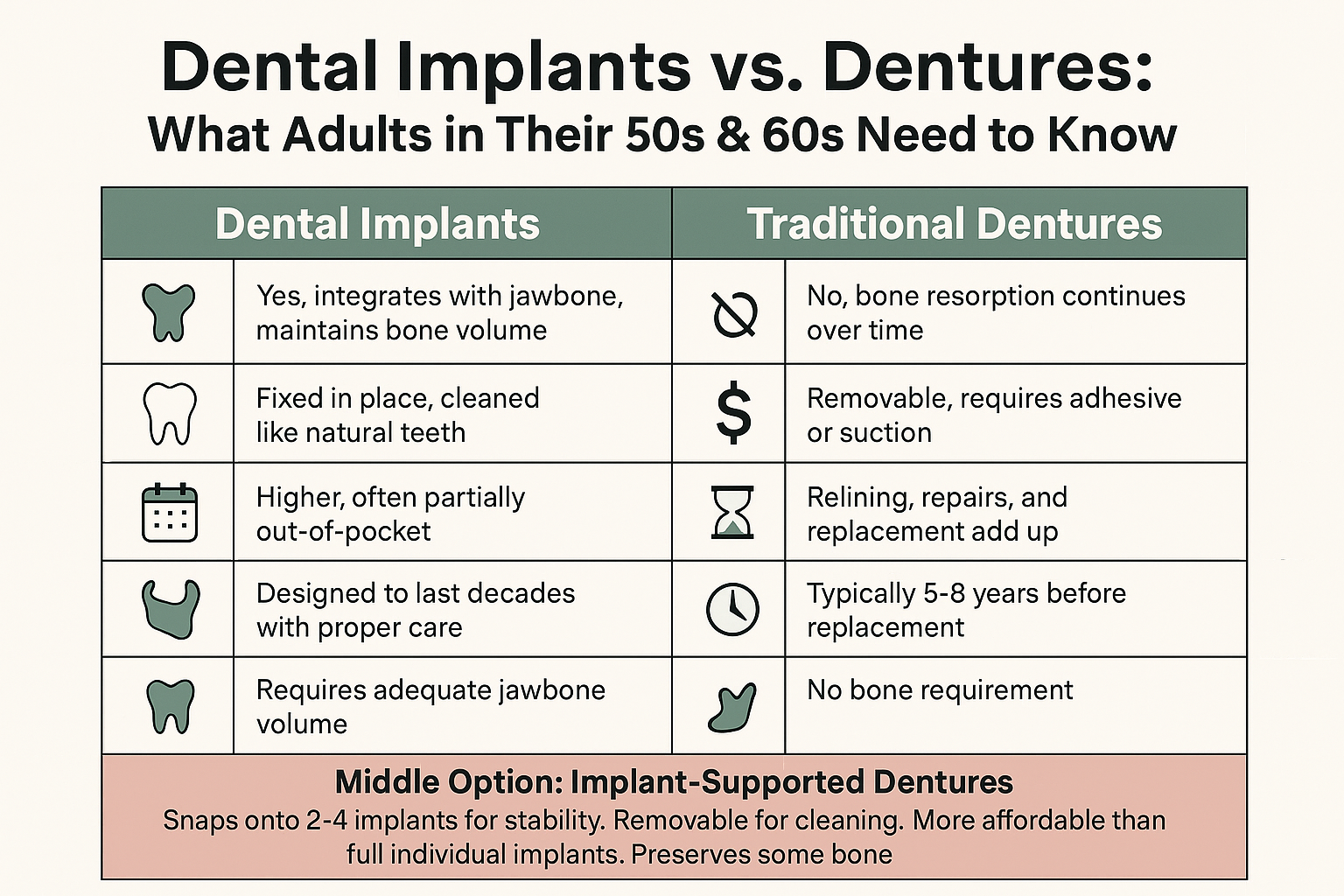
Implants vs. Dentures: The Side-by-Side That Actually Matters
This comparison covers the factors that matter most for adults in their 50s and 60s making this decision.
The Middle Option Most People Don’t Know About
When patients learn their only choices are a full set of individual implants or a traditional removable denture, many feel stuck. The individual implant route can feel out of reach financially, and traditional dentures feel like a significant compromise. What often gets left out of that conversation is implant-supported dentures.
An implant-supported denture snaps onto a small number of implants, typically two to four, rather than sitting on gum tissue alone. The denture itself is still removable for cleaning, but it has genuine stability that traditional dentures don’t offer. You’re not relying on adhesive. The denture doesn’t shift when you chew.
For patients replacing a full arch of teeth, this approach can offer a meaningful middle path:
- More stable than a traditional denture for eating and speaking
- Less expensive than replacing every missing tooth with an individual implant and crown
- Still maintains some bone volume in the areas where implants are placed
- Removable for routine cleaning, which many patients prefer
This option comes up regularly in consultations for patients who’ve lost most of their teeth in one arch. It’s also worth noting that at our practice, Dr. Jaewon Kim, our board-certified periodontist, is available in-house to evaluate bone volume and handle any bone grafting if it’s needed before implant placement. That kind of evaluation matters, because not every patient has enough jawbone to support implants without some preparation first.
The detailed implant cost breakdown we’ve published goes into how the number of implants, the need for bone grafting, and the type of restoration all factor into what patients actually pay. It’s worth reading before your consultation.
How the Three Options Compare for Adults Replacing Multiple Teeth
This table focuses on the practical differences for patients in their 50s and 60s who are replacing several teeth, not just one.
| Option | Bone Preserved? | Removable? | Relative Starting Cost | Best For |
|---|---|---|---|---|
| Traditional Denture | No | Yes | Lower | Patients prioritizing upfront affordability or who are not candidates for implants |
| Individual Implants + Crowns | Yes, at each site | No | Higher | Patients replacing specific teeth who want the closest thing to natural teeth |
| Implant-Supported Denture | Partially | Yes | Mid-range | Patients replacing a full arch who want stability without the cost of individual implants |
What Your Bone Situation Has to Do With It
One thing patients often don’t anticipate is that not everyone qualifies for implants right away, even if they want them.
Implants need enough jawbone to anchor into. When teeth have been missing for a while, or when gum disease has affected the bone, that volume may not be there. A thorough evaluation using digital imaging can show exactly what’s present, and in many cases, bone grafting can rebuild that volume before implants are placed.
This is not a small detail for adults in their 50s and 60s. If multiple teeth were lost years ago, more bone resorption has likely occurred than a patient might expect. That doesn’t automatically rule out implants, but it does mean the timeline may be longer and the process may involve an additional step.
For patients considering implants after a recent extraction, socket preservation is a bone grafting procedure performed at the time of the extraction specifically to minimize that bone loss. It makes future implant placement more predictable and often simpler. Our article on why bone grafting comes up explains this process and what it means for your timeline in plain terms.
The American Academy of Periodontology provides useful background on how bone health connects to implant outcomes for patients who want to read more from an authoritative clinical source.
Frequently Asked Questions About Implants vs. Dentures
I’ve had missing teeth for several years. Does that mean implants aren’t an option for me?
Not necessarily. Years of tooth loss do mean more bone resorption has likely occurred, which can affect whether implants are immediately possible. But in many cases, bone grafting can rebuild enough volume to support implants. The first step is a proper evaluation with imaging so you know exactly what you’re working with.
Will my PPO insurance cover any of the implant cost?
It depends on your specific plan. Many PPO plans classify implants as elective restorative treatment and cover little or nothing, while some plans do provide a benefit. Dentures tend to be covered at a higher percentage. The only way to know for sure is to have your benefits verified before your consultation, which is something we can help with. Our article on how dental insurance works in Washington covers why the details vary so much from plan to plan.
How long does getting implants actually take from start to finish?
It varies, but for most patients replacing multiple teeth, the full process from initial evaluation to final restoration takes several months to over a year. That timeline includes implant placement, the healing period where the implant integrates with the bone (called osseointegration), and then the restorative phase where the crown or denture is attached. If bone grafting is needed first, that adds additional healing time before implant placement can begin.
I’ve heard implants are painful. Is that accurate?
Most patients are surprised by how manageable the discomfort is. The surgical phase is done under local anesthesia, so you don’t feel it during the procedure. Post-procedure soreness is normal for several days, and it’s typically managed well with over-the-counter pain relief. The healing phase, while it takes months, is not painful for most people, it’s mostly a waiting period.
What happens if I get a denture now but want implants later?
This is a real consideration, and the answer depends on timing. The longer a denture is in place without any implants supporting the bone, the more bone volume may be lost. That can make future implant placement more complicated and may require bone grafting that wouldn’t have been necessary earlier. It’s worth having an honest conversation about the long-term plan at the start, not after years have passed.
Can I do implant-supported dentures instead of a full set of individual implants?
Yes, and for patients replacing a full arch this is often a very practical middle path. Implant-supported dentures snap onto two to four implants for stability while still being removable for cleaning. They provide much better function than traditional dentures and come at a lower total cost than replacing every tooth with an individual implant. Whether you’re a candidate depends on your bone volume and overall oral health, which an evaluation can determine.
Ready to Talk Through Your Specific Situation?
If you’re somewhere in the Renton or South King County area and trying to figure out whether implants, dentures, or something in between is the right path, the most useful thing you can do is get a proper evaluation with imaging. The answers really do depend on your bone volume, your insurance, and how many teeth you’re replacing. You can reach us at 425-430-0400 or visit cedardentalgroup.com to schedule a consultation and get the information you need to make a confident decision.
