

Direct Answer: Delta Dental of Washington’s Ascent plan covers major work like crowns and root canals at 50 percent of the allowed amount, within a plan year maximum that starts at $1,000 and grows to $1,500.
The first question we hear on the phone is almost never about pain. It is “do you take my insurance?” About one in five calls that reach our front desk in Renton starts there, and plenty of them end there too.
Delta Dental is the plan people name more than any other, and lately the one they name most specifically is Ascent. It is an individual plan, not an employer plan, and it behaves differently in two ways that almost nobody explains in plain language.
I want to walk through what the plan documents actually say about a crown or a root canal, where the surprise balance usually comes from, and the two questions worth asking any South King County office before you sit in a chair.
The Two Mechanics That Define the Ascent Plan
Most individual dental plans make you wait six or twelve months before they pay a dime toward major work. Ascent does not. According to Delta Dental of Washington’s own Ascent plan page, coverage begins the first of the month after you enroll, with no waiting period.
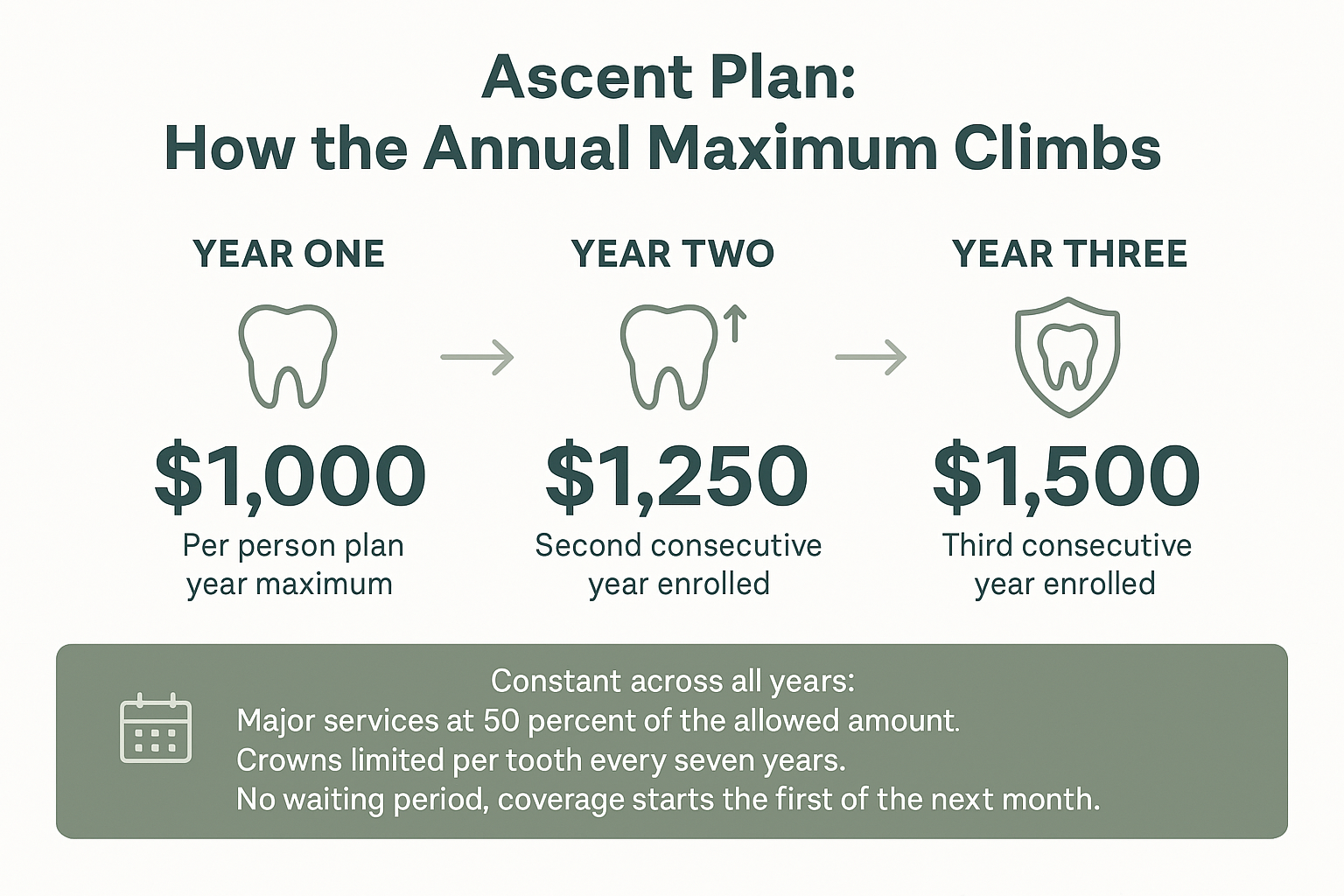
The second mechanic matters even more if you are planning a crown. The per person plan year maximum is not a flat number. The published plan materials describe it climbing the longer you stay enrolled:
- Year one: $1,000 per person
- Year two (consecutive): $1,250
- Year three (consecutive): $1,500
That escalator changes when it makes sense to schedule bigger work. If you need one crown now and another later, starting in year one and finishing in year two gives you more room than cramming both into a single plan year.
I will say the obvious thing here anyway. Carriers revise plan details, deductibles, and maximums from year to year, so the current plan document is the final word, not a blog post. Read the summary before you enroll and keep a copy.
Why 50 Percent Does Not Mean Half Your Bill
The percentage is rarely what surprises people. Delta Dental of Washington’s plan footnotes place major services, including crowns, root canals, and implants, at 50 percent of the allowed amount.
That phrase, allowed amount, is doing a lot of work. It is the carrier’s negotiated fee for that procedure, not the office’s fee. The plan pays half of the allowed amount, not half of whatever appears on your estimate.
Then there are frequency limits, which is where the real shock lives. The plan materials note crowns at 50 percent per tooth, every seven years. A frequency limit is a clock attached to one specific tooth, not a rule about your whole mouth.
So if tooth number 14 was crowned four years ago under any plan, that tooth is on a clock even though the rest of your mouth is wide open. I have had patients learn mid-treatment that a benefit was only payable once every seven years, and that conversation is a bad one to have after the fact.
One habit prevents most of this: ask for a predetermination in writing before major work. The office files the proposed codes with the carrier, the carrier responds with what it will pay, and you get a number on paper before anyone picks up a handpiece. Delta Dental’s own materials suggest predetermination for crowns. It takes a couple of weeks and it is worth every day of the wait.
How Ascent Treats Different Kinds of Dental Work
This is the plain read of the plan structure. Exact percentages, deductibles, and limits vary by plan year, so treat this as a map rather than a quote.
| Type of Care | How the Plan Materials Describe It | What Catches People Off Guard |
|---|---|---|
| Preventive (cleanings, exams, X-rays) | Covered at the plan’s most generous tier, listed separately in the plan document | Cleanings have their own frequency rules, usually counted per calendar period |
| Basic restorative (fillings) | Covered at a middle tier, below preventive and above major | A filling that turns out to need a crown jumps tiers mid-visit |
| Crowns | Major services, 50 percent of the allowed amount | Limited per tooth, every seven years, predetermination suggested |
| Root canal therapy | Major services, 50 percent of the allowed amount | The crown that follows is a separate procedure with its own share |
| Dental implants | Major services, 50 percent of the allowed amount | Bone grafting, extraction, and the implant crown are all billed separately |
| Plan year maximum | $1,000 year one, $1,250 year two, $1,500 year three | It is a ceiling on what the plan pays, not on what you can be charged |
“We Take Delta Dental” and “We Are In Network” Are Different Answers
Delta Dental of Washington describes Ascent as a PPO plus Premier plan. You may see any dentist you like, but your share can be larger out of network.
That distinction gets blurred constantly. An office can honestly say it accepts Delta Dental while being contracted with one network and not the other, and your balance changes depending on which.
We hear the fallout from this weekly. Callers who had a dentist drop out of their network want the in network status confirmed before they will even book a cleaning. One person filled out our website form asking us to verify network status first, cleaning second.
Two questions settle it in about five minutes:
- “Are you contracted with this specific Delta Dental network?” Name the network on your card, not just the carrier.
- “If you are not, what does my share look like on a crown or a root canal?” A good front desk can answer this or run a benefit check while you hold.
If the answers are fuzzy, our piece on how to check what your dental plan will pay before you sit in the chair walks through doing it yourself. And since plenty of people in Renton, Kent, Tukwila, and Burien already drive past three or four offices on their way down I-405, a five minute verification call is worth more than a mile saved. More on why networks keep shifting in what happened when dentists left PPO networks in 2026.
What Changes Between Year One and Year Three
The Ascent maximum is not static. Here is how it climbs for someone who stays enrolled, and what stays the same underneath it.
Set the Maximum Against What the Work Actually Costs
Here is the honest part. A maximum in the $1,000 to $1,500 range covers preventive care comfortably. It does not usually carry a root canal and a crown on the same tooth in one plan year.
I am not going to print a flat price, because there is no such thing. When people call us price shopping, often after getting a quote somewhere else, the range they hear from our front desk moves based on real clinical variables:
- Which tooth it is. A front tooth and a molar are different jobs.
- How many canals are involved. Molars commonly have three or four, and each one adds time.
- Whether a buildup or post is needed to give the crown something solid to sit on.
- Lab and material choices for the final restoration.
- Whether a predetermination has been filed, which changes what you owe, not what it costs.
An exam with X-rays is the only honest way to get a real figure, and any office worth your time will give you one in writing afterward. If you want the long version, we broke down why two root canal estimates in Renton differ so much and what sits behind a crown’s price.
When the work outruns the maximum, there are two normal moves: sequence treatment across two benefit years, or use a payment plan. Both options are covered here.
The Timing Angle Most Articles Miss
Delta Dental of Washington states that its individual plans can be purchased any time of year, not only during an exchange window. Combined with no waiting period, that means coverage can begin the first of the next month.
Compare that to Washington Healthplanfinder, where open enrollment for the coming year runs November 1 through January 15. If you are shopping because an employer plan ended or because the adult dental benefit under Apple Health changed, those are two different calendars. We covered that situation separately in our guide to the 2027 enrollment window.
This city runs on employer benefit rhythms. Between the Boeing 737 plant and the hospital systems nearby, a large share of Renton picks plans in October and November and resets every January. If you do not have an employer plan, you are out of step with that calendar, and an individual plan that starts the first of the next month is simply a different animal.
Frequently Asked Questions About the Delta Dental Ascent Plan
Does the Ascent plan really have no waiting period for a crown?
That is what Delta Dental of Washington’s plan page states: no waiting period, with coverage starting the first of the month after you enroll. The catch is not time, it is the 50 percent major services tier and the per tooth frequency limit on crowns. Confirm both against the current plan document before you count on it.
What does “50 percent of the allowed amount” actually mean for my bill?
The allowed amount is the carrier’s negotiated fee for that procedure, not your dentist’s fee. The plan pays half of that allowed amount, you pay the rest, and the total still has to fit under your plan year maximum. Out of network, the gap between the allowed amount and the billed fee is usually yours as well.
How do I avoid finding out a benefit was not payable after the work is done?
Ask for a predetermination in writing before any major procedure. The office submits the proposed codes, the carrier responds with what it will pay, and you see the number before treatment starts. It takes a couple of weeks and it prevents most of the billing surprises I hear about.
If a root canal and a crown both hit the same plan year, will my maximum cover them?
Usually not in full. Both are major services at 50 percent, and a $1,000 to $1,500 maximum gets consumed quickly when two major procedures land on the same tooth. Sequencing across two benefit years is a common and reasonable way to handle it when the tooth is stable enough to wait.
My card says Delta Dental. Why does the office still need to check anything?
Because Ascent is described as a PPO plus Premier plan, and accepting Delta Dental is not the same as being contracted with the specific network on your card. Ask which network the office is contracted with, then ask what your share looks like if it is not the one you have.
Want your Ascent benefits read before you book?
One thing worth knowing as you compare offices around Renton and South King County: a single plan year maximum stretches further when the specialist work does not require a separate referral and a separate bill. At Cedar Dental Group, Dr. Jaewon Kim, a board certified periodontist, handles gum grafting, periodontal surgery, and bone grafting on site, and Dr. Joe Dutner handles root canal therapy in house, so one treatment plan and one set of benefits get coordinated in one place. If you would like your specific plan reviewed before scheduling, you can call 425-430-0400 or visit cedardentalgroup.com.
