

Direct Answer: Washington’s open enrollment for 2027 coverage is expected to run November 1 through December 31, 2026. Confirm the dates on Healthplanfinder, and know that dental is a separate plan you add yourself.
The call I least like taking is the one in February from someone who just realized the window closed. They were ready to get a cleaning on the books, they finally had time to shop for coverage, and the sign-up period for the year ended weeks earlier without them noticing.
That risk is higher than usual this time around, because the 2027 enrollment window in Washington looks different from the one you may remember. If you are self-employed, on contract, between jobs, or working somewhere that does not offer dental, this is your shopping season and the calendar moved.
Around Renton that split is pretty visible. Plenty of neighbors work at the Boeing 737 final assembly plant or in health care, two of the city’s biggest employment sectors, and they get a benefits email every fall. Everyone else has to go find coverage on their own. This article is about buying your own plan, which is a different question from how an existing plan pays out or when a benefit year resets.
The 2027 window is likely shorter than the one you remember
For years, Washington Healthplanfinder open enrollment started November 1 and ran through January 15. A lot of people have that January date filed away in their head, and it is the single most common reason someone misses the deadline.
Reporting on the 2027 plan year says Washington announced a window of November 1 through December 31, 2026. The change traces back to a federal rule requiring open enrollment to end no later than December 31.
Here is the honest complication. Several national dental coverage explainers still list a January 15, 2027 end date, so the sources genuinely disagree right now. Before you plan around either one, pull up the state’s own enrollment periods page on Washington Healthplanfinder and read the published dates there.
A few things worth knowing while you are on that page:
- The exact start and end dates for the 2027 plan year, straight from the state
- Whether a plan selected in November starts January 1, or later if you enroll near the deadline
- Special enrollment periods, which open a 60 day window after a qualifying life event like losing a job, losing other coverage, or moving
That 60 day rule matters for anyone laid off mid-year. You are not stuck waiting until next November, but you do have a clock.

Buying a medical plan on the exchange does not get you dental
This is the single most useful fact for a Washington shopper, and it trips people up every year.
Medical plans sold through Healthplanfinder do not include embedded dental benefits for adults. If you sign up for a medical plan and stop there, you will not have dental coverage.
The only way to get dental through the exchange is to purchase a stand-alone dental plan alongside it. It is a separate item you add during the same trip through the site, and it is easy to blow past when your attention is on premiums, deductibles, and whether your doctor is in network.
I have talked to people who did everything right on the medical side, felt good about it, then found out at a dental appointment that nothing applied. Nobody enjoys that conversation.
So when you are checking out, slow down at the dental step and confirm you actually selected a plan. If you want a broader picture of what dental coverage does and does not do once you have it, we walk through that in how dental insurance works in Washington, and where it falls short.
Three lines in the summary of benefits that decide what you actually pay
Most people compare individual dental plans on the monthly premium alone. The premium is the easiest number to find and the least useful one for predicting what you pay when real treatment comes up.
Individual plans are built differently than the group plans people are used to from an employer. That difference shows up the moment you need a crown or periodontal treatment instead of a cleaning.
These are the three lines I would read first:
- Annual maximum. This is the ceiling on what the plan pays in a benefit year. Individual plans often cap lower than group plans, and a single crown or a course of gum treatment can run you up against it.
- Service tiers. Plans sort treatment into preventive, basic, and major categories, and each tier pays at a different percentage. Where your plan files a crown, a root canal, or scaling and root planing changes your share a lot.
- Waiting periods. Many individual plans cover cleanings right away but make you wait 6 to 12 months before major work is covered at all. If you already know a crown or gum treatment is coming, read this language twice.
Cost questions come up constantly on our phone line, usually from someone comparing offices after getting an estimate elsewhere. Around South King County, people shopping a root canal or a crown are commonly quoted a wide range, and the spread is real because it depends on the tooth, the complexity, and what restoration goes on top. Any office, including ours, needs to see the tooth before giving you a number you can rely on.
If you want to pin down your own share before you sit down, here is how to check what your dental plan will pay before you sit in the chair.
What to Look For in a Plan Summary
Pull up the summary of benefits for any plan you are considering and find these four items before you compare premiums.
| What to find | Where it usually appears | Why it changes your out-of-pocket |
|---|---|---|
| Annual maximum | Top of the benefits summary | Caps total plan payment for the year, so major work can exceed it fast |
| Preventive / basic / major tiers | Coverage percentage chart | Determines whether a crown is paid at a high or low percentage |
| Waiting period for major services | Footnotes or limitations section | Can delay coverage on crowns and gum treatment by 6 to 12 months |
| Deductible | Usually listed just below the maximum | Comes out of your pocket first, before the plan pays anything on most tiers |
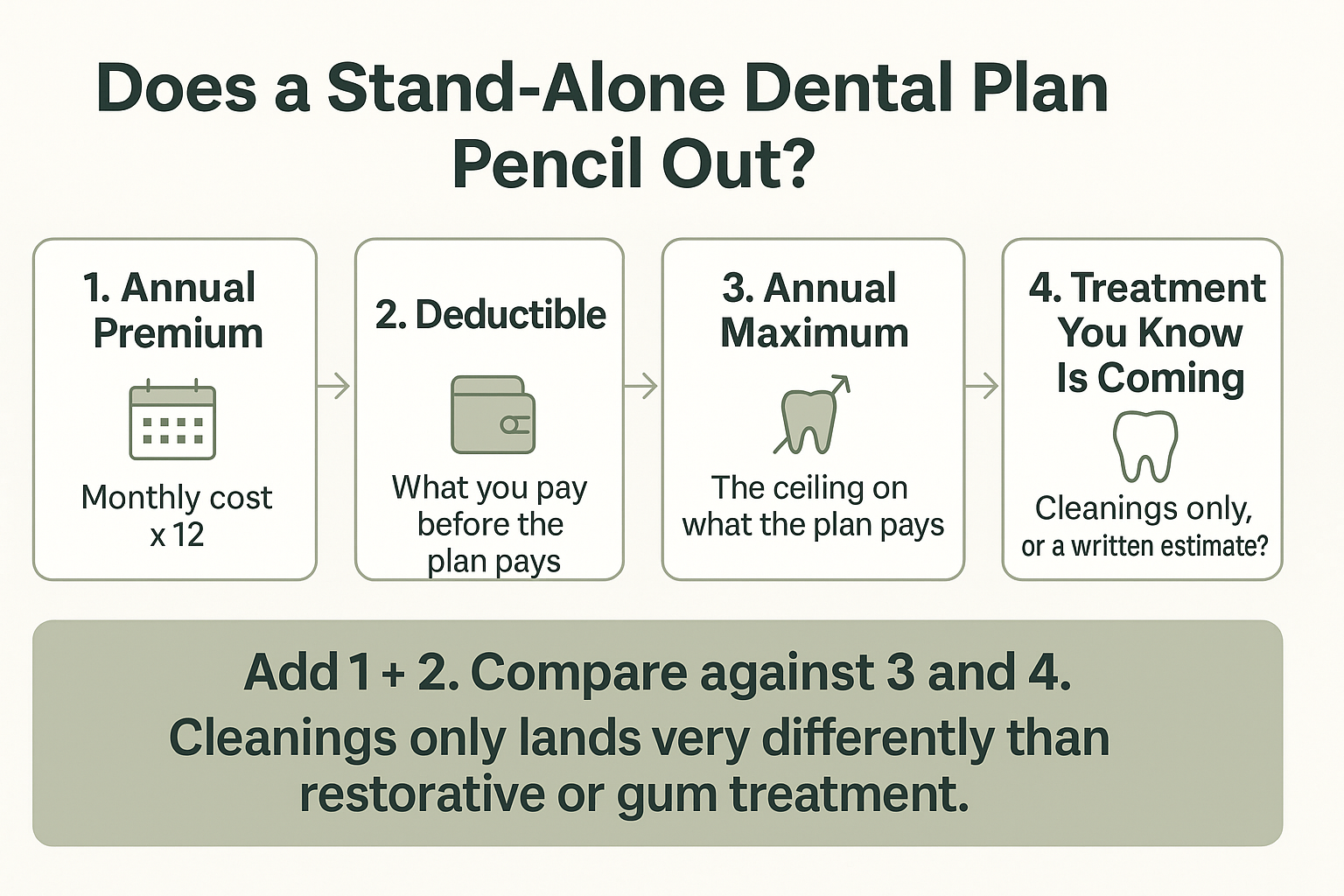
Does a Stand-Alone Dental Plan Pencil Out for You?
This is arithmetic you can do at your kitchen table in about ten minutes. Four numbers tell you most of what you need to know.
Apple Health, PPO, and DHMO: what the card in your wallet controls
This question comes up constantly, and it deserves a straight answer instead of a runaround.
Apple Health, Washington’s Medicaid program, does include adult dental coverage. Enrollment is not limited to the November window the way a purchased plan is. If you qualify based on income, you can apply year round.
But acceptance is a separate issue from coverage. Not every dental office contracts with every plan type, and that is where calls go sideways.
The practical difference to understand:
- PPO plans let you see providers in or out of network, with different payment levels. Out-of-network PPO patients often still get meaningful coverage.
- DHMO or HMO plans assign you to a contracted provider, and care outside that contract generally is not paid.
- Apple Health has its own provider contracts that an office either holds or does not.
At our office we work with most major PPO plans, including out-of-network PPO, and we do not take HMO products. That is not a judgment about anyone’s plan, it is just how the contracts are written.
The fastest way to avoid a wasted phone call is to have your card in hand and read the plan type off it before you ask any office about acceptance. We break the distinctions down further in PPO, DHMO, or Apple Health: what your dental card controls in Washington.
When a plan does not pencil out
Sometimes the math says no. If you only need two cleanings and an exam a year, twelve months of premium plus a deductible can end up costing more than paying directly, especially on a plan with a long waiting period.
If that is where you land, it helps to know what preventive care runs without coverage so you are comparing real numbers. We walk through the factors in what shapes the cost of a cleaning and exam in Renton without insurance.
For larger treatment, third-party payment plans like Cherry and Sunbit are a common way people stage work over months rather than paying all at once. Plenty of patients use one of those instead of a dental plan, or alongside one after the annual maximum runs out.
One thing coverage shoppers miss about specialty referrals
Coverage questions do not stop at the general dentist. When gum surgery or a root canal gets referred out, that specialty office is its own business with its own network agreements, its own estimate, and its own draw against your annual maximum.
That is worth knowing before you buy, because two separate estimates from two separate offices can eat a modest annual cap quickly. Our board-certified periodontist and in-house endodontist see patients inside the same practice and the same treatment plan, which keeps sequencing and cost in one conversation. If annual maximums are new to you, here is what happens to unused dental benefits when the year ends.
Frequently Asked Questions About Buying Dental Coverage in Washington
When exactly does open enrollment end for 2027 coverage in Washington?
Reporting on the 2027 plan year points to November 1 through December 31, 2026, shortened by a federal rule requiring enrollment to end no later than December 31. Some national sources still list January 15, 2027, so confirm the published dates on the Washington Healthplanfinder site before you plan around either one.
If I buy a medical plan through Healthplanfinder, is dental included?
No. Adult medical plans sold through the exchange do not include embedded dental benefits. You have to add a stand-alone dental plan as a separate purchase during the same enrollment, and it is easy to skip if you are focused on the medical side.
I lost my job in March. Do I have to wait until November?
Not necessarily. Losing job-based coverage is a qualifying life event, which generally opens a 60 day special enrollment window. Check the state’s enrollment periods page for the current list of qualifying events and how the 60 days are counted.
Can I get a crown covered right after I sign up?
Often not. Many individual plans cover preventive care immediately but apply a waiting period of 6 to 12 months before major services are paid. If you already have an estimate in hand for a crown or gum treatment, read the waiting period language before you choose a plan.
Does Apple Health cover adult dental, and is it accepted everywhere?
Apple Health does include adult dental coverage, and you can apply year round rather than only during open enrollment. Acceptance varies by office though, so call with your card in hand and ask about your specific plan type before assuming.
Sorting out coverage before you book?
If you are weighing a stand-alone dental plan this enrollment season and want to know how a specific plan would work here, our front desk can look at your card and talk through it with you. We see patients from Renton, Kent, Tukwila, Burien, and Newcastle, and we are happy to answer coverage questions before anything gets scheduled. You can reach us at 425-430-0400 or read more at cedardentalgroup.com.
