

Direct Answer: Most Washington dental plans cap payouts around $1,000 to $1,500 a year. Patient financing spreads the leftover balance over months, often with an interest free promotional window if you pay it off in time.
You get handed a treatment plan. The number at the bottom is four figures, and you already know your dental plan is not going to cover most of it. That gap is the part nobody warned you about.
I hear this on the phone constantly from people across Renton and South King County. One caller told us plainly that they were price-shopping after a $1,000 quote from another dentist. That is a completely reasonable thing to do.
So let me walk through the math most people are doing in their head, explain how dental payment plans and financing for major treatment actually work mechanically, and give you the questions to ask before you sign anything.
Why Your Treatment Plan Costs More Than Your Plan Will Pay
Here is the structural issue. Most dental plans sold in Washington carry an annual maximum, a hard ceiling on what the carrier will pay out in a benefit year.
That ceiling commonly lands somewhere in the $1,000 to $1,500 range, and it has barely moved in decades while the cost of dental work has climbed steadily. The cap is not a reflection of what your mouth needs. It is a number set by the plan.
So it does not take much to run past it:
- A single crown can consume a large share of a yearly max on its own
- A root canal followed by a crown on the same tooth often clears it entirely
- A dental implant involves several separate steps, sometimes including bone grafting, spread across months
- Scaling and root planing for gum disease is usually billed by quadrant, so four quadrants add up
When your estimate outruns your maximum, nothing went wrong. No one overcharged you. The plan simply stopped paying at its ceiling, and everything above that line is the patient portion.
If you want the longer version of how these caps and category rules operate, we broke it down in how dental insurance works in Washington, and where it falls short.

How Third Party Dental Financing Actually Works
Almost nobody explains the mechanics of patient financing, which is why people either sign without reading or refuse it out of suspicion. Both reactions cost you money.
Here is what the moving parts are. We offer Cherry and Sunbit as patient financing options, and the general structure is similar across most of these lenders.
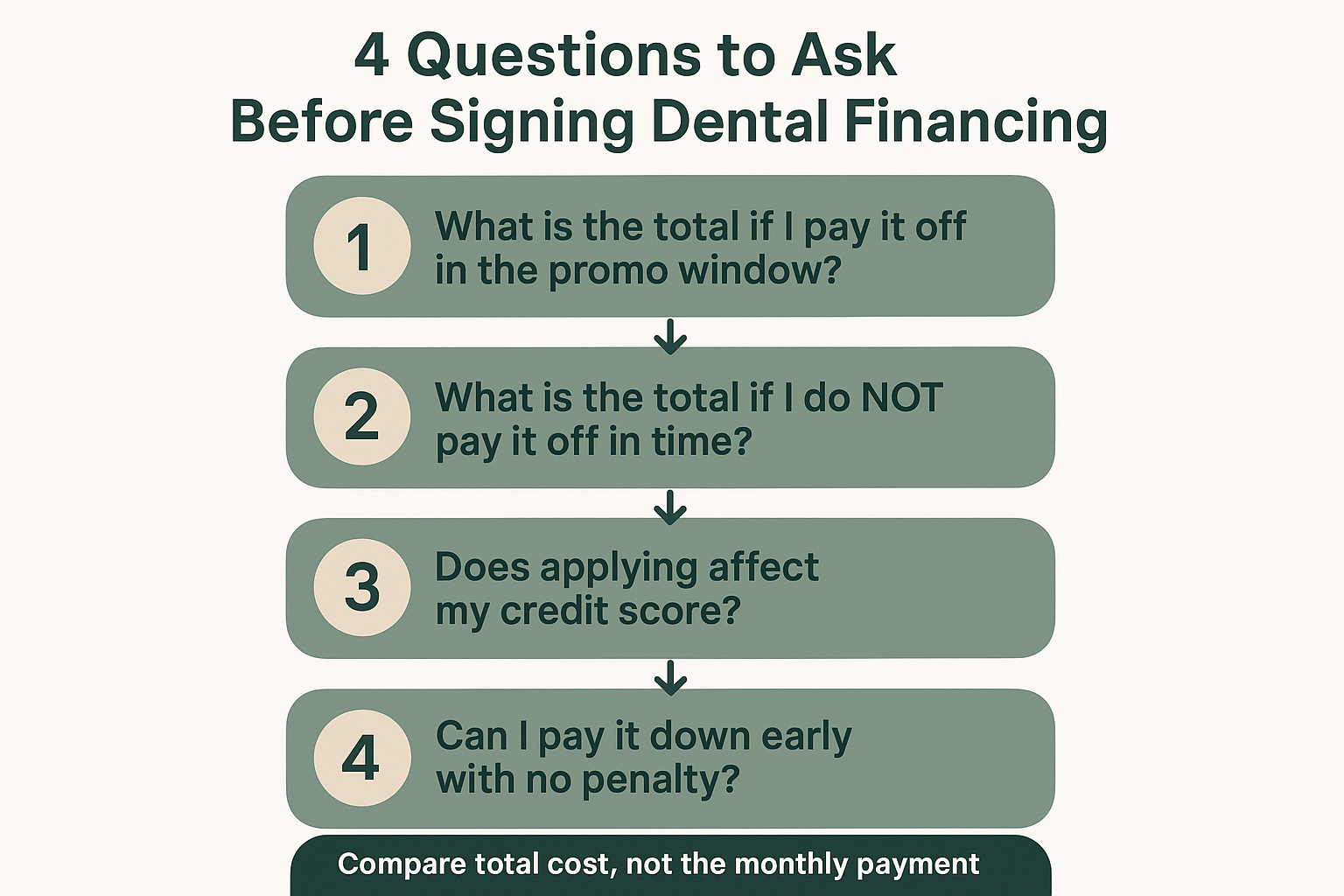
The credit check. Applying usually starts with a soft pull, which does not affect your credit score. Some lenders convert to a hard pull at approval or at a certain loan size. Ask which one applies before you tap submit.
The promotional window. Many offers include a stretch of months at 0% interest. If the balance is cleared inside that window, you paid the sticker price and nothing more.
Deferred interest. This is the part that catches people. On some plans, if any balance remains when the promo period ends, interest is charged retroactively on the original full amount, not the leftover. A $3,000 balance paid down to $200 can still trigger interest on the whole $3,000.
The monthly payment is the wrong number to compare. A lower monthly payment usually just means a longer term. Compare total cost paid, not the monthly.
Four Questions to Ask Before You Sign a Financing Offer
Run every offer through these four questions at your kitchen table, not at the front desk while someone waits.
Ways to Cover the Part Your Plan Will Not Pay
Financing is one option among several. Most people end up combining two or three of these.
| Approach | How it generally works | What to look at closely |
|---|---|---|
| Annual plan maximum | The carrier pays up to its yearly cap, which on many Washington plans sits somewhere around $1,000 to $1,500 | How much has already been used this year, and whether the cap resets in January or on your hire date |
| Phasing treatment across two benefit years | Part of the plan happens now, the rest after the cap resets | Only works when the delay does not change the clinical outcome. Ask your dentist directly |
| Third party patient financing | A lender pays the office up front, you repay in monthly installments, often with a promotional interest window | Total cost inside and outside the promo window, and whether interest is deferred |
| HSA or FSA dollars | Pre tax money applied to your out of pocket share | FSA funds often expire at year end, HSA funds typically roll over |
| Paying the patient portion up front | One payment covering your share at the start of treatment | Some offices offer a courtesy adjustment for this. Ask rather than assume |
Why Nobody Can Give You a Real Number Over the Phone
This frustrates people, and I understand why. You call, you ask what a root canal costs, and you get a range that spans more than a thousand dollars.
That is not evasiveness. The same named procedure genuinely costs different amounts depending on things a dentist has to see first:
- Which tooth it is. A front tooth with one canal is a different procedure from a molar with three or four
- Whether a crown follows. Many back teeth need one after a root canal, and that is a separate code and a separate cost
- Whether infection or prior treatment is involved. A retreatment of a tooth someone else worked on takes longer and is harder
- Whether bone or gum work is part of the plan. An implant site that needs grafting first is a different timeline and a different number
- How your plan categorizes it. Basic versus major changes the percentage split, and some plans impose waiting periods
Any office that gives you a precise figure sight unseen is guessing. What you actually want is a written estimate after an exam, not a verbal ballpark before one.
Two estimates for the same tooth can differ for honest reasons. We walked through that in what a root canal costs in Renton, and why two estimates differ so much.
Ask Your Dentist to Rank the List
This is the question I wish more people asked, and it is different from asking what everything costs.
When a treatment plan lists six items, those items are not equal. Some protect the structure of a tooth and are genuinely time sensitive. Some address comfort. Some are elective.
People come to us with stacked needs all the time. One person wrote in asking to schedule an annual exam, x-rays, and a cleaning, plus fillings, plus a conversation about an implant, all at once. That is a normal situation, and it is reasonable to ask which part comes first.
So ask these three things out loud:
- Which item on this list protects the tooth? That is the one to fund first
- Which item can wait a quarter or two without changing the outcome? Some genuinely can
- What does the plan look like if only part of it happens this year?
A good answer sounds like reasoning, not pressure. You are not being cheap by asking. You are sequencing a plan around real cash flow, which is what most adults actually have to do.
This is a separate question from calendar timing. If your concern is using benefits before they reset, that is covered in how to use your PPO benefits before they reset on major dental work.
Get the Coverage Expectations in Writing First
What erodes trust is almost never the price. It is the surprise. A patient who understood a night guard would be partly covered, then got the claim denied, remembers that for years.
You can head most of that off before treatment starts. Any office should be able to honor these four requests:
- A written estimate, with your portion and the projected carrier portion listed separately
- The procedure codes being billed, so you can read them against your plan booklet
- A pre treatment estimate submitted to your carrier on larger work, sometimes called a predetermination
- A clear statement of what happens if the carrier pays less than projected
A predetermination is the carrier putting its expected payment in writing before the work happens. It is not an ironclad guarantee, but it removes most of the guesswork on crowns, implants, and periodontal surgery.
Washington also tightened its dental benefit rules recently. Senate Bill 5351 took effect July 27, 2025 and addressed carrier practices including same day denials and virtual credit card payments, as documented by the Washington State Dental Association.
If the codes on your estimate look like a foreign language, start with what the D-codes on your dental estimate mean.
One Practice or Three: It Changes the Paperwork Too
Here is a cost clarity issue people rarely think about until they are in it. A multi step plan split across separate specialist offices usually means separate estimates, separate claims, and separate deductibles to track.
That is three sets of paperwork, three front desks, and three different answers about what your plan will pay. It also makes it harder to see the whole number before you commit to step one.
At Cedar Dental Group, Dr. Susan Chu works alongside Dr. Jaewon Kim, a board-certified periodontist, and Dr. Joe Dutner, our in-house endodontist. Surgical and root canal steps sit inside one coordinated plan instead of being referred out across South King County.
As one patient put it in a review: “They have financing options that have saved me many times!” Deja S.
That consolidation does not make treatment free. It does make the total easier to see up front, which is usually what people are really asking for when they call about price.
Frequently Asked Questions About Dental Payment Plans in Washington
Does applying for dental financing hurt my credit score?
Usually the application itself is a soft credit check, which does not affect your score. Some lenders switch to a hard pull at approval or above a certain loan amount. Ask which applies before you submit, and ask it as a direct question.
What exactly is deferred interest?
On a deferred interest plan, if any balance is left when the promotional window closes, interest gets charged retroactively on the original full amount, not just the remaining balance. It is the single most expensive detail to miss. If you take a promotional offer, set your own payment schedule to clear the balance with a month to spare.
Why won’t anyone quote me a price over the phone?
Because the honest answer depends on which tooth, how many canals, whether a crown follows, and whether infection or prior work complicates it. A range is the most anyone can responsibly give before an exam. Push for a written estimate after the exam instead.
What happens if my plan pays less than the estimate predicted?
The difference becomes your responsibility, which is why a predetermination matters on bigger work. Ask the office up front how they handle it, and keep every document the carrier sends you.
Can I split a treatment plan across two benefit years?
Often yes, and it can be a smart move when the delay is clinically safe. But not every item tolerates waiting. Ask your dentist specifically which steps can shift into next year and which ones should not.
Want to see what your plan looks like on paper?
If you are sitting with an estimate and trying to work out what your share would actually be, we are happy to talk it through. Patients in Renton, Tukwila, Kent, Burien, and Newcastle are welcome to call 425-430-0400 or visit cedardentalgroup.com to ask what a specific plan would look like written out. No rush, and no pressure to decide anything on the phone.
