

Direct Answer: Work backward from treatment your dentist has already discussed, add an allowance for preventive visits, then check your employer’s cap. Your FSA covers what your dental plan’s annual maximum will not.
There is a blank box on your benefits portal at work asking for a dollar amount. And there is a dental estimate sitting in your inbox that you have not said yes to yet.
Those two things are the same decision, usually about a week apart. Most people in Renton fill in that box sometime in late October or November, then do not touch it again for a year.
I am not going to tell you what number to pick. What I can do is explain how people work backward from a planned crown, root canal, or implant to a number they can live with, and which pieces of that math actually belong to your health FSA instead of your dental plan.
Two pots of money that get blurred together constantly
Almost every cost conversation I have starts with these two getting mixed up. They are not the same, and the difference is the whole reason this article exists.
Your dental plan’s annual maximum is the carrier’s ceiling. It is the most the plan will pay toward your care in a benefit year, and for most PPO plans in Washington it tends to land somewhere in the one to two thousand dollar range. Once you hit it, the carrier stops paying.
Your health FSA is your own money, set aside before taxes, elected once a year. It can go toward deductibles, coinsurance, and the part of a bill your plan simply will not touch.
A few numbers worth knowing before you fill in that box:
- The 2026 health FSA salary reduction limit is $3,400, with up to $680 able to carry into the following year where the employer allows it
- The IRS usually publishes the next year’s figure in a revenue procedure in late October or November, so treat any 2027 number you see as expected rather than confirmed
- Benefits firms have projected roughly $3,500 for 2027, and a projection is all that is
- Your employer can set a cap lower than the IRS maximum, and can choose whether to offer a carryover or a grace period
The IRS guidance on health flexible spending arrangements spells out the rules. Your plan documents spell out what your employer actually chose.
The enrollment window is shorter than your treatment plan
Renton is a benefits town. Boeing Commercial Airplanes builds the 737 here, and health care and manufacturing sit among the city’s three largest employment sectors at roughly 6,928 and 6,561 residents respectively.
The daytime population climbs 5.4 percent on commuting alone, which means a big share of the people I see are driving in from Kent, Tukwila, Burien, or Newcastle to jobs that run two to three week enrollment windows in the fall.
Search behavior follows the same shape. Seattle-Tacoma searches for Washington dental insurance run around 1,900 a month and spiked to 4,400 in September and 3,600 in October last year.
Here is the pattern I see go wrong. Someone gets a treatment plan in September, decides to compare a few offices first, and quietly lets the enrollment window close while they are still shopping.
Pull the treatment plan up on one screen and the enrollment portal on the other. Guessing from last year’s election is how people end up short by exactly the amount of one crown.
Nobody can hand you a reliable dental budget before an exam
Cost and quote questions come up in roughly 8 percent of the calls that reach our front desk. One caller told us plainly that she was shopping around after getting a $1,000 quote somewhere else.
Our team gives ranges on the phone and then recommends coming in, and that is not a dodge. The real number depends on what the X-rays show.
What moves a crown or implant estimate up or down:
- Whether the tooth needs a buildup or post before a crown can seat properly
- Whether the nerve is involved, which turns one procedure into root canal therapy plus a crown
- Whether an implant site has enough bone, or needs bone grafting first
- Whether gum disease needs treating before any restorative work begins
- Which lab and material the restoration calls for
If you want to see how those pieces stack up on paper, what sits behind a crown’s price walks through buildups, posts, and lab work. And the D-codes on your estimate explains why a bill can differ from the printout.
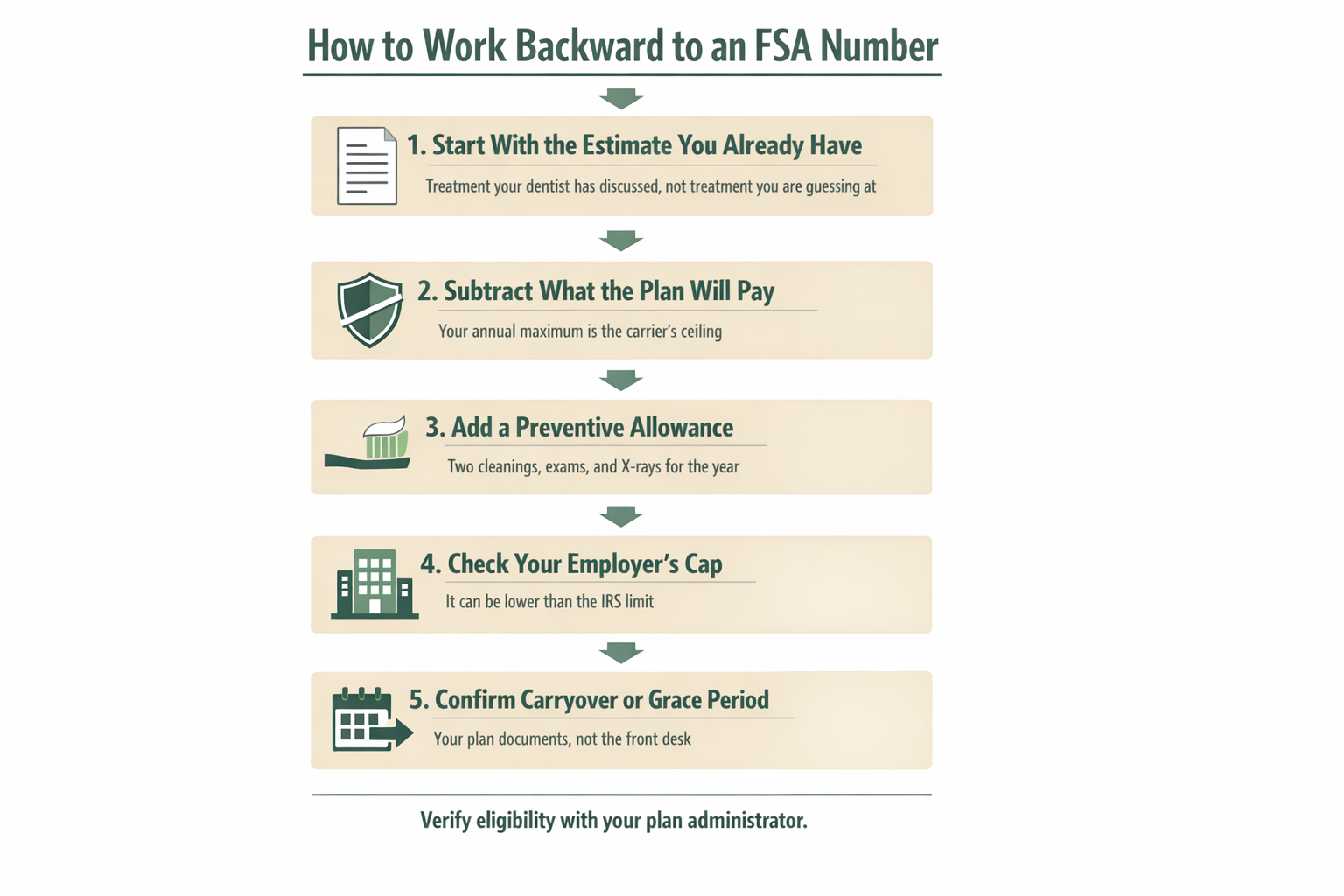
The honest move during open enrollment is to elect based on treatment a dentist has already discussed with you, plus a realistic allowance for two preventive visits and X-rays. Anything beyond that is a guess wearing a dollar sign.
Annual maximum vs. health FSA, side by side
These two line up differently on almost every variable that matters. Worth a look before you commit to a number.
| Dental plan annual maximum | Health FSA | |
|---|---|---|
| Whose money | The carrier’s | Yours, set aside pre-tax |
| Who sets the ceiling | Your dental carrier | The IRS cap, or lower if your employer chooses |
| Covers cosmetic work | Generally no | Generally no, though the line can move with documentation |
| Tied to a network | Yes, payment differs in and out of network | No, network status does not change eligibility |
| If you do not use it | Resets and is gone | Forfeited unless your plan offers carryover or a grace period |
| When you decide | Set by the plan you enroll in | You pick the amount during open enrollment |
Working backward to a number
This is the order I suggest people walk through before typing anything into the election box.
What FSA dollars generally cover, and what they generally do not
This is where I see the most surprise, and it maps exactly onto what people here are already asking about. Our website form submissions routinely mix restorative and cosmetic interest in a single message. One new patient asked to book an exam, X-rays, and a cleaning, then added fillings and an implant consultation. Another asked about a chipped front tooth alongside a first cleaning.
The working rule is simple. Treatment that restores function is generally eligible. Treatment that is purely cosmetic generally is not.
Generally eligible:
- Fillings, crowns, and bridges
- Root canal therapy and endodontic care
- Deep cleanings, meaning scaling and root planing
- Periodontal surgery, gum grafting, and bone grafting, which are three distinct procedures for three distinct conditions
- Implant placement and the restoration on top of it
Generally not eligible:
- In-office Zoom whitening and other purely cosmetic enhancements
- Anything your plan administrator classifies as elective with no restorative benefit
Our own cosmetic page says the same thing in plainer terms. Most cosmetic work is elective and typically not covered, while treatments carrying a restorative benefit may be partially covered.
Clear aligners sit in a gray zone that depends on documentation and on how your plan is written. For anything in that zone, ask your plan administrator in writing. That answer belongs to them, not to a dental front desk.
If your dentist left the network, or you have no dental plan at all
Insurance acceptance is the first thing people ask about on the phone, showing up in roughly 19 percent of the calls we sample. Callers name their plan before they name their problem.
One message that came through our website put it this way: a dentist had recently gone out of network under a Regence plan, and the patient needed a new provider.
Here is the part that genuinely helps. FSA dollars are not tied to a network. They apply the same way to in-network coinsurance, to out-of-network cost sharing, and to care for someone carrying no dental plan at all. Nationally, about 27 percent of adults have no dental coverage, according to the CareQuest Institute’s 2024 report.
If you are weighing a network change, what more dentists leaving PPO networks means for your plan covers how the math shifts.
For work that outruns both the annual maximum and the FSA, third-party payment plans like Cherry and Sunbit are tools patients use. How dental payment plans work in Washington explains the mechanics without the sales pitch.
The order of treatment decides which year the cost lands in
This is the piece almost nobody thinks about during open enrollment, and it changes the answer more than the dollar amount does.
If gum treatment has to happen before restorative work, or if a root canal comes before a crown, the sequence determines which calendar year each cost falls in. A plan finished in a single spring is budgeted one way. A plan that spans two years is budgeted another way entirely.
A couple of common sequences:
- Scaling and root planing first, then crowns once the tissue is stable
- Root canal therapy, then the crown that protects the tooth afterward, covered in why a crown follows a root canal
- Extraction with socket preservation, healing time, then implant placement, laid out in the implant timeline when a bone graft is part of the plan
At Cedar Dental Group, Dr. Jaewon Kim, a board-certified periodontist, handles gum grafting, periodontal surgery, and bone grafting in-house, and Dr. Joe Dutner, our in-house endodontist, performs root canal therapy. That means the sequence and rough timing can be mapped in one place instead of across two or three referral offices with their own schedules.
One review put the thing patients seem to value most in plain words: “They are transparent on the costs and offered many different payment options.”
Before you finalize an election, ask for the planned order of treatment and approximate timing. That one question tells you whether you are budgeting for one year or two.
Frequently Asked Questions About FSA Dental Elections for 2027
Can I use FSA money for a crown or a dental implant?
Generally yes. Both restore function, which is the test most plans apply. Keep your itemized statement, and confirm with your plan administrator before you assume it, since documentation requirements vary by employer.
What happens if I elect too much and do not spend it?
It depends entirely on what your employer chose. Some plans allow a carryover, which was up to $680 for 2026 where permitted. Others offer a grace period of a couple of extra months. Some offer neither, and the unspent amount is forfeited. This is the single most important thing to look up in your plan documents before you pick a number.
The IRS has not announced the 2027 limit yet and my enrollment closes soon. What do I do?
Elect based on your employer’s stated cap, which is what the portal will actually enforce. Employers often set their own ceiling below the federal maximum anyway, so the IRS figure may not be the binding number for you.
Does an FSA still help if my dentist is out of network?
Yes. FSA eligibility has nothing to do with network status. The dollars apply to out-of-network coinsurance the same way they apply in network, and they work for someone with no dental plan at all.
Can I use FSA dollars for teeth whitening?
Generally no. In-office whitening is considered cosmetic, not restorative. If you are planning whitening alongside restorative work, budget for it separately rather than rolling it into the election.
Should I just elect the maximum to be safe?
Only if you know the money will get used. Without a carryover or grace period, over-electing means handing back real dollars at the end of the year. Starting from a treatment plan you have actually discussed with a dentist is a steadier way to land on the number.
Want the treatment sequence mapped before you set your election?
If you are sitting with an estimate and a benefits deadline in the same week, a consultation can at least tell you the planned order of treatment and roughly when each piece would happen. We are taking new patients in Renton and see people commuting in from Kent, Tukwila, Burien, and Newcastle. You can reach us at 425-430-0400 or at cedardentalgroup.com to learn more.
