

Direct Answer: D-codes are standardized CDT procedure codes that describe one dental treatment each. Your insurance reviews the code, not the conversation in the chair, so the code decides what gets paid, reduced, or denied.
You are sitting in your car outside the office holding a printed treatment plan. Down the left side are codes like D4341, D2740, and D4921, and at the bottom is a total. Nobody translated any of it for you.
So you do what most people in Renton do. You type the bare code into Google, because a line item showed up on a statement and no one explained it.
I want to fix that here. This is what those codes actually are, why the number you paid at checkout can differ from the bill that arrives weeks later, and the short list of questions that gets you real clarity before you agree to treatment.
D-Codes Are the Language Your Insurance Reads, Not You
Every code starting with a D is a CDT code, short for Current Dental Terminology. It is the standardized shorthand maintained by the American Dental Association that every dental office and every insurer in the country uses to describe one single procedure.
Here is the part that reframes the whole document: the code is what your insurance company reviews. Not the conversation you had in the chair. Not the X-ray you were shown. The claim goes out as a set of codes with dates and fees attached, and a claims processor who has never met you decides from that alone what gets paid, reduced, or denied.
A few you are likely to see:
- D0120 and D0150 cover exams, periodic and new patient
- D1110 is an adult cleaning, the routine one
- D4341 and D4342 are scaling and root planing, billed by section of the mouth, not per tooth
- D2740 is a porcelain or ceramic crown
- D2950 is a core buildup, the filler material that rebuilds a tooth so a crown has something to sit on
D4921 is gingival irrigation, a rinse of the gum pockets during a cleaning. It is small, and it is one of the most looked-up codes after the fact simply because people spot an unfamiliar line and want to know what it was. That is really all it is.

Why the Number at Checkout Is Not the Final Number
This is the single biggest source of frustration I hear about, and it comes up on our phones regularly. Someone paid one amount on the day of treatment, then a smaller balance showed up weeks later, and it feels like a bait and switch. It usually is not. It is the sequence working as designed.
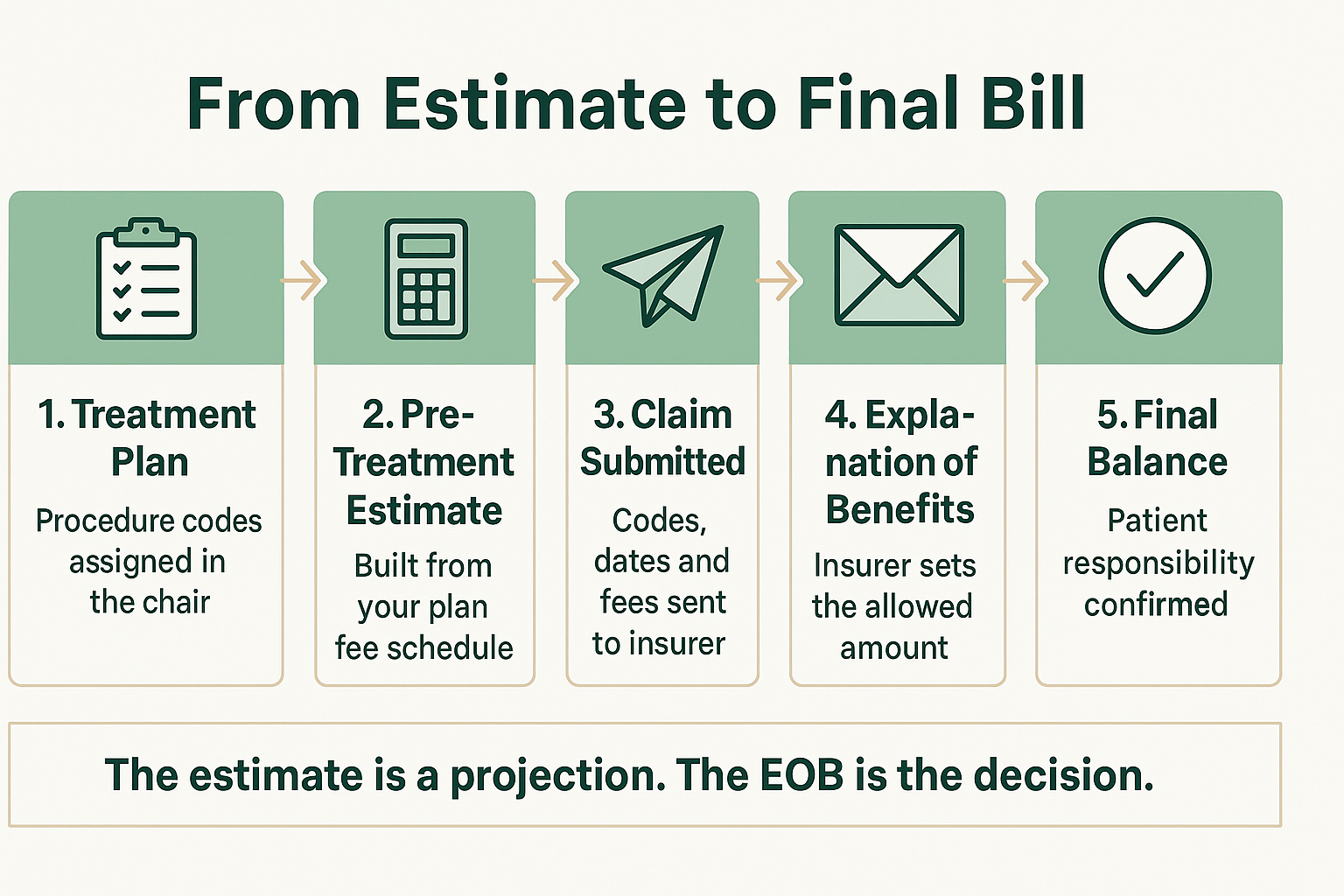
The order goes like this:
- The office builds an estimate from your plan’s fee schedule plus its best read of your remaining benefits
- The claim goes out under specific procedure codes
- Your insurer processes it and issues an explanation of benefits, the EOB
- The EOB sets the real allowed amount and the real patient responsibility
An estimate is an informed projection, not a locked price. The office can see the fee schedule, but it cannot see a claim your other provider submitted last month, or a frequency clock that reset differently than expected.
And this gap is a recognized problem industry-wide, not a quirk of one office. Downcoding and retroactive claim denials pushed more than 100 dental insurance reform bills across 37 states in the 2026 legislative sessions, with 16 states enacting new laws, according to reporting from the ADA. If you want the Washington-specific picture, I wrote more about how dental insurance works here and where it falls short.
The Lines on Your EOB That Actually Decide What You Owe
When the EOB arrives, most people read the top and the bottom and skip the middle. The middle is where the answer lives.
| Line on the EOB | What it means | Why it matters |
|---|---|---|
| Submitted charge | The fee the office billed for that code | Rarely what anyone actually pays on a PPO plan |
| Allowed amount | The contracted fee your plan recognizes for that code | This is the real base number for the math |
| Plan paid | The insurer’s share of the allowed amount | Reflects your coverage percentage for that code category |
| Patient responsibility | Your share after the plan pays | This is the line that decides your bill. Read it first |
| Remarks or adjustment codes | Short notes like frequency limit or alternate benefit | Explains why a code was reduced or denied, in a few cryptic words |
From Estimate to Final Bill, Step by Step
Five stages sit between the treatment plan you sign and the balance you eventually owe. Knowing where you are in the sequence takes most of the surprise out of it.
Why a Code Gets Denied Even When the Treatment Was Right
Denials often turn on the code, not the care. That is exactly why they feel blindsiding. One patient was told a night guard would be partially covered, and months later learned the claim had been denied and the balance was hers.
The usual culprits:
- Frequency limits. Two cleanings per benefit year, X-rays once every so many months. Come in a few weeks early and the code bounces
- Waiting periods. Many plans make you wait 6 to 12 months before major codes like crowns are eligible at all
- Alternate benefit clauses. Your plan may pay a tooth-colored back filling at the rate of a metal one, and you cover the difference
- Missing documentation. X-rays, periodontal charting, or a narrative did not make it with the claim. This is a fixable denial, not a real no
- A true exclusion. The plan simply does not cover that code, ever
That middle group matters most, because a denial for missing paperwork can often be resubmitted and paid. A real exclusion cannot.
The practical move is simple. Ask for the code list before treatment, then call your own plan and verify those exact codes. A general “yes, you have coverage” from anyone, including a front desk, is not the same as confirming D2740 is eligible on your policy this year.
One Tooth, Two Appointments, Three Codes
Here is a realistic example, because the abstract version never lands.
Say a molar needs root canal treatment and then a crown. That is not one procedure. It lands as separate codes on separate dates:
- The endodontic code for the root canal, at the first visit
- A core buildup code, rebuilding the tooth so it can hold a crown
- The crown code, often several weeks later
Each one is claimed on its own and each one draws down your annual maximum. If the root canal happens in November and the crown lands in January, they hit two different benefit years, with two separate maximums and possibly two deductibles.
That is why your portion can shift between the first appointment and the last. If the root canal used more of your maximum than projected, the crown estimate changes. If you are planning around this, using your PPO benefits before they reset on major work is worth reading before you pick appointment dates.
What actually drives the number, by the way, is tooth position, whether that tooth has been treated before, the materials chosen, and whether a specialist is involved. Any figure without those details attached is a guess.
The Short Script That Gets You Clarity Before You Commit
You do not need to be confrontational to get this. Front desks answer these questions all day. Ask:
- “Can I get a written pre-treatment estimate with the procedure codes listed?”
- “Which of these codes have been submitted for preauthorization?”
- “What does this estimate assume about my annual maximum and my deductible?”
- “If a code gets denied for documentation, will you resubmit it?”
An itemized, coded receipt is also what an FSA administrator wants for reimbursement. For 2026 the health FSA contribution limit sits at $3,400, with limited carryover depending on your employer’s plan, so staging coded treatment across two benefit years is a real planning tool rather than a technicality.
And if a plan feels heavier than you expected, taking the coded estimate to another dentist is completely normal. I put together a guide on what to bring to a second opinion and what to ask.
Your Plan Type Settles the Question Before Any Code Matters
About one in five callers to our office opens with the insurance question before anything clinical. The plans named most often across Renton, Kent, Tukwila, Burien, and Newcastle are Delta Dental PPO, GEHA, Humana, UnitedHealthcare, and Cigna.
The distinction that matters first is plan structure:
- PPO plans let you see any dentist, with better benefits in network. Out of network, many patients still see solid coverage once the codes are run
- HMO and managed care plans assign you to a contracted provider. If the office is not contracted, the network question is settled and no code discussion changes it
Washington has also been tightening the rules insurers play by. If you carry a plan here, the state’s dental loss ratio law is worth understanding.
One more thing about our area. Roughly four in ten Renton residents speak a language other than English at home. Handing someone a coded document with no explanation fails a lot of people, and that is a communication problem, not a patient problem.
Estimates Get Simpler When the Work Stays in One Building
When periodontal surgery or root canal care gets referred out, you end up managing two estimates, two claim submissions, and two front desks trying to sort out which benefit year each procedure fell into. Nobody has the full picture of your remaining maximum, so both estimates are built on partial information.
We keep that under one roof. Dr. Jaewon Kim, a board-certified periodontist, handles surgical periodontal care including gum grafting, bone grafting, and periodontal surgery. Dr. Joseph Dutner provides endodontic treatment on site. That means one coordinated estimate and one claim trail instead of a handoff.
The other half of it is being told plainly what you do and do not need. One patient put it this way in a review: “She is honest and will tell me that I don’t need something that previous dentists have pushed.” A shorter code list is often the most useful thing a dentist can hand you.
Frequently Asked Questions About Dental Procedure Codes
What is D4921 on my dental bill?
D4921 is gingival irrigation, a therapeutic rinse of the gum pockets performed during a cleaning or periodontal visit. It is a small add-on line item, and many plans do not cover it separately.
Why did I get a bill weeks after I already paid at the office?
Because what you paid was based on an estimate, and the insurer had not processed the claim yet. Once the explanation of benefits comes back, the allowed amount and your actual share are set, and any difference shows up as a small residual balance or a refund.
Can I ask for the procedure codes before I agree to treatment?
Yes, and you should. Ask for a written pre-treatment estimate with the codes listed, then call the number on your insurance card and verify those specific codes. That is far more reliable than a general confirmation that you have coverage.
What does it mean if my plan applied an alternate benefit?
It means your plan paid for a less expensive version of what you received. A common example is a tooth-colored filling on a back tooth being reimbursed at the rate of a metal filling, leaving you responsible for the difference. It is a coverage limitation written into the policy, not an error.
Is a denied claim ever worth appealing?
Often, yes. If the denial was for missing X-rays, charting, or a clinical narrative, the claim can usually be resubmitted with that documentation and paid. If the code is a written exclusion on your policy, an appeal will not change the outcome, and the EOB remarks section is where you can usually tell which situation you are in.
Want your estimate explained code by code?
If you are holding a treatment plan from anywhere in Renton or South King County and the codes on it are not making sense, we are happy to walk through what each line represents and what drives the number for your specific situation. You can reach our office at 425-430-0400 or read more at cedardentalgroup.com. No pressure either way, and no obligation to move your care.
