
Direct Answer: A crown quote in Renton is several charges stacked together: the crown, the lab work, and sometimes a buildup or post. Only an exam and X-rays settle your real total.
Most people who ask me about a crown start with a number. They got a quote at another office, looked up a national average online, and the two did not line up. The quote looked high, and nobody explained why.
Here is what I have learned from fielding those calls in Renton: a crown quote is almost never one price. It is a stack of separate charges, and the crown itself is often the least surprising item on the sheet.
This article walks through that stack line by line. What each charge is for, what clinical situation triggers it, and how to compare two quotes without assuming the cheaper office is the better deal.
Why a Dental Crown Cost in Renton Is Never Just One Number
When someone shows me a treatment plan from another office, the first thing I do is read the line items. A crown plan usually has two to four separate procedure codes on it, not one.
That matters because online cost trackers almost always publish a figure for the crown alone. Compare a full treatment plan against that single average and you will walk away thinking you are being overcharged, when what you are actually looking at is more work.
A typical crown plan can include:
- The crown itself, which covers the preparation of the tooth, the temporary, and the seat visit at most offices
- A core buildup, when there is not enough natural tooth left to hold the crown
- A post, placed inside a tooth that has already had a root canal
- Crown lengthening, a gum procedure needed when the edge of the crown would sit too close to the gumline
- The lab fee baked into the restoration charge, which varies with material and whether the crown is milled in the office or sent out
Every one of those is a real clinical decision, not padding. If you want help reading the codes themselves, we covered that in what the D-codes on your dental estimate mean.
The Add-Ons Patients Rarely Hear About Up Front
These three charges cause most of the confusion I see. Each one answers a different problem with the tooth.
The core buildup. A crown needs something to grip. When a tooth has a large old filling, a fractured cusp, or decay that hollowed out the middle, there is not enough solid structure left to hold a crown in place. A buildup rebuilds that core in filling material first, so the crown has a stable shape to sit on.
The post. This one only shows up on a tooth that has had root canal treatment. If the crown portion of that tooth is mostly gone, a small post is cemented down into one of the cleaned canals to anchor the buildup. A tooth with plenty of structure left usually does not need one.
Crown lengthening. When decay or a fracture tracks below the gumline, the margin of the crown has nowhere clean to sit. Crown lengthening is a periodontal procedure that reshapes a small amount of gum and bone so there is healthy tooth above the gumline to seal against. It adds a healing period before the crown can be made.
None of these are optional extras. They are the reason two honest offices can quote very different totals for the same tooth and both be right.
What Each Line on a Crown Plan Is Actually Paying For
Here is how I explain the stack when a patient brings in a plan from somewhere else. Fees shift from office to office, so treat the cost effect as direction, not as a figure.
| Line item | What triggers it | Effect on your total |
|---|---|---|
| Crown | A tooth that is cracked, heavily filled, or weakened after treatment | The base charge, and usually the largest single line |
| Core buildup | Too little sound tooth structure left to hold a crown | A moderate add-on, common on back teeth with big old fillings |
| Post | A root canal treated tooth with most of its crown portion missing | A smaller add-on, only on endodontically treated teeth |
| Crown lengthening | Decay or fracture extending below the gumline | A significant add-on, plus extra healing time before the crown |
| Lab or milling fee | Material choice and whether the crown is made in-house or sent out | Usually built into the crown fee, but worth asking about |
Why Nobody Can Give You a Real Crown Number Over the Phone
Our front desk gives ranges on the phone, then recommends an exam. I know how that can land when you are shopping. A range can sound like a dodge.
It is not. Before imaging, a range is the honest answer. The things that decide your number are not visible from the outside of the tooth.
An exam and X-rays settle four questions:
- How much sound tooth structure is actually left underneath that old filling
- Whether decay has tracked below the gumline, which is what triggers crown lengthening
- Whether a cusp is already fractured, which changes whether a buildup is needed
- Whether your bite is loading that tooth hard, which affects material choice
Once those are answered, you should get a written treatment plan with the procedure codes on it. Asking for one is normal, and it is the only document that lets you compare two offices fairly.
The fear I hear most often is being quoted low, getting in the chair, and watching the number climb. A coded written plan is the protection against that. If something changes once treatment starts, you want an office that stops and tells you before it bills you.
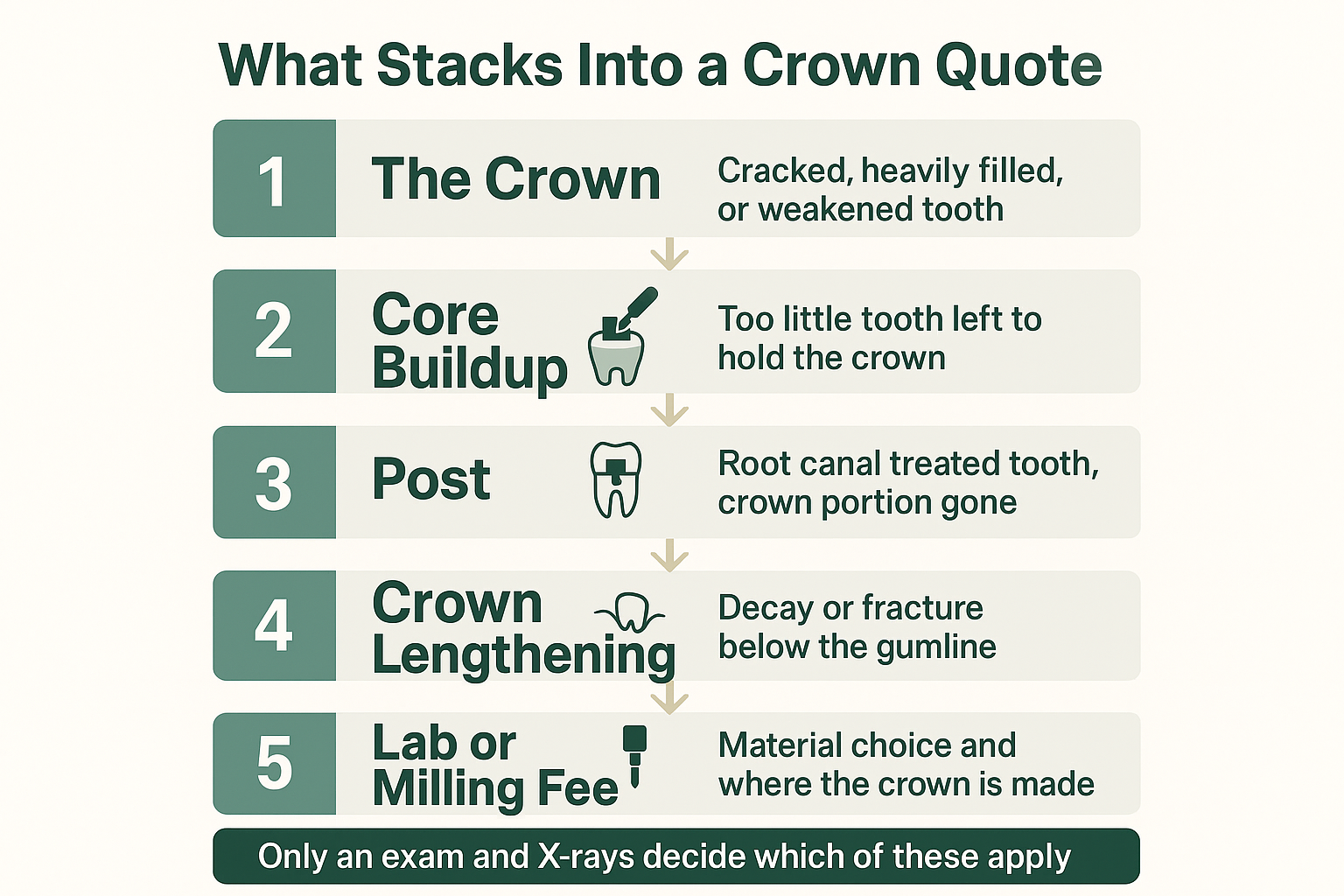
How a Crown Quote Stacks Up
This is the mental picture I want you to carry into any cost conversation: one tooth, several possible charges, each with its own trigger.
How to Compare Two Crown Quotes Without Guessing
If you are holding a quote from another office and want to know whether it is reasonable, price alone will not tell you. Ask both offices the same five questions and the picture clears up fast.
- What material is this crown, and why that one for this tooth?
- Does this fee include the temporary crown and the seat visit, or are those billed separately?
- Is the crown milled here in the office or sent to an outside lab?
- Is a buildup or post already included in this number, or would that be added later?
- Can I get this in writing with the procedure codes on it?
One more piece of context worth knowing. Industry cost reporting puts a wide national spread on a single crown and ties most of that variation to local overhead, rent, wages, and lab pricing rather than to the procedure itself. The American Dental Association’s Health Policy Institute stopped publishing its longstanding Survey of Dental Fees in 2023, which is part of why the online averages you find now disagree with each other so much.
Puget Sound overhead sits above the national middle. Lab pricing and wages here are simply higher than in much of the country. A Renton number compared against a national average will always look high for reasons that have nothing to do with the dentist in front of you. If you want a structured way to bring a plan for review, a second opinion visit is a reasonable step.
The Crown That Catches People Off Guard Is the One That Follows Something Else
This is the sequencing surprise, and I see it often enough that I bring it up before treatment starts.
A root canal fee does not include the crown. Root canal treatment cleans and seals the inside of the tooth. The crown that protects what is left of it afterward is a separate procedure with a separate fee. We go into the clinical side of that in why a crown follows a root canal.
An implant fee does not include the crown either. The implant is the post placed in the jawbone. The crown that screws or cements onto it is its own charge, and sometimes so is the connector between them. One patient here called to book a cleaning and to get a quote for two crowns on recent implants, and the conversation turned straight to what was left on the annual maximum. The full arc is laid out in the actual breakdown of implant cost.
And a crown is not permanent furniture. Crowns come loose or fail years later, and we get those calls regularly. A replacement crown is its own cost with its own coverage rules, and many plans will not pay for a replacement until a set number of years has passed since the original.
Renton’s Benefits Calendar Changes What You Personally Pay
The clinical fee for a crown does not move with the calendar. Your out-of-pocket number absolutely does.
Most dental plans run on a calendar-year maximum that expires December 31, and a crown is a major-service item that can eat a large share of that maximum on its own. If you need more than one crown, you have a real decision about sequencing, not just a clinical one.
This shows up in Renton more than you might expect. Search traffic for crown cost here climbs in January and February, and local searches for a dentist spike in October and again in January, which tracks with employer open enrollment in the fall and fresh benefits in the new year.
It makes sense for this city. The Boeing 737 final assembly plant anchors Renton, and health care and manufacturing are two of its three largest employment sectors. That is a benefits-heavy job market, and people here plan around their plan year.
Splitting two crowns across two benefit years is a conversation to have with the office handling the work, not a call to make on your own. The urgency of the tooth has to come first. We go deeper on timing in how to use PPO benefits before they reset.
Why Keeping the Sequence in One Place Simplifies the Math
There is a practical reason cost conversations here tend to stay in one building instead of bouncing between offices.
Root canal care is handled in-house by Dr. Joe Dutner, a board-certified endodontist, and surgical and implant-related work by Dr. Jaewon Kim, a board-certified periodontist. When a crown depends on a step that has to happen first, the sequencing and the fees get planned together rather than split across separate practices and separate estimates.
That also means fewer surprises about who is billing for what. One patient put the tone of these conversations well in a review: “She is honest and will tell me that I don’t need something that previous dentists have pushed.”
Frequently Asked Questions About Crown Costs in Renton
Why is the quote I got higher than the average I found online?
Usually because you are comparing a full treatment plan against a figure for the crown alone. If your plan includes a buildup, a post, or crown lengthening, you are looking at more work, not a higher markup. Local overhead in the Puget Sound area also sits above the national middle, so a Renton number will read high against a national average every time.
Can you just tell me what a crown costs over the phone?
We can give you a range, and we will. We cannot give you a firm number until an exam and X-rays show how much sound tooth is left and whether decay has gone below the gumline. A range before imaging is the honest answer, not a stall.
Does my insurance cover the buildup and the post too?
It depends on the plan. Many PPO plans treat the buildup and post as separate covered procedures, and some apply different percentages to them than to the crown. All of them count against the same annual maximum. Ask for a written plan with the codes on it so your benefits can be checked line by line before anything starts.
Is a crown milled in the office cheaper than one made at a lab?
Not automatically. In-office milling removes an outside lab fee but adds equipment and material cost, and the material options differ. The better question is which material suits that specific tooth and bite, then what the all-in fee covers.
What happens if a crown I already paid for fails?
Lost and loose crowns are common calls. Sometimes the existing crown can be recemented, and sometimes the tooth underneath has changed and a new crown is needed. A replacement crown is billed as its own procedure, and most plans will not pay toward one until several years have passed since the original.
Want a Second Set of Eyes on a Crown Quote?
If you are holding a treatment plan from another office in Renton, Kent, Tukwila, or anywhere else in South King County, we are happy to look it over and explain what each line covers. There is no obligation attached to that conversation. You can reach Cedar Dental Group at 425-430-0400 or read more at cedardentalgroup.com.
