
Direct Answer: Root canal fees in the Renton area usually land in the low thousands before insurance, and the crown afterward is billed separately. Tooth position and your plan decide what you actually pay.
Most people who call us about a root canal are calling us third or fourth. They spend an afternoon working down a list of Renton offices, asking the same question at each stop, and every office gives them a different number.
One caller put it plainly: “I’m price-shopping after a $1,000 quote from another dentist.” That is a completely reasonable thing to do. But comparing headline numbers across four offices rarely tells you what you’ll actually pay.
So instead of handing you one figure that would probably be wrong for your tooth, I want to show you how to read a root canal estimate. Once you can see the parts, the gap between two quotes usually stops looking mysterious.
Why no honest office gives one flat root canal price over the phone
A root canal is not one procedure with one fee. It is a procedure whose difficulty is set by which tooth it is, what has already been done to it, and what the X-ray shows once someone actually looks.
When a new patient with no insurance calls and asks what a root canal runs here, our front desk gives a range. In our practice that range has generally sat somewhere around $1,900 to $3,000, depending on the tooth and the situation, and an individual case can land outside it in either direction.
That is not evasion. An office that gives you a crisp single number over the phone is quoting the easiest version of the procedure, and if your tooth turns out to be harder, the number moves later.
There are really only three things worth asking any office on that first call:
- Which tooth is it, and what does that tooth usually run here?
- Is the crown included in that figure, or billed separately?
- Will you send a pre-treatment estimate to my plan before we start?
The third question is the one almost nobody asks, and it is the one that turns a phone guess into a number in writing.
What actually moves the number on a root canal
This is the part local pages skip, and it is the part that explains most of the spread between two quotes.
Tooth position matters most. A front tooth typically has one canal. A premolar often has two. A molar commonly has three or four. Every extra canal means more chair time, more instrumentation, and more sealing, so fees climb toward the back of the mouth.
Whether the tooth has been treated before changes everything. Retreating an old root canal means carefully removing the prior filling material before any new work can begin. That is a different, longer procedure than a first-time root canal, and it is priced that way. If you are in that situation, what retreatment actually involves is worth reading before you compare quotes.
Other things that sit inside that range:
- Curved or calcified canals that are narrow and hard to follow to the tip
- Infection that has spread past the root tip into the surrounding bone
- A post and core buildup, needed when so little tooth structure is left that the crown needs an anchor
- The number of visits, since some teeth are finished in one appointment and some are not
None of that is visible over the phone. It shows up on an X-ray and in the exam.
How tooth position affects complexity and fee
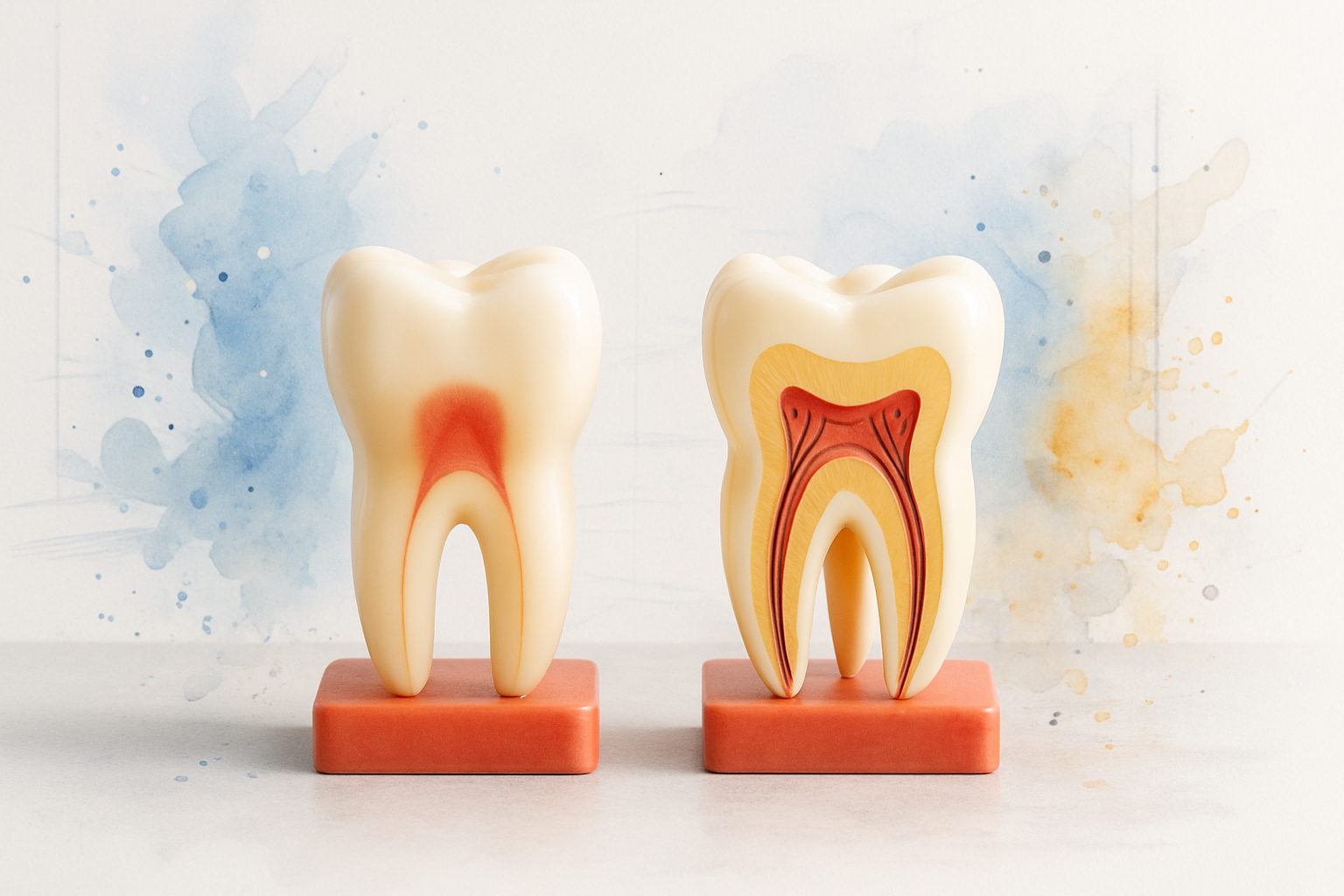
This is the single biggest reason two root canal quotes can differ by hundreds of dollars for the same patient. Figures below describe relative complexity, not set pricing.
| Tooth | Typical number of canals | What that means for chair time and fee |
|---|---|---|
| Front tooth (incisor or canine) | 1 | Shortest, most straightforward, lowest end of the range |
| Premolar | 1-2 | Middle of the range, occasionally a surprise second canal |
| Molar | 3-4 | Most chair time and instrumentation, highest end of the range |
| Previously treated tooth (any position) | Varies | Old filling material must be removed first, priced as retreatment |
If you only priced the root canal, you priced about half the treatment
Here is where most phone comparisons fall apart. The root canal fee and the crown fee are two separate line items on the estimate.
A treated back tooth almost always needs a crown afterward to hold it together under chewing force. The clinical reasoning behind that is its own conversation, and we cover why a crown usually follows a root canal separately. For cost purposes, what matters is that the crown is billed on its own line, often at a different coverage percentage than the root canal.
Restorative line items stack up quickly in this market. One local caller asking about two crowns after implant work was looking at a little over $4,000 out of pocket after her plan’s discount applied. That was her plan, her materials, and her two teeth, so treat it as a sense of scale rather than a quote.
What shifts a crown fee:
- Material chosen, since all-porcelain, zirconia, and metal-backed crowns are priced differently
- Whether a post and core buildup is needed first
- Your plan’s crown coverage, which is often separate from endodontic coverage
- Frequency limits, since many plans will not replace a crown on the same tooth within a set number of years
The only accurate number comes from an exam, an X-ray, and a written estimate with every code on it.
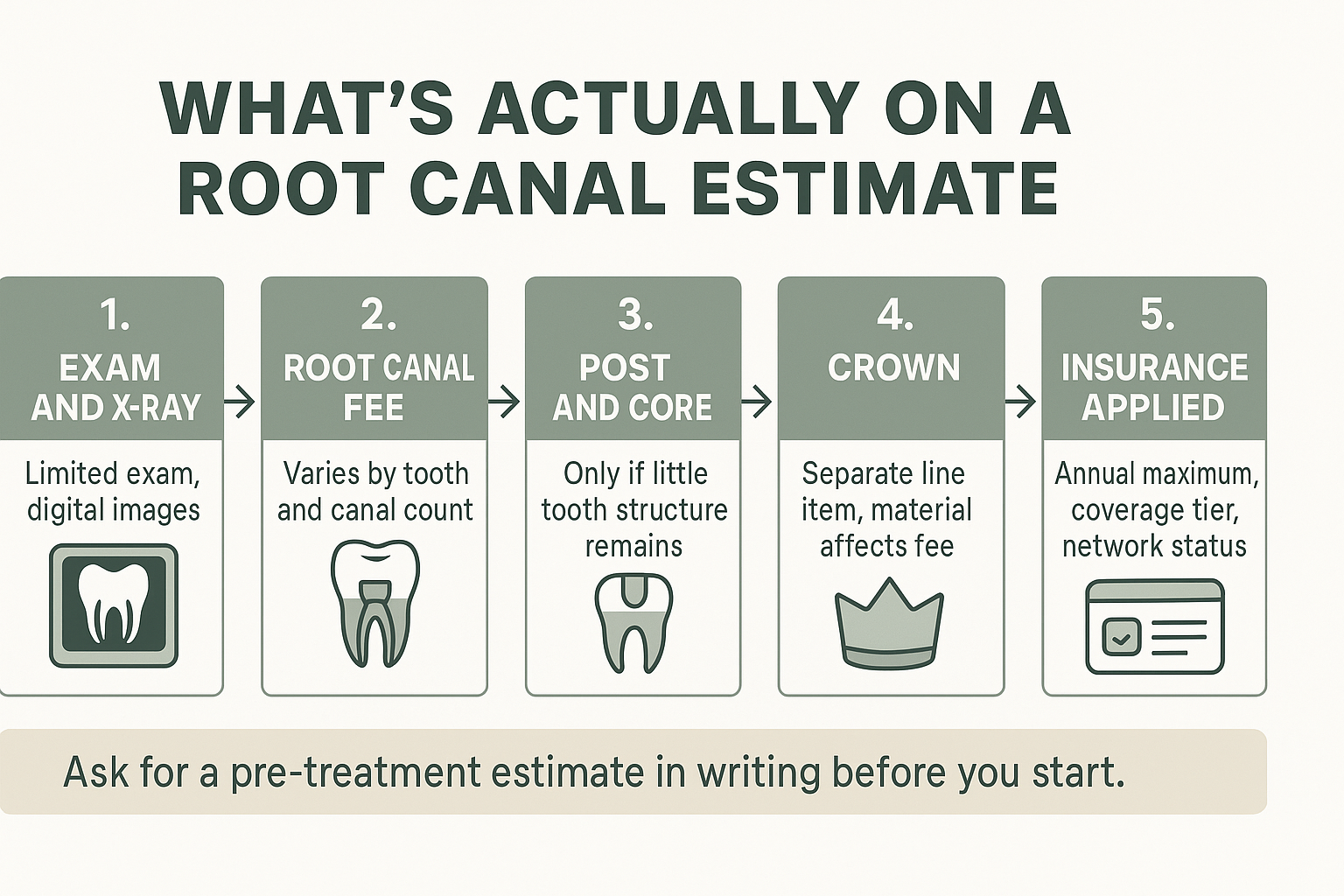
The five line items behind a root canal estimate
When you see the estimate broken into parts, the gap between two offices usually explains itself.
The insurance mechanics that decide what you personally pay
Two offices can quote the same fee for the same tooth and still hand you two very different out-of-pocket numbers. That difference lives almost entirely in your plan.
Annual maximum. Most PPO plans in this market cap what they will pay in a year somewhere in the $1,000 to $2,000 neighborhood. A root canal plus a crown can use most of a single year’s benefit in one stretch, and anything past the cap is yours.
How your plan classifies the procedure. Some plans treat endodontic treatment as a basic service, some as a major service. That single classification can swing the covered percentage significantly, and it is set by your employer’s plan design, not by the office.
In-network versus out-of-network. Callers ask about this constantly, usually naming Delta Dental PPO, GEHA, Humana, UnitedHealthcare, or Cigna. Out-of-network does not mean no coverage. It means reimbursement is calculated differently, often against the plan’s own fee schedule rather than the office’s.
The pre-treatment estimate. This is the request an office sends your insurer before treatment so you can see the projected split in writing. It is not a guarantee of payment, but it turns a phone guess into a document.
If the codes on that document look like a foreign language, our breakdown of D-codes on a dental estimate walks through what each one means.
Sequencing a root canal and crown across the calendar line
A lot of Renton patients carry benefits through jobs at the 737 plant, in health care, or in manufacturing, and those plans follow a fall enrollment cycle with benefits that reset January 1.
That creates a practical scheduling option. A treatment plan that starts in late December and finishes in January can draw on two benefit years instead of one, which matters when a root canal and a crown together would otherwise blow past a single year’s maximum.
Washington’s individual market runs on a similar calendar. Open enrollment through the state exchange runs from early November into mid January, with a mid December cutoff for coverage that starts on January 1, according to the Washington Health Benefit Exchange.
This is a scheduling conversation to have with a front desk, not a reason to rush anything. Clinical need always sets the timeline first. But if your tooth is stable and you are choosing between mid December and early January, it is worth five minutes at the desk.
What the conversation looks like without dental insurance
Roughly a quarter of American adults carry no dental coverage at all, and about one in five adults have put off dental care because of cost. If that is you, you are in ordinary company, and nobody here is going to make you feel otherwise.
The options usually look like this:
- Third party payment plans such as Cherry and Sunbit, which split the balance into monthly payments
- In-house membership plans, which some offices offer to discount fees for people without insurance
- Staging treatment, so the tooth causing the problem gets handled first and the rest is sequenced over time
I will not quote you a monthly figure, because that depends entirely on the amount financed, the term, and what you qualify for. What I can tell you is that asking about it early changes the conversation, because a treatment plan built around a budget looks different from one built without knowing there is a budget.
A patient who had been away from the dentist for years put it this way in a review: “They are transparent on the costs and offered many different payment options, as well as showing how much it would cost to restore all my teeth.” That kind of full picture is easier to plan around than a single scary number.
And if you are still deciding whether a root canal is even the right call for your tooth, how that decision actually gets made is a better starting point than a price list.
Why the cost conversation changes when the endodontist is in the building
One more thing worth knowing as you compare estimates around Renton and the rest of South King County. Dr. Joe Dutner is a board-certified endodontist and President of the American Board of Endodontics, and he treats root canals on site at Cedar Dental Group rather than sending patients across town to a standalone endodontic office. For you, that means one exam, one treatment plan, and one team coordinating the root canal and the restoration that follows, instead of two offices each generating their own estimate and each working from their own set of images. If you want the longer version, we wrote about what changes when an endodontist works in-house.
Frequently asked questions about root canal cost in Renton
Why is a molar root canal so much more expensive than a front tooth?
Canal count. A front tooth usually has one canal, while a molar commonly has three or four. Each one has to be cleaned, shaped, and sealed individually, so a molar takes considerably more chair time.
Should I be suspicious if another office quotes me much less?
Not automatically. Check three things first: which tooth the quote is for, whether the crown is included, and whether it is a phone estimate or a written one after an exam. Most large gaps between quotes come down to one of those three, not to one office being overpriced.
Can I get the root canal now and the crown later?
Sometimes, and it is a common way to spread cost across two benefit years. But there is a limit. A treated back tooth without a crown is more vulnerable to fracture over time, so this is a timing question to work out with your dentist rather than an open-ended delay.
Does dental insurance cover root canals?
Most PPO plans cover some portion. How much depends on whether your plan classifies endodontic treatment as basic or major, where you stand against your annual maximum, and whether the office is in-network. A pre-treatment estimate is the only way to see your specific split before you commit.
What does out-of-network actually mean for my bill?
It means the plan calculates reimbursement against its own fee schedule instead of a contracted rate. You often still receive meaningful coverage. It is worth having the office check your specific benefits rather than assuming an out-of-network office is off the table.
What if the tooth already had a root canal years ago?
Then you are looking at retreatment, which is a different procedure. The old filling material has to be removed before anything new happens, which adds time and complexity, and it is estimated separately from a first-time root canal.
Want a written estimate instead of a phone guess?
If you have been collecting quotes around Renton and none of them line up, an exam with images and a pre-treatment estimate will tell you more than four phone calls will. Our office is on Hardie Ave. SW near downtown Renton, and we see patients from Kent, Tukwila, Burien, Newcastle, and the wider Seattle area. You can reach Cedar Dental Group at 425-430-0400 or read more at cedardentalgroup.com whenever you are ready.
