
Direct Answer: Unused dental benefits usually disappear. Most plans run on a calendar year, so whatever is left of your annual maximum expires December 31 and does not carry forward. Your deductible resets too.
Every fall I start getting the same call. Someone in Renton says they were told they have money left on their dental plan, and they want to know if it is real and whether it is about to disappear.
The short answer is that it is real, and yes, on most plans it does disappear. Unused dental benefits do not roll over into the new year. On December 31, whatever is left of your annual maximum is simply gone.
This article covers three things: what actually happens to that money, how to check your remaining balance with the plans we see most often in South King County, and how patients use it up without cramming everything into a stressful December visit.
Where Unused Dental Benefits Actually Go When the Year Ends
Dental insurance does not work like health insurance. Instead of a deductible you spend down toward full coverage, most dental plans cap what they will pay in a plan year, and that cap is called your annual maximum.
In our market, annual maximums commonly land somewhere in the $1,000 to $2,000 range, though it varies a lot by employer and plan tier. Once you hit it, the plan stops paying for the rest of the year. If you never come close to it, the leftover amount does not bank, transfer, or refund. It resets to zero.
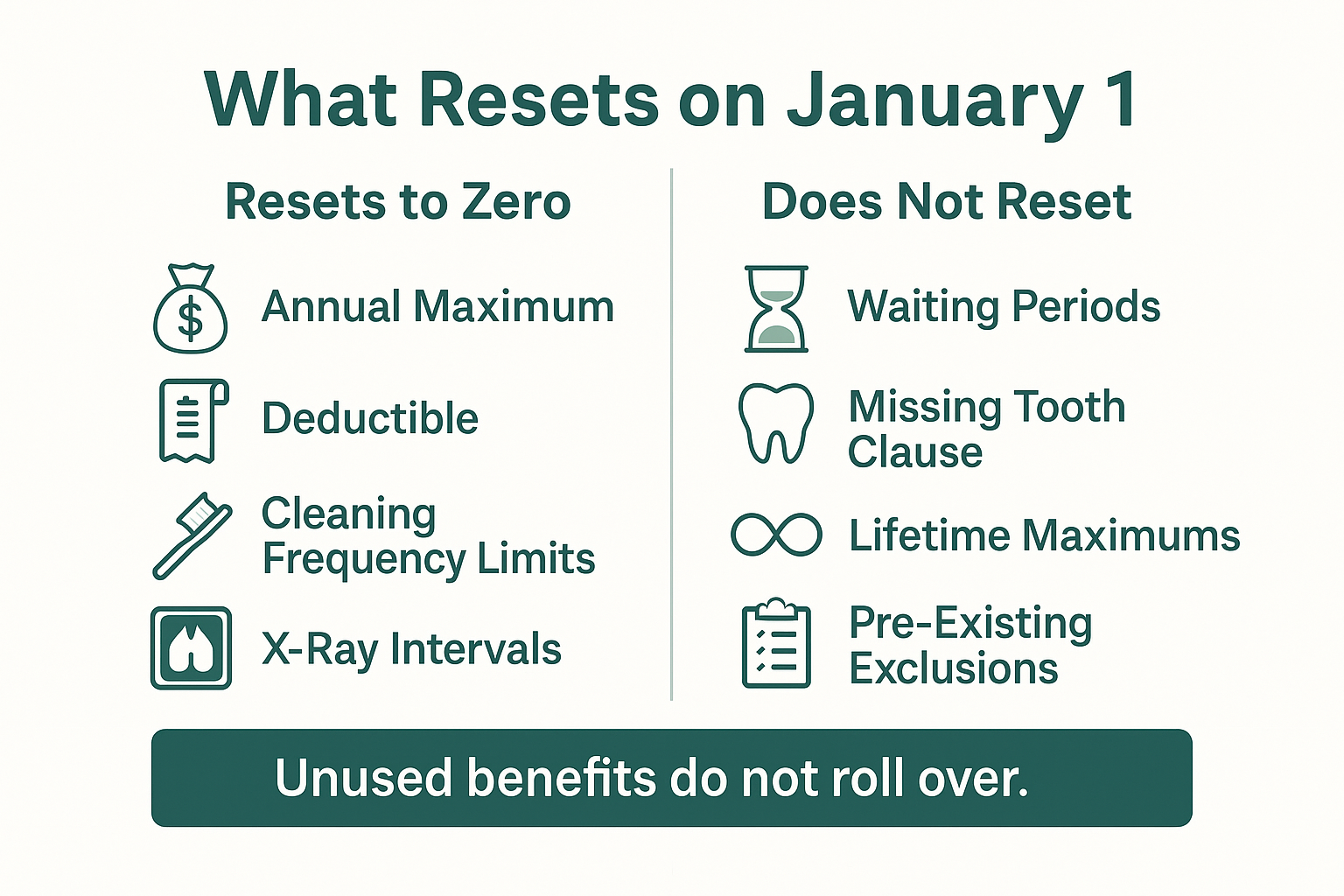
Here is what turns over on January 1 for most calendar-year plans:
- Annual maximum goes back to full, and any unused portion is forfeited
- Deductible resets, so you pay it again before certain benefits apply
- Frequency limits reset, such as two cleanings per year or X-rays at set intervals
- Waiting periods on newer plans keep counting and do not reset
One important check before you plan anything: not every plan runs on the calendar. Some employer plans in Washington use a fiscal or anniversary year, meaning your reset date might be July 1 or the month you were hired. Two minutes on the phone with your carrier settles it. The Washington State Office of the Insurance Commissioner has a plain-language overview of how dental plan maximums and limits work if you want to read up first.
How to Check Your Remaining Annual Maximum Before You Schedule
The single most common question we field on the phone is whether we take a specific plan. It comes up in roughly one out of every five calls, and the plans people name most often are Delta Dental, Regence, United Healthcare, and Guardian.
But in-network status is only half of it. The other half is knowing what you actually have left to spend. Every major carrier will tell you if you ask for two specific numbers:
- Remaining annual maximum for this benefit year
- Remaining deductible, and whether it applies to preventive visits
You can get both from the member portal or by calling the number on the back of your card. It usually takes under ten minutes. Write the numbers down along with the date you checked, because pending claims can shift the balance.
One more thing worth asking while you have them on the line: whether your plan pays based on the date service is completed or the date it starts. That matters for anything done across two appointments, like a crown. On many plans the delivery date is the one that counts, so a crown prepped in late December and seated in January may bill against the new year. Ask, do not assume.
If your coverage picture feels murky in general, we broke it down further in how dental insurance works in Washington and where it falls short.
Where to Look Up Your Balance by Carrier
These are the four plans we hear named most often by patients in Renton, Kent, Tukwila, and Newcastle. Portal names change from time to time, so the phone number on your card is always the reliable backup.
| Carrier | Where to check | What to ask for |
|---|---|---|
| Delta Dental of Washington | Member portal or the number on your card | Remaining annual maximum and whether the plan year is calendar-based |
| Regence | Member sign-in, dental benefits summary | Remaining maximum, remaining deductible, in-network status for your specific dentist |
| United Healthcare | Member portal or member services line | Remaining maximum plus frequency limits on cleanings and X-rays |
| Guardian | Member portal with your member ID | Remaining maximum and coverage percentage by treatment category |
| Apple Health | Member services or your coverage letter | Covered service categories and any current limits |
What Resets and What Does Not
A quick reference for what changes on January 1 versus what carries forward with you.
Why Bundling Treatment Into One Visit Makes Sense in the Fall
A pattern I see every year: someone realizes in early December that they have several hundred dollars of benefit sitting unused, and they want it all done at once.
That instinct is right, and it works better when there is still room on the schedule. We regularly have patients ask to combine an exam, X-rays, a cleaning, a filling or two, and a consultation about an implant into a single trip. When the clinical picture allows it, that is often the most efficient way to spend down a remaining maximum without taking four separate days off work.
A realistic bundle might look like:
- Exam and digital X-rays to see what is actually going on
- Routine cleaning, which most PPO plans cover at or near 100 percent
- A filling or two on decay caught during the exam
- A consultation on longer-term work such as a crown or an implant
That last one matters more than people expect. A consultation lets you find out what the work involves and what it may cost before the calendar forces the decision. If you are weighing bigger treatment, how to use your PPO benefits before they reset on major dental work walks through the sequencing, and our breakdown of what goes into dental implant cost covers the pieces that drive the number.
On costs generally: fees vary by tooth, material, and how much of the tooth is left. Any office can give you a range, but a written estimate after an exam is the only number worth planning around. Ask for one.
If You Have Not Been in Years, Start With the Cleaning
A lot of the messages we get open the same way. Someone says they have not been to a dentist in years, they know they are overdue, and they are not sure where to begin.
Start with the preventive visit. On most PPO plans, cleanings and exams are the most fully covered benefit you have, often at 100 percent with no deductible. It is the easiest thing to use before it resets, and it gives you a real picture instead of a guess.
The other reason to go early rather than late: October and November schedules are far easier than December. Once the holidays hit, the calendar compresses, and the appointments left are the ones nobody wants.
That timing matters even more for patients who get anxious in the chair. Several people have told us straight out that they panic when they see the instrument tray, or that they cannot stand hearing what is happening. Booking early means a longer, unhurried appointment slot instead of a squeeze-in. If that is you, what to expect when you have not been to the dentist in years is worth a read first, and so is how to tell if a practice is actually built for anxious patients.
One patient put it simply in a review: “I used to feel anxious about going to the dentist, but this team completely changed my perspective.” That shift usually starts with a low-pressure first visit, not a marathon treatment day.
Frequently Asked Questions About Unused Dental Benefits
Can I roll unused dental benefits into next year?
Almost never. A small number of plans offer a carryover or rewards feature that banks a limited amount, usually only if you had a claim that year. Ask your carrier specifically whether your plan has a carryover benefit, because the default answer for most plans is no.
Does my deductible reset on January 1 too?
On calendar-year plans, yes. That means if you finish part of your treatment in December and part in January, you may pay the deductible twice. It is one of the better reasons to complete a treatment plan within a single benefit year when your dentist says that is clinically reasonable.
How do I know if my dentist is in-network with my plan?
Check your carrier’s provider directory, then confirm directly with the office. Directories are not always current. We work with most major PPO plans including Delta Dental, Regence, United Healthcare, and Guardian, and the front desk can verify your specific benefits while you are on the phone.
If I start a crown in December, does it count toward this year’s maximum?
It depends on the carrier. Many plans bill against the date the crown is seated, not the date it is prepped, which can push it into the new benefit year. Ask your plan directly before you schedule if the timing matters to your budget.
Is it worth using leftover benefits on whitening?
Usually not, because most plans treat whitening as cosmetic and do not cover it at all. Your remaining maximum is better spent on preventive and restorative work that the plan actually pays toward. We covered the details in our guide on whether dental insurance covers teeth whitening.
Want to know what your plan still covers this year?
If you are in Renton or anywhere across South King County and you are not sure what is left on your plan, we are glad to help you check before you commit to anything. Cedar Dental Group works with most major PPO plans, and we can often group an exam, cleaning, and a treatment discussion into one visit so the benefit gets used without a string of appointments. You can reach us at 425-430-0400 or read more at cedardentalgroup.com whenever you are ready.
