
Direct Answer: You have a right to copies of your dental records. Sign a release, ask for X-ray image files, chart notes, and your treatment plan, and most unfinished work restarts where you left off.
A message came through our website recently that reads almost word for word like a dozen others we get: “Looking for a dentist in my new area. I have dental work that was started but not finished.”
Some people moved down from north Seattle and want a shorter drive. Some changed jobs and picked up new coverage. Underneath all of it is the same worry, which is starting from zero and paying twice for work someone already did.
That is usually not what happens. Here is what your record actually contains, what you have a right to, and how unfinished treatment gets picked back up at a new office in Renton.
What a dental record actually contains, and what to ask for by name
“Send my records” is a vague request, and vague requests come back thin. Ask for the pieces by name and you get something a new dentist can actually read.
Here is what is worth requesting:
- X-rays as image files, not screenshots or photos of a monitor. Original files hold the detail needed to judge decay and bone level.
- Chart notes, which are the written history of what was done at each visit and why.
- Your current treatment plan, including anything that was recommended but never scheduled.
- The periodontal chart, if gum measurements were ever taken. This is a grid of numbers showing pocket depths around each tooth.
- Any recent referral letters or specialist reports, if you were sent out for surgery or a root canal.
Records requests between offices are routine traffic. Roughly one in ten calls our front desk fields is an office asking us for records or X-rays, or us asking someone else. One recent call was another dental office requesting a periodontal chart so they could compare gum measurements over time.
You usually do not have to broker any of it yourself. Sign a release at the new office and let the two front desks handle the rest.
Your rights when a previous office is slow to send records
A lot of patients assume records can be held over their head. They cannot.
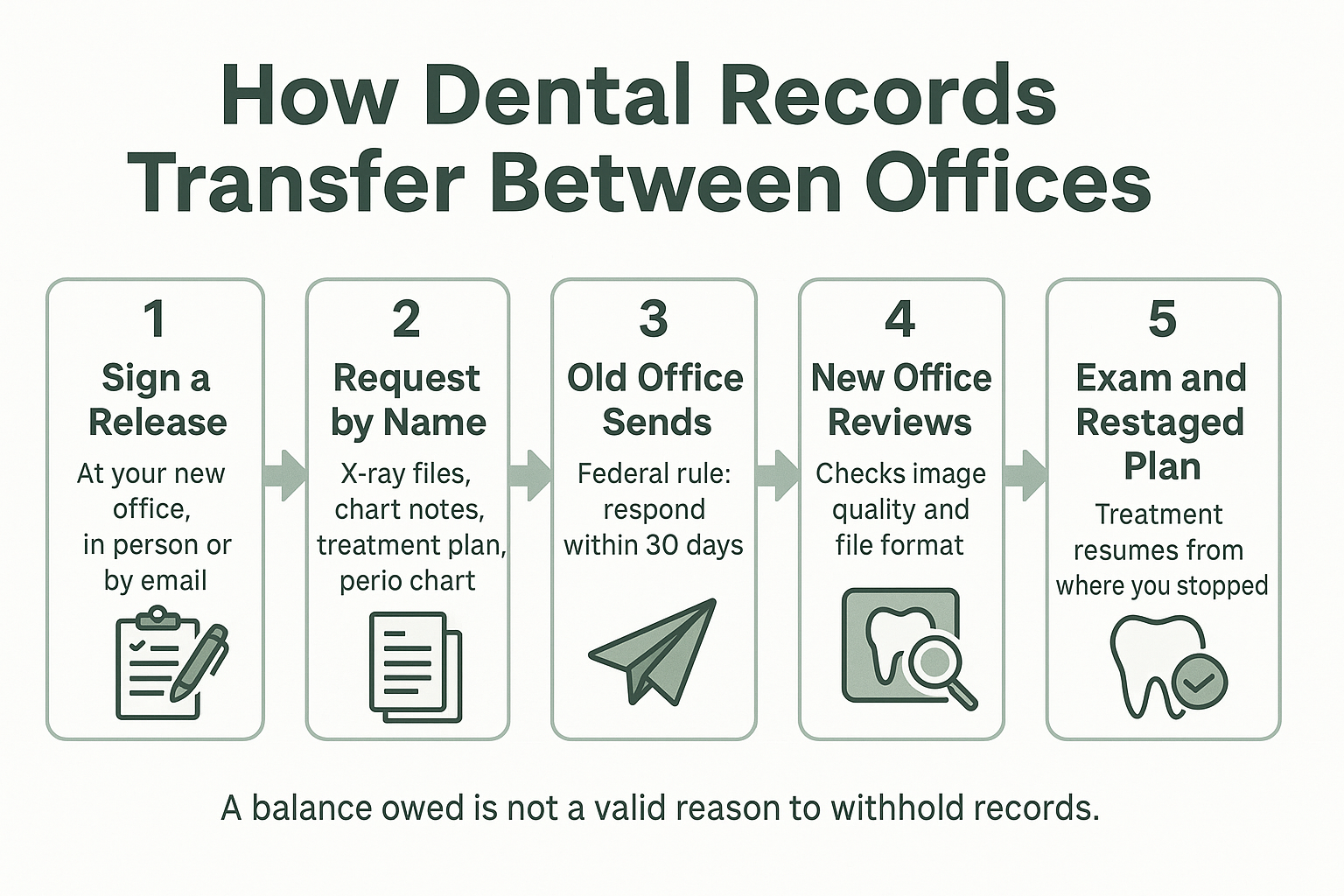
Under federal privacy rules, you have the right to inspect and receive a copy of your own dental records. A few things follow from that:
- An unpaid balance is not a valid reason to refuse. A billing dispute and a records request are separate issues.
- Any fee must be limited to the real cost of copying, supplies, and postage. It cannot be a charge for the office’s time searching or a flat penalty.
- Thirty days is the general outside window for a provider to respond to your request.
- Put it in writing. An email or a portal message creates a paper trail with a date on it.
The U.S. Department of Health and Human Services lays this out plainly in its guidance on the patient right of access, including the rule that fees must be reasonable and cost based.
Most offices send records the same week without a word of friction. Knowing the rule is just insurance for the rare case that drags.
If I bring my X-rays, do I still need new ones?
This is the second question almost everyone asks, and the honest answer is sometimes yes, sometimes no.
Three things decide it:
- Diagnostic quality. A blurry bitewing or a partial series that skips half your molars cannot rule out decay between teeth.
- Age. Images get less useful for judging active decay and bone levels as time passes. A film from four years ago tells us about your history, not your present.
- File format. Practice software does not always open another system’s export cleanly. Sometimes what arrives is a compressed image that has lost the detail we needed.
When the images do transfer cleanly, they are genuinely valuable, and not only for saving a scan. Most PPO plans limit how often they will pay for a full series, so a usable transferred set can spare you an out of pocket charge for a duplicate. Frequency limits vary a lot by plan, so confirm yours with your carrier or ask a new office to verify benefits before your visit.
Even when we do take new images, the old ones still earn their place. Comparing two sets side by side shows change over time, which is how we tell a stable spot from one that is moving. Our patients notice that. One review put it this way: “She shows me my xrays, tells me what she’s looking at, and compares previous xrays” – Mike M.
The records transfer, start to finish
Five steps from first call to first appointment, and roughly where the waiting happens.
Unfinished work: the three handoffs we see most
This is where the real anxiety lives, and most articles skip it entirely. Here is how the common ones actually go.
A crown that was prepped somewhere else. The tooth was shaped, an impression or scan was taken, and a temporary was cemented on. What we need to know is when the temporary was placed, whether the permanent crown was ever ordered, and whether it can be released to us. Temporaries are built for weeks, not months, so the timeline matters more than anything. If the lab work is gone or the margin has been compromised by a long wait, we re-prep and start that step again.
A deep cleaning that got interrupted. Scaling and root planing is often scheduled by quadrant, meaning your mouth is split into four sections over two or more visits. We need which quadrants were completed and on what dates, plus the periodontal chart that justified the treatment. Finished quadrants get re-measured and maintained. Unfinished ones get scheduled.
An implant plan already partway done. The extraction may have happened. There may be graft material healing in the socket. We need to know what was placed at the site, when, and whether a healing period was specified. Bone needs months to integrate, so the answer is often that you are simply not due yet.
The honest message across all three: these plans get restaged from where you stopped, not thrown out and rebuilt. What slows things down is missing information, not the switch itself.
What your new dentist needs for each mid-treatment situation
If you only ask your old office for one thing, ask for the item in the middle column that matches your situation.
| Where you left off | What the new office needs to know | What usually happens next |
|---|---|---|
| Crown prepped, temporary in place | Date the temporary was placed, whether the lab case exists | Permanent crown seated, or the tooth re-prepped if too much time passed |
| Deep cleaning done in quadrants | Which quadrants, which dates, plus the periodontal chart | Completed areas re-measured, remaining quadrants scheduled |
| Extraction or grafting done, implant pending | What was placed at the site and when healing began | Healing checked with imaging, implant staged when the bone is ready |
| Root canal started, not finished | Which tooth, what was completed, whether medication was left inside | Treatment completed, then a plan for the final restoration |
The insurance and timing piece nobody warns you about
Job changes drive a lot of these switches, and they bring two wrinkles worth planning around.
First, coverage is verified per practice, not once for all dentists. PPO, managed care, and state plans behave very differently from one office to the next, and a plan with a future effective date may not cover a visit booked before it starts.
Second, and this one surprises people: your calendar year maximum follows you, not the practice. If your old dentist billed a crown in March, that amount already counted against this year’s limit. Starting somewhere new in August does not reset it.
That matters most when you have unfinished major work. Sometimes the smarter move is finishing one phase this year and staging the next after the reset. Our guide on how dental insurance works in Washington covers where these plans tend to fall short, and using PPO benefits before they reset walks through the timing math.
Plan details vary enough that general context only gets you so far. Confirm your specific benefits with your carrier or have the office verify them for you.
Why continuity matters more when specialists are involved
A lot of the people who transfer to us are driving from Kent, Tukwila, Burien, or Newcastle, and several have told us they noticed our office near downtown Renton while running errands on Hardie Ave SW. Most of these switches are about a shorter drive, not anything going wrong at the old practice.
Where it gets more complicated is when there is periodontal surgery, gum grafting, bone grafting, or a root canal in your history. Many nearby practices coordinate advanced cases out to separate specialist offices, which means a second records handoff for you and another set of forms.
We handle that differently, because the review of your old records and the next step happen in the same building. Dr. Jaewon Kim is a board-certified periodontist and handles gum grafting, periodontal surgery, and bone grafting here. Dr. Joe Dutner is our in-house endodontist for root canal care, which we wrote about in what changes when an endodontist does it in-house. Dr. Susan Chu handles general and cosmetic care alongside both of them.
If you are switching partly because you were not sure about a recommendation, that is worth naming out loud. Our piece on getting a second opinion on a treatment plan covers what to bring and what to ask.
Frequently Asked Questions About Switching Dentists and Transferring Records in Renton
Can my old dentist refuse to send records because I owe them money?
No. Under federal privacy rules, an outstanding balance is not a valid reason to withhold your records. The bill still needs to be resolved with that office, but the two things are separate.
How long does a records transfer usually take?
In practice, most offices send records within a few business days once a signed release arrives. Thirty days is the general outside window a provider has to respond, so if you are past a couple of weeks, follow up in writing.
Do I have to request my records myself, or will the new office do it?
Almost always the new office handles it. You sign a release, they send the request, and the two front desks sort it out. Requesting a copy for your own files is still a good idea, especially if you move again.
What if my old office already ordered my crown?
Ask whether the lab case can be released. Sometimes it can. If the temporary has been on for months or the tooth has shifted, we may need to re-prep and take a new scan, and we will tell you honestly which situation you are in before anything starts.
Will I have to redo a deep cleaning I already paid for?
Not the quadrants that were completed. Those get re-measured and moved into maintenance. What we need is the dates and the periodontal chart so we are not guessing about which sections were treated.
Thinking about moving your care to a new office in Renton?
We are taking new patients, including people mid-treatment who are not sure where their old plan left off. If you have questions about what to request from a previous office or how your unfinished work would pick back up, you are welcome to call us at 425-430-0400 or read more at cedardentalgroup.com. No rush, and no pressure to book anything before you have your answers.
