
Direct Answer: A small chip or shallow crack often can be repaired with a filling or bonding. A break that weakens the tooth’s structure, or pain that lingers after biting, usually means a crown is the better choice.
One of the most common questions we hear at Cedar Dental Group goes something like this: “I have a broken tooth, do I need an implant, a veneer, or just a filling?” We see versions of that question in our contact forms regularly, and the honest answer is: it depends on where the break is, how deep it goes, and what your symptoms are telling us.
A tooth that looks broken on the outside is not always in crisis. But a tooth that looks only mildly chipped can sometimes have a crack running toward the root that changes everything about the repair plan. The difference between a filling and a crown is not about cosmetics, it is about how much structural support the remaining tooth actually needs.
This article walks through the three things I look at when a patient comes in with a cracked or broken tooth: the location and depth of the damage, what the pain pattern is telling us about the nerve, and what happens when the decision gets delayed.
Location and Depth: Where the Break Is Determines the Fix
Not all cracks are the same, and the location of the damage is the first thing that shapes the treatment decision.
A small chip on the edge of a front tooth, the kind that happens when you bite something hard, can usually be repaired with tooth-colored composite bonding or a filling. The tooth structure is still largely intact, the bite pressure on that area is lower, and a well-placed filling bonds to the remaining enamel and holds up well. If you’re curious how bonding compares to a veneer for this kind of cosmetic fix, veneers vs. bonding walks through exactly that decision.
A broken cusp on a back molar is a different situation. Back teeth take the full force of chewing, somewhere around 200 pounds of pressure per square inch according to the American Dental Association. When a cusp breaks off, the walls that remain are under-supported. A filling placed inside a weakened tooth shell does not hold those walls together, it just fills the gap. A crown, by contrast, wraps around the entire visible tooth and distributes biting force across the crown material itself rather than pressing outward on brittle remaining walls. That is why a crown is typically the right call for a broken cusp, a tooth that already has a large existing filling, or any crack that runs down toward the gumline.
One patient who came to us had already had the same tooth filled twice by a previous dentist, and both fillings had chipped. The problem was not the quality of the filling material, it was that the tooth needed circumferential support, not a patch. A crown solved it.
What Your Pain Pattern Is Actually Telling You
Symptoms matter as much as the visible break, sometimes more. Pain gives us real information about what is happening inside the tooth, and understanding the pattern helps patients come to their appointment already knowing what territory we might be in.
Pain that flares when you bite down and then fades quickly is a common sign of a crack that has not yet reached the pulp, the soft inner tissue that contains the nerve and blood supply. The tooth is registering pressure at the crack site, but the nerve itself is still intact. In most of these cases, a crown placed while the crack is still confined to the crown of the tooth is all that is needed.
Pain that lingers after biting, aches on its own, or wakes you up at night suggests the crack may have extended into the pulp. When the pulp becomes infected or irreversibly inflamed, a crown alone will not resolve the pain, the tooth will first need a root canal evaluation. We have an in-house endodontist, Dr. Joe Dutner, who handles exactly this kind of care without sending patients to a separate office. Understanding why a crown is often recommended after a root canal is useful context if you find yourself in that situation.
If you have been sitting with tooth pain and are not sure whether to call now or wait, tooth pain that won’t go away covers that timing question in more detail.
Filling vs. Crown: A Quick Reference
This table summarizes the situations where each treatment is typically appropriate. It is a general guide, an exam and X-rays are always needed to confirm the right path.
| Situation | Filling or Bonding | Crown |
|---|---|---|
| Small chip on a front tooth edge | Usually appropriate | Rarely needed |
| Minor crack not near the pulp | Often appropriate | Sometimes, depending on depth |
| Broken cusp on a back molar | Not enough support | Typically required |
| Tooth with a large existing filling | Often not stable enough | Usually the better choice |
| Crack extending toward the gumline | Not appropriate | Required, if tooth is saveable |
| Pain that lingers after biting | Not sufficient alone | Crown plus root canal evaluation |
How a Crack Progresses: What the Timeline Looks Like
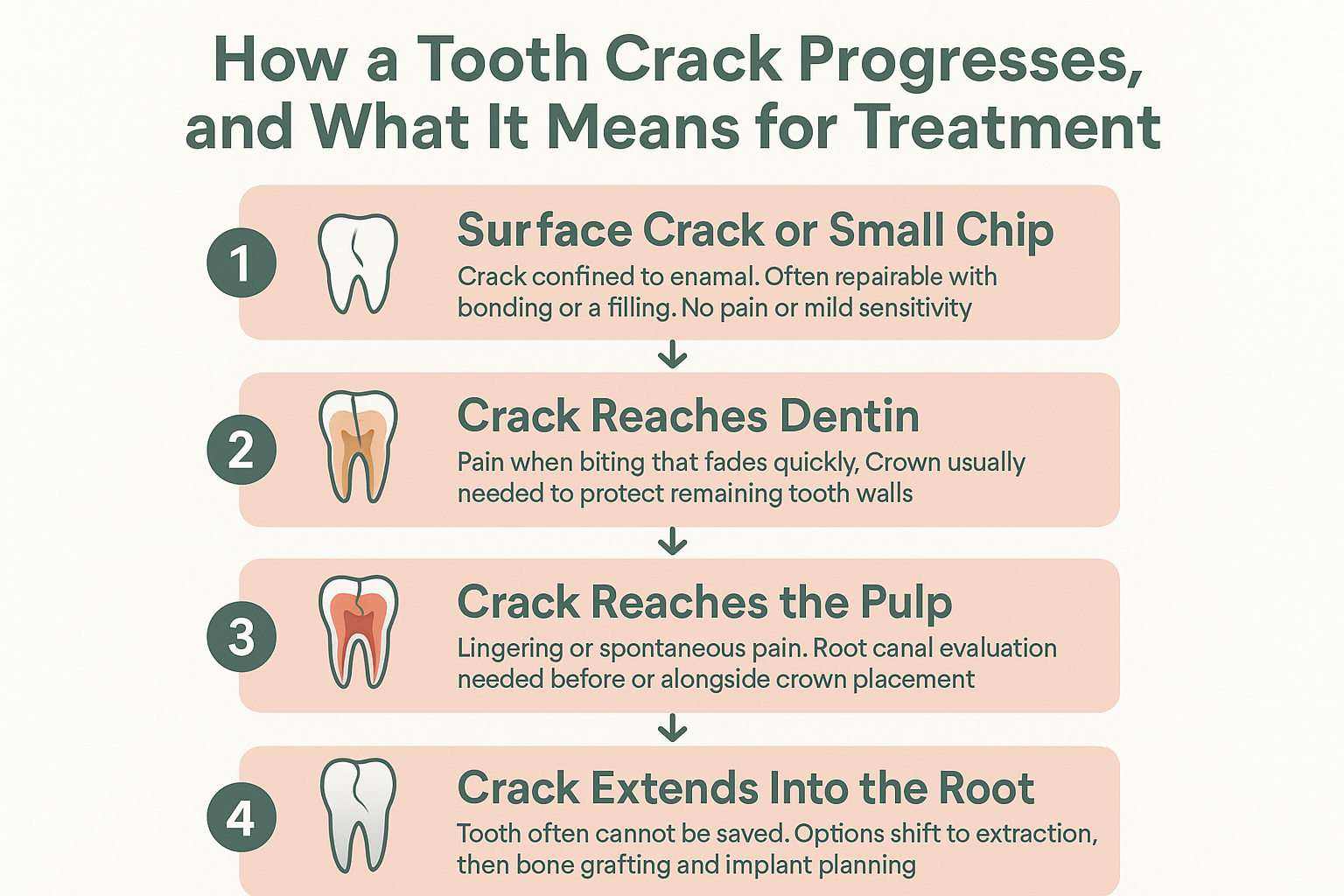
This infographic shows the four stages a crack can move through and what treatment looks like at each stage.
Why Timing Matters More Than People Realize
I want to be honest about this without being alarmist, because patients deserve the full picture.
A crack that is still confined to the visible part of the tooth, what dentists call the crown of the tooth, is almost always manageable with a crown. The repair is predictable, recovery is straightforward, and the tooth is preserved. That is a very different situation from a crack that has been allowed to extend into the root over several months.
Once a crack reaches the root, the tooth often cannot be saved. The options shift to extraction, and extraction introduces a new set of decisions, including the real risk of jawbone loss at the extraction site if it is not addressed. If an implant becomes the path forward, that conversation may also involve bone grafting to rebuild the volume needed to support the implant. For patients curious about what that process looks like, why bone grafting comes up and what it means for your timeline is worth reading.
The repair timeline is something patients have real control over. Getting an evaluation while the crack is still in the early stages almost always means simpler, less expensive treatment and a better long-term outcome for the tooth. For anyone comparing what happens next if a tooth does need to come out, crown vs. bridge vs. implant explains how patients typically work through that decision.
Frequently Asked Questions About Cracked and Broken Teeth
My filling chipped twice. Does that mean the tooth actually needs a crown?
Probably, yes. A filling that keeps failing in the same tooth is usually a sign that the tooth itself does not have enough structural integrity to hold a filling under normal bite pressure. A crown encircles the tooth rather than sitting inside it, which distributes chewing forces very differently. An exam will confirm whether that is what is happening, but repeated filling failures are a strong signal.
I have a broken tooth but no pain at all. Do I still need to see a dentist?
Yes, and the absence of pain does not mean the crack is minor. Many cracks cause no discomfort until they reach the pulp, by which point the treatment is more involved. A dental X-ray and visual exam can show how far a crack has progressed before symptoms develop.
How much does a crown cost in the Renton area?
Crown costs vary based on the tooth being treated, the material used, and your insurance coverage. In general, patients in the South King County area see costs that can range quite a bit depending on those factors. Cedar Dental Group accepts most major PPO dental plans including Delta Dental, Cigna, and MetLife, which can meaningfully offset the out-of-pocket cost. The best way to get a clear number is to call for a consultation, we can check your specific benefits before your appointment.
What if the crack has reached the nerve? Does that mean I need both a root canal and a crown?
Often, yes. When a crack reaches the pulp and the nerve becomes infected or inflamed, a root canal removes the damaged tissue and relieves the pain, but it also leaves the tooth more brittle. A crown placed after the root canal protects and stabilizes what remains. We have an in-house endodontist, Dr. Joe Dutner, who handles root canal care here, so patients do not need to be referred out for that part of the treatment.
I’m nervous about the exam itself. Is that normal?
Very normal. A lot of patients who come in for a cracked tooth have some history of dental anxiety, especially if they have had a bad experience with a previous dentist. We hear this regularly. Going to the dentist when you’re genuinely scared covers what actually helps, it is worth reading before your visit.
Not Sure What Your Tooth Actually Needs?
If you have a cracked, chipped, or broken tooth and are trying to figure out whether it needs a filling, a crown, or something more, the clearest next step is an exam. We serve patients throughout Renton and the surrounding South King County area, Kent, Tukwila, Newcastle, and Burien, and we can usually get a picture of what is happening quickly. Call us at 425-430-0400 or visit cedardentalgroup.com to request a consultation.