

Direct Answer: Telling your dental team about your anxiety before your appointment is the single most useful thing you can do. That one step changes how the entire visit is structured around you.
If you’ve been putting off a dental appointment for months, or years, because the thought of sitting in that chair fills you with dread, this article is written for you specifically. Not for people with mild nerves who just don’t love the dentist. For the person who cancels the appointment, or never makes it in the first place, because the anxiety is genuinely that bad.
We hear from patients across Renton and South King County who’ve gone three, four, even five years without care because of fear rooted in a past bad experience. One person who reached out to us described skipping dental care for about three years because of a few rough visits at a previous practice, combined with anxiety that made every step of scheduling feel like too much to face. That story is more common than most people realize.
There are concrete things that actually help anxious patients get through the door and through the appointment. None of them are vague reassurances. This is what works in practice.
Say Something Before You Arrive, This Is the Most Important Step
The single biggest thing an anxious patient can do is tell the practice about their anxiety before the appointment, not after they’re already in the chair trying to hold it together.
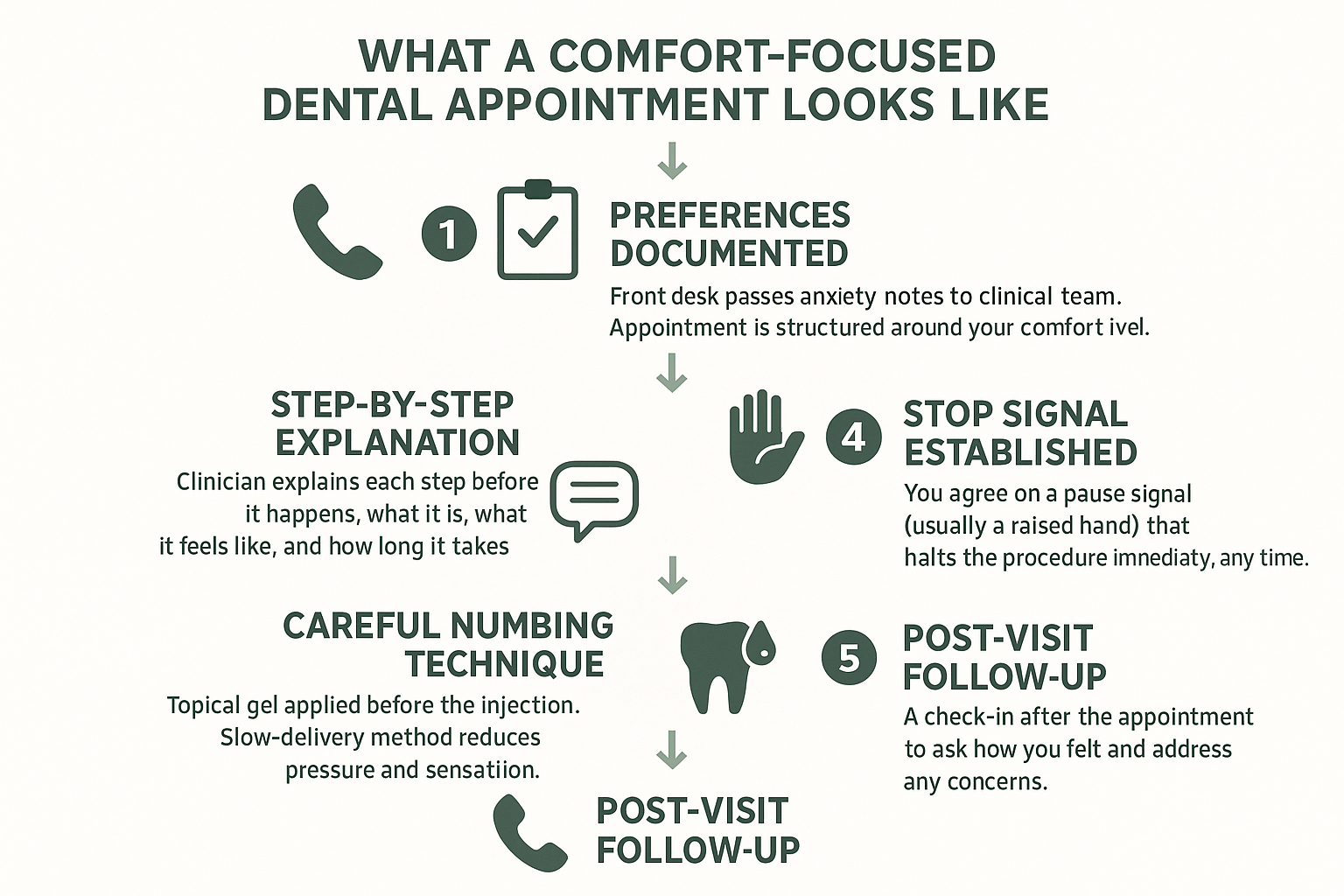
When someone calls or fills out a form and mentions that they have dental anxiety, or a history of bad experiences, that information shapes the entire appointment. At a practice where staff document patient preferences, that note travels from the front desk to the clinical team before you walk in. It changes the pace of explanations, how often the clinician checks in with you, and whether you want to be talked through every step or prefer quiet.
None of that can happen if you say nothing. Many anxious patients white-knuckle through appointments without telling anyone they’re struggling. The team doesn’t know to slow down, check in, or give you a way to pause things.
Specific things worth communicating ahead of time:
– Whether you want each step explained before it happens
– Whether you’d like a signal, like raising your hand, to pause the procedure at any point
– Which parts of dental visits bother you most (sounds, sensations, the feeling of losing control)
– Whether you’d prefer a shorter first visit just to get comfortable before any treatment starts
You don’t have to frame it perfectly. Saying “I have really bad dental anxiety and I’ve been avoiding the dentist” is enough. A patient-focused team works from there.

What ‘Comfort-Focused’ Actually Looks Like During the Visit
Practices that describe themselves as anxiety-friendly say it a lot. What does it actually mean in a real appointment?
From what we do here and what our patients consistently describe, a comfort-focused appointment has a few specific features:
- Being walked through each step before it happens, not just told what procedure is next, but told what it will feel like and how long it takes
- Procedures paused on request, a clear stop signal (usually a raised hand) that the clinician watches for and honors immediately
- Short first appointments, especially for patients who’ve been away for years, a limited first visit focused on getting comfortable with the environment before any major treatment begins
- Follow-up after the visit, a quick check-in to ask how the patient is feeling, which matters more than most practices acknowledge
One patient described her experience this way: Dr. Chu “walked me through every step and explained the procedure, which helped a lot and made me feel way more relaxed. Overall, the whole visit was way easier than I expected.”
Another wrote that he has “really bad anxiety with other dentists” but does “really well” here because the approach is calm and everything is explained thoroughly.
These aren’t unusual outcomes. They’re what happens when anxiety is treated as relevant clinical information rather than a sidebar.
For patients curious about whether a specific practice is genuinely set up for this, how to tell if a dental practice is actually built for anxious patients lays out the concrete markers worth looking for.
The Needle Fear Is Real, and It’s Often Based on Outdated Experience
A lot of dental anxiety comes down to one specific thing: the injection used to numb the area before treatment. And for many patients, that fear is rooted in an experience from years or even decades ago.
Local anesthesia technique has changed significantly. Most offices now apply topical numbing gel to the gum tissue before the injection, which dulls the surface sensation before the needle makes contact. Slow-delivery technique, where the anesthetic is administered gradually rather than quickly, reduces the pressure sensation that many patients associate with pain.
One of our patients who described herself as someone who “really sweats when it comes to needles” wrote that she “hardly felt anything” and was able to relax through the procedure. That’s not an unusual report. It’s a consistent outcome when numbing is handled carefully.
If you’ve avoided the dentist partly because you’re dreading the injection, it’s worth knowing that what you’re anticipating may be very different from the current experience. Telling your clinician specifically that you’re afraid of needles gives them the cue to be especially deliberate about numbing preparation.
The American Dental Association’s patient resources cover the range of anesthesia and comfort options available for dental care.
What a Comfort-Focused Appointment Looks Like, Step by Step
This breakdown shows how a thoughtfully structured dental visit differs for an anxious patient versus a standard appointment flow.
The Shame About Avoiding the Dentist Is Something We Need to Address Directly
One pattern keeps anxious patients away longer than almost anything else: the belief that a dentist is going to judge them for how their teeth look after years of avoidance.
This fear is real and it makes sense. If you’ve avoided dental care for three or four years, you may assume that walking in means walking into a lecture. You expect to be made to feel bad about the gaps in care, about the state of your teeth, about whatever damage accumulated while you stayed away.
That’s not how a patient-focused practice operates.
One patient who came in needing significant restorative work specifically because of long-term avoidance wrote about finding the practice non-judgmental and transparent about costs and treatment options from the start. Another wrote that they were “met right where they were at”, not where someone thought they should be.
What we’re interested in is your oral health right now, and what makes sense to address going forward. The years before you walked in are context, not a verdict.
If you’ve been away for a long time and aren’t sure what to expect, you haven’t been to the dentist in years, here’s what to expect walks through the process honestly, including what a first visit after a long gap typically involves.
And if tooth pain is part of what finally pushed you to make an appointment, tooth pain that won’t go away: when to wait and when to call now helps you sort out urgency before you even pick up the phone.
Anxiety Level vs. What Type of Support Actually Helps
Dental anxiety exists on a spectrum. The right support depends on where you are on it, here’s a practical guide.
| Anxiety Level | What It Looks Like | What Tends to Help Most |
|---|---|---|
| Mild nervousness | Uncomfortable but able to complete visits | Clear explanations, calm pace, check-ins during treatment |
| Moderate anxiety | Often delays or cancels appointments | Communicating anxiety ahead of time, stop signal, short first visit, topical numbing preparation |
| Significant fear | Avoids the dentist for years at a time | All of the above, plus building trust over multiple shorter visits before longer treatment |
| Severe dental phobia | Cannot complete visits without support | Conversation with the clinician about sedation options or phased care, what’s available varies by practice |
Sedation Isn’t the Only Option, and Most Patients Don’t Need It
A lot of anxious patients assume that sedation is the answer they’re looking for. And for a smaller group of patients with severe phobia, it can be genuinely useful.
But most people with dental anxiety, including people who’ve avoided the dentist for years, get through appointments fine with thoughtful standard care rather than sedation. The comfort comes from pace, explanation, trust in the clinician, and the stop signal, not from being sedated.
Sedation also has real considerations: it usually costs more, it requires someone to drive you home, and it doesn’t address the underlying anxiety for future visits the way positive experiences do.
The most useful question to ask isn’t “do you offer sedation?” It’s “how do you handle anxious patients?” The answer tells you whether the practice actually has a structured approach or is just saying what sounds reassuring.
If you’re weighing your options and trying to understand what to look for in a Renton-area practice, what makes a dentist feel less intimidating and the best dentists for dental anxiety in Renton are both worth reading before you decide.
Frequently Asked Questions About Dental Anxiety
What should I actually say when I call to make an appointment as an anxious patient?
You don’t need a script. Saying something like “I have pretty bad dental anxiety and I’ve been avoiding the dentist for a while” is enough. The front desk will note it and pass that information to the clinical team. From there, the appointment can be structured around your pace, your preferences, and what you need to feel safe.
Is it embarrassing to admit I haven’t been to the dentist in years?
No. A patient-focused practice is not there to evaluate your history or make you feel bad about gaps in care. Patients come in all the time after three, four, or five years away, often because anxiety or a previous bad experience kept them from going back sooner. What matters is where things stand now and what makes sense to address going forward.
I’m scared of the needle specifically. Is there anything that actually helps with that?
Yes. Topical numbing gel applied to the gum tissue before the injection is standard at patient-focused practices, and it makes a real difference. Slow-delivery technique further reduces the sensation. Many patients who describe themselves as needle-phobic are surprised by how little they feel. Tell your clinician specifically that needles are your main concern, that cue changes how the numbing process is handled.
Can I ask to stop or pause during a procedure if I need to?
Yes, and you should establish that signal before the procedure starts, not try to figure it out mid-appointment. A raised hand is the most common stop signal. Any clinician taking anxiety seriously will acknowledge it clearly before starting and will stop immediately when you use it.
Do I need sedation if I have severe dental anxiety?
Not necessarily. Most patients with significant anxiety, including those who’ve avoided the dentist for years, get through appointments with thoughtful standard care rather than sedation. That said, if your anxiety is genuinely severe and past experiences suggest standard care hasn’t been enough, it’s worth asking the practice directly what options they can discuss with you.
I need a lot of work done. Does that mean I have to sit through a long appointment?
Not all at once. A reasonable approach for anxious patients who need significant treatment is to start with a shorter first visit focused on getting comfortable, then plan treatment in phases. Spreading work across multiple shorter appointments is a real option and worth discussing during your initial consultation.
Ready to Try Again, on Your Terms?
If dental anxiety has kept you away from care in Renton or the surrounding South King County area, Cedar Dental Group is a reasonable place to start. We have experience working with patients who’ve been avoiding the dentist for years, and we take that history seriously rather than brushing past it. You can reach us at 425-430-0400 or visit cedardentalgroup.com to learn more or request an appointment, and when you do, tell us about your anxiety. That’s exactly the kind of information that helps us take care of you the right way.