

Direct Answer: Your first visit back is an exam, X-rays, and a conversation — not a lecture. We assess where things are now and build a plan together. No judgment about the gap.
“I have a long history with the dentist” — that phrase comes up more than almost any other when new patients reach out to us. It doesn’t mean someone neglected their teeth on purpose. It usually means there were bad experiences, life got busy, insurance ran out, or a little anxiety turned into a lot of avoidance. Years go by faster than anyone expects.
We hear this constantly at our Renton practice. Someone finally gets dental coverage through a new job. Someone moves to South King County and decides a fresh start means a fresh dentist. Someone submits a form that says simply, “I haven’t seen a dentist in a long time.” These are the patients I want to speak to directly in this article.
If that’s you — if it’s been three, four, eight, or more years since you sat in a dental chair — this is a straightforward explanation of what your first appointment back actually looks like. Nothing exaggerated, nothing designed to scare you into booking faster.
What Happens at Your First Appointment After a Long Gap
The short version: we look at where things are right now, take X-rays, talk through what we find, and put together a plan that makes sense for your situation. That’s it. No same-day procedures happen without your explicit consent.
Here’s the typical sequence for a returning patient who hasn’t been in for several years:
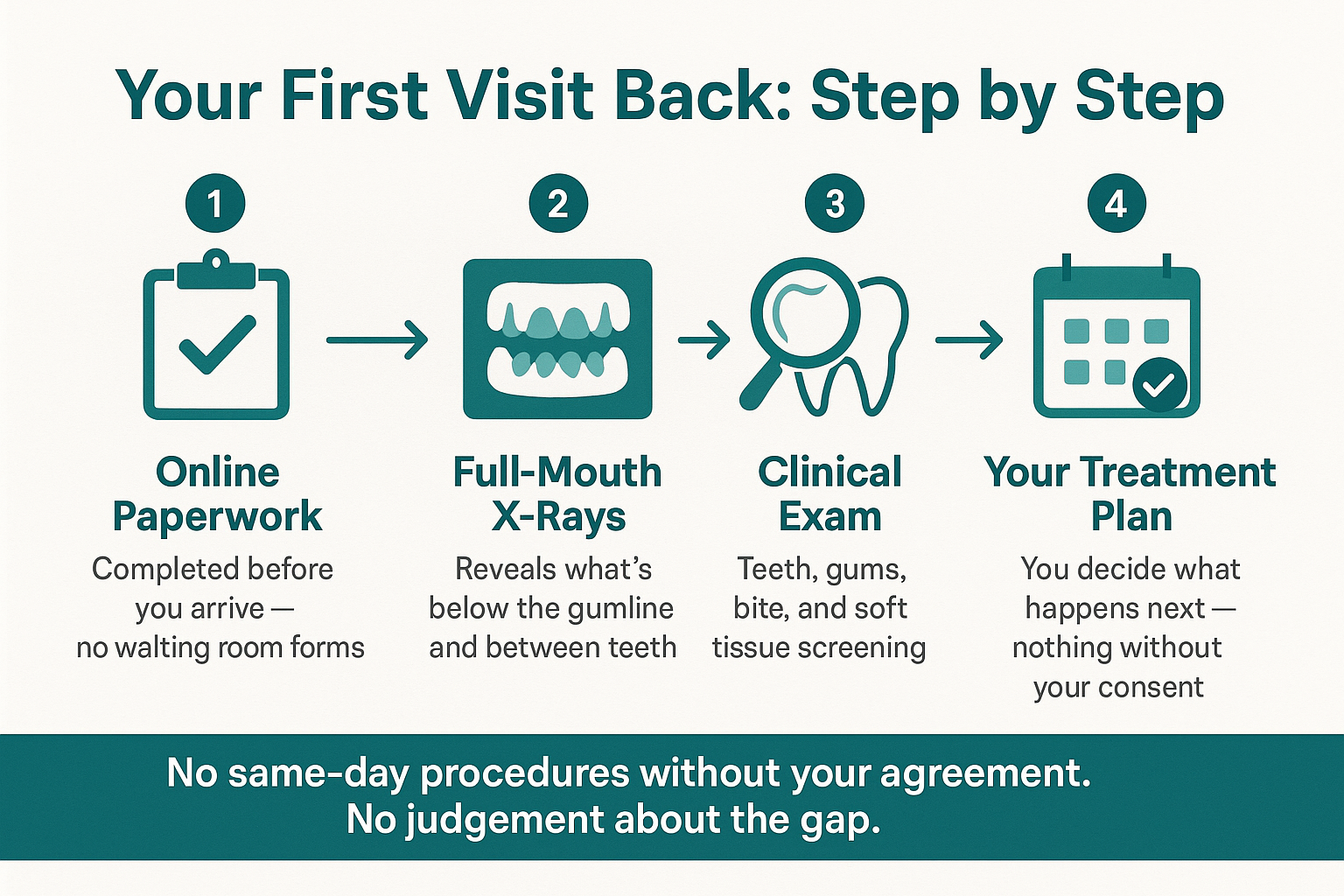
- Check-in and paperwork — most of this is done online before you arrive, so you’re not sitting in the waiting room filling out forms
- Full-mouth X-rays — these give us a picture of what’s happening below the gumline and between teeth, where problems often develop silently
- A gentle clinical exam — Dr. Chu checks your teeth, gums, bite, and soft tissues; this includes a screening for signs of gum disease and oral cancer
- A conversation about what we found — not a lecture, not a list of everything wrong; a clear explanation of what’s there, what needs attention soon, and what can wait
- A treatment plan you help shape — if work is needed, we talk through options, sequencing, and what your insurance is likely to cover before anything is scheduled
For patients who are coming back after a significant gap, we often recommend a deep cleaning rather than a standard prophylaxis — but that’s a conversation, not an assumption. We explain why if we think it’s warranted.

The Judgment Question — Addressed Directly
This is the thing most people are actually worried about, even if they don’t say it out loud. They’re not scared of the drill. They’re scared of being made to feel bad about the gap.
I want to be straightforward about how we approach this: no one on our team is going to comment on how long it’s been, ask why you didn’t come in sooner, or make you feel like you’re behind. The only thing that matters at a first visit is where your oral health stands right now and what we can do from here.
One of our own reviewers put it well: “I hadn’t been to the dentist in more years than I care to admit and I was very hesitant to go here as well. It ended up being the best choice I could have made.” That’s the experience we aim for every time.
Some patients arrive having had genuinely bad experiences before — a dentist who was dismissive, a procedure that hurt more than it should have, or a billing surprise that left a bad taste. If that’s part of your history, telling us about it at the start of your appointment is genuinely useful. It changes how we communicate with you throughout the visit. Understanding what actually makes a dental practice less intimidating can help you know what questions to ask before you book anywhere.
What You Might Actually Find After Several Years Away
Most people who come back after a long absence discover their situation is more manageable than they feared. That said, a few things do tend to show up that wouldn’t be there with regular care:
Tartar buildup is the most common finding. Plaque that isn’t removed by brushing hardens into tartar (also called calculus) within about 24 to 72 hours, and once it’s hardened, brushing alone won’t remove it — only a professional cleaning can. The longer the gap, the more buildup tends to accumulate, particularly along the gumline and behind lower front teeth. If you want to understand the difference between what you can remove at home and what requires a visit, this breakdown of plaque versus tartar is worth reading.
Early gum disease is another common finding. The clinical term is gingivitis when it’s in early stages — inflammation and bleeding along the gum margin. When it’s progressed further, it becomes periodontitis, which involves actual bone loss around the teeth. The American Academy of Periodontology notes that nearly half of American adults over 30 have some form of periodontitis, so finding early signs after a gap in care is not unusual. The key is catching it before significant bone loss occurs.
Cavities that have been sitting are also common. A small cavity found during an exam is typically straightforward to treat. One that’s been progressing for a few years may have reached the pulp of the tooth — which is when a root canal becomes part of the conversation. That’s not a threat; it’s just the clinical reality of what happens when decay goes unaddressed.
None of these findings are automatic. Some patients return after five years with very little that needs attention. Others need more. The only way to know is the exam.
Common Findings After a Long Gap — and What They Usually Mean
This gives a general sense of what different findings typically involve. Every patient’s situation is different, and the exam will give us a much clearer picture than any general guide can.
| What We Find | What It Means | Typical Next Step |
|---|---|---|
| Tartar buildup | Hardened plaque that brushing can’t remove | Professional cleaning (standard or deep depending on severity) |
| Gingivitis | Early gum inflammation — still reversible | Cleaning plus improved home care |
| Periodontitis | Bone loss around teeth — requires active treatment | Scaling and root planing; possible specialist evaluation |
| Small cavity | Decay limited to outer tooth structure | Composite filling |
| Deep decay | Decay near or at the pulp of the tooth | Crown, or root canal evaluation if needed |
| Missing tooth with gap | Bone loss begins within months of tooth loss | Implant, bridge, or other restoration discussion |
What Your First Appointment Back Actually Looks Like
Here’s a step-by-step view of how a returning patient visit typically flows — from check-in to leaving with a plan.
If You Just Got Insurance — This Is the Right Time
A noticeable pattern in the patients who reach out to us: they’ve been meaning to go for years, and getting dental coverage through a new employer finally gave them the push. One caller said it plainly — he had work that needed to get done, had been putting it off, and once he got insurance through work he decided it was time.
That’s a very common and completely valid reason to start. If you have Delta Dental or another PPO plan, a first-visit exam and X-rays are typically covered at or near 100% under most plans. A cleaning is usually covered at the same level. That means your first appointment back may cost you very little out of pocket — though actual coverage depends on your specific plan, and we verify benefits before you come in so there are no surprises at checkout.
One thing worth knowing: if we find that a deep cleaning (scaling and root planing) is needed rather than a standard prophylaxis, that’s billed differently and your coverage share may be different. We explain that before any treatment begins. If cost is a concern, saying so at the start of your appointment means we can build a plan that’s realistic for your situation — including sequencing treatment across multiple visits if needed.
When More Specialized Care Comes Into the Picture
Most patients returning after a gap need things that fall squarely within general dentistry — cleanings, fillings, maybe a crown. But sometimes a longer absence means we find issues that benefit from specialist-level care.
For patients with more advanced gum disease, Dr. Jaewon Kim — our board-certified periodontist — handles that care in-house. If gum recession is present, gum grafting is one of the procedures he performs here, without a referral to a separate office. For patients with deep decay where the tooth’s pulp has been affected, Dr. Joe Dutner is our in-house endodontist — he handles root canal therapy here. If you’ve ever wondered how the decision between a root canal and other options actually gets made, that article walks through the clinical reasoning clearly.
Having both specialists on-site matters for patients who’ve been away a while. It means that if we find something during your exam that would normally require a referral somewhere else in Renton or Seattle, we can often handle it here — same practice, same records, same team you’ve already met.
Frequently Asked Questions About Coming Back After a Long Gap
Will the dentist or hygienist comment on how long it’s been?
No. We’re not there to audit your past decisions. The appointment is focused entirely on where things are now and where we go from here. Patients who’ve mentioned their gap at the start of the appointment consistently tell us it never came up again after that.
How long will the first appointment take?
For a returning patient, plan on roughly 60 to 90 minutes for a first visit that includes X-rays, a full exam, and a cleaning if your gum health allows for it that same day. If findings suggest a deeper cleaning is needed, we may schedule that as a separate appointment to allow adequate time.
What if I have anxiety about dental visits?
Tell us before you come in — and tell the front desk when you arrive. It genuinely changes how we approach the appointment: slower pace, more check-ins, stopping when you need a break. We have patients who’ve written that they’d had bad experiences elsewhere and were hesitant, and ended up saying the visit was the best dental experience they’d had. If you want to think through what to look for in a practice before booking, this guide on finding a dentist built for anxious patients covers the specifics.
What if I haven’t been in eight or ten years — is it going to be really bad?
It might be more involved than a routine visit, but “bad” isn’t the right frame. Some patients who’ve been away a decade have surprisingly manageable situations. Others have more to address. We won’t know until we look, and the exam itself is gentle. Whatever we find, we explain it clearly and give you options — you’re never pushed into a decision on the spot.
Can I just get a cleaning without the full exam?
In most cases, a cleaning without an exam isn’t something we can do responsibly for a new or returning patient. The exam tells us what kind of cleaning is actually appropriate — a standard prophylaxis or a deeper scaling. Skipping the exam would mean cleaning without knowing whether it’s adequate or whether there’s something else that needs attention first.
What if work gets found that I can’t afford right now?
We sequence treatment by priority. Some findings are urgent; others can wait three to six months without significant progression. We’ll be transparent about which is which so you can make decisions based on real information. We also work with patients on phasing treatment across time to fit within what insurance covers and what’s manageable out of pocket.
Ready to Get Back on Track?
If it’s been a few years — or more — the first step is just booking the exam. We see patients from across Renton and the surrounding South King County area, including Kent, Tukwila, Newcastle, and Burien, many of whom came in after long gaps and left with a clear plan and a lot less anxiety than they expected. You can reach Cedar Dental Group at 425-430-0400 or visit cedardentalgroup.com to request an appointment — the form takes about two minutes, and someone from our team will follow up to confirm your insurance and get you scheduled.
