

Direct Answer: Medicare Advantage dental benefits can change each plan year. Read your plan’s Annual Notice of Change before the October 15 to December 7 window to see what your 2027 dental coverage actually pays.
Every fall I take the same call. Someone in Renton tells me their plan card says it includes dental, and they are not sure what that actually means until a crown, a deep cleaning, or a denture lands on the treatment plan.
Medicare’s Annual Enrollment Period runs October 15 through December 7, 2026. Anything you change in that window takes effect January 1, 2027.
My honest take: the most useful thing you can do before October 15 is not shop for a new plan. It is spend twenty minutes with the notice your current plan already mailed you, because that document is where a dental benefit quietly shrinks or moves tiers. Below I will walk through what to read, why the numbers move year to year, and the four questions that decide what a benefit is worth once you are in the chair.
What Medicare Advantage Dental Coverage for 2027 Actually Is
Original Medicare, meaning Parts A and B, does not pay for routine dental care. Cleanings, fillings, crowns, and dentures sit outside it.
Medicare Advantage plans add dental as a supplemental benefit. That is the part printed on your card, and it comes in two very different shapes.
- A flat allowance. The plan gives you a set pot of money for the year, sometimes a few hundred dollars, sometimes more. You spend it until it is gone.
- Percentage coverage by category. This behaves more like a traditional PPO plan. Preventive care may be covered at a high percentage, major services at a lower one, with an annual maximum on top.
Those two structures look similar on a brochure and behave nothing alike at a front desk. An allowance of a few hundred dollars disappears fast against a crown. A percentage plan might pay a slice of several procedures across the year.
For scale: roughly 65 percent of Medicare beneficiaries, close to 37 million people, have no dental coverage at all. Among those who do use dental services, widely cited analyses put average annual out-of-pocket spending somewhere around $922.
So a modest benefit is still worth understanding. It just needs to be measured against what you are actually likely to need, not against the word “included” on a card.

The Annual Notice of Change Is the Document That Matters
Medicare Advantage and Part D plans send out an Annual Notice of Change, usually by the end of September. Most people glance at the premium line and set it down.
That notice is where next year’s dental terms live. Pull last year’s schedule of benefits out of the drawer and compare these lines side by side:
- The dental allowance amount, and whether it resets yearly or quarterly. A quarterly allowance that does not roll over behaves very differently than an annual one.
- Whether dental shares a pot with vision and hearing. Combined allowances get spent on glasses before anyone thinks about a crown.
- Which tier each service sits in. Cleanings and exams usually sit in preventive. Crowns, dentures, periodontal treatment, and root canal therapy usually sit in a major services tier with a lower payment level.
- Copays per service, line by line, not just the headline number.
- Network changes. Provider lists get trimmed between plan years.
- Waiting periods on major services, which can run several months after your start date.
Plan mailings vary in timing and format, so confirm the current year’s enrollment dates and your own plan details directly on Medicare’s official site. If you want a broader primer on how plan structure drives what gets paid, I wrote about what your dental card controls in Washington separately.
Allowance vs. Percentage Coverage: How They Behave Differently
Both show up as “dental included.” Here is how each one tends to play out across a year of actual care.
| What you are checking | Flat dental allowance | Percentage-based coverage |
|---|---|---|
| Cleanings and exams | Draws down the same pot as everything else | Often covered at a high percentage, sometimes fully |
| Crowns and dentures | Can consume the full allowance in one visit | Paid at a lower percentage, subject to an annual maximum |
| Periodontal treatment | No separate category, same pot | Usually sits in a major or specialty tier |
| When it runs out | When the dollars are spent, with nothing left for the year | When you hit the annual maximum |
| Provider choice | Varies; some plans restrict where the allowance can be used | Depends on whether the network is open PPO or closed |
Why the Dental Allowance Moves From One Year to the Next
This part makes the year-to-year changes make sense, and almost nobody explains it.
CMS rates Medicare Advantage plans on quality using a star system. Plans that score four stars or higher earn bonus payments.
That bonus money frequently funds the extras: dental, vision, and hearing. When a plan’s rating or its underlying economics shift, the supplemental benefits are often the first thing adjusted.
So a dental allowance is not a fixed promise attached to the plan name. It is a line item that moves with the plan’s finances.
That is why picking a plan once and leaving it alone for six years tends to backfire. The plan you chose in 2021 may have a meaningfully different dental section in 2027, and the only notice you get is the one in the mail each September.
Four Questions That Decide What a Dental Benefit Is Really Worth
Our callers ask these questions, just usually in the wrong order. Answer them in this sequence before you enroll.
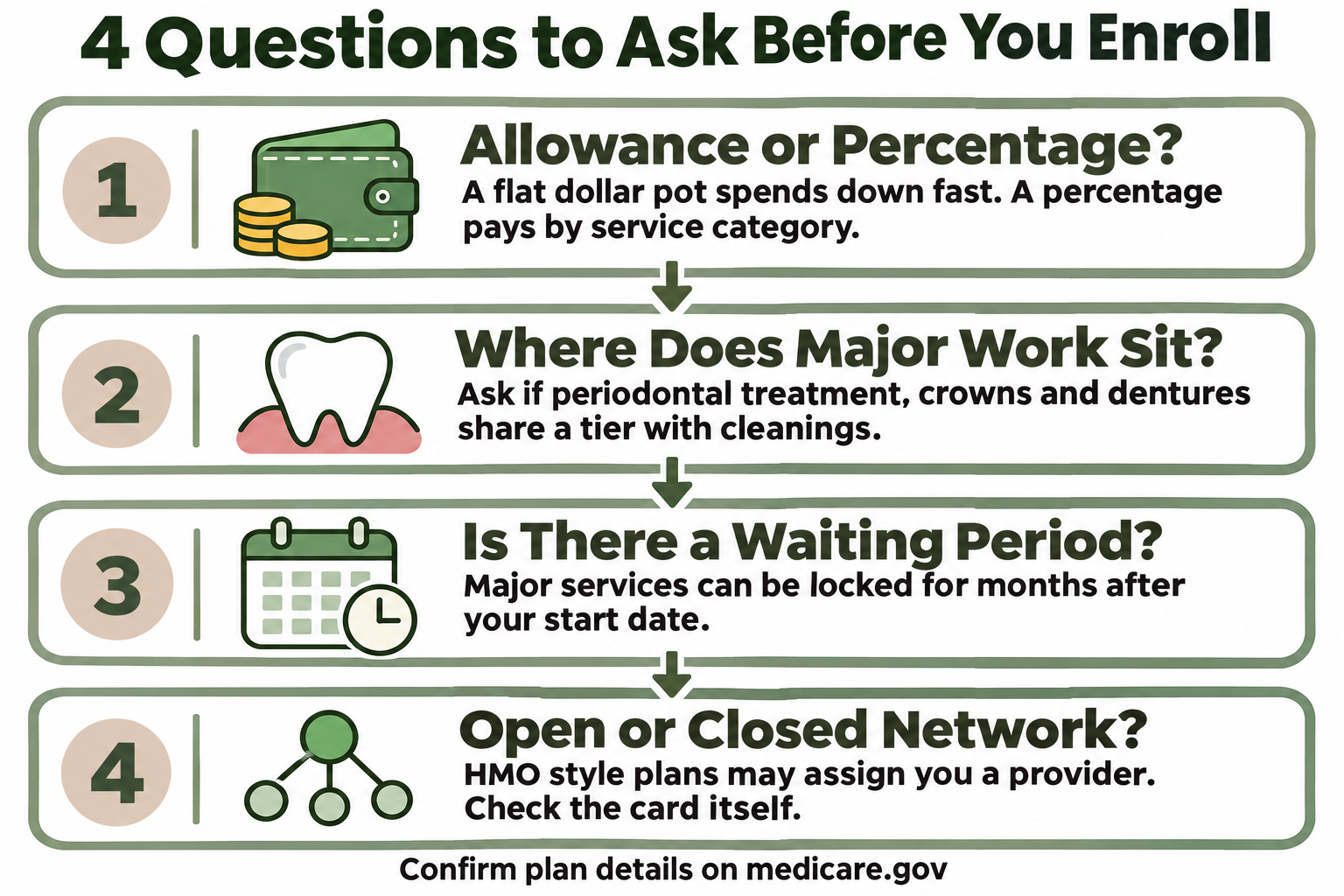
What Happens When the Benefit Meets the Chair
Here is where I see the gap between what people expect and what the plan does.
We hear from callers whose plan turns out to be HMO style with an assigned provider. They found us through reviews or the sign near Walgreens, they are ready to come in, and the plan sends them somewhere specific instead. That is worth checking on the card before enrollment, not after.
The other gap is category placement. A gum graft for recession, periodontal surgery for advanced gum disease, and bone grafting to rebuild jaw structure are three separate procedures for three separate conditions, and plans do not always treat them the same way. Root canal therapy sits in its own category again. I have written more on how coverage gets decided for a gum graft if that is your situation.
On cost, I will be straight with you. We do not quote plan-specific dollar figures from the outside, because an allowance, a tier, and a network status all change the answer.
What turns a rough range into a real estimate is an exam and X-rays. That is what tells anyone which tooth needs what, and which procedure codes end up on the estimate. If you want to see how those codes drive the final number, the D-code breakdown walks through it.
We are glad to look at a benefit breakdown with a patient before anything gets scheduled. Reading it together beats guessing at it alone.
Frequently Asked Questions About Medicare Advantage Dental Coverage
When exactly do I need to act for 2027 coverage?
The Annual Enrollment Period runs October 15 through December 7, 2026, and changes take effect January 1, 2027. Your plan’s Annual Notice of Change usually arrives by the end of September, which gives you a couple of weeks to read it before the window opens. Plan mailings vary, so confirm dates on medicare.gov.
My card says dental is included. Isn’t that enough to know?
Not really. “Included” can mean a few hundred dollars a year shared with vision and hearing, or it can mean percentage coverage with an annual maximum. The structure is what determines whether the benefit helps with a cleaning, a crown, or neither.
Does a Medicare Advantage dental allowance work like a PPO plan?
No. An allowance is a pot of money you draw down until it is empty. A PPO pays a percentage by service category, so preventive care might be covered at one level and major work at another, up to an annual cap. The two can look similar in a brochure and feel completely different at the front desk.
What if I don’t have any dental coverage at all?
You are in a large group. Roughly 65 percent of Medicare beneficiaries have no dental coverage. Plenty of people in Renton, Kent, and Tukwila pay out of pocket and plan their care in stages, and third party payment plans are available for patients without a dental plan.
Can you tell me what my specific plan will pay before I come in?
We verify benefits directly with the plan rather than guessing from a plan name, and we can review a breakdown with you. The honest limit is that an exact figure for a crown or a periodontal procedure still depends on what the exam and X-rays show.
Want Help Reading Your Dental Benefit Before the Window Closes?
If you live in Renton or anywhere around South King County and your plan notice is sitting unopened on the counter, we are happy to look at the dental section with you. Our team verifies benefits directly with the plan rather than guessing, we accept most major PPO dental plans, and third party payment plans are available for patients without dental coverage. You can reach Cedar Dental Group at 425-430-0400 or at cedardentalgroup.com to ask a coverage question.
