
Direct Answer: Most patients feel significant tenderness for the first 3-5 days after gum grafting, return to desk work within 2-3 days, and feel close to normal by the end of week two.
For most patients, the procedure itself isn’t what holds them back from agreeing to a gum graft. It’s the recovery. What will eating look like? How many days will I need off work? Will I be in real pain, or just uncomfortable? These are the questions we hear most in the days before surgery — and the answers patients find online are often either too vague to be useful or alarming enough to make things sound worse than they are.
This article walks through what gum grafting recovery actually looks like, day by day, over the first two weeks. We’ll cover what changes between week one and week two, what the donor site feels like (and why it’s often more noticeable than the graft itself), and what to eat when your options feel very limited. If you’re a working adult in Renton trying to figure out how this fits into your schedule, this is written for you.
If you’re still weighing whether you need a graft at all, How Do I Know If My Gum Recession Is Serious Enough To Need A Gum Graft? is a good place to start before reading this one.
The First 48 Hours: What’s Normal, What to Watch For
The first two days are the most restricted part of recovery — and also the part that causes the most anxiety going in. Understanding what’s actually happening in your mouth makes the experience a lot easier to manage.
Right after the procedure, you’ll leave with gauze in place and likely some numbness from the local anesthetic that can last 3-5 hours. Once that wears off, tenderness sets in. Most patients describe it as a sore, pressure-like feeling rather than sharp pain — similar to how your mouth feels after a deep cleaning, but more localized.
Expect some swelling, particularly along the cheek near the grafted site. This typically peaks around day 2 or 3 and then gradually resolves. Mild bruising on the outside of the face is also possible, especially for patients with lighter skin.
A few things to keep in mind during these first 48 hours:
- Do not use a straw. The suction can disrupt the graft before it starts bonding.
- No rinsing forcefully. Gentle saltwater rinses may be recommended, but swishing hard can disturb clotting.
- Keep your head slightly elevated, even while sleeping, to reduce swelling.
- Avoid any physical activity — even a moderately brisk commute can increase blood flow and disrupt early healing.
- Cold, soft foods only — more on this in the diet section below.
Medication is part of the picture too. Most patients are given a prescription anti-inflammatory and sometimes an antibiotic. Taking these on schedule, even before the numbness fully wears off, makes a real difference in how comfortable day two feels.
The Part Most Patients Don’t Expect: The Donor Site
When patients picture discomfort after a gum graft, they usually focus on the area where the graft was placed — the spot along the gumline where recession was visible. But for many patients, the roof of the mouth ends up being the more noticeable source of sensitivity.
Most gum grafts use tissue taken from the palate (the roof of your mouth). This is called a connective tissue graft or a free gingival graft, depending on what layer of tissue is harvested. The palate is used because the tissue there is dense and adapts well to the grafted site. But it does create a second surgical wound, and that wound is constantly involved in basic functions — swallowing, speaking, eating.
A protective dressing is placed over the palate to keep it covered and reduce friction. This dressing acts like a bandage and typically stays in place for the first week or so. While it’s there, you may notice that your speech sounds slightly different — a mild thickness or tendency to slur certain sounds. This is completely normal and resolves as the dressing is removed and the tissue heals. Most patients find it’s barely noticeable to others even when it feels obvious to them.
The palate heals relatively quickly — it has a strong blood supply — but it tends to feel raw and tender for days 3 through 7 before it starts to calm down noticeably.
Some patients receive donor tissue from a tissue bank instead of from their own palate. This is called an allograft, and it eliminates the second surgical site entirely. Recovery is generally more comfortable for these patients because there’s only one healing area to manage. The tradeoff is that outcomes between palate-derived and bank-derived tissue are similar for many cases, but not identical — Dr. Kim will explain which approach is appropriate for your specific situation based on the recession pattern and your anatomy.
If you want more background on what gum recession looks like before it reaches the point of needing a graft, Gum Recession: How to Tell If It’s Getting Worse — and What Stops It covers that well.
What to Eat for Two Weeks: A Real Guide, Not a One-Liner
“Eat soft foods” is the advice you’ll find everywhere. It’s not wrong, but it doesn’t actually help you plan meals for two weeks when your palate is tender and you’re trying to get enough to eat.
Week one is the most restricted. The goal is food that requires almost no chewing, won’t irritate the surgical sites, and won’t require suction to eat or drink. Temperature matters too — cold and cool foods reduce inflammation, while hot foods increase blood flow to the area and can disrupt healing.
Foods that work well in week one:
- Greek yogurt (plain or lightly sweetened, not fruit-chunk style)
- Scrambled eggs (soft, not browned)
- Ripe banana, avocado, soft melon
- Smooth hummus, mashed potatoes without skins
- Cool broth-based soups — sipped from a spoon, not a straw
- Soft tofu, cottage cheese
- Protein shakes blended smooth with no seeds or chunks
Foods to avoid entirely during week one:
- Anything crunchy — crackers, chips, granola, raw vegetables. Even small crumbs can lodge in the surgical site.
- Acidic foods — citrus, tomato-based sauces, vinegar. These irritate healing tissue.
- Alcohol — it’s a blood thinner and can delay healing. Also avoid alcohol-based mouthwash.
- Spicy foods — they increase inflammation.
- Chewy foods — bread, meat that requires pulling or tearing, gummy textures.
Week two is noticeably easier for most patients. Swelling has largely resolved, the palate dressing is usually removed, and the grafted site is beginning to integrate. Most patients can add soft-cooked pasta, soft fish, scrambled eggs with toppings, and well-cooked grains back into their rotation.
The shift back to a full normal diet — including raw vegetables, crusty bread, and anything that requires biting through — typically happens around weeks 4-6, once Dr. Kim confirms the graft has taken and the tissue is stable.
Week-by-Week Recovery at a Glance
Every patient heals differently, but this general timeline gives a realistic picture of what to expect during the first two weeks of gum graft recovery.
| Timeframe | What You’re Likely Feeling | Activity & Diet Notes |
|---|---|---|
| Hours 1-6 | Numbness fading, mild pressure beginning | Cold soft foods only; rest at home; no driving if sedated |
| Days 1-2 | Peak tenderness, possible mild swelling | Soft cool diet strictly; no physical exertion; work from home if possible |
| Days 3-5 | Palate site often most noticeable now; swelling beginning to ease | Same diet restrictions; desk work typically manageable by day 3 |
| Days 6-7 | Tenderness reducing; dressing may still be in place | Some patients add soft-cooked foods; follow-up appointment likely |
| Week 2 (Days 8-14) | Significantly more comfortable; palate visibly healing | Soft diet continues but wider variety; most patients feel close to normal |
| Weeks 4-6 | Graft integrating; tissue firming up | Return to normal diet after clearance from periodontist |
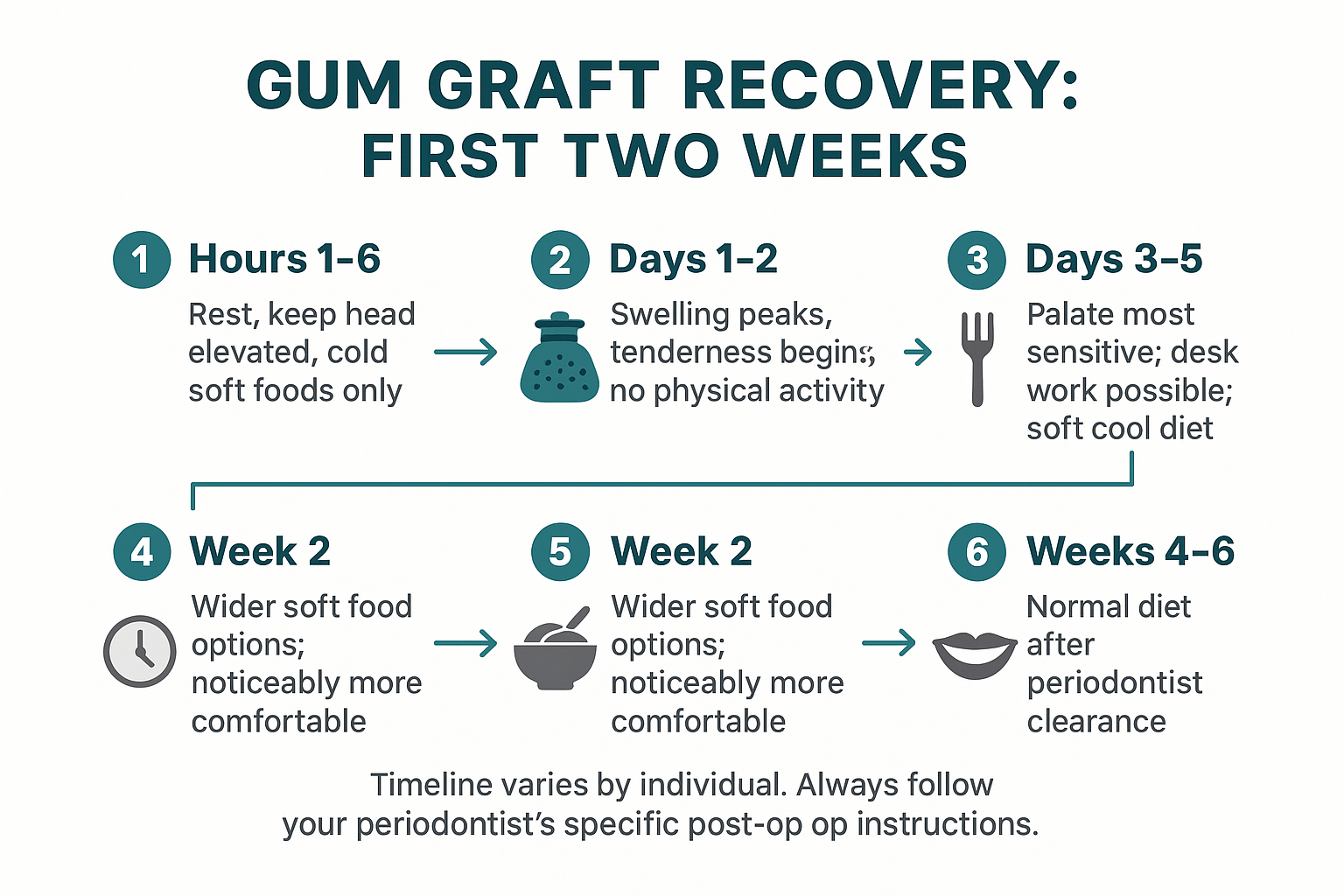
How the Two Weeks Break Down
This infographic summarizes the key milestones in gum graft recovery — from the first day through the end of week two.
Planning Around Work: How Much Time Do You Actually Need?
This is a practical question, and it deserves a direct answer. Most Renton patients who work desk jobs — office roles, remote work, roles where you’re primarily at a computer — are back at work within 2 to 3 days. Day one is a rest day. Day two is usually manageable at home with medication on board. By day three, most people are functional enough to sit through a workday.
If you have a physically demanding job — construction, nursing, any role that keeps you on your feet and moving — plan for closer to 5 to 7 days before returning. Physical activity raises blood pressure and increases blood flow to the surgical site, which can slow healing and increase swelling during the first week.
For public-facing roles — sales, teaching, healthcare, anything requiring extended speaking — the palate dressing in week one may create mild speech changes that are noticeable to you even if subtle to others. Some patients describe it as a slight thickness in certain sounds, particularly “s” and “th.” It resolves fully once the dressing is removed and the palate heals, but it’s worth factoring into your schedule if clear speech is part of your job.
If dental anxiety is part of your experience and you’re already managing some apprehension about the procedure itself, How to Tell If a Dental Practice Is Actually Built for Anxious Patients may be worth reading before your appointment. Knowing what to expect — and feeling confident in who’s performing the procedure — genuinely changes how recovery feels.
Who Performs Your Graft Matters More Than You Might Think
Gum grafting is a surgical procedure. The skill of the person placing the graft directly affects how the tissue heals, how the site looks long-term, and how your recovery goes. A graft that is placed with precision — the right depth, the right tension, the right suturing — heals more predictably than one that isn’t.
Board certification in periodontology requires three years of post-doctoral residency training beyond dental school, including extensive surgical experience specifically in gum and bone procedures. Not every dentist who performs grafts holds this credential.
For patients in Renton who would otherwise need a referral to a separate specialist across town — or into Seattle — having a board-certified periodontist available in-house simplifies the entire process. Your general dentist, your periodontist, and your recovery care are all coordinated in one place. That matters especially when post-operative questions come up, because your provider already knows your case.
For more background on what the gum grafting process involves before recovery begins, Receding Gum Grafting Surgery: A Patient’s Guide is a thorough overview worth reviewing before your consultation.
Frequently Asked Questions About Gum Graft Recovery
How much pain is normal after a gum graft?
Most patients describe the discomfort as moderate and manageable, not severe. The first 2-3 days are the most uncomfortable. Prescription anti-inflammatories and, when appropriate, pain medication keep most people comfortable. Sharp or worsening pain after day 4 or 5 is worth calling your periodontist about — it can occasionally signal an issue with the graft site that needs attention.
Can I brush my teeth after surgery?
You’ll be given specific instructions, but generally — avoid brushing the surgical site directly for at least the first week. You can brush other areas of your mouth carefully. A prescription antimicrobial rinse is usually recommended to keep the area clean without mechanical contact.
What if my palate dressing falls off early?
Call the office. It doesn’t automatically mean something has gone wrong, but Dr. Kim will want to know so he can assess whether the site needs to be recovered or is far enough along to heal without it.
Will the graft look different from my natural gumline when it heals?
There’s often a slight difference in color or texture initially — the grafted tissue can look a bit paler or thicker than the surrounding gum. For most patients, this blends in significantly over 3-6 months as the tissue integrates and the blood supply establishes. The functional result — protected tooth roots, a stable gumline — is the primary goal, and the cosmetic result typically improves with time.
Is recovery different if I got donor tissue instead of my own palate tissue?
Yes, meaningfully so. If you received tissue from a tissue bank (allograft), there is no second surgical site. Recovery tends to be more comfortable overall because only one area is healing. You’ll still follow similar diet and activity restrictions, but the palate-related discomfort — the sensitivity, the dressing, the speech changes — won’t apply to you.
When will I know if the graft actually worked?
Your periodontist will evaluate the graft at your follow-up appointments. By weeks 4-6, it’s usually clear whether the tissue has integrated well. Full maturation — where the graft looks and functions like natural gum tissue — can take 3-6 months. The early sign that things are going well is simply that the tissue stays in place, stays pink and firm, and the area doesn’t hurt when gently touched.
Have Questions Before You Commit to a Graft?
Dr. Jaewon Kim, our board-certified periodontist, performs gum grafting in-house at Cedar Dental Group — so patients in Renton and across South King County don’t need a separate referral or a trip into Seattle to see a specialist. If you’re weighing whether a graft is the right next step, or you just want to understand what the process looks like for your specific situation, we’re happy to walk through it with you. Call us at 425-430-0400 or visit cedardentalgroup.com to schedule a consultation.
