

Direct Answer: A waiting period delays coverage on major work by time. A missing tooth clause can exclude a tooth that was already gone when your plan started, no matter how long you wait.
You picked a plan during open enrollment in the fall. The card showed up, coverage started January 1, and the gap where a molar used to be is finally going to get handled. That is the reasonable assumption, and it is the one I hear most often on the phone.
Then the estimate comes back and the implant is still sitting at full price. Not because anyone made a mistake, but because two different contract rules are doing two different jobs, and almost nobody reads them as separate lines.
Insurance is the single most common question we get asked before anything else. So let me pull those two rules apart: the waiting period on major services, and the missing tooth clause. One delays you. The other can exclude a specific tooth permanently.
Waiting Periods and the Missing Tooth Clause Are Two Separate Rules
Patients tend to collapse both into one vague idea: my insurance should cover this. The plan booklet treats them as unrelated provisions, printed in different sections, sometimes pages apart.
Here is the practical difference:
- A waiting period is about time. Many plans delay benefits on major services such as crowns, bridges, and implants for roughly 6 to 12 months after your effective date. Preventive visits usually start right away.
- A missing tooth clause is about a specific tooth. If the tooth was already gone on the day your coverage began, the plan may never pay to replace it, no matter how many years you stay enrolled.
- Neither one cancels the other. You can clear a 12 month waiting period and still get a denial on tooth number 19 because of the clause.
That combination is what catches people. Someone enrolls in a new plan specifically to fix a gap, waits patiently through the delay, then learns the delay was never the obstacle.
If you want the broader picture of how plan design works in this state, we walk through it in how dental insurance works in Washington.
What the Missing Tooth Clause Actually Says
This is the rule that surprises people most, and the one worth understanding precisely.
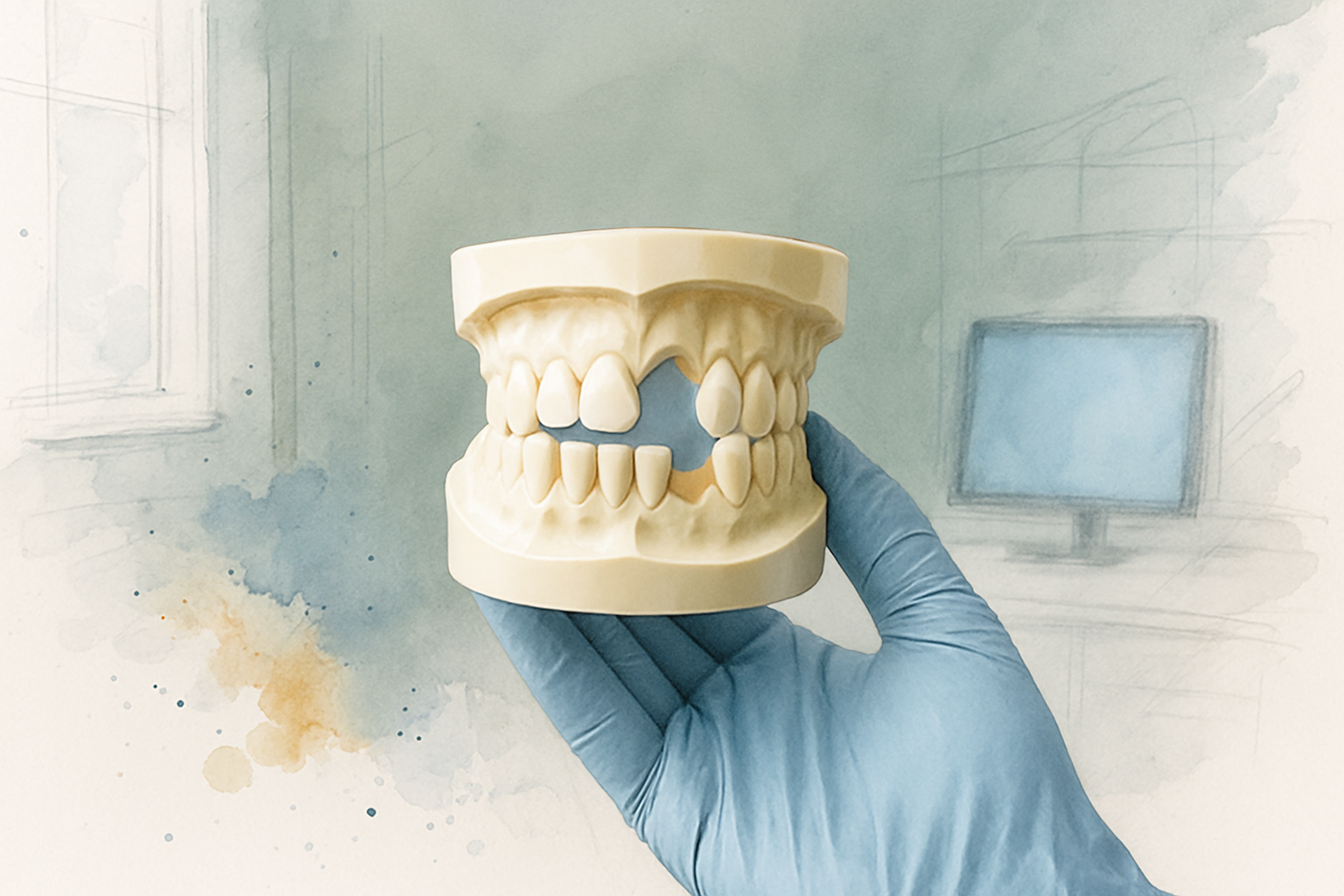
A missing tooth clause excludes payment for replacing a tooth that was already missing on the date your coverage started. The key detail: it follows the tooth, not the procedure. Switching your plan from a bridge to an implant does not get around it, because the exclusion is attached to the space, not the treatment code.
The good news is that this clause is common but far from universal. Billing sources indicate a large share of plans carry it, while some carriers write plans with no missing tooth exclusion at all. Others waive it when you can document continuous coverage with no meaningful gap between your old plan and the new one.
So call member services and ask three specific questions:
- Does my plan include a missing tooth clause?
- Does it apply to this tooth number? (Have the number ready. Your dentist can give it to you.)
- Does proof of prior continuous coverage waive it, and what documentation do you need?
Ten minutes on the phone beats a guess. Plans differ enough that the answer genuinely varies from one card to the next, even between two coworkers at the same employer who chose different tiers.
Waiting Period vs. Missing Tooth Clause at a Glance
These two provisions get mixed up constantly. This is the short version of how each one behaves.
| Question | Waiting Period on Major Services | Missing Tooth Clause |
|---|---|---|
| What triggers it | Your plan’s effective date | The date the tooth was lost |
| What it limits | When coverage starts | Whether a specific tooth is covered at all |
| Typical length | Often 6-12 months, varies by plan | No time limit, it can apply indefinitely |
| Does switching procedures help | No, it applies to the category | No, it follows the tooth, not the treatment |
| Can it be waived | Sometimes, with prior continuous coverage | Sometimes, with documented continuous coverage |
| Who confirms it | Member services and your plan booklet | Member services, in writing, by tooth number |
A Verbal Yes Is a Starting Point. A Written Pre-Determination Is Protection.
The most useful thing you can do before any major work begins is request a pre-determination of benefits. It is a formal request your dental office submits to your carrier before treatment, asking in writing what the plan will pay.
What goes in:
- The tooth number in question
- The exact procedure code being proposed
- The date the tooth was lost, when that matters
- Supporting X-rays or scan images
- Any documentation of prior continuous coverage
What comes back is a written response with a reference number and a date, showing the estimated plan payment, the patient portion, and any exclusions that apply. That document is what holds up when a claim is actually processed in March.
Local reviews of dental billing frustration tend to follow one shape: someone was told a service should be covered, then received a denial months later, and came away telling everyone to get it confirmed in writing first. I agree with that advice completely.
Think of a pre-determination as something you can request, not something that happens to you. Ask for it by name. We cover the full process in how to check what your dental plan will pay before you sit in the chair.
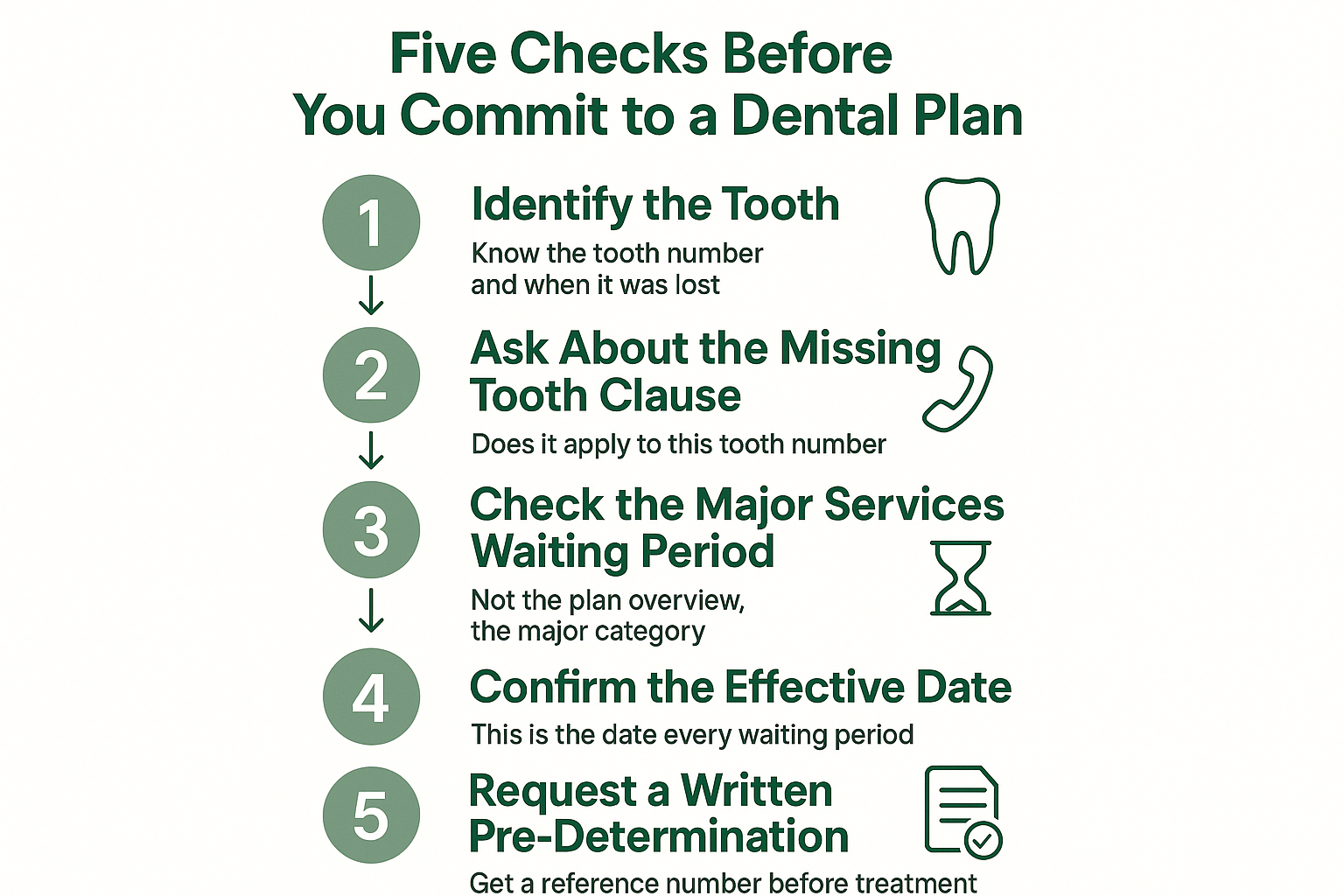
The Five Checks to Run Before You Commit
Run these in order, before you pick a plan and before you schedule major treatment.
Sequencing Is the Real Skill: Annual Maximums and Benefit Years
Once you know what the plan will and will not pay, the next question is order of operations. This is where a good treatment plan earns its keep.
Most PPO plans cover major services at roughly half the allowed amount, up to an annual maximum that commonly lands somewhere in the $1,000 to $2,000 range. That cap resets with the benefit year. Those two numbers together determine what belongs in December and what belongs in January.
Here is the move most people have not considered. When a case involves an extraction, a bone graft, healing time, and then a restoration, the clinical timeline already spans months. Splitting that across two benefit years can be a coverage decision rather than a clinical delay:
- Extraction and socket preservation graft in one benefit year
- Healing period through the reset
- Implant placement and the crown in the next benefit year
Two annual maximums instead of one, with no rushing of the biology. The implant timeline when a bone graft is part of the plan walks through what those healing windows actually look like.
On cost, I will not pin a number to your case from a blog post. What I can tell you is what moves it: tooth position, whether grafting is needed, the materials chosen for the final restoration, and which specialist performs which step. The actual breakdown of what goes into implant cost covers each of those variables. An exam and a written estimate are the only way to get a real number.
I talk to people in Renton every week who are price-shopping after a quote from another office, which is completely fair. Renton’s median household income sits just above one hundred thousand dollars, so this is a market that can fund major treatment. People here want the sequence explained before they commit, not a discount.
The Enrollment Calendar and the Treatment Calendar Collide in the Same Six Weeks
Employer open enrollment around here runs largely through October and November. Washington Healthplanfinder’s window opens November 1, and signing up by December 31 gives you a January 1 start date, which you can confirm on the state’s Healthplanfinder coverage page.
That January 1 effective date is what starts the clock on every waiting period in the plan. Pick the plan without knowing which tooth is at issue, and you may spend a year waiting on a benefit that was never going to apply.
Renton has a lot of benefits-carrying employers. The Boeing 737 final assembly plant is the city’s largest employer, and health care and manufacturing sit among the top employment sectors, so fall benefit changes hit a big share of patients here all at once.
We also hear from people whose longtime dentist recently went out of network, which forces the plan question and the provider question into the same month. If that is you, how PPO network changes affect your coverage is a useful read before you choose.
And no, there is no judgment here about how long it has been since your last visit. The gap is just a fact to work around.
Frequently Asked Questions About Waiting Periods and Missing Tooth Clauses
If my tooth was pulled after my new plan started, does the missing tooth clause still apply?
Generally no. The clause targets teeth that were already missing on your effective date. If the extraction happened while you were covered under the current plan, replacement is usually eligible, subject to waiting periods and your annual maximum. Confirm it in writing anyway.
Can I get around the clause by choosing a bridge instead of an implant?
No. The exclusion follows the tooth, not the procedure. If tooth number 19 was gone before coverage started, the plan is excluding the replacement of that space regardless of whether you choose a bridge, a partial, or an implant.
How long does a pre-determination take to come back?
It varies by carrier, but two to six weeks is a common range. That is one more reason to start the conversation in the fall rather than the week you want treatment. The response includes a reference number, which is the part that matters later.
Does a waiting period reset if I change plans?
Often yes, which catches people who switch carriers mid-treatment. Some plans credit prior continuous coverage and shorten or waive the wait. Ask specifically whether your months under the previous plan count, and get the answer documented.
Is it worth enrolling at all if the implant will not be covered?
Frequently, yes. Even when the replacement itself is excluded, a plan may still cover the extraction, the graft, cleanings, periodontal therapy, and restorative work on other teeth. Run the math on the whole treatment plan rather than the single procedure.
Thinking Through a New Plan and an Old Gap?
When coverage forces work to be staged across two benefit years, it helps to have the surgical and restorative steps planned by one team rather than coordinated between separate offices on separate timelines. Our Renton practice has a board-certified periodontist on staff for grafting and implant placement and a board-certified endodontist in house for root canal care, and we accept most major PPO plans, with Cherry and Sunbit options for work that falls outside coverage. As one patient put it, “They are transparent on the costs and offered many different payment options” (Joe T.). Benefits can be verified and a pre-determination submitted before anything is scheduled, and you are welcome to talk it through at 425-430-0400 or at cedardentalgroup.com.
