
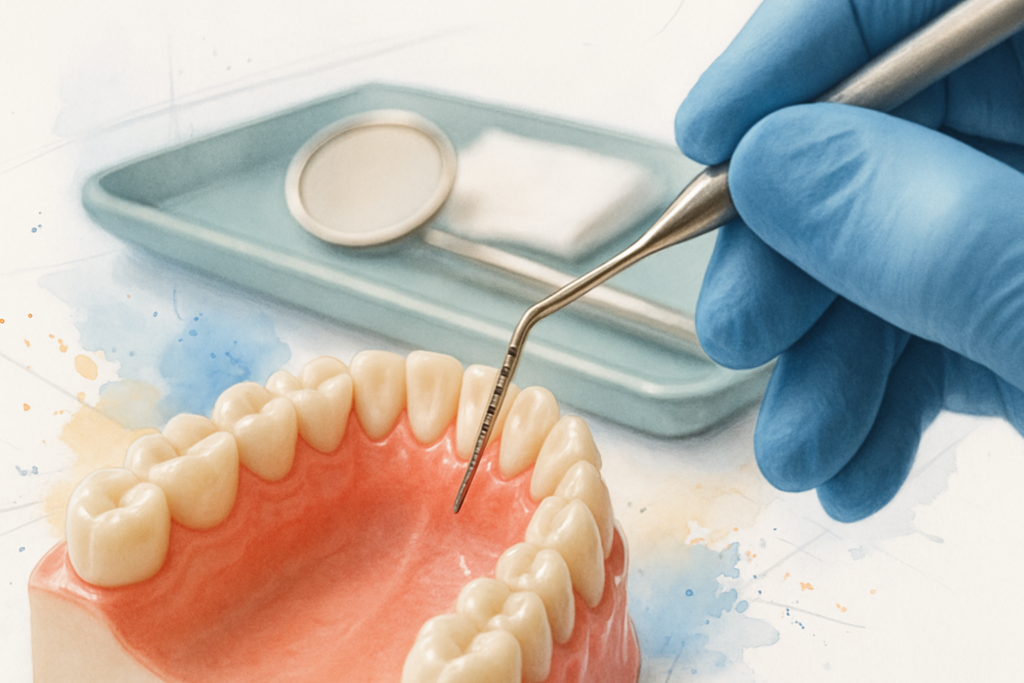
Direct Answer: Those numbers are gum pocket depths in millimeters, measured at six spots per tooth. Roughly 1-3 mm is cleanable at home, 4 mm is a watch area, and 5 mm or deeper usually needs professional help.
You are lying back with a bib clipped to your collar, and someone behind your head starts calling out numbers. Three, two, four. Three, three, five. Then it stops, and nobody translates.
I hear about this constantly from adults in Renton and around South King County. People call asking to book a periodontal cleaning by name without being certain how it differs from a regular one, and others tell me their hygienist keeps bringing up pockets and they cannot tell whether that is a real finding or a nudge toward more treatment.
So let me answer the question most people are too polite to ask out loud. Here is what a periodontal chart records, what the depths generally mean, and who decides what happens next.
What a periodontal chart actually records
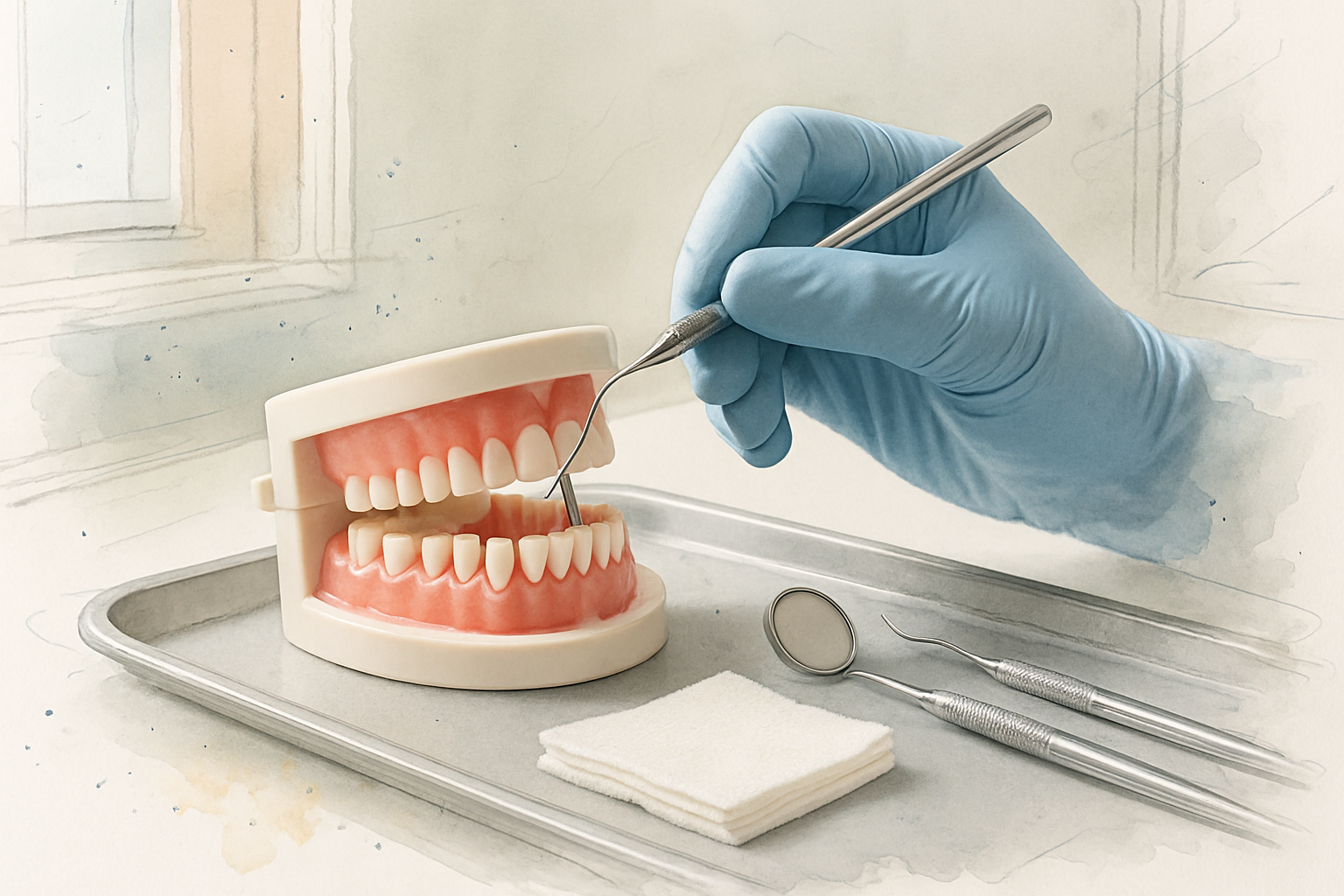
The numbers are millimeters. A slim instrument called a periodontal probe slides gently into the space between your gum and your tooth, and the depth of that space gets written down.
It is measured at six spots per tooth, three on the cheek side and three on the tongue side. With a full set of teeth, that is a lot of individual readings, which is why the process takes a few minutes and sounds like someone reciting a phone number.
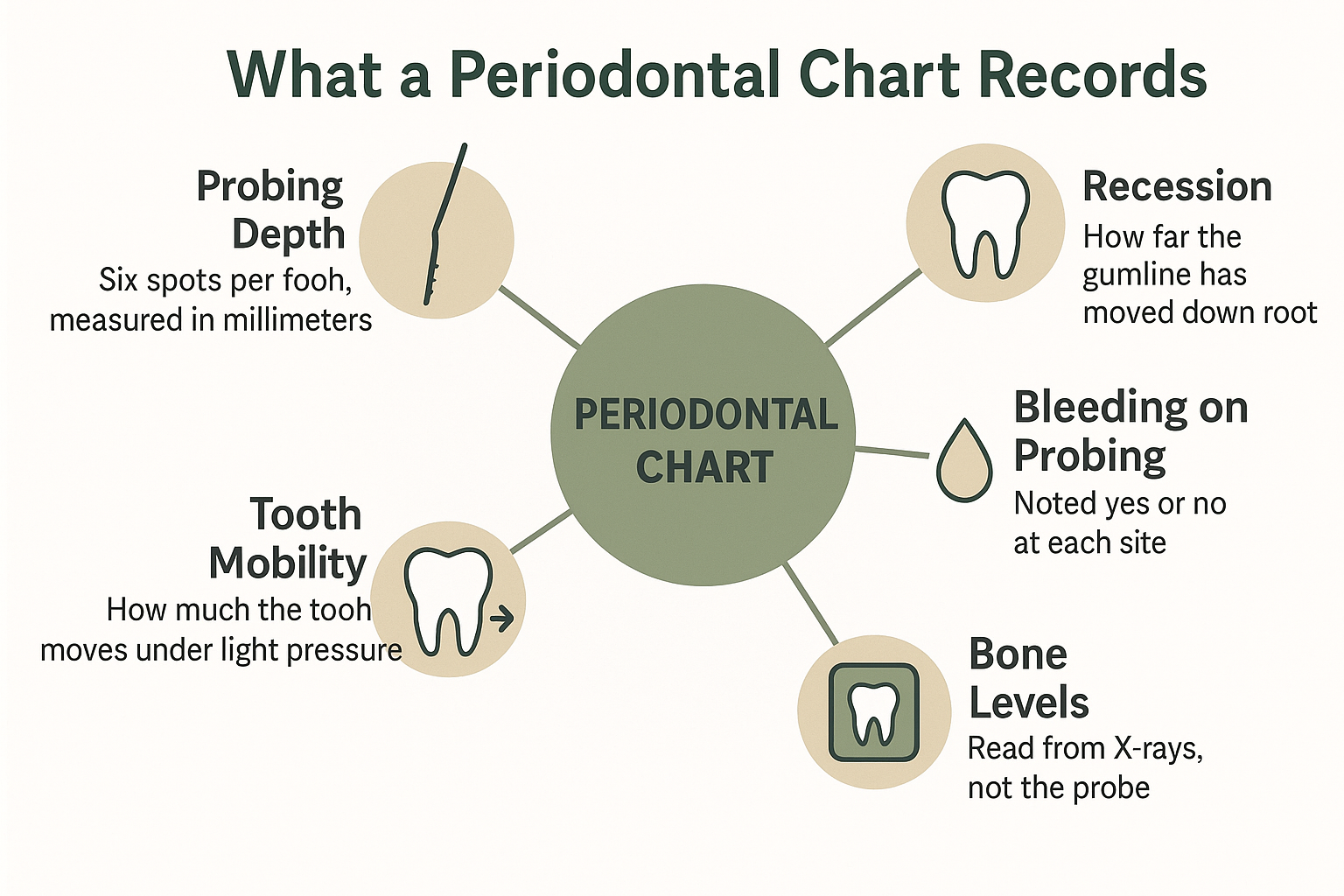
But depth is only one column on the chart. A full periodontal exam also records:
- Recession, meaning how far the gumline has moved down the root compared to where it started
- Bleeding on probing, noted as a simple yes or no at each site
- Mobility, or how much a tooth moves when light pressure is applied to it
- Furcation involvement, which is bone loss between the roots of a molar
- Bone levels, read from your X-rays rather than from the probe
Those last two matter because depth alone can mislead. A pocket can read deep because the gum tissue is swollen and riding high, or because bone underneath has been lost. Those are different situations with different plans.
What the pocket depth numbers generally mean
There is no single cutoff that applies to every mouth, but there are general ranges most clinicians work from.
1 to 3 mm is the range a toothbrush and floss can realistically keep clean at home. Bristles and floss reach the bottom of a shallow pocket, so plaque does not get to sit undisturbed.
4 mm is a watch area. It is not an emergency and it does not mean you did anything wrong, but it sits right at the edge of what home care can reach, especially on back teeth where angles get awkward.
5 mm and deeper is territory brushing and flossing cannot get to. Bacteria settle below the gumline where nothing you do at home disturbs them, which is when professional cleaning below the gum starts getting discussed.
A few things worth knowing about the numbers themselves:
- Readings are rounded to the nearest millimeter, so a 4 and a 5 can be closer than they sound
- Different hands can read the same site slightly differently, which is normal
- Swollen tissue can inflate a reading, and it can drop on its own once inflammation calms down
The National Institute of Dental and Craniofacial Research is a solid plain-language source if you want to read about gum disease outside of a dental office.
How pocket depth readings are usually interpreted
This is a general reference, not a diagnosis. Your own chart gets read alongside bleeding, recession, and bone levels.
| Reading | What it generally suggests | What often follows |
|---|---|---|
| 1-3 mm, no bleeding | Within reach of brushing and flossing | Routine cleaning at your usual interval |
| 1-3 mm, bleeding present | Inflammation without much depth yet | Home care coaching and a re-check |
| 4 mm | Borderline, hard to clean at home | Re-measured at the next visit to see the direction |
| 4 mm with bleeding, several sites | Active inflammation in reachable-but-not-quite territory | Closer monitoring or a conversation about deeper cleaning |
| 5 mm or deeper | Beyond what home care reaches | Scaling and root planing discussed, X-rays reviewed for bone |
| 6 mm or deeper with bone loss | Advanced, often localized | Periodontal evaluation to judge the best path forward |
Why context matters more than any one number
This is the part that almost never gets explained in the chair, and it is the part that keeps people from panicking over a single reading.
One isolated 5 mm behind a back molar reads very differently than 5s showing up across the whole mouth. A single deep spot tucked behind a wisdom tooth area, where a toothbrush rarely arrives at a clean angle, is often a local access problem. Fives scattered through every quadrant point to something more general.
Bleeding changes the picture too. A 3 mm site that bleeds every time it is touched can matter more than a quiet 5 mm site that never bleeds. Bleeding is the sign that the tissue is actively irritated right now, while a calm deep pocket may be a stable scar from something that already happened years ago.
What usually triggers a re-measure rather than a change in plan:
- A handful of new 4s with little or no bleeding
- Readings that moved by one millimeter, which can be measurement variation
- Swelling tied to a recent illness, a new medication, or a stretch of skipped flossing
What usually triggers a real conversation about the plan:
- Multiple 5s and 6s, especially in more than one area of the mouth
- Bleeding at most sites rather than a few
- X-rays showing bone that sits lower than it did at the last full set
The chart also drives scheduling. When pockets and bleeding are widespread, cleanings often move to a shorter interval, which is why some patients end up on a three-month cleaning rhythm instead of the twice-a-year pattern they grew up with.
The five things on a periodontal chart
Depth gets all the attention, but it is one of five measurements that get recorded and read together.
Who is reading the chart, and what a periodontist adds
This is where people get genuinely confused, and I understand why.
Your general dentist and hygienist gather the measurements and interpret them. They are the ones who spot the trend, decide whether a site gets watched or treated, and set your cleaning interval.
A periodontist reads the same chart differently. They are looking at depth alongside the bone loss pattern on your X-rays to judge whether non-surgical care is actually holding, or whether the numbers have stopped responding. That judgment call is the whole reason the specialty exists.
Here is the local wrinkle. When people in Renton search for a gum specialist, the results often push them toward practices in Bellevue, Tacoma, or Silverdale. So a lot of patients around South King County assume that once their numbers get worse, a referral across the water or down I-5 is the automatic next step, with a new set of X-rays and a wait of several weeks before anyone explains anything.
It does not have to work that way. In our office the chart is read by Dr. Jaewon Kim, a board-certified periodontist, in the same building where the measurements were taken. The recession column on that same chart is also what a specialist looks at when discussing whether tissue coverage is worth talking about, though that is a separate conversation from the depths themselves.
What to do with this at your next cleaning
You do not need to memorize anything. You just need to ask for the information, which almost nobody does.
- Ask for your numbers out loud. A simple “can you tell me where my deepest spots are?” gets you a real answer in about thirty seconds.
- Ask for a printed or emailed copy of the chart. It is your record. Offices produce it routinely.
- Compare this year to last year. The trend line tells you far more than any snapshot does.
A mouth that was mostly 3s and is now mostly 3s with two 4s is a stable mouth. A mouth that was mostly 3s and is now speckled with 5s is telling you something changed, and it is worth asking what.
One more practical note. If deeper cleaning does come up, the treatment codes on your estimate and what your plan covers are their own puzzle, and understanding the D-codes on a dental estimate makes that conversation a lot shorter. Costs for periodontal treatment vary widely depending on how many quadrants are involved and what your plan allows, so treat any number you see online as rough context and ask your own office for an itemized estimate.
Frequently Asked Questions About Periodontal Exam Numbers
Is a 4 mm pocket bad?
Not on its own. 4 mm is a watch area, right at the edge of what brushing and flossing can reach. One or two 4s with no bleeding usually just get re-measured at your next visit to see which direction they are heading.
Why does my hygienist keep mentioning pockets? Is that a sales push?
It is a real clinical finding that gets written into your chart at every periodontal exam, and it is measured the same way in every office. The honest way to tell is to ask for the actual numbers and a copy of the chart. If someone recommends treatment, the readings should back it up, and you should be able to see them.
What is the difference between a regular cleaning and a periodontal cleaning?
A regular cleaning works at and just above the gumline. Scaling and root planing, which people call a deep cleaning, cleans the root surface below the gumline where a pocket of 5 mm or more puts bacteria out of reach. After that, cleanings often shift to a shorter interval to keep the depths from creeping back.
Can pocket depths get better, or are the numbers permanent?
Depths can improve, especially when the reading was driven by swollen, inflamed tissue rather than lost bone. Once bone is gone it does not grow back on its own, but the pocket can still become healthier and easier to maintain. That is why bleeding and bone levels get read alongside the depth.
Do I automatically need to see a periodontist if my numbers go up?
No. Plenty of charts improve with non-surgical care and a tighter cleaning schedule. A periodontal evaluation makes sense when depths stay deep after treatment, when bone loss shows a pattern, or when surgery is one of the options worth weighing.
Want your own numbers explained?
If you have been hearing depths called out for years without anyone walking you through them, you are allowed to ask. We are happy to go over a chart and explain what the readings mean for your situation, and having a board-certified periodontist on-site in Renton means the measurements, the interpretation, and any surgical opinion stay inside one plan rather than getting handed to a separate office weeks later. You can reach Cedar Dental Group at 425-430-0400 or read more at cedardentalgroup.com.
