

Direct Answer: Out of network with a PPO means your dentist has no contracted fee schedule with your plan. You usually still have real benefits, but the estimate is built off the office’s full fee.
Before anyone asks me about comfort, scheduling, or what a cleaning involves, they ask one thing first: do you take my insurance? Roughly one in five calls to our front desk opens with that exact question, and callers name plans by name. Delta Dental PPO comes up far more than any other, followed by GEHA, Humana, UnitedHealthcare, and Cigna.
One message that came through our website this summer said nothing else at all. Just a short line asking whether we see patients with Delta Dental. That is the real gate, and everything else waits behind it.
This fall that question got harder to answer from memory, because more dentists across the country left at least some PPO networks in 2026 than in any recent year. If you live in Renton or anywhere in South King County and you are picking a plan for next year, here is what network status actually changes, and how to check it before you commit.
Why More Dentists Went Out of Network in 2026
The American Dental Association’s economic research found that by the first quarter of 2026, about 22% of dentists had already dropped out of at least some insurance networks that year. Late in 2025, roughly 35% said they intended to. So the intent was higher than the follow-through, but the direction is clear.
The stated reason is not complicated. Contracted reimbursement rates have not kept pace with what it costs to run a practice, and at some point the math on a given contract stops working.
That pressure is not abstract in Renton. Commercial rent near downtown, hygienist wages competing with Seattle and Bellevue offices, lab fees, and supply costs all moved in the same direction over the last few years.
None of this makes insurers or other practices villains. It just means one thing for you as a patient:
- You cannot assume last year’s network status carries into next year.
- A practice that was in network on your 2026 plan may not be contracted for 2027.
- Carriers also restructure networks, so the change can come from either side.
That is worth knowing in October, not in March when you are already sitting in the chair.

Three Situations People Constantly Blur Together
Most of the confusion I hear on the phone comes from treating three very different situations as if they were one. They are not, and sorting them out is the single most useful thing you can do before you pick a plan.
In network. The practice has signed a contract with that carrier and agreed to a set fee schedule. Your share is calculated off those contracted fees.
Out of network, PPO. No contract, but the practice can still bill the plan on your behalf, and in most cases you still have real benefits. This is the one people misread as “not accepted,” and it costs them good options.
A plan that will not work at all. A DHMO or HMO card typically assigns you to one specific provider, and that provider is printed right on the card. If an office is not your assigned provider, they cannot treat you under that plan no matter how much everyone wants it to work. Apple Health and some state managed plans work on similar assignment rules.
We had a caller this summer whose longtime dentist went out of network with Regence, and she went looking for someone new while assuming out of network meant she would pay everything herself. It usually does not. If you want the full breakdown of what your card controls, we walked through it in PPO, DHMO, or Apple Health.
What Your Card Is Actually Telling You
Pull out your card before open enrollment closes and match it against this. The plan type is usually printed near the top or on the back.
| What the card shows | What it means at the front desk | What to verify |
|---|---|---|
| PPO, practice is contracted | Your share is figured from a contracted fee schedule | That the contract is active for the coming plan year, not just the current one |
| PPO, practice is not contracted | The office can still bill the plan; benefits usually still apply | Coinsurance percentage, deductible, annual maximum, and the plan’s allowed amount |
| DHMO or HMO with an assigned provider listed | Only that assigned provider can treat you under the plan | Whether the plan allows you to change your assigned provider, and when |
| Apple Health or a state managed plan | Coverage is limited to contracted providers and covered procedures | Which offices in South King County are contracted, directly with the plan |
The Out-of-Network PPO Math, in Plain Numbers
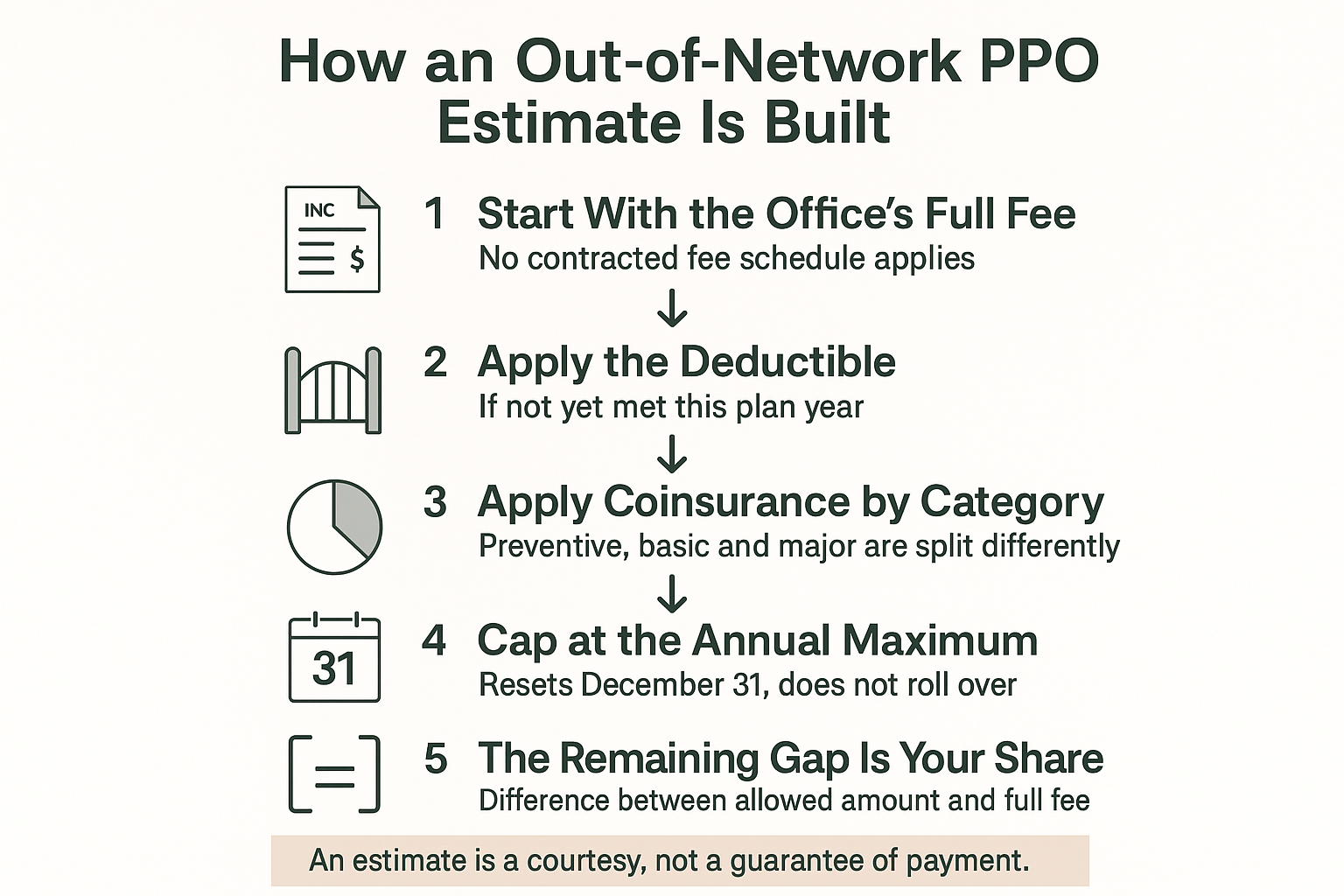
Here is how an estimate gets built when a practice is out of network with your PPO. Nothing about it is hidden, but almost nobody explains the order of operations.
1. The office starts from its full fee for the procedure, not a contracted rate.
2. The plan applies your deductible if you have not met it yet for the year.
3. The plan applies its coinsurance percentage for that category of treatment. Preventive, basic, and major work are usually split at different levels, and major work is typically covered at the lowest percentage.
4. The plan caps its total payout at your annual maximum.
5. Whatever sits between the plan’s allowed amount and the office’s full fee is the part you may owe on top.
That last line is the whole ballgame. On a cleaning the gap is usually small enough that people barely notice. On a crown, an implant, or periodontal surgery, it is the number worth knowing before you sit down.
And it is an estimate, not a bill. Per the ADA’s guidance on out-of-network billing, any estimate is a courtesy based on the information the carrier supplies, and it is not a guarantee of payment.
Which is exactly why I push people to get a written pre-treatment estimate with the procedure codes on it for anything beyond a cleaning. If the codes on that estimate look like a foreign language, we broke down what D-codes mean in a separate piece.
How an Out-of-Network PPO Estimate Gets Built
This is the sequence a benefits coordinator runs through when your plan has no contracted fee schedule with the office.
Why This Is a Fall Question, Not a Spring One
The calendar is the reason to sort this out now. Three enrollment windows stack up in the same few weeks:
- Washington Healthplanfinder open enrollment for individual plans runs November 1 through January 15.
- Most employer open enrollment lands in October and November.
- Medicare’s Annual Enrollment Period runs October 15 through December 7, with changes effective January 1.
Renton skews heavily toward benefits-carrying employment. With the Boeing 737 final assembly plant anchoring the city and health care and manufacturing among the largest local employment sectors, a big share of the people reading this are staring at a plan comparison sheet right now.
One more piece of timing. Calendar-year maximums expire December 31 and do not roll over. If you already have treatment planned and unused benefit sitting there, that is a separate decision from which plan you pick for next year, and we covered it in how to use PPO benefits before they reset.
Picking a plan without checking network status for the coming year is how people end up surprised in February.
A Verification Sequence You Can Run Yourself
This takes about fifteen minutes and saves a lot of frustration. Run it in this order.
- Read the card first. Find the plan type, and look for an assigned provider name or clinic number. If one is printed there, you are likely on a DHMO or HMO and the rules are different.
- Call the carrier’s member line. Ask specifically whether the practice is contracted for the coming plan year, not the current one. Those are two different answers and the rep will not volunteer the distinction.
- Ask the dental office to verify your benefits directly. A good front desk will run it while you are on the phone and tell you the coinsurance split, the deductible, and what is left of your annual max.
- For anything beyond a cleaning, request a written pre-treatment estimate with the procedure codes. Crowns, implants, root canal therapy, gum grafting, and bone grafting all belong in this category.
One warning worth taking seriously: a carrier’s online network directory can lag months behind reality. I have seen listings still showing practices that dropped a network, and listings missing practices that joined one. That is why two-sided verification beats trusting a website.
If the outcome is that you are changing offices, moving your records is more straightforward than most people expect. We walked through that process in switching dentists in Renton.
Common Questions About Out-of-Network PPO Dental Coverage in Washington
If my dentist goes out of network, do I have to find a new one?
No. With a PPO, you can keep seeing the same office and the plan will usually still pay a share. What changes is how the estimate is calculated and how much of the fee sits outside what the plan allows. Whether that gap is worth it depends on the work you need and how much you value continuity with a dentist who already knows your history.
Does out of network mean I pay the whole bill myself?
Almost never with a PPO. That assumption is the single most common thing I correct on the phone. You still have a deductible, a coinsurance percentage, and an annual maximum, and all of those still apply.
Can I use my DHMO card at an office that is not my assigned provider?
Not for covered services under that plan. A DHMO or HMO assigns you to one provider, and that assignment is what unlocks the benefit. Some plans let you change your assigned provider, usually effective the first of the following month, so that is the question to ask your carrier.
How far ahead should I check network status for next year?
Before you finalize your election, so during October and November for most employer plans, and anytime from November 1 through January 15 if you are shopping on Washington Healthplanfinder. Contracts turn over at the plan year boundary, so checking in December for a January start is cutting it close.
Is a pre-treatment estimate a guarantee of what I will pay?
No, and any office that tells you otherwise is overpromising. It is built from the benefit information your carrier provides, and the ADA describes it as a courtesy rather than a guarantee of payment. It is still far better than guessing, especially on crowns, implants, and periodontal surgery.
Checking a Plan Before You Enroll?
We accept most major PPO plans, including Aetna, Ameritas, Anthem, Cigna, Delta Dental, GEHA, Guardian, Humana, MetLife, Mutual of Omaha, Premera, Regence, Sunlife, United Concordia, and United Healthcare, and our team can look up your specific benefits over the phone rather than leaving you to guess from a directory listing. For patients without coverage, Cherry and Sunbit payment options are available. If you are in Renton, Tukwila, Kent, Burien, or Newcastle and want a straight answer about a plan before the enrollment window closes, you can reach us at 425-430-0400 or at cedardentalgroup.com.
