

Direct Answer: Washington’s dental loss ratio law requires insurers to spend a minimum share of premiums on patient care and rebate policyholders if they fall short. It does not change how your plan tiers coverage.
The most common question I hear on our phone line is some version of “do you take my insurance?” It is usually the first thing out of someone’s mouth, before they mention the tooth that has been aching for a week.
But the question underneath that question is bigger. Even when a plan is accepted, most patients in Renton have no clear picture of how their benefits apply to different kinds of care. A cleaning, a crown, and a gum procedure are treated very differently by the same plan.
In 2025, Washington passed something called a dental loss ratio law. It is a real change, and it is worth understanding if you are planning bigger dental work in 2026. Below I will explain what it does, why your plan sorts services into tiers, and how that tiering hits periodontal care hardest.
What a Dental Loss Ratio Actually Is
A loss ratio is a simple idea wrapped in insurance language. It is the share of your premium dollars that an insurer spends on actual patient care instead of administration, marketing, and profit.
If a carrier collects $100 in premiums and pays out $60 in dental claims, the loss ratio is 60 percent. The other $40 stays with the company.
Washington was one of four states in 2025 to pass dental loss ratio legislation. The law sets a minimum spending threshold on patient care, and when a carrier falls short, it owes rebates to policyholders.
Here is what that means in practice for someone in South King County:
- Insurers now have to report how much of your premium actually reaches the dental chair
- If they miss the threshold, money comes back to you rather than staying on their books
- Over time, the reporting pressure is meant to discourage plans that collect a lot and pay out a little
What the law does not do is raise your annual maximum, change how your plan categorizes services, or make a gum graft cheaper this year. It is a transparency and accountability measure, not a benefit expansion. I want to be honest about that, because I have seen patients read a headline and assume their coverage just got better.
Why Washington State Dental Insurance Sorts Care Into Tiers
Almost every PPO plan sold in Washington splits dental services into three buckets. The bucket a procedure lands in decides what percentage the plan pays.
- Preventive: exams, cleanings, X-rays. Often covered at or near 100 percent, and on many plans these do not count against your annual maximum
- Basic: fillings, simple extractions, sometimes root canal therapy. Commonly covered around 70 to 80 percent, though this varies by plan
- Major: crowns, bridges, implants, and most periodontal and surgical care. Frequently covered at closer to 50 percent
The tier system is why one caller can ask about a periodontal cleaning and teeth whitening in the same message and assume they are similar purchases. They are not. One is a treatment for gum disease that a plan may partially cover, and the other is elective cosmetic care that plans almost never touch.
If you want a deeper walkthrough of how the mechanics work here, we covered it in how dental insurance works in Washington and where it falls short.
The number that gets people is the annual maximum. Many plans still cap out around $1,000 to $1,500 a year, a figure that has barely moved in decades while treatment costs have climbed. That gap is exactly why the loss ratio conversation started.
How Common Procedures Typically Get Tiered
This is a general picture of how PPO plans in Washington tend to categorize care. Your specific plan document is the only source of truth for your own coverage.
| Procedure | Usual Tier | What That Means for You |
|---|---|---|
| Cleaning and exam | Preventive | Often fully covered, may not count toward your annual max |
| Tooth-colored filling | Basic | Partial coverage, moderate hit to your annual max |
| Root canal therapy | Basic or Major | Varies widely by plan, worth checking before you schedule |
| Scaling and root planing | Major on most plans | Higher cost share, counts against the annual max quickly |
| Crown | Major | Often around a 50 percent share, frequency limits apply |
| Gum grafting, flap surgery, bone grafting | Major | Highest cost share, often needs pre-authorization |
| Zoom whitening | Not covered | Elective cosmetic care, paid out of pocket |
Periodontal Coverage Is Where the Annual Maximum Disappears
Scaling and root planing, gum grafting, periodontal flap surgery, and bone grafting are four different procedures for four different clinical problems. They are not interchangeable, and I try to be careful about that distinction with every patient.
What they share is a billing reality. On most PPO plans they land in the major tier, which means a higher cost share and a much faster burn through your yearly cap.
This is the thing patients usually learn at the treatment coordinator’s desk instead of before. That timing is the problem, not the coverage itself.
A realistic example: say you have a $1,500 annual maximum, active gum disease that needs deep cleaning, and a molar that needs a crown. Both are real needs. Doing all of it in one calendar year likely means you exhaust the maximum partway through and pay the rest yourself.
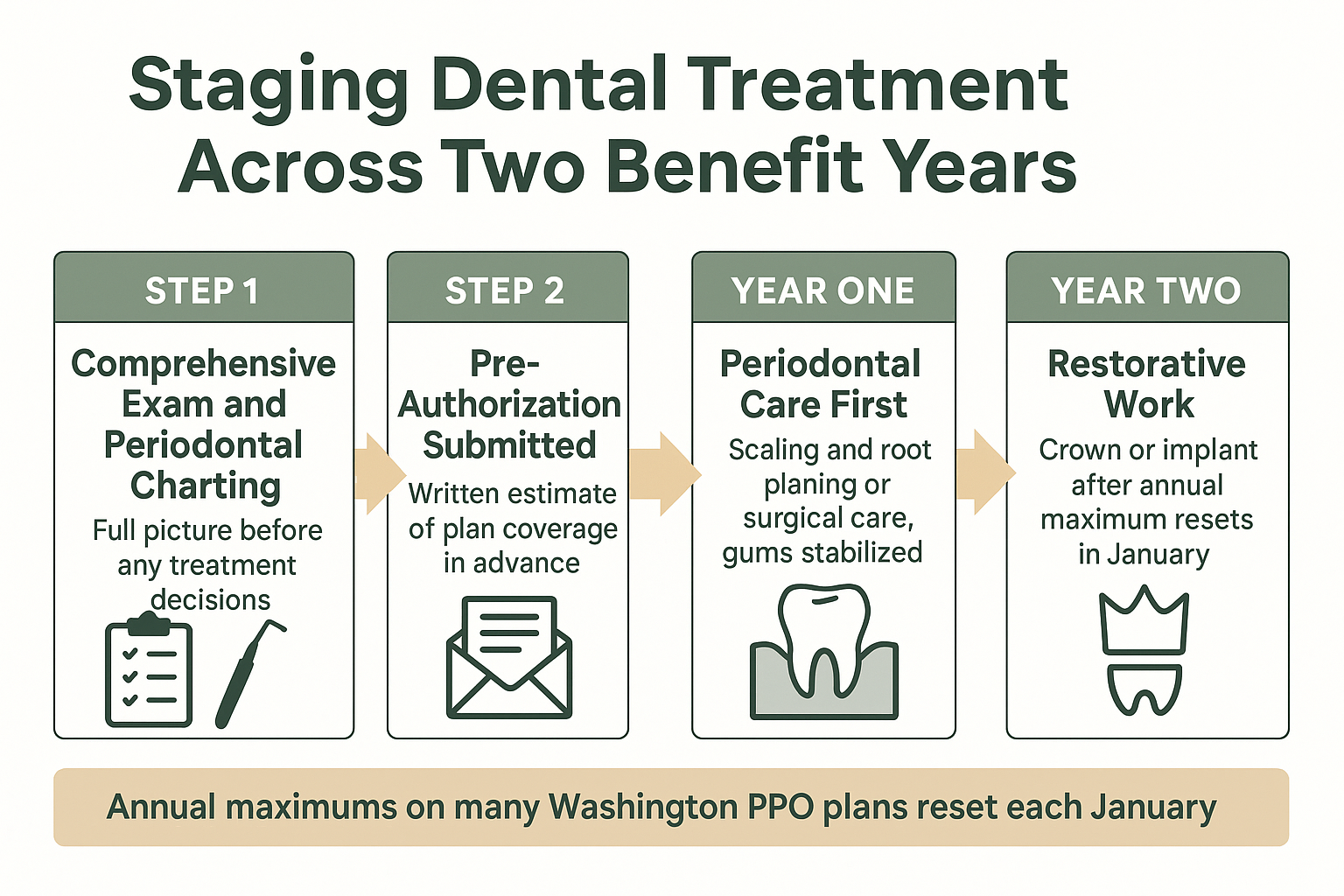
Staging is often the smarter path:
- Address the periodontal condition first, because stable gums are the foundation for any restorative work that follows
- Let the benefit year reset in January, when a fresh maximum becomes available
- Sequence the crown or implant work into the new year, with pre-authorization submitted ahead of time
This is not about gaming the system. Gum health genuinely needs to come before restorative work, and the calendar just happens to cooperate. We wrote more about timing in how to use your PPO benefits before they reset on major dental work.
Coverage for grafting in particular depends heavily on how the case is documented, which we broke down in when a gum graft is covered by insurance and when it is not.
Staging Treatment Across Two Benefit Years
Here is how a treatment plan with both periodontal and restorative needs might be sequenced when the annual maximum is the limiting factor.
PPO, HMO, and Out-of-Network: Know Where You Stand Before You Call
A lot of phone calls end the moment someone hears their plan is not accepted. Often the caller had a plan type that was never going to work, and did not know there was a difference.
- PPO plans let you see providers outside the network. Your plan usually still pays a percentage, just based on a different fee schedule
- HMO or DHMO plans assign you to a specific contracted provider. Care outside that assignment is generally not covered at all
- Apple Health and other Medicaid programs work under their own rules and their own provider lists
That middle category is the one that surprises people. If you have a DHMO and you go elsewhere, you are paying the full fee. If you have a PPO and you go out of network, you still have insurance and it still pays something.
The most-named plans on our line are Delta Dental PPO, GEHA, Humana, UnitedHealthcare, and Cigna. We accept most major PPO plans, and out-of-network PPO patients regularly get meaningful coverage here.
Washington Healthplanfinder offered nine certified dental plans for 2026, and stand-alone dental coverage can be bought separately from a medical plan. If you are between jobs or shopping during open enrollment, that is worth knowing before you assume you have no options.
The practical move is to look at your card and find the plan type. That single word, PPO or HMO, tells you more about your options than the carrier name does.
Frequently Asked Questions About Washington Dental Coverage
Will the dental loss ratio law lower what I pay for a crown next year?
Probably not directly. The law governs how insurers spend premium dollars and requires rebates when they fall short, but it does not change your annual maximum, your cost-share percentages, or how your plan tiers procedures.
Why can’t the front desk give me one exact price for a root canal?
Because the honest answer depends on the tooth. A front molar with one canal and a back molar with four are different procedures with different codes. Cost ranges for endodontic treatment in the Seattle area are wide, and the only way to get a firm number is an exam, imaging, and a pre-authorization submitted to your plan. We would rather give you a real figure late than a wrong figure early.
Is a periodontal cleaning the same as a regular cleaning under my insurance?
No. A routine cleaning is preventive. Scaling and root planing is a treatment for gum disease and usually sits in the major tier, with a higher cost share and a real hit to your annual maximum.
Does insurance ever cover teeth whitening?
Almost never. Whitening is considered elective cosmetic care, so it is paid out of pocket on virtually every plan.
What is pre-authorization and should I ask for it?
It is a written estimate from your insurer showing what they expect to cover before treatment happens. For anything in the major tier, especially periodontal surgery or grafting, I would always ask for one. It takes a few weeks and it removes most of the guesswork.
Want a clearer picture of your own coverage?
If you are in Renton, Kent, Tukwila, Burien, or Newcastle and you are trying to plan treatment around a tight annual maximum, a conversation about your specific plan is usually the fastest way to get clarity. We are happy to look at your benefits and walk through what a staged plan could look like, with a board-certified periodontist and an in-house endodontist available under the same roof. You can reach us at 425-430-0400 or read more at cedardentalgroup.com.
