
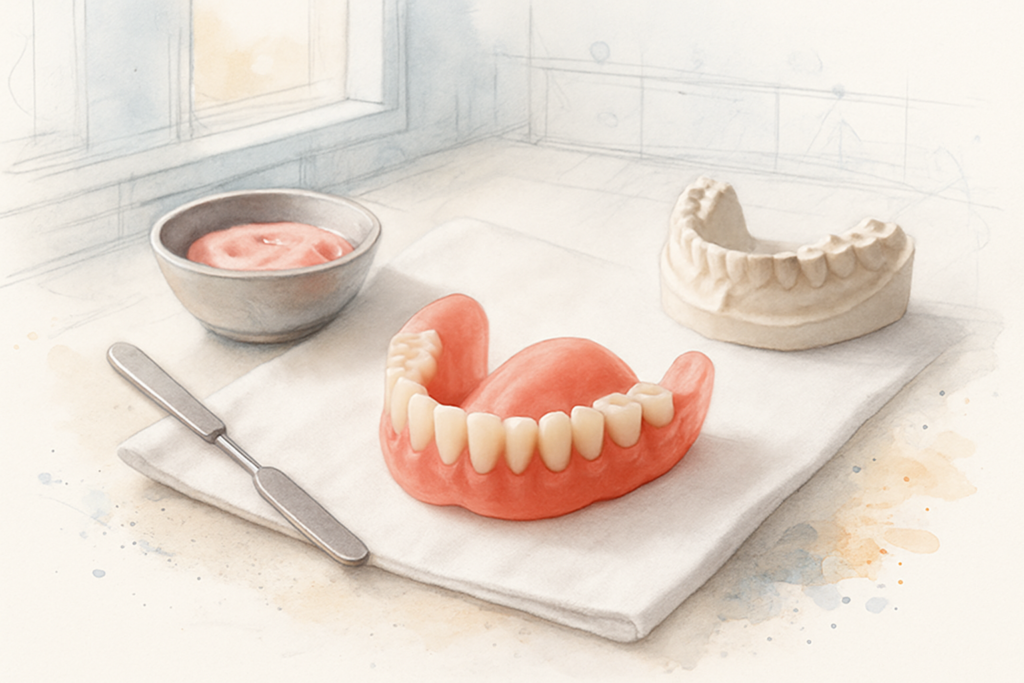
Direct Answer: An immediate denture is placed the same day teeth are removed. It is the real denture, refitted over time with relines as gums heal, usually with a final hard reline around six to nine months.
In my experience, the hardest part of getting dentures is not the surgery, the healing, or even the first few weeks of learning to chew again. It is a misunderstanding about which set is the finished set.
I have seen this pattern more than once. A patient leaves the office the day their teeth come out wearing a denture, assumes it is a temporary placeholder, and then months later learns that it was the definitive appliance all along. That is a painful surprise, and it is completely avoidable.
This guide walks through how the first year actually goes for dentures and partials in Renton, WA: what an immediate denture is, why the fit changes, when relines happen, and how insurance timing tends to work in Washington. My goal is that you finish reading knowing what questions to ask before extraction day, not after.
Immediate Denture vs. Conventional Denture: Settle This Before Extraction Day
There are two basic paths, and they feel very different from the patient’s side of the chair.
An immediate denture is made in advance from impressions taken while your teeth are still in place. It goes in the same day the teeth come out, so you never leave without teeth. The tradeoff is that it is built for a mouth that does not exist yet, so it is designed to be adjusted and relined into its long-term form.
A conventional denture is made after the gums have healed, usually several months post-extraction. Because your ridge has settled, we can do a wax try-in, where you actually see and approve the tooth position and look before anything is finalized.
What to ask before you agree to extractions:
- Is the denture I am getting on surgery day the definitive one, or a separate temporary that will be replaced?
- If it is the definitive one, how many adjustments and relines are included in the plan?
- Will I get a wax try-in, and if not, when do I get to see how the teeth will look?
- What is the plan if the fit still is not right after healing?
Neither path is wrong. But you deserve to know which one you are on.
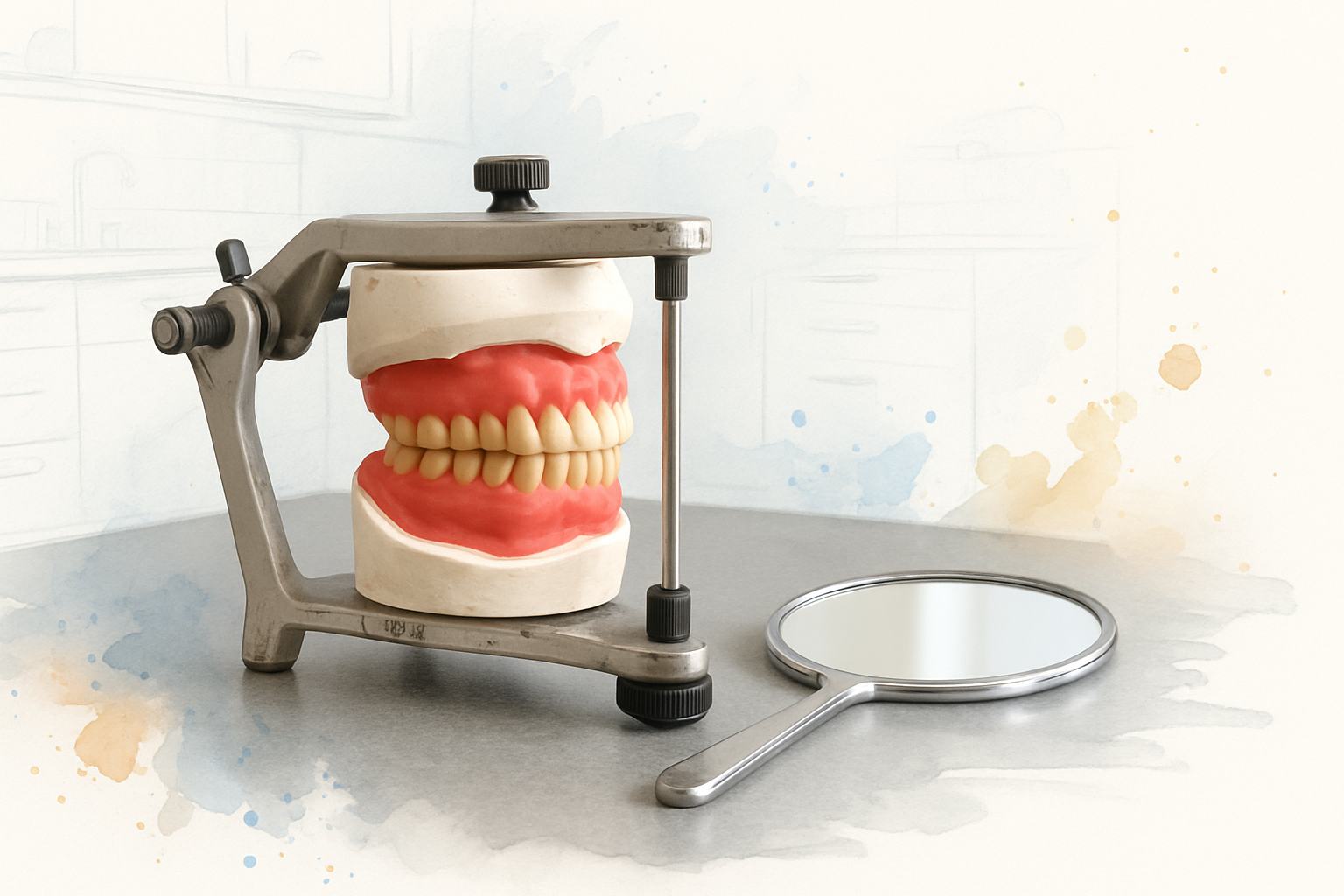
The Healing Arc: Why a Denture That Fit on Day One Feels Loose by Week Three
This is the part almost nobody explains at the consult, and it explains most of the frustration I hear about.
When teeth are removed, the gums swell first and then shrink. The bone ridge underneath begins remodeling right away. Change is fastest in the first few weeks and keeps going through roughly the first four to six months.
So a denture that seated beautifully on day one can start rocking by week three. That is not a mistake. That is your mouth healing on schedule.
Here is what a reline is, in plain terms: we add new material to the inside surface of the denture so the base matches the current shape of your gums. The denture is not thrown out and started over. It is refitted.
- Soft relines use a cushioning material and are commonly used during the active healing stretch. They may be repeated.
- A definitive hard reline is typically done once healing has settled, often somewhere in the six to nine month range.
That timing is not something we invented. Clinical treatment guidance on immediate dentures notes that these appliances require relining, and occasionally remaking, as tissue and bone heal.
Plan on adjustment visits. They are part of the treatment, not evidence that something went wrong.
What the First Year Usually Looks Like
Timelines vary by person, healing speed, and how many teeth were removed. This is the general arc I walk patients through.
| Timeframe | What is happening | What typically happens at the office |
|---|---|---|
| Day of extraction | Denture placed immediately, gums swollen and tender | Post-op instructions, soft diet, follow-up scheduled within a couple of days |
| Weeks 1 to 3 | Swelling drops, ridge starts reshaping, fit loosens | Sore spot adjustments, speech and chewing check-in |
| Months 1 to 4 | Bone and tissue changing fastest | One or more soft relines to keep the base seated |
| Months 4 to 6 | Changes slow down noticeably | Fit reassessed, comfort and bite reviewed |
| Months 6 to 9 | Healing largely settled | Definitive hard reline commonly performed |
| Year 2 and beyond | Slow, gradual ridge shrinkage continues | Periodic checks, another reline eventually |
Eating and Talking: What Is Normal, and What Is a Fit Problem
Some discomfort in the early weeks is expected. Here is what falls in the ordinary column:
- Sore spots at specific points along the gum line, which we relieve by adjusting the denture edge
- Extra saliva for the first several days as your mouth reacts to something new
- A bulky feeling, especially on an upper denture that covers the palate
- Slurred consonants, particularly S and F sounds, which usually improve with a week or two of reading out loud
Most people move from soft foods back toward normal chewing gradually over weeks, not days. Cutting food smaller and chewing on both sides at once helps more than people expect.
Now the line that matters. If you cannot chew anything but soup weeks into the process, that is not something to wait out. I have read the account of a patient elsewhere who described exactly that, lost significant weight, and concluded the fit was never going to be addressed.
Persistent inability to eat is a fit issue, and fit issues have fixes. Adjustments, a soft reline, a bite correction. Say something at week two rather than month five, and it is a much smaller conversation.
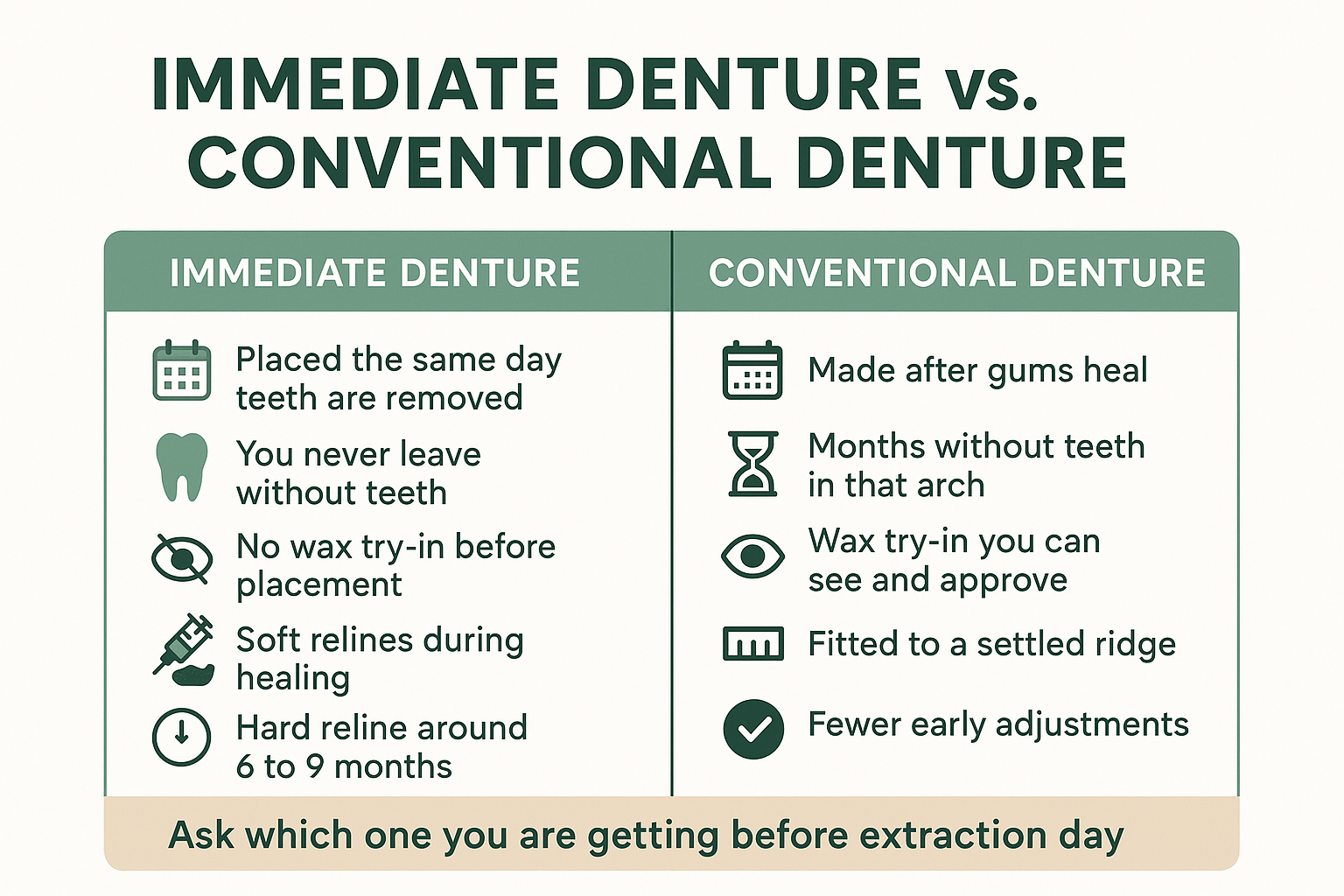
Immediate vs. Conventional at a Glance
This side-by-side covers the difference patients most often wish someone had drawn out for them before surgery day.
How Washington Dental Plans Usually Treat Denture Work
I will not quote you a price here, because the honest answer depends on your plan, your arch, and how many extractions are involved. What I can explain is the structure, which is where people get caught off guard.
Most PPO plans in Washington treat a denture as a major restorative benefit, commonly paid at roughly half after your deductible. That coinsurance level is the first thing to confirm.
The second thing matters more. Many plans will only replace a denture once every several years, a clause often written as five to seven years. If your first set does not fit the way you hoped, that replacement clock is already running.
A few structural details worth asking about before treatment starts:
- Relines and adjustments carry their own frequency limits, separate from the denture benefit
- A hard reline is usually billed as its own procedure, not bundled into the denture fee
- Calendar-year maximums expire December 31, which matters when denture work spans two benefit years
The single most useful move is to request a pre-treatment estimate that lists the denture and the anticipated reline as separate line items. Our front desk can submit that before you commit to anything.
If you want more background on how coverage behaves here, we covered it in how dental insurance works in Washington and in using PPO benefits before they reset.
Partials Are Not Just Smaller Dentures
Callers in Renton, Kent, and Tukwila often use “dentures” and “partials” interchangeably. Clinically they are different appliances with different long-term care.
A partial denture fills gaps using small clasps that rest on your remaining natural teeth. Those anchor teeth carry extra load, so their health becomes part of the treatment plan, not a side note.
Cleaning changes too:
- Plaque collects around the clasps, so those spots need deliberate attention daily
- The teeth touching the partial need more care than they did before
- The partial itself comes out for cleaning, and the gum tissue underneath needs brushing as well
One practical advantage: a partial can sometimes be modified if another tooth is lost later, rather than replaced entirely. That only works smoothly if the same office has your records and knows how the appliance was built, which is a real reason to keep care in one place over the years.
What Happens Under the Denture Over the Long Run
Once teeth are gone, the ridge of bone that held them gradually shrinks. That process never fully stops, which is why a denture that has been comfortable for years eventually feels loose and needs another reline.
There are ways to slow that. Socket preservation is a distinct bone grafting procedure done at the time of extraction to limit early bone loss. It is a periodontal procedure, handled by a periodontist, not something that happens at the denture appointment itself.
Snap-in, implant-supported dentures also exist as a later option for people who want more stability. I mention that only as sequencing context, since decisions made at extraction time can affect what is possible years down the road. If you are weighing that broader choice, how adults in their 50s and 60s actually decide walks through it properly.
Why Having the Specialists On Site Changes the Sequence
Denture treatment rarely happens in isolation. Extractions come first. Sometimes bone work comes with them. Then the denture, then the relines.
In our office, dentures and partials are designed by Dr. Susan Chu. When extractions or bone-related foundation work are part of the sequence, Dr. Jaewon Kim, a board-certified periodontist, handles that side here on site.
That means you are not sent into Seattle mid-treatment and then sent back with someone else’s notes. The plan stays with one team.
The feedback I value most is about being told the plan in advance. As one patient put it: “She is honest and will tell me that I don’t need something that previous dentists have pushed.” If you have been away from care for a while, what to expect after years without a dentist covers that first visit without judgment.
Frequently Asked Questions About Dentures and Partials
Is the denture I get on extraction day my permanent one?
In most immediate denture plans, yes, it is the definitive appliance, refitted over time with relines rather than replaced. Some treatment plans use a separate temporary instead. Ask which one you are getting before extraction day, and get the answer in writing on your treatment plan.
How many adjustment visits should I expect in the first year?
It varies, but several is normal. Most people need a few sore spot adjustments in the first month, one or more soft relines through the active healing months, and a hard reline in the six to nine month range. Those visits are part of the plan, not a sign something failed.
Why does my denture feel loose after only a few weeks?
Because your gums and the bone underneath are still reshaping, and they change fastest early on. The denture did not shrink. Your ridge did. That is exactly what a reline addresses.
Will my insurance pay for the reline separately?
Usually a hard reline is billed as its own procedure with its own frequency limit. Coverage differs by plan, so request a pre-treatment estimate listing the denture and the reline as separate lines before you start.
Can I get a partial if only a few teeth are missing?
Often yes, as long as the remaining teeth that will hold the clasps are healthy enough to carry the extra load. That assessment is part of the exam, since those anchor teeth become central to how well the partial works over time.
How long before I can eat normally again?
Plan on a gradual return over weeks, not days, starting with soft foods and cutting things smaller. If you still cannot chew anything solid several weeks in, that is a fit issue worth bringing in rather than waiting out.
Want to Know Which Denture Path Fits Your Situation?
Our office sits near downtown Renton, and we see patients from Kent, Tukwila, Burien, and Newcastle who want specialist-level care without the drive into Seattle. If you are weighing extractions and want the timeline, the reline schedule, and the benefit structure explained before you decide anything, we are happy to walk through it. You can reach us at 425-430-0400 or at cedardentalgroup.com whenever you are ready.
