

Direct Answer: An endodontist is a dentist with 2-3 extra years of training focused only on the inside of the tooth. When one works in-house, you skip the outside referral, the second office, and the repeated history.
You go in for a toothache, you get an answer, and then someone hands you a referral slip with a different office’s name on it. Now you are calling a place you have never been, explaining the same pain again, and waiting for a slot that may be weeks out.
I hear about that gap all the time from patients in Renton and around South King County. Several callers have asked us directly whether root canal therapy happens here or gets sent somewhere else, and one caller worried that a practice with a single general dentist would mean a capability gap.
It is a fair question. This article covers what an endodontist actually is, why the specific tooth in your mouth changes the difficulty, and what genuinely changes when that specialist works down the hall instead of across town.
What an Endodontist Is, and How the Training Differs
Every dentist learns root canal therapy in dental school. A general dentist can legally and skillfully perform one, and many do.
An endodontist goes further. After dental school, they complete an additional 2-3 year graduate residency devoted entirely to the pulp, the nerve, and the root structure of the tooth.
That residency focuses on a narrow set of problems in real depth:
- Diagnosing pain that does not point clearly to one tooth
- Mapping canal systems that branch, curve, or hide
- Retreating root canals that were started or finished elsewhere and did not settle
- Treating teeth with calcified canals, cracks, or prior trauma
- Working under high magnification for the entire procedure
The American Association of Endodontists describes endodontists as specialists who limit their practice to this work, which is why complex cases tend to get routed to them.
So the honest framing is not that a general dentist cannot do a root canal. It is that a molar with four canals and a sharp curve is a different job than a front tooth with one straight canal, and the specialist has spent years on the harder version.
Why the Tooth in Question Changes Everything
Root canal therapy sounds like one procedure. In practice it is one procedure with a very wide range of difficulty.
The basic steps are the same every time: remove the inflamed or infected pulp tissue from inside the tooth, clean and shape the canal system, then seal it so bacteria cannot move back in.
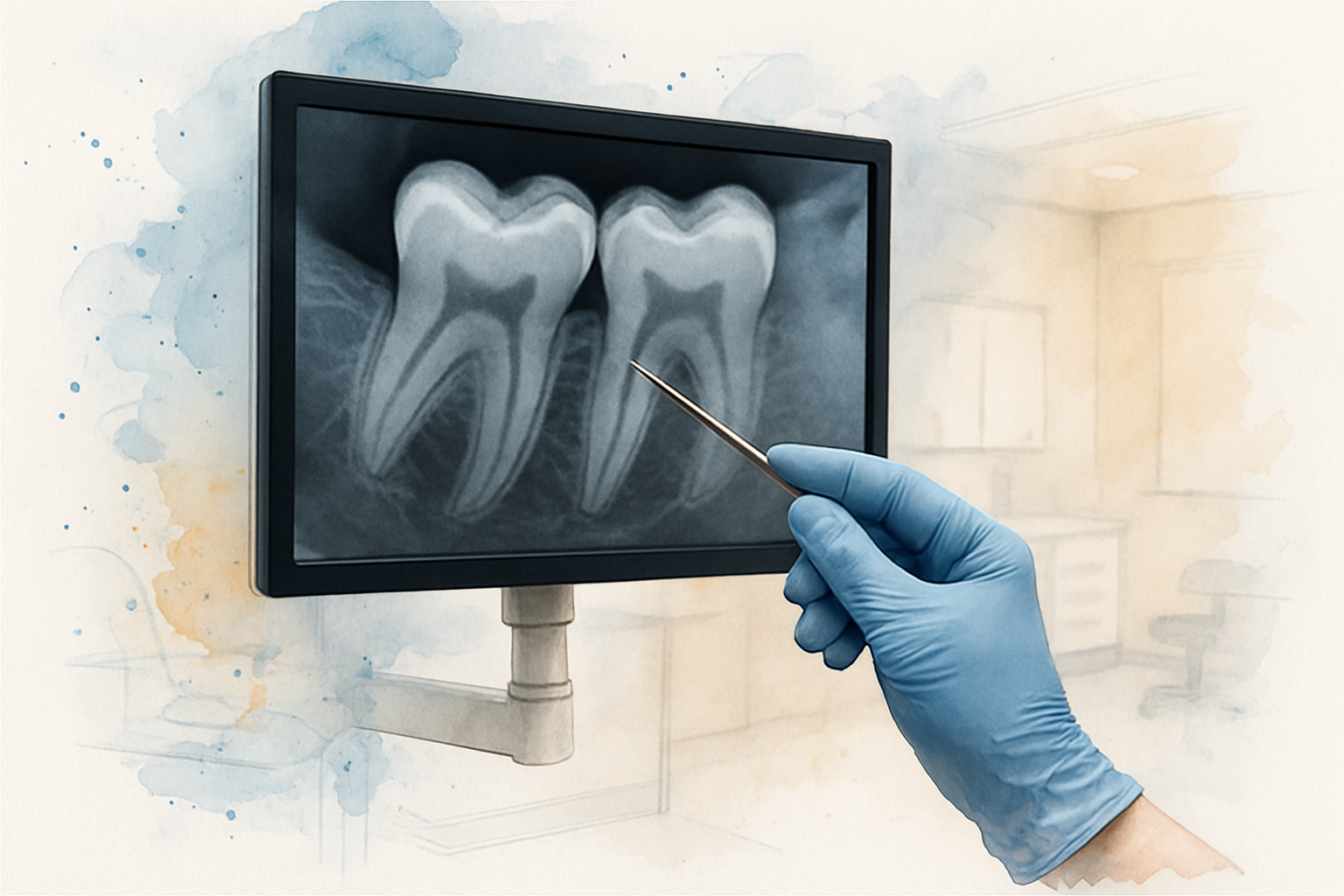
What changes is the plumbing. A front tooth usually has one canal. A lower molar often has three, and an upper molar can have four, including one small canal that is easy to miss without magnification.
Add a few common complications and the picture shifts again:
- Curved canals that bend sharply near the tip of the root
- Calcified canals that have narrowed over years and are hard to find
- Teeth that already had a large filling or crown placed on top
- A tooth that was opened at another office and never finished
That last one shows up in our contact forms more than you would guess. One new patient wrote in saying they had dental work started but not finished and needed regular care again.
If you are still deciding whether the tooth needs this at all, our breakdown of how the root canal decision actually gets made walks through what a dentist is weighing before recommending it.
How Canal Complexity Varies by Tooth
Here is a general sense of what changes from the front of the mouth to the back. Your own anatomy can differ, which is exactly why imaging comes first.
| Tooth type | Typical number of canals | What tends to make it harder |
|---|---|---|
| Front teeth (incisors, canines) | Usually 1 | Straightforward shape, but trauma history can complicate it |
| Premolars | 1 to 2 | Canals can split partway down the root |
| Lower molars | Typically 3 | Curved roots, tight access at the back of the mouth |
| Upper molars | 3 to 4 | A small extra canal is common and easy to overlook |
| Previously treated teeth | Varies | Existing filling material must be removed before retreatment |
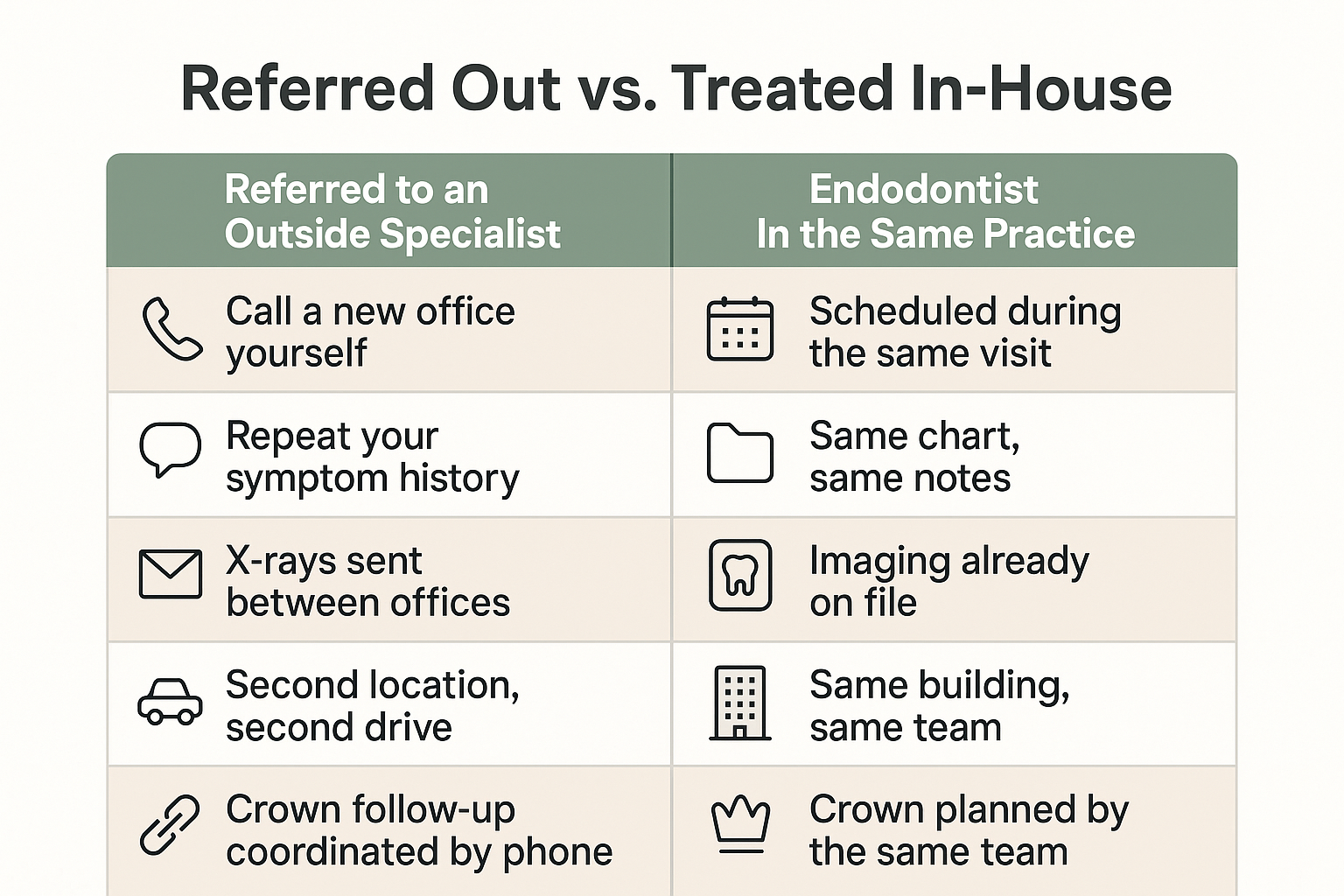
Referred Out vs. Treated In-House
This is the practical difference most patients feel, and it has little to do with the clinical steps themselves.
What Actually Changes When the Endodontist Is Down the Hall
The clinical steps of a root canal do not change based on the address. What changes is everything around them.
When the dentist who diagnoses the problem and the specialist who treats it share one practice, a few things stop happening:
- No handoff gap. Your chart, your X-rays, and the notes from your exam are already there.
- No re-explaining. You do not describe the same throbbing molar to a fourth front desk.
- No separate scheduling loop. The appointment gets set while you are still in the chair.
- No coordination guesswork afterward. The tooth almost always needs a crown, and the person placing it already knows exactly what was done inside.
That last point matters more than people expect. We wrote separately about why a crown is usually recommended after a root canal, and the timing of that restoration is part of protecting the work.
This is also the honest answer to the “only one general dentist” concern. Dr. Susan Chu handles general and cosmetic care, Dr. Jaewon Kim is a board-certified periodontist handling surgical gum and bone work, and Dr. Joe Dutner is our in-house endodontist. Three sets of hands, one chart, one building near downtown Renton.
Questions Worth Asking Before You Book the Procedure
If you have already been told you need a root canal and you are deciding where to have it done, these are the questions that actually separate one office from another:
- Who performs the root canal here, a general dentist or an endodontist?
- Is that person board certified? Dr. Dutner holds board certification from the American Board of Endodontics and serves as its President.
- Will the procedure happen at this location or somewhere else?
- Is magnification used during treatment?
- Who places the crown afterward, and when?
- What does the estimate include, and what does my plan cover?
On that last one, cost varies a lot by tooth. A front tooth with a single canal and a molar with four are not the same amount of work, and estimates in the Puget Sound market can range widely as a result.
Rather than trusting a number over the phone, ask for a written estimate after imaging, and ask whether financing options are available. Many patients here carry Delta Dental PPO, Premera, Regence, or similar plans, and benefits differ enough that a real verification beats a guess.
If nerves are part of what is holding you back, that is worth saying out loud when you call. One patient put it simply in a review: “Dr Chu is gentle, calm and explains everything thoroughly.” Our guide to finding a dentist for anxiety in Renton covers what to look for.
Frequently Asked Questions About In-House Endodontic Care
Is a root canal from an endodontist better than one from a general dentist?
Not automatically. A skilled general dentist handles straightforward cases well every day. The difference shows up on molars with multiple or curved canals, calcified anatomy, and retreatment cases, where an endodontist’s extra 2-3 years of focused training and daily repetition matter most.
How long does a root canal appointment usually take?
It depends heavily on the tooth. A single-canal front tooth can often be completed in under an hour, while a molar with three or four canals may take 90 minutes or more, and some cases are split across two visits.
What does a root canal cost in the Renton area?
Cost varies by tooth type, canal count, and whether it is a first treatment or a retreatment, so quoted ranges in South King County are broad. Insurance often covers a meaningful share as a restorative benefit. Call us at 425-430-0400 for a real estimate after imaging rather than relying on a phone guess.
My root canal was started at another office and never finished. Can that be picked up here?
That situation comes up regularly, and it is exactly the kind of case endodontic training covers. It starts with imaging and an exam to see what was done, what remains, and whether the tooth is still a good candidate for completion or retreatment.
Do I still need a crown if a specialist did the root canal?
Usually, yes. A treated tooth is hollowed out and more prone to fracture, and a crown protects it under chewing pressure. Having the crown planned by the same team that treated the canal keeps the timing tight.
Want to Understand Your Options Before You Decide?
If you have been told you need a root canal and you are weighing where to have it done, we are happy to answer questions without any pressure to schedule. Our Renton office at 280 Hardie Ave. SW is a short drive from Tukwila, Kent, Newcastle, and Burien, and both our endodontist and periodontist see patients on-site. You can reach us at 425-430-0400 or read more at cedardentalgroup.com.
