
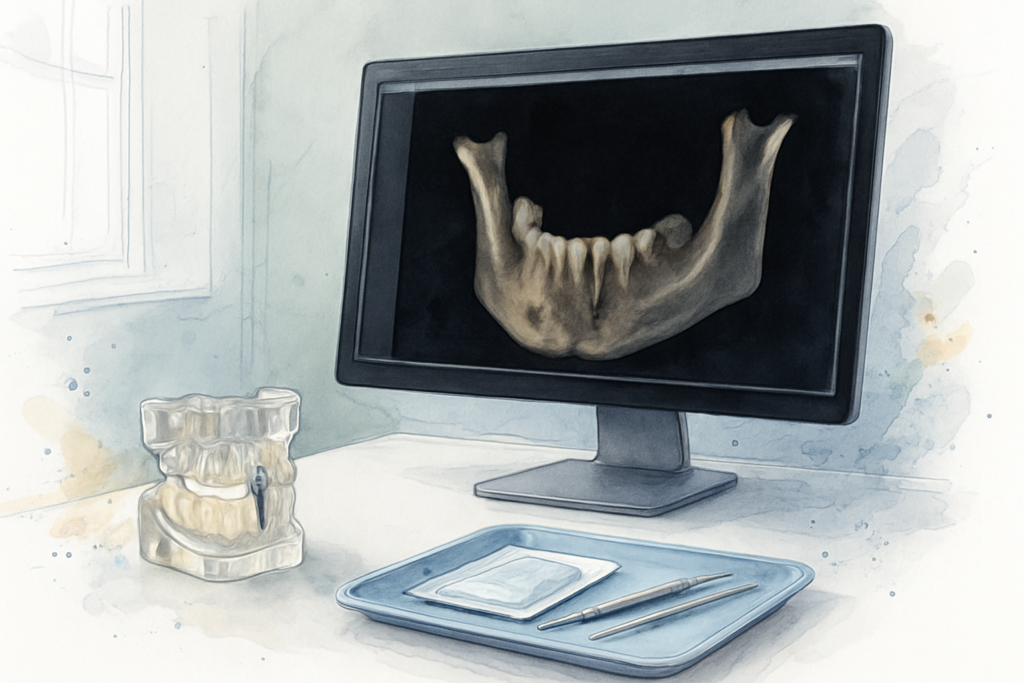
Direct Answer: When a bone graft is needed first, the full implant process usually runs about 7 to 14 months from your first appointment to the final crown, depending on how long the site has been empty.
Most people come in expecting to hear one word: implant. Then the plan comes back with bone graft listed first, and the reaction is almost always the same. Not fear about the surgery, but frustration about the calendar.
We hear it on the phone here in Renton several times a month. Someone got a quote somewhere, saw what they described as extra steps, and called to ask how much longer this whole thing is going to take.
So I want to walk through the real sequence, stage by stage, with honest ranges instead of soft reassurance. I will also cover socket preservation, which is the single thing that most often decides whether your case is simple or complicated later.
The short answer on the dental implant process timeline with grafting
From your first exam to the day the crown goes on, plan on roughly 7 to 14 months when grafting is part of the treatment. That is a wide range on purpose, because two patients with the same missing molar can land at opposite ends of it.
What pushes you toward the shorter end:
- The tooth is still in place, or came out recently, so the graft is done at the same time as the extraction
- Bone loss is limited to one site rather than spread across an area
- You heal predictably and do not smoke
- No active gum disease needs treating first
What pushes you toward the longer end:
- The tooth has been gone for years and the ridge has thinned
- The graft needs to rebuild height as well as width
- Gum disease has to be brought under control before any surgical step
- The site is in the upper back jaw, where the sinus limits available bone
Here is the part I try to say early, because it changes how people feel about the wait. Almost none of that time is spent in a chair. The vast majority of it is healing time, where you go about your normal life in Renton, Kent, or wherever you are commuting from, with nothing to do but let bone mature.
The full sequence, stage by stage
Every plan is different, but the order rarely changes. Understanding the order is what makes the total span feel logical instead of arbitrary.
1. Evaluation and 3D imaging. One appointment. A cone beam scan shows bone volume in three dimensions, which a standard X-ray simply cannot do. If you want more on that, we wrote about what a 3D scan shows that a regular X-ray cannot.
2. Extraction with socket preservation, if the tooth is still there. Same visit. More on this below, because it matters more than people realize.
3. The bone graft itself. Usually a single appointment. Graft material is placed and often covered with a membrane to protect it while your body rebuilds.
4. Graft maturation. The long wait. Typically 3 to 6 months for a preserved socket, and 4 to 9 months for a ridge that has to be rebuilt from a long-healed site.
5. Implant placement. One appointment, generally an hour or two. The titanium post goes into the rebuilt bone.
6. Osseointegration. Another 3 to 6 months while bone fuses to the implant surface. This step cannot be rushed.
7. Abutment and final crown. Usually 3 to 6 weeks from the impression or scan to the seated crown.
Dr. Jaewon Kim, our board-certified periodontist, handles the grafting and the surgical implant preparation. Dr. Susan Chu handles the restorative side, including the crown. Both happen in the same building on Hardie Ave., which removes the back-and-forth coordination patients describe as the most confusing part when two separate offices are involved.
Stage-by-Stage Timeline at a Glance
These are typical ranges we see, not promises. Your own plan depends on what the scan shows and how your body heals.
| Stage | Typical Timeframe | What Is Actually Happening |
|---|---|---|
| Exam and 3D imaging | 1 visit, plan within 1-2 weeks | Measuring bone volume and mapping the implant position |
| Extraction with socket preservation | Same appointment as extraction | Graft material placed immediately to hold the site |
| Bone graft (standalone) | 1 appointment | Rebuilding width or height of a collapsed ridge |
| Graft healing | 3-6 months (preserved socket), 4-9 months (rebuilt ridge) | Your body replaces graft material with your own bone |
| Implant placement | 1 appointment, 1-2 hours | Titanium post set into the healed bone |
| Osseointegration | 3-6 months | Bone fuses directly to the implant surface |
| Abutment and final crown | 3-6 weeks | Connector placed, crown made and seated |
| Total span | Roughly 7-14 months | Mostly healing time, not appointment time |
Socket preservation: the step that decides how hard this gets later
This is the concept almost nobody has heard of until it is too late to use it. When a tooth comes out, the bone that held it no longer has a job. It begins to shrink, and the fastest loss happens in the first 6 to 12 months.
Socket preservation means placing graft material into the empty socket at the same appointment as the extraction. It does not stop bone loss entirely. It slows it enough to keep the site usable for an implant later.
Why this matters to you right now:
- If your tooth is still in place, you likely have the option, and taking it usually keeps you on the shorter end of the timeline
- If you had an extraction elsewhere and nobody mentioned it, that is often why your current plan looks more involved
- Rebuilding a collapsed ridge later is a bigger procedure with a longer healing window than preserving the site on day one
I have sat with plenty of patients from Tukwila and Newcastle who pulled a tooth years ago, felt fine, and are now surprised that the site needs rebuilding first. Nobody did anything wrong. Bone just responds to losing a root. If you are weighing timing right now, how long you can wait after losing a tooth is worth reading before you decide.
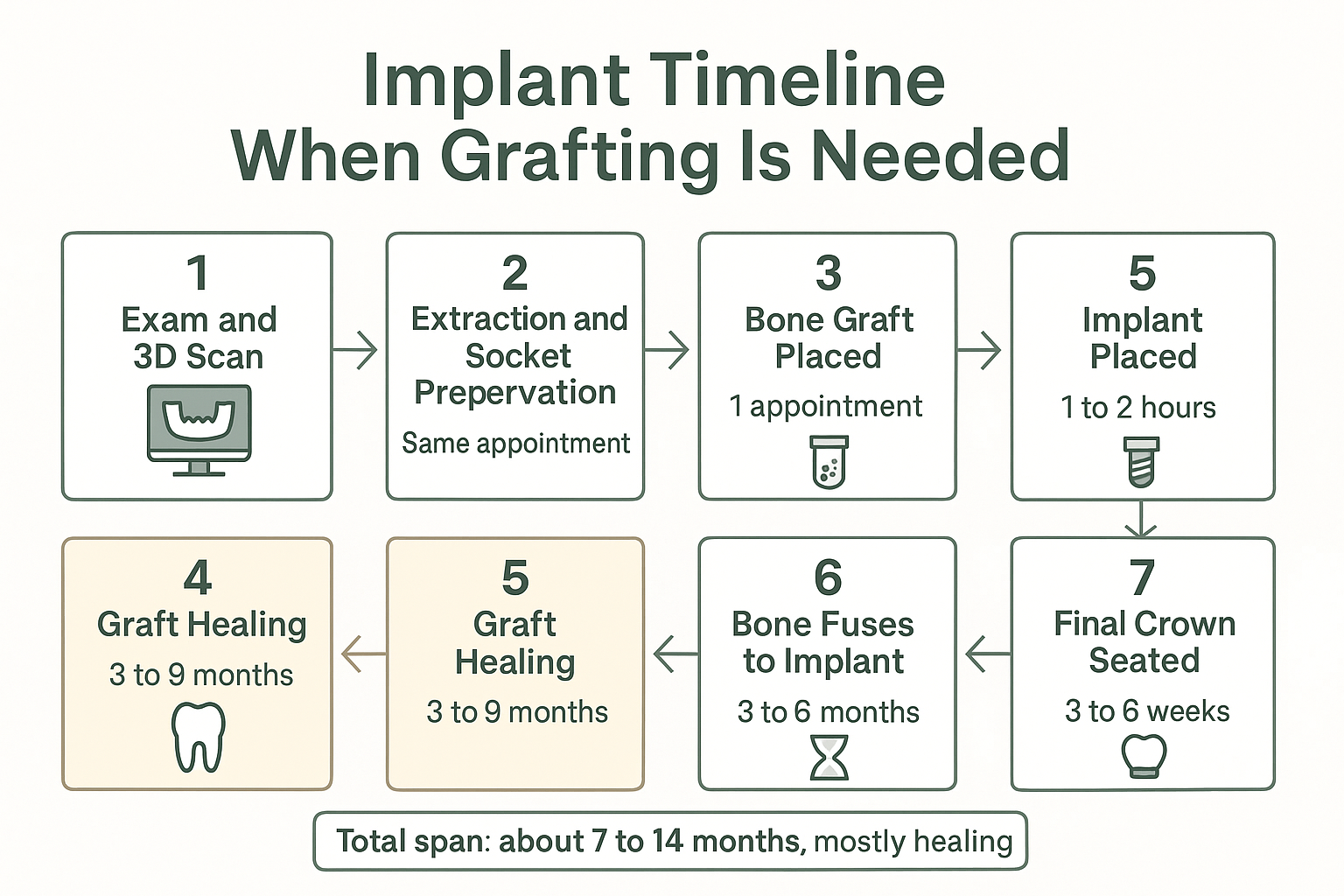
The Implant Sequence, Start to Finish
Here is the whole path in one view, with the healing windows shown as their own steps rather than hidden between appointments.
How a two-year timeline can work in your favor on benefits
This is the part researcher-type patients tend to appreciate, and it is one of the few upsides of a longer plan.
Most dental plans in Washington run on a calendar year and reset on January 1. Annual maximums are usually modest, often in the $1,000 to $2,000 range depending on the plan, and a grafting-plus-implant plan can easily exceed that in a single year.
Because the graft and the implant are naturally separated by months of healing, treatment that starts in the second half of one year often finishes in the next. That can mean two separate annual maximums apply instead of one. Nothing about the clinical timing changes. The billing simply falls on both sides of the reset.
A few practical notes:
- Ask for a pre-treatment estimate in writing before the first surgical step, not after
- If you have an FSA through a Washington employer, unused funds are generally forfeited at year end under IRS use-it-or-lose-it rules, so timing a stage before December can matter
- Grafting and implant coverage are handled very differently by different plans, and some treat the graft as a separate benefit category entirely
I am not giving financial advice here, and every plan reads differently. But knowing this before you start gives you room to sequence things deliberately. Our team goes deeper on this in how dental insurance works in Washington and where it falls short, and on what actually goes into implant cost.
What you can expect to be doing during all that healing time
The word “months” sounds worse than it feels. Here is what those stretches actually look like day to day.
After a graft or socket preservation, the tender period is usually the first 3 to 5 days. Soft foods, no chewing on that side, and careful cleaning around the site. Most people are back to normal routines quickly.
During the long maturation window, you have almost nothing to do. We check the site periodically, and in a visible spot a temporary tooth option can usually be discussed so you are not walking around with a gap while you wait.
One thing I want to be direct about: healing time is not padding. Placing an implant into bone that has not fully matured is how implants fail later. The wait is the part that makes the result last.
Frequently Asked Questions About Implants and Bone Grafting
Can the graft and the implant be done at the same appointment?
Sometimes, yes. When bone loss is minor and the implant can still be stabilized, a graft can be placed at the same time as the implant. That is decided from the 3D scan, not from a guess, and it is not an option when the ridge needs significant rebuilding first.
Will I have a gap in my smile the whole time?
Not usually, if the tooth is visible. A temporary option can often be discussed so the space is covered while the graft and implant heal. Back molars are handled differently since they are not visible when you talk or smile.
Why did my previous dentist not mention socket preservation when they pulled my tooth?
There are legitimate reasons it might not have been recommended, including active infection at the site or uncertainty about whether an implant was in your future. It also simply does not come up in every conversation. Either way, it is not something you need to fix retroactively. It just means the current plan starts with rebuilding rather than preserving.
Where does the graft material come from?
It depends on the site and what needs rebuilding. Options include processed donor bone, mineral-based synthetic material, or in some cases your own bone. All standard materials are biocompatible and act as a scaffold that your body gradually replaces with its own bone.
How much does a bone graft add to the cost of an implant?
It varies quite a bit based on how much bone needs rebuilding, which material is used, and whether it is done alongside an extraction or as a standalone procedure. A standalone ridge augmentation costs considerably more than socket preservation at the time of extraction. The only honest number is one that comes after a scan, so ask for a written estimate before anything begins.
Do I need to travel into Seattle for the surgical part?
Not necessarily. Grafting and the surgical side of implant preparation are performed here in Renton by our board-certified periodontist, and the restorative work happens in the same practice. For patients driving in from Kent, Burien, or Newcastle, that usually means fewer separate offices to coordinate between.
Want a clearer picture of your own timeline?
If you have a plan in hand that includes grafting and you are trying to understand the sequence and the calendar, a consultation with imaging is the only way to get real numbers for your situation. Our team in Renton sees patients from across South King County for exactly these conversations, and there is no pressure to commit to anything at that visit. You can reach us at 425-430-0400 or read more at cedardentalgroup.com.
