

Direct Answer: Cold sensitivity that shows up or worsens over time often means gum recession has exposed root surface, which has no enamel. Options range from desensitizing care and monitoring to a gum graft.
It usually starts small. A sip of ice water hits one spot and you flinch, or a cold breeze on the walk in from the parking garage downtown makes one tooth zing for a second.
People reach out to us about this all the time. Several describe sensitivity on one side of the mouth, sometimes with soreness they cannot quite pin down, and they almost always ask the same thing: nothing broke and I have no new cavity, so why does this hurt?
When cold sensitivity appears gradually without a recent filling or crown, gum recession exposing the root surface is one of the most common explanations we find. I want to walk through why that happens, why root surface reacts so differently than the top of your tooth, and what the actual range of options looks like from conservative to surgical.
Why exposed roots react to cold so much more sharply
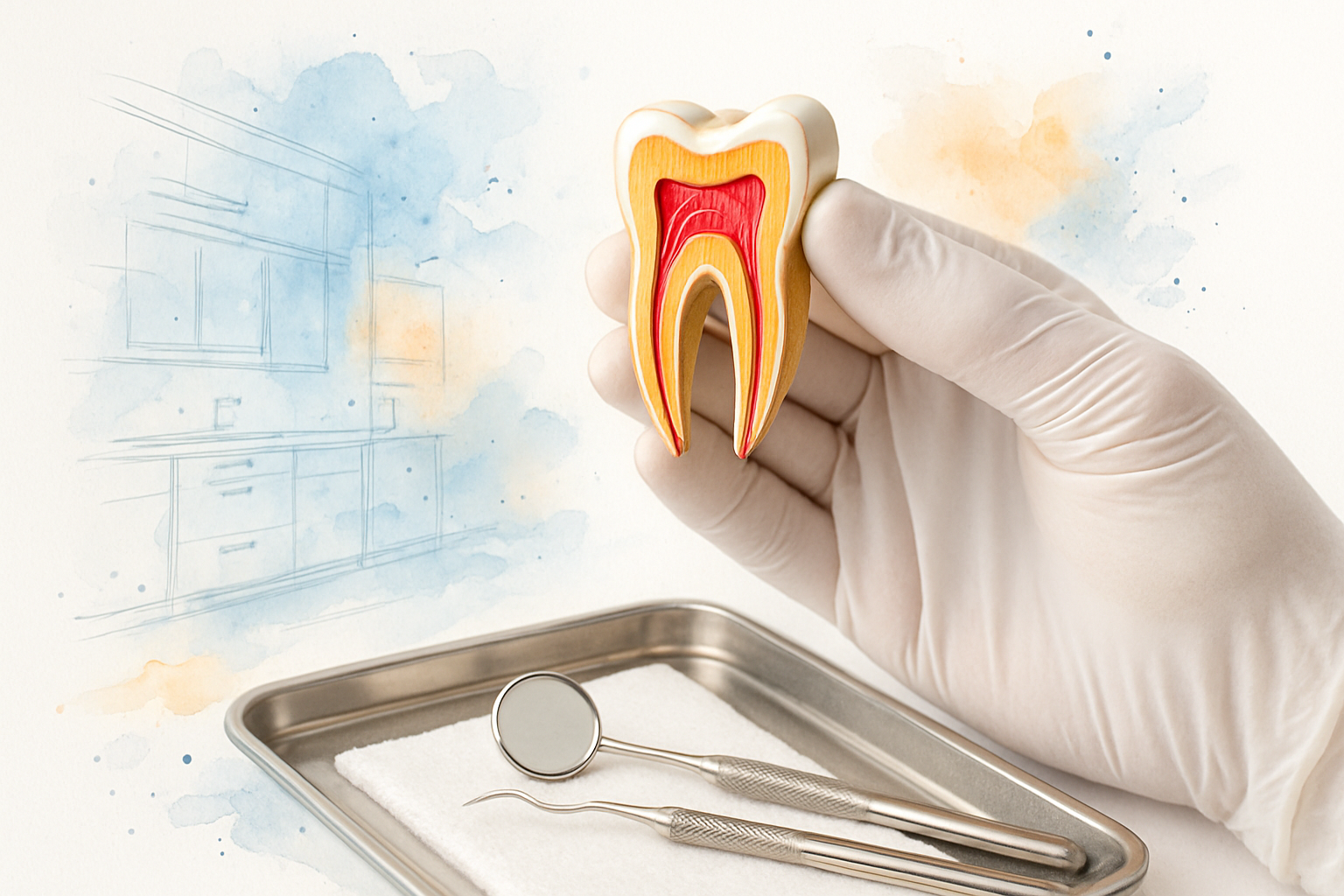
The part of your tooth you can see above the gumline is covered in enamel, the hardest tissue in the human body. Enamel is a good insulator. It dulls temperature and pressure before those signals ever reach the nerve.
The root is built differently. Its outer layer is cementum, a thinner and far more porous material that was never designed to be out in the open. Under it sit thousands of microscopic tubules that run toward the nerve like tiny straws.
So when gum tissue pulls back and root surface gets uncovered, cold liquid, cold air, and even brushing pressure travel almost directly inward. That is why this kind of pain feels different from a cavity:
- Sharp and fast rather than a dull throb
- Triggered on contact with cold, sweet, or air, then gone within seconds
- Often traceable to one or two teeth near the gumline, not a whole quadrant
- Frequently worse in winter, when Renton tap water runs colder
A cavity or an inflamed nerve tends to linger, wake you up at night, or ache without being touched. If your discomfort hangs on for minutes or comes out of nowhere, that points somewhere else, and our guide on tooth pain that will not go away covers those patterns.
What actually pulled the gums back in the first place
Recession is rarely one single cause. In most of the adults we see across Renton, Kent, and Newcastle, it is a combination of habits and biology that built up over years.
The usual contributors:
- Brushing pressure and stiff bristles. Scrubbing hard with a medium or firm brush wears tissue at the gumline. This is the most common cause I see in people with otherwise healthy mouths.
- Gum disease. Inflammation and bone loss around a tooth take supporting tissue with them. The National Institute of Dental and Craniofacial Research has a plain-language overview of how gum disease progresses that is worth reading.
- Thin gum tissue you were born with. Some people simply have less attached tissue covering the root. Nothing they did caused it.
- Clenching and grinding. Heavy forces on a tooth can contribute to tissue and bone changes at the neck of the tooth.
- Tooth position. A tooth sitting slightly outside the arch has less bone in front of it to begin with.
Why the cause matters: it changes the plan. Recession from aggressive brushing may stop moving once the technique changes. Recession driven by active gum disease keeps going until the disease is treated, which is why we look at that first.
Reading your own symptoms before your appointment
This is not a diagnosis, but it does help you describe what you are feeling more precisely, which makes the exam faster and more useful.
| What you notice | What it often points toward | What usually gets checked |
|---|---|---|
| Quick zing from cold water, gone in seconds, near the gumline | Exposed root surface from recession | Recession measurement, tissue thickness, brushing habits |
| Ache that lingers minutes or wakes you at night | Nerve inflammation or deeper decay | X-rays, nerve testing, bite check |
| Sensitivity on a tooth that already has a crown | Margin, bite, or nerve issue under the restoration | Crown fit, bite adjustment, X-ray |
| Tenderness with bleeding gums and bad taste | Active gum inflammation or deeper pockets | Full periodontal probing, pocket depths |
| Soreness on the roof of the mouth plus one-sided sensitivity | Two separate things happening at once | Soft tissue exam alongside the tooth exam |
The range of options, from conservative to surgical
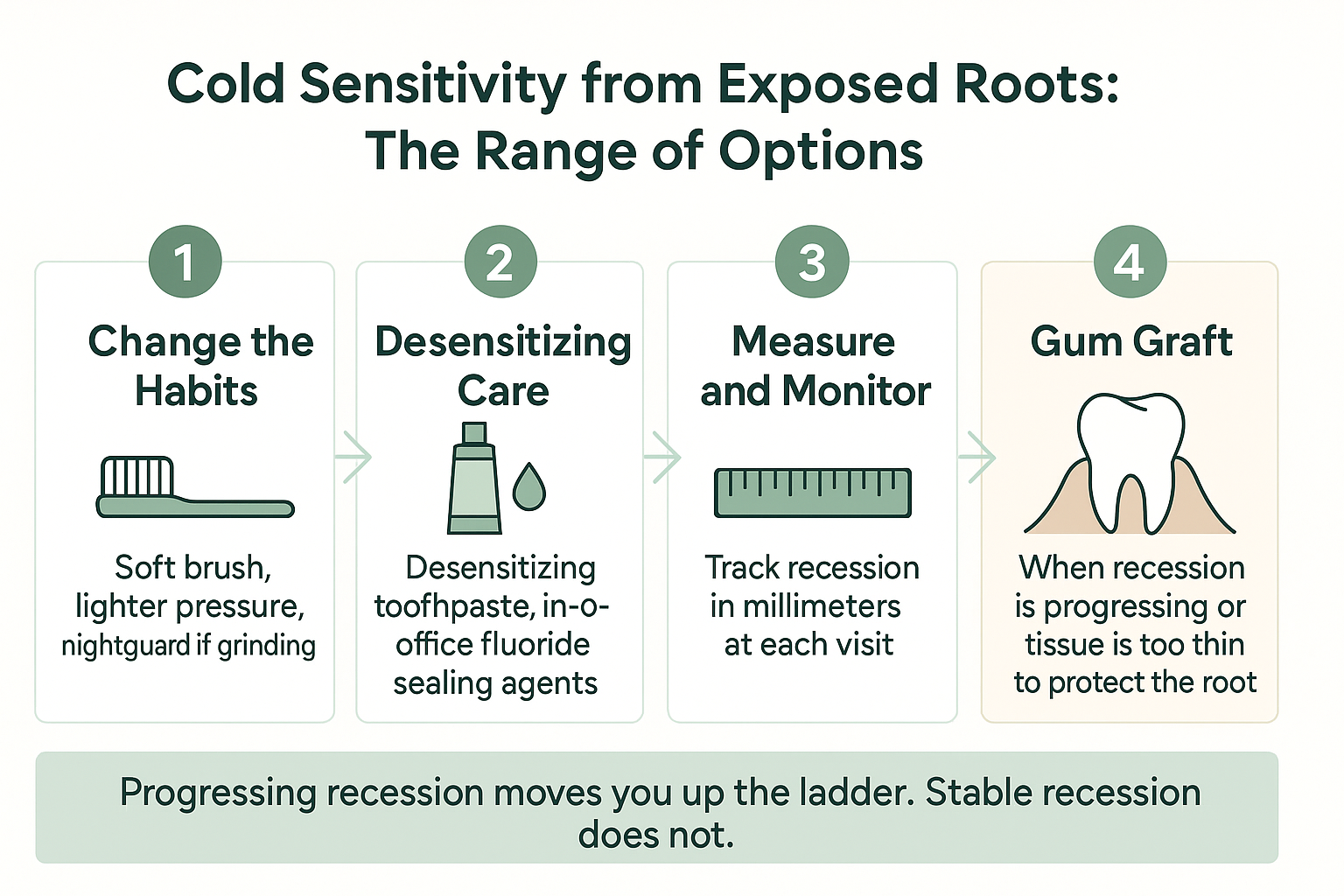
Most people assume exposed roots mean surgery. In practice there is a ladder, and many patients stay on the lower rungs for years.
When desensitizing care is enough, and when a graft becomes the recommendation
Not all sensitivity from exposed roots needs surgery. That is the part most people are surprised to hear.
Mild recession in a stable spot, with no ongoing bone loss and enough attached tissue left to protect the tooth, is often managed without any procedure at all. That usually means a desensitizing toothpaste used consistently for six to eight weeks, in-office fluoride, a softer brush with lighter pressure, and measured checks over time to confirm nothing is moving.
A gum graft moves from option to recommendation when the picture changes:
- The recession is measurably progressing between visits
- There is too little attached gum tissue left to protect the root long term
- The exposed root is at real structural risk, such as notching or decay forming on the root surface
- Sensitivity is affecting daily life enough that living with it is not reasonable
- A future implant or restoration needs a healthier tissue foundation around it
When a graft is the right call, our board-certified periodontist Dr. Jaewon Kim handles it here in the office rather than sending you to a separate specialist across the lake. If you want the mechanics of that procedure, we cover what the first two weeks of recovery actually look like and how to tell whether recession is serious enough to need a graft in more detail.
What we actually look at during the exam
Sensitivity by itself does not tell us much. Measurements do.
At a sensitivity-focused visit, the things that drive the decision are:
- How many millimeters of root are exposed on each affected tooth, recorded so it can be compared later
- How much attached tissue remains below the recession, since thin tissue is what fails over time
- Pocket depths around the tooth, which separate simple recession from active gum disease
- X-rays of the bone level, because tissue loss and bone loss are not the same problem
- Your brushing technique, which I ask people to demonstrate rather than describe
One of the most common things patients tell us afterward is that they finally understood what was happening. As one review put it, “She explained everything clearly, answered all my questions without rushing.” That is the standard we hold ourselves to, because a patient who understands the why makes a better decision about the what.
If your sensitivity turns out to be tied to gum inflammation rather than tissue position alone, the treatment path shifts. Our piece on gum surgery versus deep cleaning explains how that fork in the road gets decided.
Frequently Asked Questions About Cold Sensitivity and Exposed Roots
Can exposed root sensitivity go away on its own?
The sensitivity often calms down, yes. Desensitizing toothpaste and lighter brushing pressure help many people within six to eight weeks. But the recession itself does not grow back, so the exposed surface is still there even when it stops hurting.
Will a filling fix sensitivity on the root?
Sometimes, and it depends on what is there. If the root has worn into a notch or has decay, a bonded restoration can cover that surface and cut the sensitivity. It does not replace missing gum tissue or stop recession from continuing, so it is a repair rather than a fix for the underlying cause.
How much does treatment for this cost in the Renton area?
It varies widely because the range runs from a tube of toothpaste to a surgical procedure with a specialist. Cost drivers include how many teeth are involved, whether gum disease treatment is needed first, and how your plan classifies the work. We are in-network with most major PPO plans and can check your specific benefits before anything is scheduled, so ask us for an estimate on your situation instead of working from a general number.
Does dental insurance cover a gum graft?
Often partially, when the graft is documented as medically necessary rather than cosmetic. The coverage decision usually turns on measurements and clinical notes, and we walk through exactly how that gets determined in our article on graft coverage.
I have a crown on the sensitive tooth. Is this still recession?
It can be, especially if root surface is showing below the crown margin. But crowned teeth have their own set of causes for sensitivity, including bite pressure and the margin seal. We cover those separately in why a crown can still feel sensitive.
Is it worth coming in if the sensitivity only lasts a second?
Worth mentioning at your next cleaning, at minimum. A quick measurement now gives us a baseline, and a baseline is the only way to know later whether the recession is stable or moving. That single number changes the whole recommendation.
Want to know what is behind your cold sensitivity?
If cold water has started catching one spot and you would rather understand it than guess at it, an exam with measurements will tell you where you actually stand. We see adults from Renton, Tukwila, Kent, Burien, and Newcastle who want the explanation before the treatment plan. You can reach our office at 425-430-0400 or read more at cedardentalgroup.com.
