
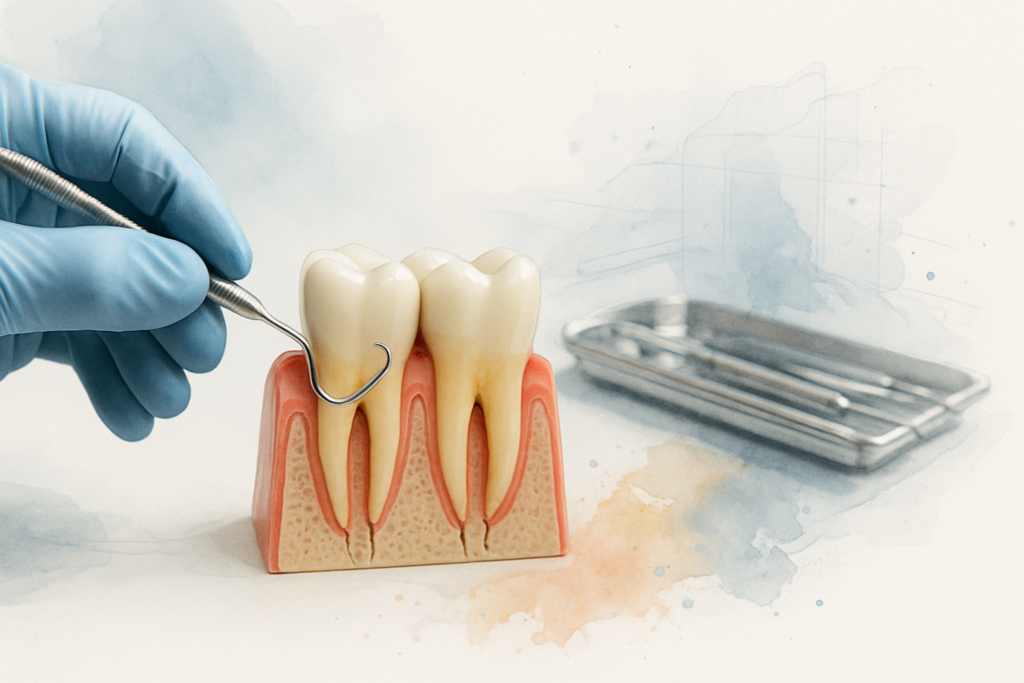
Direct Answer: Deep cleaning removes bacterial buildup above and below the gumline. Gum surgery addresses structural damage, deep pockets, bone loss, or tissue changes, that cleaning alone cannot reverse.
One of the questions I hear most often from patients who’ve already gone through a deep cleaning goes something like this: ‘I did everything they told me to. Why am I still being told I need surgery?’ It’s a fair question, and the frustration behind it is real. These are people who followed through on a difficult procedure, and now they’re being told it wasn’t enough.
The short answer is that deep cleaning and periodontal surgery solve different problems. One clears out bacterial buildup. The other addresses the structural damage that bacterial disease leaves behind. Understanding that difference is what helps patients move from feeling like surgery is being pushed on them, to understanding why the numbers are pointing in a specific direction.
If you’ve been putting off dental care for a while and just got insurance through work, you’re not alone. A caller told us recently: ‘I’ve got a lot of work that needs to be done on my teeth. I’ve been putting it off for a while, and now that I got actual insurance through work I was like, alright, time to get them fixed.’ That starting-over moment is incredibly common, and this article is written for exactly that person.
What Deep Cleaning Actually Does, and What It Can’t Do
Scaling and root planing, the clinical name for deep cleaning, is a non-surgical procedure that removes tartar and bacterial deposits from tooth surfaces above and below the gumline. It also smooths the root surface so gum tissue can reattach more easily. If you want more background on how tartar forms in the first place, this breakdown of plaque vs. tartar explains the biology well.
For patients with early to moderate gum disease, scaling and root planing often produces real improvement. Gum inflammation decreases, pockets get shallower, and regular maintenance can hold things steady from there.
But there are conditions deep cleaning cannot reverse:
- Pockets too deep for instruments to reach and clean thoroughly
- Bone loss that has already occurred beneath the gumline
- Gum tissue that has pulled away from teeth and will not reattach on its own
These are structural problems. Cleaning removes bacteria, but it doesn’t rebuild bone, close deep pockets, or reattach detached tissue. That’s not a failure of the procedure, it’s just a different clinical problem requiring a different approach. If your dentist has already recommended surgery after a deep cleaning, this article on why that recommendation comes up walks through that specific situation in more detail.
Pocket Depth: The Number That Usually Tips the Recommendation
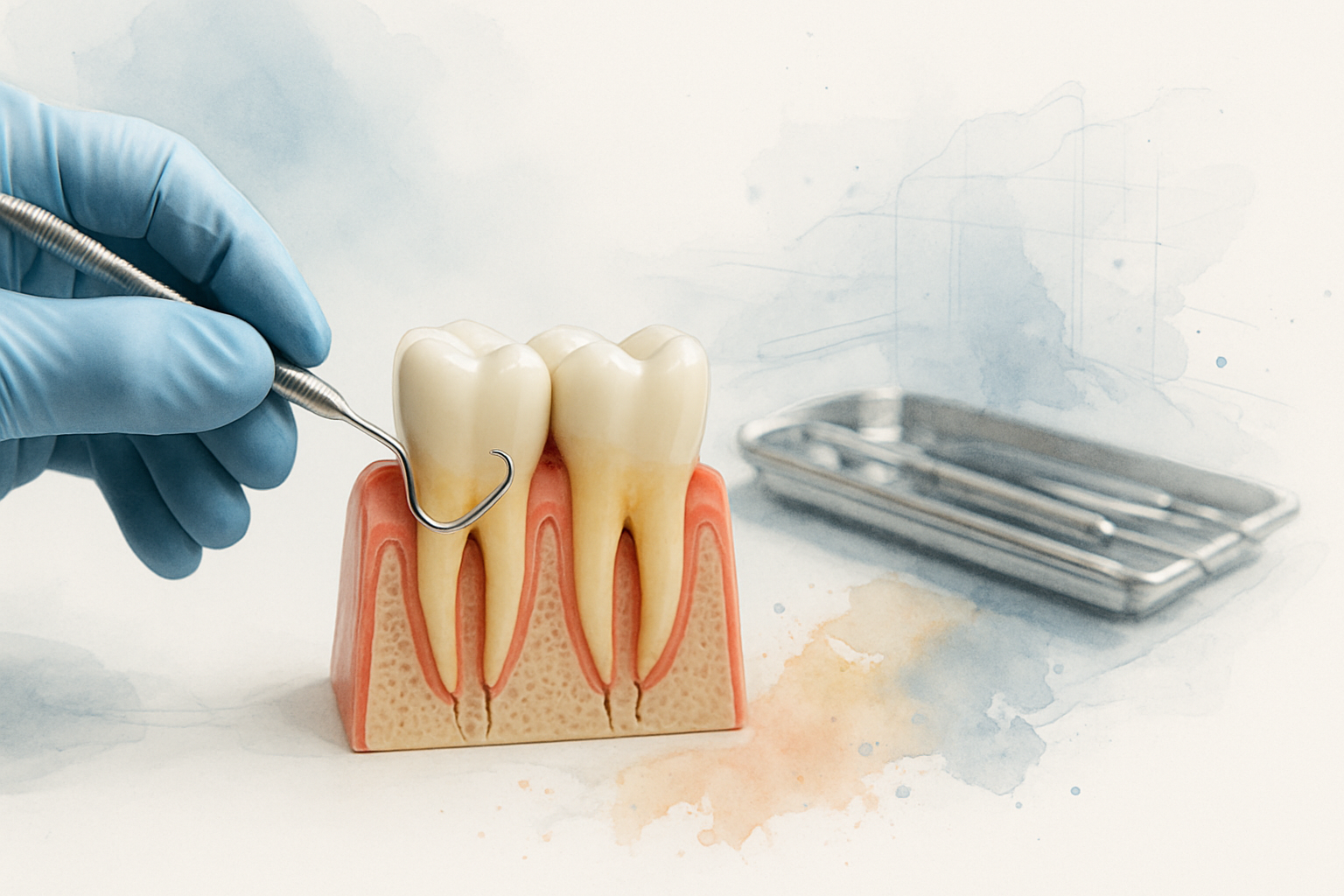
When a hygienist calls out numbers like 2, 3, 4, or 6 during your exam, they’re measuring periodontal pocket depth in millimeters, the space between your gum tissue and the surface of the tooth root. This measurement is one of the most important tools we have for tracking gum disease progression.
Here’s what those numbers mean in plain terms:
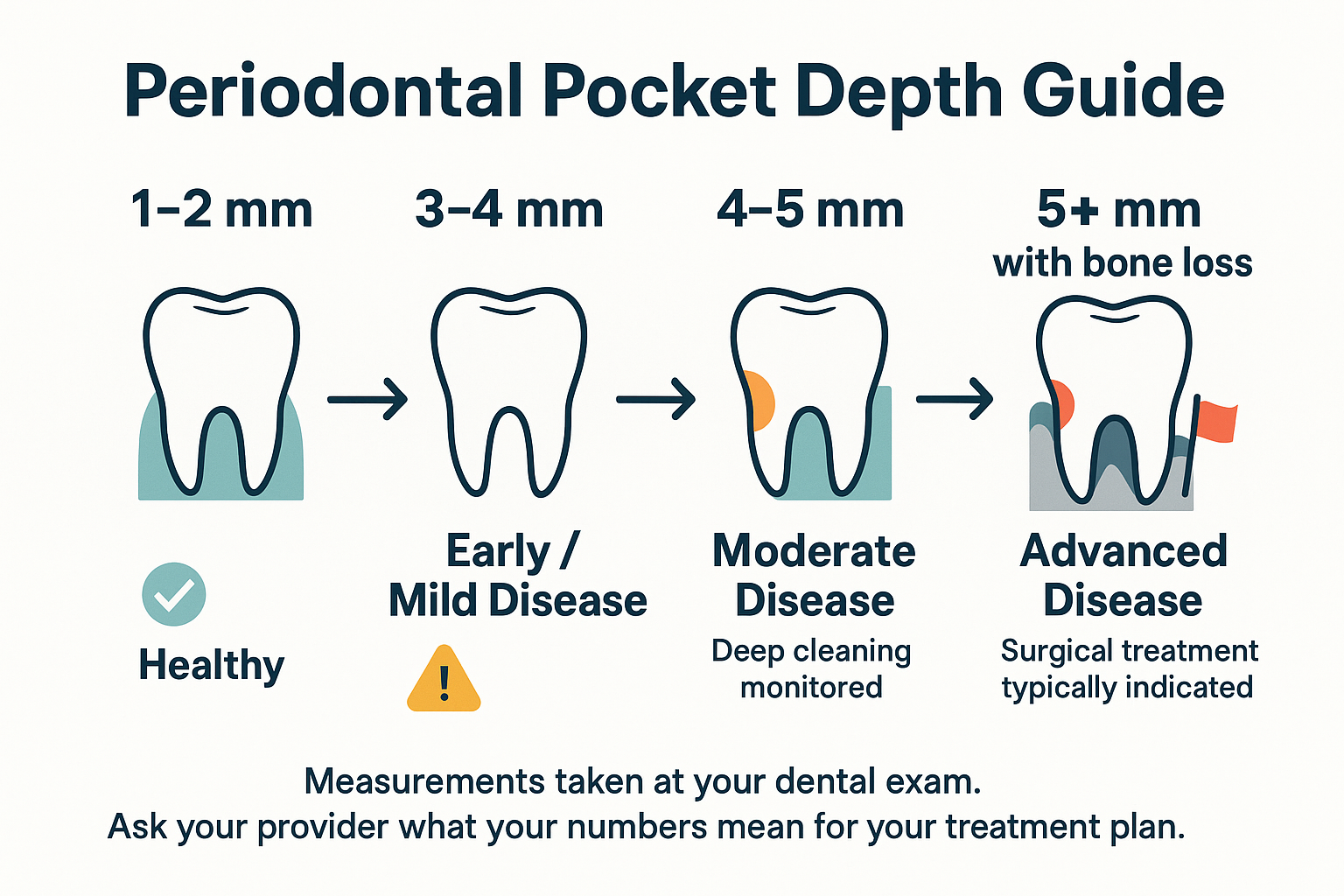
- 1 to 3 mm: Healthy. Gum tissue is fitting snugly around the tooth.
- 4 to 5 mm: Moderate disease. Deep cleaning may reduce these pockets, and the response is monitored over time.
- 5 mm or deeper with bone loss present: This is typically where evidence-supported treatment shifts toward surgical options, flap surgery or regenerative procedures.
The reason surgery enters the picture at deeper measurements is mechanical. A dental instrument can only clean effectively to a certain depth. Beyond that threshold, bacterial deposits remain even after a thorough deep cleaning, and continued infection accelerates bone loss.
According to the American Academy of Periodontology, surgical periodontal therapy is indicated when pockets remain deep after non-surgical treatment and bone loss has occurred. This isn’t a judgment call that varies from dentist to dentist, it’s the direction the clinical data points.
Patients who understand this measurement tend to feel less like surgery is being sold to them and more like the math is simply pointing somewhere specific.
Periodontal Pocket Depth: What the Numbers Mean
This reference chart shows how pocket depth measurements correspond to gum health status and typical treatment direction.
Is Periodontal Surgery Cosmetic? What’s Actually at Stake
This concern comes up more than you’d expect. Patients researching gum surgery sometimes wonder whether it’s primarily an appearance-driven procedure, something done to make gums look better rather than to address a real health problem.
Periodontal surgery is a health procedure. The conditions that lead to it, significant bone loss, deep uncontrolled pockets, tissue that has permanently detached, do not reverse on their own. Left untreated, they typically worsen. The bone that has been lost doesn’t grow back without intervention, and ongoing bacterial infection in deep pockets accelerates further destruction.
This matters beyond gum health alone. If you’re eventually going to need a dental implant, a crown, or any restoration that depends on solid bone and stable gum tissue, the condition of that underlying structure determines what’s possible. You can read more about how bone structure affects implant timing in this breakdown of what bone grafting means for your treatment timeline.
The appearance of gum tissue can absolutely improve after surgery, but that’s a byproduct of treating a biological problem, not the reason the procedure is recommended.
Deep Cleaning vs. Periodontal Surgery: A Side-by-Side Look
These two treatments address different stages and types of periodontal disease. Understanding where each one fits helps make sense of a treatment plan recommendation.
| Factor | Deep Cleaning (Scaling & Root Planing) | Periodontal Surgery |
|---|---|---|
| What it treats | Bacterial deposits above and below gumline | Structural damage: deep pockets, bone loss, detached tissue |
| Procedure type | Non-surgical | Surgical |
| Typical pocket depth range | Pockets in the 4-5 mm range | Pockets 5 mm or deeper, especially with bone loss |
| Anesthesia | Local anesthetic | Local anesthetic; sedation options may be available |
| Recovery | Mild soreness, 1-3 days | Soft diet for several days; full healing over several weeks |
| Goal | Remove infection, allow tissue to reattach | Access deeper areas, remove diseased tissue, preserve bone |
What Recovery from Gum Surgery Actually Looks Like
Recovery is one of the most-searched subtopics around periodontal surgery, and most of what people find online covers the basics without much specificity. Here’s what the first week typically involves in practice.
In the first 24-48 hours, some swelling and mild bleeding are normal. Keeping your head elevated and applying a cold compress to the outside of your face helps with both. Most patients manage discomfort with over-the-counter pain relief, though prescription options may be provided depending on the extent of the procedure.
For the first several days, expect to stick to soft foods:
- Scrambled eggs, yogurt, mashed potatoes, smoothies
- Avoid anything crunchy, hard, or requiring forceful chewing
- No straws, suction pressure can disrupt healing tissue
Physical activity should be limited for the first few days. Increased heart rate raises blood pressure at the surgical site and can slow early healing.
If your procedure involved a gum graft, there may be a second area of soreness at the donor site, typically the roof of the mouth, that feels different from the surgical site. Both are normal, but they may peak at slightly different times. For a thorough look at what graft recovery involves week by week, this gum grafting recovery guide is worth reading before your procedure.
Reach out to the practice if you notice: heavy bleeding that doesn’t slow, significant swelling that increases after day three, or a fever. These aren’t common, but they’re worth a call.
Frequently Asked Questions About Gum Surgery in Renton
I just had a deep cleaning six months ago. Why is surgery being recommended now?
Deep cleaning reduces bacterial infection and gives gum tissue a chance to reattach. But if your pockets remain 5 mm or deeper, or if there’s bone loss present, the deep cleaning addressed the bacteria without being able to reach or reverse the structural damage underneath. Surgery is the next clinical step, not a sign that the deep cleaning failed.
Will my dental insurance cover periodontal surgery?
Many dental insurance plans include some coverage for periodontal procedures, but the specifics vary widely, by plan, by the number of teeth involved, and by whether you’ve met your annual maximum. The best way to know what your plan covers is to have the practice verify your benefits before treatment begins. We do that as part of the consultation process.
Is gum surgery painful?
The procedure itself is done under local anesthetic, so you shouldn’t feel pain during it. Post-operative soreness is normal and manageable for most patients, typically handled with over-the-counter medication, though prescriptions are available when needed. Patients who’ve been anxious about the experience beforehand often tell us it was more manageable than they expected.
Do I need to see a specialist, or can my regular dentist handle gum surgery?
Flap surgery and regenerative periodontal procedures are performed by a periodontist, a dentist who has completed additional years of specialized training in gum disease and the structures that support teeth. In many practices, that means a referral to a separate specialist office. At Cedar Dental Group, Dr. Jaewon Kim is a board-certified periodontist who performs these procedures in-house, which means patients in the Renton and South King County area don’t need to coordinate care across multiple providers.
What happens if I skip the surgery and just keep up with cleanings?
For mild to moderate disease, consistent maintenance can hold things stable. But for significant bone loss and deep uncontrolled pockets, maintenance alone typically doesn’t stop the progression, it slows it at best. The bone that’s already been lost doesn’t return on its own, and ongoing infection in deep pockets accelerates further loss over time. The decision is yours to make, and we’ll give you the information you need to make it clearly.
I haven’t been to a dentist in years. Is it too late to treat gum disease?
It’s rarely too late to start. The evaluation process is the first step, it tells you exactly where things stand, what the measurements show, and what treatment, if any, makes sense. Many patients who’ve been away for several years have done a lot of successful catching up. Starting with an honest assessment is always the right move.
Ready to Understand What Your Pocket Numbers Actually Mean?
If you’ve been told you may need gum surgery, or you’re just starting to figure out where things stand after a long gap in care, a periodontal evaluation is the most useful next step. At Cedar Dental Group in Renton, Dr. Jaewon Kim is a board-certified periodontist who handles advanced gum procedures, including flap surgery and regenerative treatment, in-house. Patients across South King County who would otherwise face a referral to a separate specialist office in Seattle can get that same level of evaluation and care without the added coordination. To schedule a consultation, call us at 425-430-0400 or visit cedardentalgroup.com.
