

Direct Answer: For most adults with mild-to-moderate crowding or spacing issues, clear aligners offer better discretion and fewer lifestyle disruptions than traditional braces — but the right choice depends on what your teeth actually need.
I see this come up all the time in our office — someone books a cleaning and mentions almost as an afterthought that they’ve been thinking about straightening their teeth. They’re not teenagers. They have jobs, meetings, maybe a wedding or event on the calendar, and they’re not exactly excited about the idea of metal brackets at 35. The question they’re really asking isn’t “do aligners work?” It’s “are they right for someone like me?”
That’s a fair question, and the answer is genuinely different for adults than it is for younger patients. What you prioritize changes after 30. Discretion at work, not having to rethink what you eat, the ability to take something out before a presentation or a dinner — those things matter in ways they just don’t for a 15-year-old.
This post is meant to walk through what actually separates clear aligners from traditional braces for adults, what kinds of cases aligners handle well, and what you need to have sorted out before you start either one. We work with a lot of patients in Renton and the surrounding South King County area who come to us having already done their research — so I’ll try to give you the same honest breakdown I’d give someone sitting in our chair.
What Adults Actually Care About That Teenagers Don’t
When I talk to adults who are considering orthodontic treatment, the concerns are pretty consistent. Nobody wants to look like they’re going through a second adolescence at a client meeting. And beyond appearances, there are real practical differences that make the aligner vs. braces conversation land differently depending on your stage of life.
Here’s what I hear most often from adult patients weighing these options:
- Visibility at work — Aligners are nearly invisible day-to-day. Traditional braces are not. For professionals who present to clients or appear on video calls, this is often the deciding factor.
- Dietary restrictions — Braces mean no popcorn, no hard foods, and being careful about anything sticky. Aligners come out to eat, so there are no restrictions at all.
- Removing for events — Aligners can come out for a few hours. That flexibility matters for weddings, presentations, or any situation where you’d rather not think about them.
- Check-in frequency — Most aligner cases require office visits every 6 to 8 weeks, not monthly bracket adjustments. For working adults with full schedules, that difference is meaningful.
- Treatment length for mild cases — Adults with mild spacing or minor crowding often see aligner treatment wrapped up in 6 to 18 months, depending on the complexity. More involved tooth movement takes longer regardless of which method is used.
None of this means aligners are automatically the better choice. It means they were designed with a different patient in mind than traditional braces were — and that patient looks a lot like most of the adults who ask us about this.

What Aligners Handle Well — and Where They Have Limits
One of the most common hesitations I hear is: “I don’t even know if my case qualifies.” That’s a completely reasonable thing to wonder, and I’d rather explain it plainly than have someone assume they’re not a candidate when they actually are.
Clear aligners work well for:
- Mild to moderate crowding — teeth that have shifted or overlapped slightly
- Spacing between teeth — small gaps that have been there for years or appeared after previous orthodontic work
- Minor bite issues — certain overbite and underbite corrections that don’t require significant jaw movement
- Relapse cases — adults who had braces as teenagers and have seen their teeth shift back over time
Where traditional braces or a more involved assessment is usually needed:
- Significant bite problems involving the jaw, not just the teeth
- Severe crowding that requires substantial tooth rotation
- Cases where certain teeth need to move in complex, three-dimensional ways that aligners struggle to replicate precisely
- Patients who know they won’t be consistent about wearing trays for the required 20 to 22 hours per day — because aligners only work if they’re actually in
The only way to know which category your situation falls into is a proper clinical assessment. But if you have mild crowding, some spacing, or teeth that have shifted gradually over the years, there’s a real chance you’re a good aligner candidate. You’re an adult considering aligners — here’s what to expect covers more of that process in detail.
Clear Aligners vs. Traditional Braces — Adult Priorities Side by Side
This is a practical comparison based on what actually matters for working adults — not a technical rundown of every clinical difference.
| Factor | Clear Aligners | Traditional Braces |
|---|---|---|
| Visibility day-to-day | Nearly invisible | Visible metal or ceramic brackets |
| Food restrictions | None — remove to eat | Yes — hard, sticky foods restricted |
| Removable | Yes — out for meals and events | No — fixed until treatment ends |
| Office visit frequency | Every 6–8 weeks typically | Monthly adjustments common |
| Best fit for | Mild to moderate alignment issues | Moderate to severe, complex cases |
| Consistency required | High — must wear 20–22 hrs/day | No patient compliance needed once placed |
| Oral hygiene | Easier — brush normally | More effort around brackets and wires |
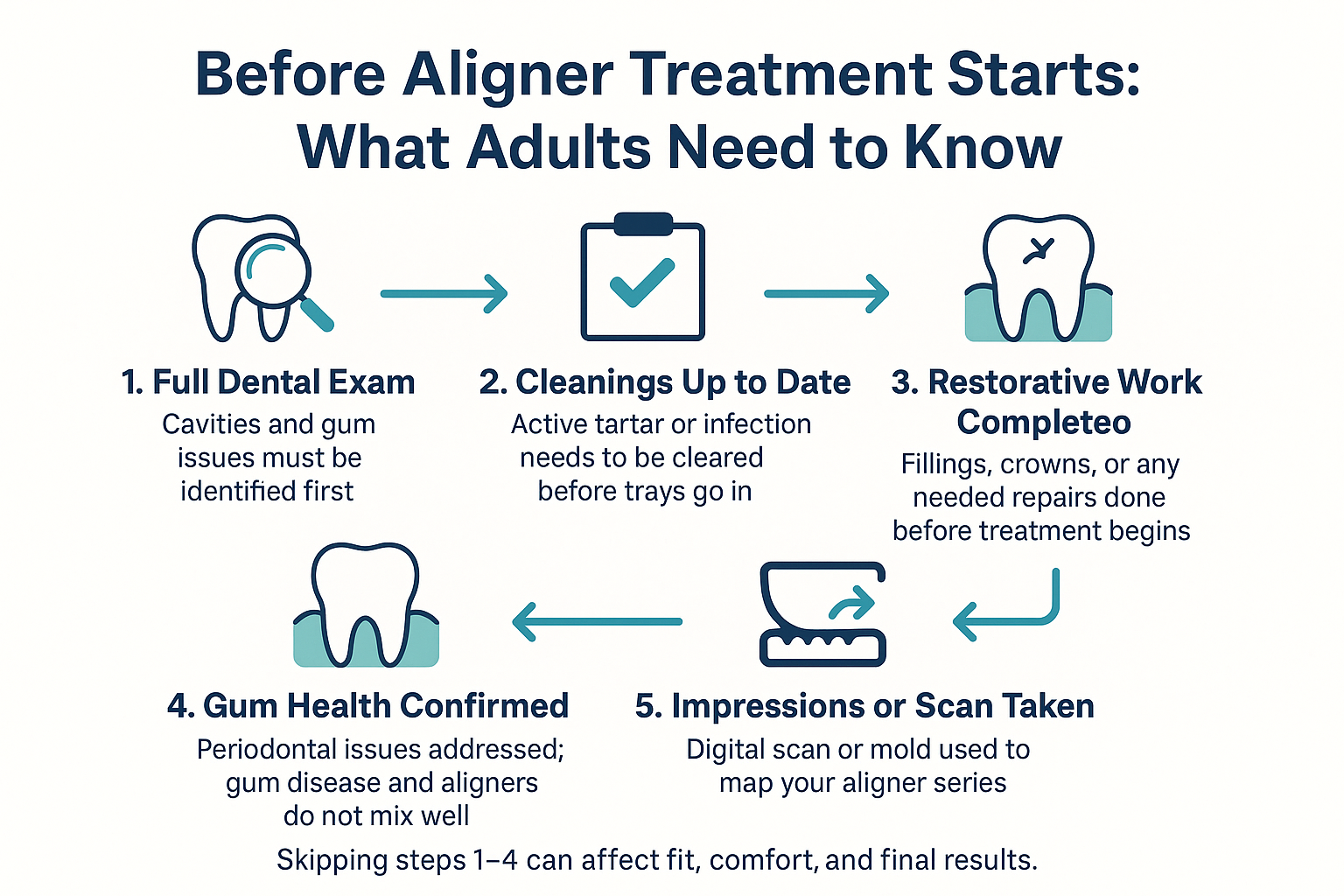
Before You Start Aligners: What Needs to Happen First
Adults sometimes don’t realize that aligner treatment doesn’t begin the day you decide you want it. There are a few steps that come first — and skipping them can cause problems down the road.
Why Your Oral Health Has to Come First
I want to spend a moment on this because it surprises some patients. Aligners don’t go over teeth that have untreated decay, active gum disease, or significant buildup. And there’s a good clinical reason for that — not a bureaucratic one.
If you have a cavity under a tray for 12 to 18 months, it gets worse. If you have early gum disease and we’re asking your gums to adapt to a moving tooth, we’re asking for problems. The sequence matters: exam, cleaning, any needed restorative work, then aligners.
This is actually one reason we see patients combine these conversations so naturally. Someone books a cleaning, mentions they’re curious about aligners, and it turns out the cleaning appointment is exactly the right place to start that evaluation. We can assess gum health, check for anything that needs attention, and give a realistic picture of whether aligner treatment makes sense — all in one visit.
For patients with gum concerns, it’s worth knowing that more advanced issues like recession or periodontal disease need to be properly managed before any tooth movement begins. Gum recession: how to tell if it’s getting worse — and what stops it is a good starting point if you’ve noticed your gumline pulling back. And if you’ve been told you have gum disease in the past, understanding why surgery might still be recommended after a deep cleaning explains what that path looks like.
What Clear Aligners Actually Cost for Adults in Renton
I won’t pretend cost isn’t part of this conversation for most people. It always comes up, and it should.
The honest answer is that pricing varies depending on the complexity of your case, the number of aligners in your series, and whether any refinements are needed along the way. In the greater Seattle area and South King County market, aligner treatment for adults generally lands somewhere in the range that most dental insurance plans partially cover — though orthodontic coverage varies significantly from plan to plan, and many adults are surprised to find they have more coverage than they assumed.
Factors that affect what you’ll pay:
- Complexity of your case — mild spacing costs less to treat than moderate crowding with bite correction
- Whether you need refinement trays at the end of treatment
- Your specific dental insurance plan and whether it includes orthodontic benefits
- Whether any restorative work is needed before treatment starts
The best thing to do is ask during your consultation. We can review your coverage and give you a clear picture of what the out-of-pocket cost actually looks like for your specific situation — not a ballpark that turns out to be wrong. For broader context on how dental costs factor into treatment decisions, finding a dentist near you that offers payment plans walks through what those options typically look like.
Frequently Asked Questions About Clear Aligners for Adults
Do clear aligners work as well as braces for adults?
For mild to moderate cases — spacing, minor crowding, slight relapse after previous orthodontic treatment — yes, the outcomes are comparable. The clinical evidence supports aligners for these case types. Where braces tend to have an advantage is in more complex tooth movement, especially cases involving significant rotation or jaw-level bite correction. Do clear aligners work as well as traditional braces? covers the comparison in more depth.
How often do I need to come in for aligner check-ins?
Most aligner cases involve a check-in visit every 6 to 8 weeks, where we confirm teeth are tracking as expected and hand off the next set of trays. This is less frequent than traditional braces, which typically require monthly adjustment appointments. For adults managing busy work schedules, that reduced frequency is a genuine practical difference.
What happens if I have a cavity or gum disease — can I still start aligners?
Not right away. Any active decay or gum disease needs to be treated first. Aligners fit tightly against your teeth, and putting trays over untreated issues for a year or more makes those problems significantly worse. Once your oral health is stable, treatment can begin. The good news is that a routine exam and cleaning appointment is often all it takes to get that picture.
I had braces as a teenager and my teeth have shifted. Am I a good candidate?
Relapse cases — where teeth have drifted back after earlier orthodontic work — are actually one of the most common reasons adults pursue aligners. These cases often involve mild movement and can be among the shorter treatment timelines. An assessment will confirm how much correction is needed, but this is a situation aligners frequently handle well.
Can I remove aligners for a special event or a work presentation?
Yes, and this is one of the reasons adults prefer them. Aligners can be removed for a few hours without disrupting treatment, as long as you’re hitting the 20 to 22 hours per day wear requirement overall. Removing them for a dinner or a presentation is fine. Removing them for most of the day, every day, is not — the teeth won’t move on schedule.
How do I know if my case qualifies for aligners or if I need something more involved?
The only real answer comes from a clinical evaluation. Generally speaking, if you have mild crowding, spacing, or gradual shifting over the years, there’s a solid chance you’re a candidate. Cases involving significant bite issues or severe crowding are more likely to need a different approach. A consultation is the right place to find out — it’s not a commitment to start treatment.
Ready to Find Out If Aligners Are Right for You?
If you’re in Renton or the surrounding South King County area and you’ve been turning this over in your head, the easiest next step is a conversation — not a commitment. Cedar Dental Group offers aligner consultations alongside routine exams, so if you’re due for a cleaning anyway, that’s a natural place to start both conversations at once. Call us at 425-430-0400 or visit cedardentalgroup.com to schedule an appointment with Dr. Chu.
