

Direct Answer: For most adults with mild to moderate alignment issues, clear aligners work just as well as braces. But for complex bite problems, traditional braces may still be the stronger option.
A lot of adults in Renton come in asking the same question: are clear aligners actually going to fix my teeth, or are they just a more convenient-looking version of doing nothing? It’s a fair question, and the honest answer is more nuanced than most aligner ads would have you believe.
Clear aligners have improved dramatically over the past decade. For the right patient, they produce results that are clinically on par with traditional braces. But “the right patient” is doing a lot of work in that sentence — and understanding what that means is the most important thing you can do before committing to 12 to 18 months of treatment.
This article focuses on two things that actually matter when you’re weighing your options: what the clinical evidence says about aligner effectiveness, and how to know whether your specific situation is one where aligners will work as well as braces — or where braces might give you a better outcome.
What the Research Actually Shows About Clear Aligners vs. Braces
Studies comparing clear aligners to traditional braces generally find similar outcomes for mild to moderate crowding, spacing, and minor bite issues. A 2020 review published in the Journal of Orthodontics found that aligners performed comparably to braces for these cases, with patient satisfaction often higher due to comfort and aesthetics.
But the research also shows consistent limitations. Aligners tend to fall short when it comes to:
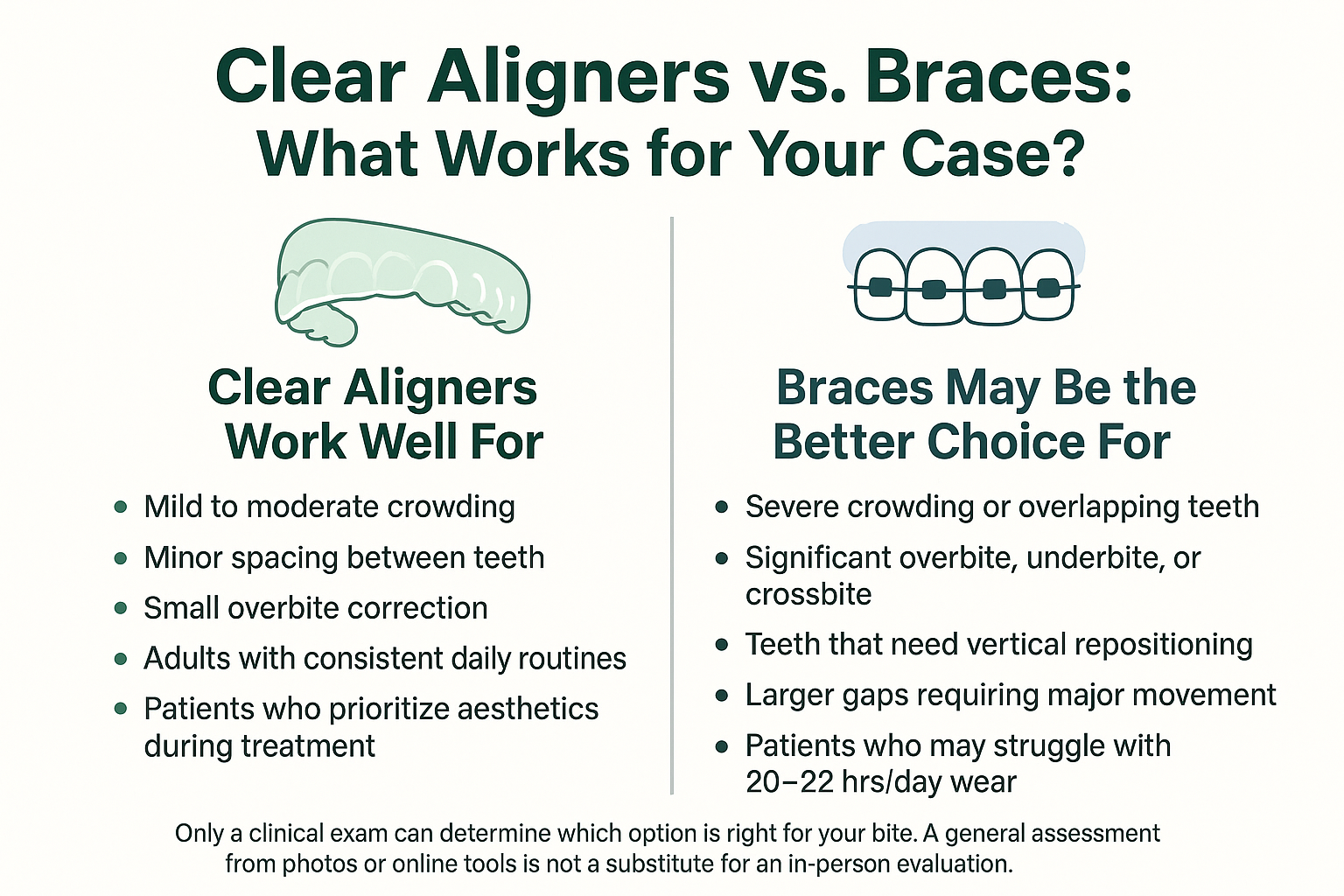
- Significant overbite or underbite correction
- Severe crowding that requires major tooth rotation
- Vertical tooth movement (moving a tooth up or down in the jaw)
- Closing large gaps between teeth
Braces give a dentist or orthodontist precise, continuous control over tooth movement using fixed brackets and wires. Aligners work in incremental steps — each tray moves teeth a fraction of a millimeter at a time. That step-by-step approach works well for a lot of movements, but some types of correction simply respond better to the constant, multidirectional force that braces can apply.
For adults with moderate alignment concerns — the kind you might have been told about for years but never addressed — aligners are a genuinely effective option. The key is having someone who can assess your specific bite before you start, not after you’re three months in and wondering why the gap isn’t closing.
The Part Nobody Tells You: Compliance Makes or Breaks Aligner Treatment
Clear aligners only work if you wear them. That sounds obvious, but it is genuinely the most common reason aligner treatment fails or takes longer than expected.
The clinical recommendation is 20 to 22 hours per day. That means aligners come out to eat, drink anything other than water, and brush your teeth — and go back in immediately after. For most patients, that leaves about two hours of “aligner-free” time per day.
Traditional braces are bonded to your teeth. They’re working whether you think about them or not. Aligners require consistent follow-through over the entire treatment period, which can run anywhere from 6 months to 24 months depending on the complexity of your case.
If you know yourself well enough to recognize that a removable device is going to spend most evenings on the nightstand, that’s genuinely important information — and it’s worth factoring into your decision alongside the clinical comparison. We’ve seen patients who would have gotten excellent results with aligners end up extending treatment by 3 to 6 months simply because wear time slipped.
If you have questions about what to expect from the process before you start, our guide on what Renton adults should know before starting clear aligners covers the day-to-day realities in detail.
Clear Aligners vs. Traditional Braces: A Practical Comparison
This comparison focuses on the factors that matter most to adults weighing their options — not just aesthetics, but effectiveness, lifestyle, and what each approach actually requires of you.
| Factor | Clear Aligners | Traditional Braces |
|---|---|---|
| Visibility | Nearly invisible when worn | Visible metal or ceramic brackets |
| Best for | Mild to moderate crowding and spacing | Mild to severe cases, including complex bites |
| Treatment time | 6–18 months (typical adult case) | 12–24 months |
| Compliance required | Yes — must be worn 20–22 hrs/day | No — fixed to teeth |
| Removable | Yes — for eating and brushing | No |
| Comfort | Smooth plastic, less irritation | Brackets can irritate cheeks early on |
| Cost in Renton area | $3,500–$7,000 depending on case | $4,000–$7,500 for full treatment |
| Dental visits | Every 6–10 weeks typically | Every 4–6 weeks for adjustments |
| Bite correction | Limited for complex bite issues | Handles complex bite correction well |
Is Your Case a Good Fit for Clear Aligners?
This quick visual guide breaks down the clinical scenarios where aligners tend to work well versus where traditional braces may be the stronger recommendation.
What a Thorough Exam Before Treatment Actually Includes
One thing worth understanding before you start any alignment treatment — braces or aligners — is that the quality of the upfront exam matters enormously.
A proper assessment before clear aligner treatment should include:
- Dental X-rays to evaluate bone levels, root positioning, and any underlying issues that could affect movement
- A full gum health evaluation — gum disease or recession needs to be addressed before orthodontic treatment begins, because moving teeth through compromised tissue can make existing problems worse
- Bite analysis to determine whether your specific misalignment is within the range that aligners handle reliably
- Photography and digital records to track progress throughout treatment
Gum health is something patients often overlook when comparing aligner options. If you have any gum recession or early signs of gum disease, that needs to be evaluated and — if necessary — treated before tooth movement starts. You can read more about what gum recession involves in our guide to receding gum grafting surgery, and if you’re unsure whether your gums are a factor, this guide on identifying gum recession walks through the signs to look for.
Patients who skip a thorough pre-treatment evaluation and go directly to a mail-order or retail aligner service are essentially skipping this step entirely. That’s not a judgment — it’s just worth knowing what you’re working with before you start.
What Clear Aligners Cost in the Renton Area — and What Affects the Price
In the South King County area, clear aligner treatment through a dental office typically runs between $3,500 and $7,000 for full treatment. The range is wide because the price depends heavily on how complex your case is and how many trays your treatment plan requires.
Some factors that push the cost higher:
- More teeth requiring movement
- Longer treatment duration (more trays = higher lab costs)
- Refinement trays needed mid-treatment to correct tracking issues
- Retainers after treatment (usually $200–$500 per set, and you’ll need them long-term)
Most dental insurance plans that include orthodontic coverage apply a lifetime orthodontic benefit — often between $1,000 and $2,000 — that can apply to aligner treatment the same way it would to braces. Check whether your plan has a separate ortho benefit or applies it through your general dental maximum.
For patients paying out of pocket, many practices in the Renton area offer financing through third-party plans. If you’re thinking through the cost side of dental care more broadly, this guide on how dental costs are changing for Renton patients offers useful context.
Frequently Asked Questions About Clear Aligners
Can I switch from clear aligners to braces mid-treatment if it’s not working?
Yes, it’s possible. If teeth aren’t tracking the way the treatment plan projected, a dentist or orthodontist can transition you to braces to continue movement. It happens more often than patients expect — particularly when a case turns out to be more complex than the initial scan indicated. The trays you’ve already completed aren’t wasted, because any movement achieved carries over. But transitioning does usually mean additional cost and a revised timeline.
Are mail-order aligners (like byte or Smile Direct) as effective as getting aligners through a dentist?
Mail-order aligner services skip the clinical exam and ongoing monitoring that in-office treatment includes. There’s no X-ray evaluation, no gum assessment, and no provider checking your progress at regular intervals. For a very narrow range of minor cosmetic corrections, some patients have been satisfied. But the risk is that problems — including unexpected root resorption or worsening gum issues — can develop without anyone catching them. Most dental associations advise against unsupervised aligner treatment for this reason.
How long do I have to wear a retainer after clear aligner treatment?
Long-term — most likely indefinitely, at least at night. Teeth have a natural tendency to shift back toward their original position after orthodontic treatment, and retainers are what prevent that. Most patients wear a retainer every night for the first year, then several nights a week after that. Stopping retainer use entirely is the most common reason adult patients see their teeth shift after completing treatment.
Will aligners work if I’ve had crowns or dental work done?
Often yes, but it depends. Aligners attach to teeth using small tooth-colored attachments called buttons or engagers. These bond to natural tooth enamel best. Crowns, veneers, and bonded restorations can sometimes make attachment placement trickier — but it’s not a disqualifying factor in most cases. This is one more reason a thorough exam matters before you start.
What happens if I lose a tray?
Most providers recommend going back to the previous tray temporarily while a replacement is ordered. Replacement trays typically cost $50–$150 depending on the practice and the aligner brand. It’s not an emergency, but you don’t want to leave a gap in your treatment for more than a few days.
Ready to Find Out If Clear Aligners Are Right for Your Bite?
If you’ve been thinking about aligners but aren’t sure whether your case is a good fit, the right starting point is an in-person exam — not a photo scan or an online quiz. At Cedar Dental Group in Renton, Dr. Susan Chu can evaluate your bite, review your gum health, and give you a clear picture of what treatment would realistically look like for your specific situation. Call us at 425-430-0400 or visit cedardentalgroup.com to schedule a consultation.
