

Direct Answer: Most adults complete clear aligner treatment in 12 to 18 months. You wear each tray for 1 to 2 weeks, switching sets as your teeth shift gradually into alignment.
You’ve been thinking about it for a while — maybe since you noticed a shift in your teeth, or maybe you just finally got tired of looking at photos and wishing things lined up a little better. Whatever brought you here, you’re not alone. Adult aligner patients now make up more than half of all orthodontic starts nationwide, and in the Renton area, we see that trend clearly in our own consult schedule.
But most of the information out there is written for teenagers or for people who’ve already decided. If you’re still in the research phase — weighing whether aligners will actually work for your situation, what daily life looks like while wearing them, and what this is realistically going to cost — this article is for you.
We’re going to focus on the parts that actually matter for an adult patient: candidacy, what the experience feels like day-to-day, and what results you can reasonably expect. We’ll skip the sales pitch and give you the real picture.
Are Clear Aligners Actually a Good Fit for Your Situation?
This is the question most people are really asking when they say they’re “considering” aligners. And the honest answer is: it depends on what’s going on in your mouth.
Aligners work well for a wide range of alignment issues in adult patients. They can handle:
- Mild to moderate crowding — teeth that overlap or feel cramped
- Spacing issues — gaps between teeth, including front teeth
- Minor bite problems — some overbites and underbites respond well to aligner treatment
- Relapse after previous orthodontic work — this is one of the most common reasons adults start aligners
What aligners are less suited for are severe bite problems, significant jaw discrepancies, or cases where teeth need to move in ways that trays can’t reliably produce. A clinician will tell you this clearly during a consult — there’s no reason to start a treatment plan that isn’t right for your case.
One thing that often gets overlooked before starting aligners: your gum health. If there’s any active gum disease or bone loss, that needs to be addressed first. Moving teeth through compromised tissue can accelerate problems rather than fix them. If you’ve been told you have gum recession or have noticed your gumline pulling back, reading about receding gum grafting surgery before your consult can help you ask better questions.
For a deeper comparison of what aligners can and can’t do compared to traditional braces, this breakdown of how clear aligners work vs. braces covers the clinical side in plain terms.

What the Process Actually Looks Like, Week by Week
Once you’re confirmed as a good candidate, the process starts with a digital scan of your teeth. No goopy impressions — a small wand moves around your mouth and builds a 3D model in about 10 minutes. From that scan, your full series of trays is fabricated and you’ll see a simulation of your projected tooth movement before anything begins.
You’ll wear each tray for 7 to 14 days, then move to the next set. Each tray is slightly different, nudging teeth incrementally. Most patients notice mild pressure for the first day or two after switching trays — not pain, just awareness that something is happening.
The two rules that determine whether your treatment works on schedule:
- Wear your trays for 20 to 22 hours per day. They come out for eating and drinking anything except water. That’s it.
- Don’t skip trays. Each tray builds on the last. Skipping or losing a tray means going back, not forward.
Check-in appointments happen roughly every 6 to 8 weeks. These are short — your clinician is confirming that teeth are tracking as planned, not doing any significant work. If something’s off, they catch it early.
Total treatment time for most adult cases falls between 12 and 18 months. Simpler cases can finish in 6 to 9 months. More involved tooth movement can push closer to 24 months. Your simulation gives you a projected timeline before you start, which most patients find helpful for planning purposes.
After your final tray, you’ll wear a retainer — this is non-negotiable. Adult teeth that were moved will want to drift back, sometimes quickly. The retainer is what locks in your result long-term.
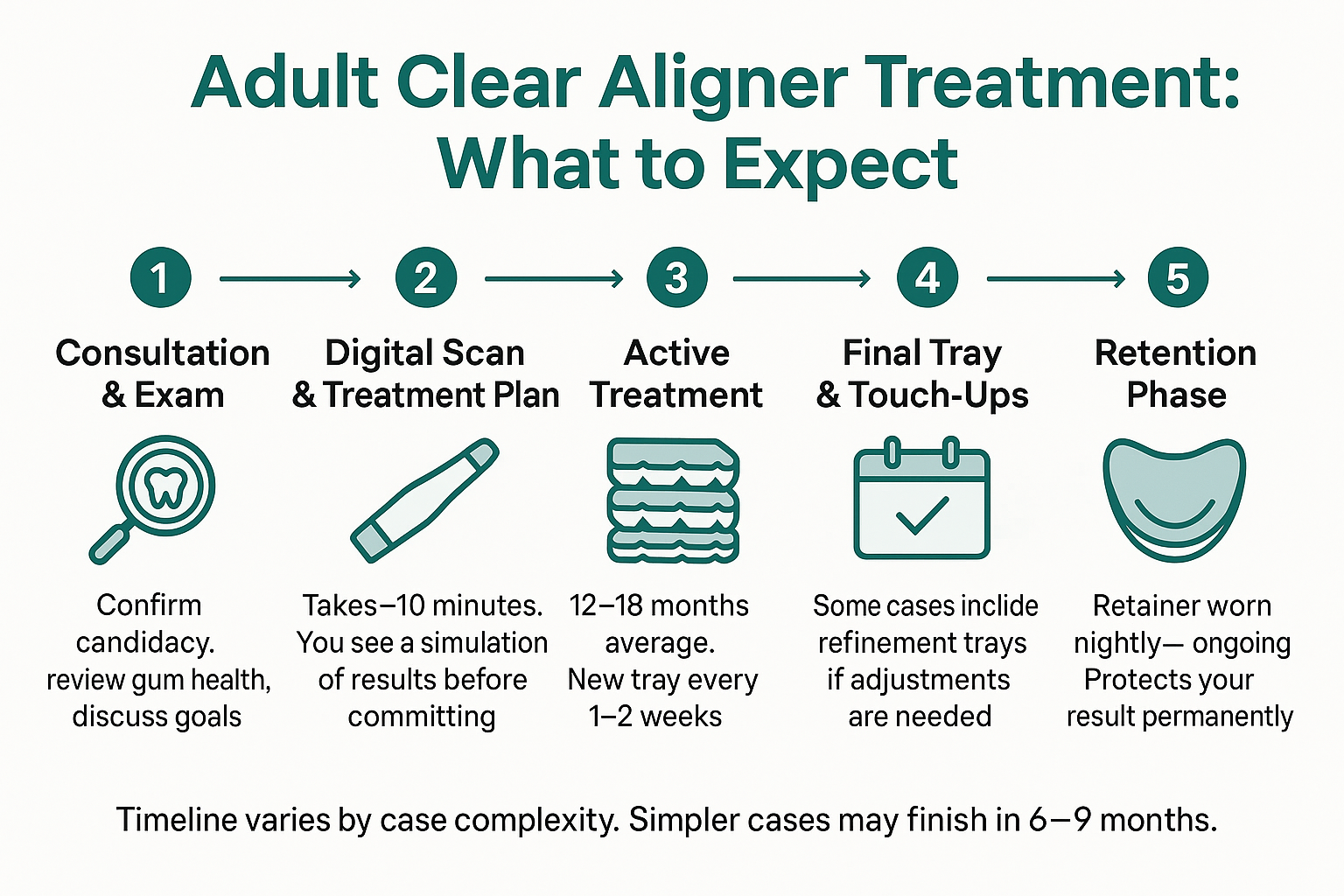
The Adult Aligner Timeline at a Glance
This shows the typical phases of clear aligner treatment from initial consult through retention, with realistic timeframes at each step.
What Aligners Cost in the Renton Area — and What Affects the Price
Most adult aligner cases in the greater Seattle and South King County area run between $3,500 and $6,500, depending on treatment complexity and how many trays are needed.
The main factors that move the number up or down:
- Case complexity — more movement required means more trays, more time, higher cost
- Whether refinements are included — some treatment plans include unlimited refinement trays; others charge for additional sets if the plan needs adjusting mid-treatment
- Where the case is managed — a dental office that manages aligners in-house (rather than outsourcing coordination) typically has more flexibility on pricing and a cleaner patient experience
Insurance sometimes covers a portion of aligner treatment under orthodontic benefits, but adult coverage is hit or miss. Many plans cap orthodontic benefits at $1,000 to $1,500 lifetime, and some plans explicitly exclude adults. It’s worth calling your insurer directly before your consult — ask specifically about adult orthodontic coverage and whether clear aligners qualify.
If you’re weighing costs against other dental priorities, it helps to have the broader picture. If you’ve also been putting off cosmetic or restorative work, reading how dental costs are shifting in the Renton market gives useful context for planning.
Payment plans are available for aligner treatment. Most practices offer in-house financing or third-party options that spread the cost over 12 to 24 months with low or no interest. If that’s something you want to explore, this guide to dental payment plans explains how those arrangements typically work.
Clear Aligner Cost Comparison: What Affects What You Pay
Here’s a quick reference for understanding how different factors shift the total cost of aligner treatment.
| Factor | Lower End | Higher End |
|---|---|---|
| Mild crowding or spacing (few trays) | $3,500–$4,200 | — |
| Moderate complexity (more movement needed) | — | $5,000–$6,500 |
| Refinements included in plan | Unlimited often included | Additional cost if not bundled |
| Insurance orthodontic benefit (adult) | $0 (many plans exclude adults) | $1,000–$1,500 lifetime max |
| Retainer (after final tray) | $200–$400 for set of retainers | Replacement cost if lost |
The Part Most Adults Don’t Anticipate: The Adjustment Period
Aligners are removable, which sounds like a pure advantage — and mostly it is. But that removability is also where treatment can quietly go off track.
The 20-to-22-hour wear requirement is harder than it sounds for adults with busy schedules. Business lunches, long travel days, dinners out — every time trays come out and don’t go back in right away, that time accumulates. Patients who consistently fall short of 20 hours tend to see their treatment timeline extend, and sometimes their teeth don’t track as planned.
There’s also a speech adjustment in the first week or two. Most people develop a very slight lisp while their tongue adjusts to the new plastic. It typically resolves on its own within 5 to 10 days. Talking more — reading out loud, taking phone calls — speeds that up.
And finally, attachments. Many aligner cases require small tooth-colored bumps bonded to certain teeth. These give the trays something to grip when more precise movement is needed. They’re not visible from a distance, but you’ll feel them. They come off at the end of treatment.
None of these things are dealbreakers — but knowing about them before you start means you’re not surprised. Patients who understand what to expect tend to follow through more consistently, and that directly affects how well treatment works. What Renton adults should know before starting aligners goes deeper on this if you want more.
Frequently Asked Questions About Adult Aligner Treatment
Will people be able to see my aligners when I’m wearing them?
For most people in most lighting conditions, no. The trays are clear plastic and sit flush against your teeth. Attachments (the small tooth-colored bumps some cases require) are visible up close if someone is looking, but not from a normal conversational distance. Under very direct lighting — stage lighting, bright photography — trays can sometimes catch the light slightly.
Do aligners hurt?
Most patients describe it as pressure, not pain — especially in the first day or two after switching to a new tray. Over-the-counter pain relievers handle it easily if needed. It generally settles within 48 hours.
What happens if I lose a tray?
You’ll typically go back to wearing the previous tray while a replacement is made. Let your dentist know right away — the longer you go without a tray, the more teeth can shift back. Replacement trays usually take 1 to 2 weeks to arrive.
Can I whiten my teeth while in aligner treatment?
Some patients do use whitening gel with their trays as a delivery method, but this should be done with your dentist’s guidance — not as a DIY experiment. Whitening during active treatment also means your final shade won’t be consistent across teeth if some areas are covered by attachments. Many patients choose to whiten after finishing treatment. If you’re curious about professional whitening options, this guide to dental insurance and teeth whitening has useful background.
I had braces as a teenager but my teeth have shifted. Am I still a good candidate?
Yes — this is actually one of the most common reasons adults pursue aligners. Relapse after prior orthodontic work is very treatable with aligners, and because the movement needed is usually modest, these cases often fall on the shorter and less expensive end of the treatment range.
Do I need to do anything to my teeth before starting aligners?
Your dentist will want any active decay or gum issues addressed before beginning. That’s not a bureaucratic hurdle — moving teeth through diseased tissue or around unfilled cavities can create bigger problems. A thorough exam and cleaning before starting is standard. Think of it as making sure the foundation is solid before you start building.
Ready to See Whether Aligners Are Right for Your Situation?
If you’re in Renton or the surrounding South King County area and want a clear answer about whether aligners make sense for your teeth, Cedar Dental Group offers consultations where Dr. Chu can review your specific case and walk you through realistic options — no pressure, no surprises. Call us at 425-430-0400 or visit cedardentalgroup.com to schedule a time that works for you.
