

Trying to understand your dental insurance plan can feel confusing. It often seems like the details are written in a foreign language, leaving you to guess what’s covered. This can lead to stress and surprise bills at the front desk.
The good news is that most plans follow a simple pattern. They usually cover preventive care (like cleanings) at a high rate, offer good coverage for basic work (like fillings), and provide less coverage for major procedures (like crowns). Cosmetic treatments are typically not covered at all. Understanding these categories is the best way to avoid financial surprises and make your insurance work for you.
Decoding Your Dental Insurance Benefits
Have you ever left a dental appointment with a bill that was much higher than you expected? If so, you’re not alone. Many patients feel blindsided by unexpected out-of-pocket costs, and this experience is a major source of anxiety about going to the dentist. Lack of price transparency is one of the biggest reasons patients feel frustrated or lose trust.
The most common misstep is assuming your insurance will automatically cover everything without asking questions first. A better approach is to see your plan as a helpful tool. Once you learn how it works, you can use it to your advantage to keep your smile healthy and your budget on track.
The Three Tiers of Dental Coverage
Most PPO dental plans sort treatments into three main categories, each with a different level of coverage. This system is designed to encourage you to maintain your oral health while sharing the cost of more complex treatments.
This diagram shows how that structure usually works.
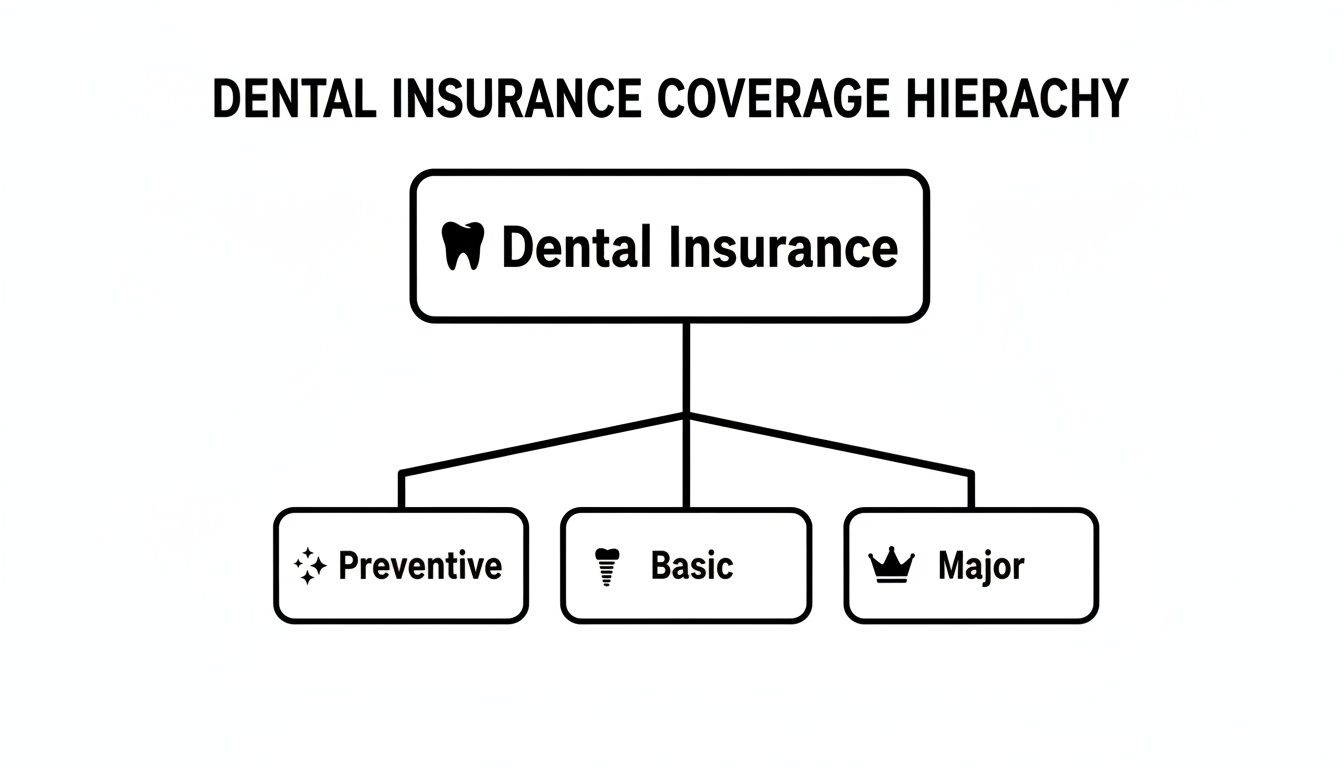
As you can see, your plan is built on a foundation of preventive care. As treatments become more complex, your insurance typically pays a smaller percentage of the cost.
Here’s a breakdown of what that means in the real world:
- Preventive Services: This is your routine care, designed to stop problems before they start. It includes check-ups, cleanings, and routine X-rays. Insurance companies want you to stay healthy, so they often cover these services at 80-100%.
- Basic Services: This category covers common fixes for problems that have already appeared, like fillings for cavities or simple tooth removals. Coverage for basic services is usually in the 60-80% range.
- Major Services: These are more complex and costly procedures needed to restore a tooth’s function or structure. This includes things like dental crowns, bridges, and dentures. Because these treatments are more involved, coverage is typically the lowest, often around 50%.
To help you see this at a glance, here’s a quick summary table.
Dental Insurance Coverage at a Glance
This table breaks down the typical coverage percentages you can expect for different types of dental services.
| Coverage Category | Typical Coverage Percentage | Common Examples |
|---|---|---|
| Preventive | 80% – 100% | Routine exams, cleanings, bitewing X-rays, fluoride treatments |
| Basic | 60% – 80% | Fillings, simple extractions, root canals, deep cleanings |
| Major | 50% | Crowns, bridges, dentures, dental implants (if covered) |
Remember, these are just general guidelines. Your specific plan may have different percentages.
At Cedar Dental Group, we help patients navigate their PPO plans all the time. We believe in open communication, so we can request a pre-treatment estimate from your insurance company. That way, you know exactly what to expect before committing to any treatment. If you need a transparent dentist in Renton, let our team walk you through your options—no surprises, just answers.
Why Your Insurance Plan Loves Preventive Care
If you want to know what part of your dental plan gives you the most value, it’s almost always preventive care. Think of it as the foundation of your oral health. Insurance companies are big fans of prevention because it keeps you healthy and saves money in the long run. That’s why services designed to stop problems before they start are typically covered at the highest rates, often between 80% and 100%.

The strategy is simple and smart. Insurers know that paying for a routine cleaning is far cheaper than paying for a complex root canal later on. It’s a win-win situation: your insurance provider saves money, and you stay healthy with little to no out-of-pocket cost.
What's Included in Preventive Care
So, what exactly falls into this highly-covered category? These are the essential services that keep your smile healthy and allow our team at Cedar Dental Group to spot potential issues early.
Your plan’s preventive benefits will almost certainly cover:
- Routine Cleanings: Usually twice a year, these appointments remove stubborn plaque and tartar that your toothbrush can't reach.
- Comprehensive Exams: Your dentist performs a full check-up of your teeth and gums to look for any signs of decay or other problems.
- Essential X-rays: Bitewing X-rays let us see what’s happening between your teeth and under the gumline, where issues often hide.
- Fluoride Treatments: This quick treatment strengthens your tooth enamel, making your teeth more resistant to cavities.
Of course, what you do at home matters, too. Learning effective ways to strengthen tooth enamel can make your professional care even more successful.
The Financial Logic Behind 100% Coverage
This focus on prevention is the core of modern dental insurance. Globally, preventive care is the largest part of the dental insurance market, making up 41.70% of the industry (Source: Grand View Research). This shows that insurance plans are designed to remove financial barriers to regular check-ups.
Actionable Takeaway: By using your preventive coverage for regular check-ups at Cedar Dental Group, you’re not just maintaining your health—you’re using your insurance in the smartest, most budget-friendly way possible.
This approach helps you avoid the common trap of waiting until something hurts to see a dentist. When you use your benefits for regular exams, you are actively preventing the need for more expensive treatments down the road. To learn more, check out our post on what is preventive dental care on our blog.
It’s like getting regular oil changes for your car. You spend a little on maintenance to avoid a huge engine repair bill later. By scheduling those twice-a-year appointments here in Renton, WA, you're making a smart investment in your health and your finances.
Understanding Basic and Major Dental Services
While routine check-ups are key, sometimes dental problems are unavoidable. When an issue does arise, your insurance coverage shifts to restorative services—a term for treatments that fix things. These services are typically split into two groups: basic and major.
Understanding the difference between these two categories will help you know what to expect when you need treatment. It allows you to plan for costs and make informed decisions about your care without any surprises.
What Are Basic Dental Services?
Think of basic services as the first line of defense when a problem occurs. These are common, straightforward fixes for issues that are still relatively simple to resolve.
Because these procedures are routine, most PPO plans offer good coverage for them, typically paying for 60% to 80% of the cost. The goal is to encourage you to fix small issues before they become bigger, more expensive ones.
Common examples of basic services include:
- Fillings: The standard solution for a cavity. We remove the decay and restore the tooth to stop the damage.
- Simple Tooth Extractions: Sometimes a tooth is too damaged to be saved and must be removed.
- Deep Cleanings: Also known as scaling and root planing, this is for patients with early signs of gum disease.
- Root Canals: This is a standard procedure to save a tooth that has a deep infection inside.
When Treatment Becomes Major
Next are major services. As the name suggests, these are more complex treatments needed when a tooth has been significantly damaged or needs to be replaced.
These treatments are more involved and often require advanced materials and more of the dentist's time. Because of that, they come with a higher price tag. As a result, insurance plans usually cover a smaller portion of the cost—typically around 50%.
Patient Tip: This is where your deductible and annual maximum become important. You’ll need to pay your deductible before your 50% coverage begins, and these costly services can use up your plan’s yearly spending limit quickly.
Typical major services include:
- Dental Crowns: A custom-made cap that fits over a damaged tooth to restore its shape, size, and strength.
- Bridges: A bridge fills the gap left by one or more missing teeth, using the nearby teeth as anchors.
- Dentures: These are removable appliances that replace multiple missing teeth.
- Dental Implants: This is a modern, permanent solution for replacing missing teeth. More and more plans are starting to offer some coverage for them.
Knowing how your specific plan categorizes these procedures is essential for planning your finances. You can learn more about the details of restorative dentistry on our blog.
Here at Cedar Dental Group in Renton, our team will always give you a clear, detailed cost estimate before we begin any work. That way, you’ll understand exactly what to expect.
What Your Dental Insurance Plan Probably Won't Cover
Knowing what your dental plan covers is only half the battle. To truly avoid unexpected bills, it's just as important to understand what your plan doesn't cover. No one likes financial surprises, especially when it comes to their health.
Most of the time, coverage is denied for procedures that are not considered essential for basic oral health. The biggest category that falls into this is cosmetic dentistry.
The Big One: Cosmetic Procedures
If your goal is a brighter or straighter smile, you will likely need to pay for it out of pocket. While these treatments can boost your confidence, insurance companies usually view them as elective, not medically necessary.
Here are a few popular treatments that are almost always excluded from standard dental plans:
- Professional Teeth Whitening: One of the most requested cosmetic services, but it's rarely covered by insurance.
- Porcelain Veneers: Veneers are designed to fix cosmetic issues like gaps or chips, so they are considered purely for appearance.
- Cosmetic Bonding: If this is done just to improve your smile's look, expect to pay for it yourself.
- Orthodontics: Braces and clear aligners usually aren't included in a basic dental plan. You often need a separate policy for them.
The good news is that the industry is changing. With demand for cosmetic treatments growing, orthodontic and cosmetic services are now the fastest-growing coverage areas in dental insurance, with a projected growth rate of 9.85% annually through 2031 (Source: Zion Market Research).
If you're curious about what's possible, you can learn more about cosmetic dentistry in Renton and see what options might work for you.
Reading Between the Lines: Policy Limitations and the Fine Print
It’s not just about which procedures are covered. Every dental plan has specific rules that can be confusing, even for a service that seems to be covered. These details are often in the policy's fine print.
Why Ask First? Many patients feel blindsided by unexpected costs because they aren't aware of their plan's specific rules. Asking for a pre-treatment estimate is the best way to get clarity before you commit to care.
To help you stay ahead, here are a few of the most common limitations to look for:
- Waiting Periods: Many plans make you wait—often six months to a year—before they will help pay for major work like crowns.
- Missing Tooth Clause: If you lost a tooth before your current insurance policy started, this clause means your plan won't pay to replace it.
- Frequency Limits: Your insurance sets a strict schedule for certain services, like two cleanings per year.
- Least Expensive Alternative Treatment (LEAT): If there are a few ways to fix a problem, your insurance will often only cover the cheapest one. For example, your plan may only pay for a metal filling, even if you and your dentist decide a tooth-colored one is better.
To make things clearer, here’s a quick comparison of what’s typically covered versus what isn't.
Covered vs Excluded Services A Quick Comparison
Use this table as a quick reference to see what your plan is likely to cover versus what might require out-of-pocket payment.
| Service | Typically Covered? | Important Notes |
|---|---|---|
| Routine Cleanings & Exams | Yes | Often covered at 100%, but frequency limits (e.g., twice a year) apply. |
| Fillings & Basic Care | Yes | Usually covered at 80%, but LEAT clauses may impact material choice. |
| Crowns & Bridges | Yes (Major Care) | Covered at a lower rate (e.g., 50%) and subject to waiting periods. |
| Teeth Whitening | No | Almost always considered a purely cosmetic procedure and excluded. |
| Veneers | No | Viewed as elective cosmetic treatment by nearly all insurance plans. |
| Implants | Sometimes | Coverage is growing, but often subject to a Missing Tooth Clause. |
Remember, this is just a general guide. The only way to know for sure is to check your individual plan.
Here at Cedar Dental Group, we make it a priority to help our Renton patients understand their benefits. We can submit a pre-treatment estimate on your behalf to get a clear breakdown from your insurance company. That way, you know what to expect before we begin.
How to Verify Your Benefits and Prevent Surprises
When it comes to dental finances, knowledge is power. The biggest mistake patients make is assuming a procedure is covered without checking first. You can avoid stress by taking a few simple steps to get a clear picture of what your plan pays for.
The golden rule is this: ask before you receive treatment. That one conversation can save you from financial headaches and unexpected bills later on.
Start with a Direct Call to Your Insurer
Your best source of information is your insurance provider. Policy documents can be confusing, but a quick phone call lets you speak with a real person.
Have your insurance card handy and a few questions ready:
- What is my remaining annual maximum for this year?
- Have I already met my deductible?
- Is a specific procedure, like a dental crown, covered by my plan?
- Are there any waiting periods I should know about?
This call gives you a good starting point, but there’s an even better way to get a clear answer.
The Best Tool for Financial Clarity: A Pre-Treatment Estimate
To eliminate any chance of a financial surprise, we always recommend a pre-treatment estimate. Our team at Cedar Dental Group sends a formal request to your insurance company that outlines the exact procedures you need.
Actionable Takeaway: A pre-treatment estimate is the best way to know your costs upfront. It outlines what your plan will pay and what your portion will be, all before you commit to treatment.
This process removes all the guesswork. Your insurer reviews the plan and sends back a document showing what they’ll cover and your estimated out-of-pocket cost. It can take a few weeks to get a response, but the peace of mind is worth the wait.
Our team at Cedar Dental Group handles this process for our Renton patients so you get the clear answers you deserve. We believe that understanding your financial options is a key part of your care. You can learn more about this by exploring why cost transparency is key in modern dentistry.
By working together, we can create a treatment plan that restores your smile and fits comfortably within your budget—no surprises included.
Your Partners in Clear and Honest Dental Care in Renton
Navigating a PPO plan can be confusing, but it shouldn't stop you from getting the dental care you need. Here at Cedar Dental Group, we are committed to making your entire experience—from the exam to payment—feel clear and straightforward.
We’ve seen how frustrating unexpected costs can be for patients, and we work hard to prevent that feeling. We believe building trust starts with giving you honest answers about your coverage and your care.

How We Help You Maximize Your Benefits
Our Renton, WA team is experienced in working with most PPO dental insurance plans. We will help you understand your benefits so you know exactly what’s covered by your dental insurance and what isn’t—before any work begins.
We take the guesswork out of the equation by:
- Verifying Your Coverage: We’ll contact your insurance provider to confirm the details of your plan.
- Submitting Pre-Treatment Estimates: For major procedures, we always get a detailed cost breakdown from your insurance company first.
- Explaining Your Options: We take the time to walk you through your treatment plan and the associated costs, so you are in control.
At Cedar Dental Group, our goal is simple: no surprises, just answers. We help you make the best decisions for your oral health and your budget with complete transparency.
Flexible Solutions for Every Smile
What about treatments that aren't fully covered? We believe your dream smile should still be within reach. That’s why we offer flexible payment solutions.
We proudly partner with Cherry financing, which lets you break down treatment costs into manageable monthly payments. It’s a popular choice for services insurance often doesn’t cover, like veneers or teeth whitening. If you're looking for compassionate and professional dental care in Renton, our team is here to help you explore all your options.
Need a transparent dentist in Renton? Let Cedar Dental Group walk you through your options. We can work together to create a plan that fits both your health needs and your financial comfort zone.
Frequently Asked Questions About Dental Insurance
Here are straightforward answers to the questions we hear most often. Knowing these key details ahead of time helps you understand what your dental plan actually covers.
What's the Difference Between an In-Network and Out-of-Network Dentist?
An in-network dentist has an agreement with your insurance company to charge pre-negotiated rates for services. This means lower out-of-pocket costs for you. An out-of-network dentist does not have this agreement, so your insurance will likely cover a smaller percentage of the bill, leaving you to pay more.
Does My Medical Insurance Ever Cover Dental Procedures?
It’s rare, but it can happen in specific situations where a dental procedure is considered "medically necessary." For example, medical insurance might help cover dental work after an accidental injury, for complex oral surgeries done in a hospital, or for dental issues caused by a medical condition.
For a quick overview of general policy terms, an AI-powered insurance guide can provide instant definitions.
What Happens If I Reach My Annual Maximum?
Your annual maximum is the total amount your insurance plan will pay for your dental care in one year. Once you hit that limit, you are responsible for 100% of the costs for any other treatment until your plan resets, which is usually on January 1st. We help patients plan their treatments to make the most of their annual maximum.
Why Would My Claim Be Denied for a Covered Service?
This can be frustrating. A service might be listed in your benefits but still be denied. This often comes down to the fine print in your policy. Common reasons include waiting periods for major work, going over your plan’s frequency limits (like more than two cleanings a year), or the insurer deciding the treatment wasn't "medically necessary."
What Is a Deductible and How Does It Work?
A deductible is the amount of money you have to pay yourself before your insurance starts to help with basic or major services. The good news is that preventive care, like regular checkups and cleanings, is usually not subject to your deductible.
Ready to get clear answers about your dental health and insurance coverage? The team at Cedar Dental Group is here to help you navigate your options with complete transparency. Contact us today to schedule your consultation in Renton, WA.
