

Direct Answer: Cedar Dental Group in Renton treats advanced gum disease for Burien patients. Dr. Jaewon Kim, a board-certified periodontist, performs periodontal surgery in house, and the practice participates with most major PPO plans.
If a dentist told you that deep cleaning was not enough and you need periodontal surgery, you were probably handed a referral slip with a specialist’s name on it. Most people near Burien assume the specialist is automatically the better choice. I want to give you a more useful way to decide.
Here is my position after years of watching how these cases actually play out in South King County: network status and who manages your gum health after the surgery matter at least as much as the surgeon’s reputation. The surgery is one day. The maintenance is the rest of your life.
At our practice in Renton, a board-certified periodontist does this work in house, and we participate with most major PPO plans. Below I will explain what the surgery is, how to check your coverage before you commit, and what a referral path really looks like week by week.
Who Is a Trusted Periodontist Near Burien, WA for Advanced Gum Disease?
If you live in Burien and need periodontal surgery, one option close to home is Cedar Dental Group, just off downtown Renton on Hardie Ave SW. Dr. Jaewon Kim is a board-certified periodontist and handles all surgical periodontal care here, including flap surgery for advanced gum disease, gum grafting for recession, and bone grafting when jawbone volume has been lost.
What that covers in practice:
- Flap surgery, also called pocket reduction surgery, for deep pockets and infection under the gumline
- Gum disease treatment including scaling and root planing when surgery is not yet the right step
- Ongoing periodontal maintenance after treatment, usually on a three or four month rhythm
- Restorative work like crowns and implants from the same chart, with Dr. Susan Chu
What affects cost and timing: how many quadrants of your mouth are involved, your measured pocket depths, whether bone grafting material is needed, and your specific plan’s coverage level. Prices vary widely between offices and plans, so treat any number you read online as rough context and ask us for a written estimate.
On the day itself, you are numb, the appointment typically runs one to two hours per treated area, and you go home the same day with aftercare instructions. Scheduling a periodontal evaluation here is usually a matter of days, and early morning times exist for people who work.
What Periodontal Surgery Actually Is, in Plain Terms
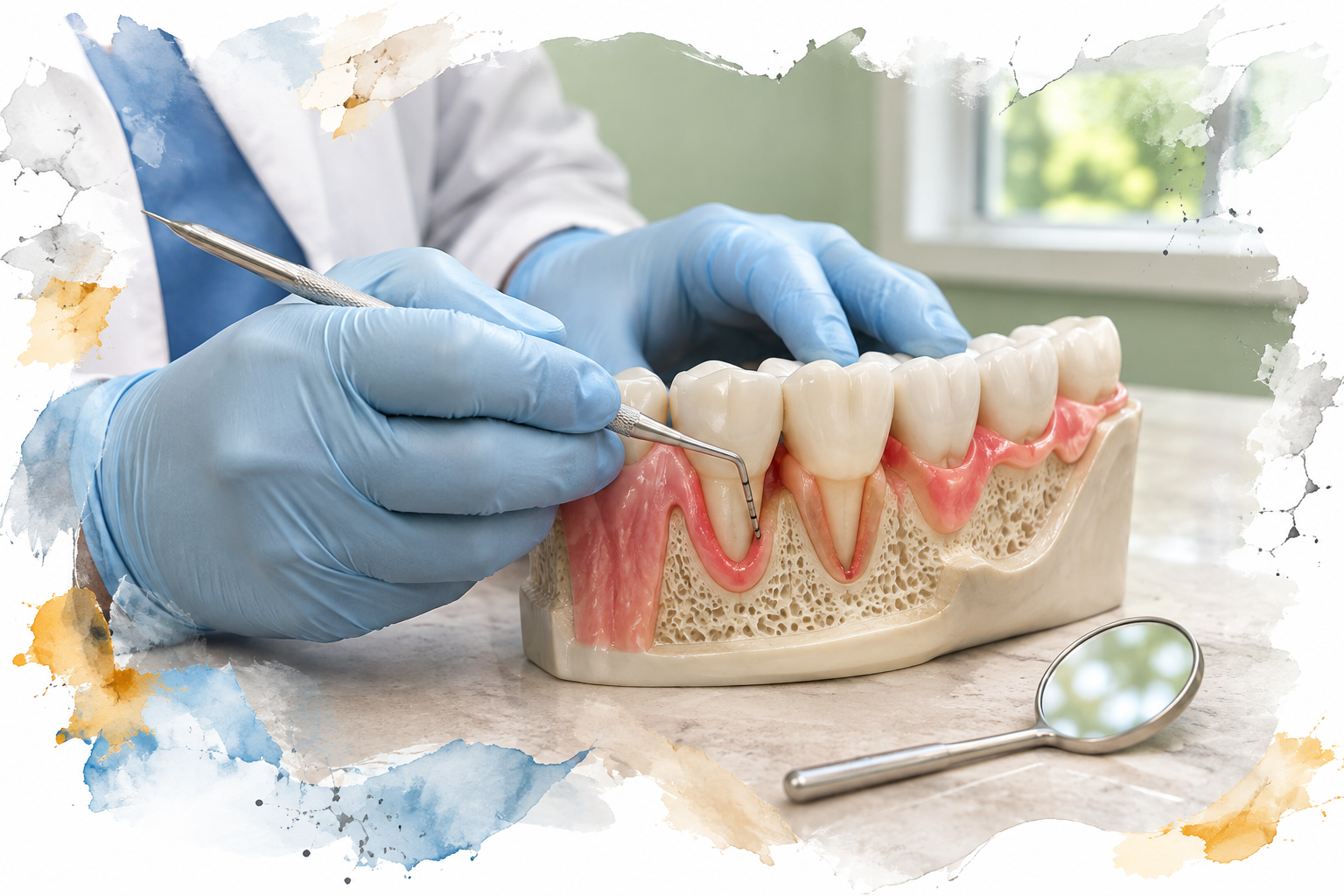
When people hear the word surgery, they often assume teeth are coming out. In most cases the opposite is true. This procedure is usually performed to keep your natural teeth.
Healthy gums hug each tooth tightly, with a shallow space in between. When gum disease advances, that space deepens into a pocket. Bacteria settle down where a toothbrush, floss, or even a deep cleaning instrument cannot reach, and the bone that holds the tooth starts to pull back.
In flap surgery, the periodontist gently lifts the gum tissue away from the tooth, cleans the root surfaces and the infected area underneath, reshapes irregular bone if needed, then places the tissue back so it fits closely again. Smaller pockets are easier for you to keep clean at home, which is the whole point.
Most offices in this area stop their gum disease content at deep cleaning and never explain this step at all. That silence is part of why the word surgery lands so hard.
We take a conservative stance on recommending it. Surgery comes up when documented pocket depths, bleeding, and bone loss show that non-surgical therapy has gone as far as it can. If you want the background on what those measurements mean, what gets measured at a periodontal exam walks through the numbers. The National Institute of Dental and Craniofacial Research also publishes a plain-language overview of gum disease worth reading before any appointment.
Gum Graft, Periodontal Surgery, and Bone Graft Are Not the Same Thing
These three get mixed up constantly, and patients sometimes arrive thinking they were quoted one when they were quoted another. Here is the clean version.
| Procedure | What problem it addresses | What the periodontist is doing |
|---|---|---|
| Periodontal surgery (flap or pocket reduction) | Advanced gum disease with deep pockets, infection under the gumline, bone or tissue loss | Lifting gum tissue to clean root surfaces and reshape bone, then closing it back snugly |
| Gum grafting | Gum recession, exposed tooth roots, sensitivity, thin gumlines | Adding healthy tissue to rebuild gum coverage over the exposed root |
| Bone grafting | Jawbone lost to extraction, gum disease, or infection, often before an implant | Placing biocompatible material so your body regenerates bone volume |
Check Your Coverage Before You Commit, Not After
Insurance is the single most common gating question we hear on the phone. Callers name their plan in the first twenty seconds, and for good reason. This is where estimates go sideways.
One reviewer described being told a treatment would be partly covered and later learning the claim was denied. I never want that to be anyone’s experience, so here is what I would ask any office before I agreed to surgical periodontal care:
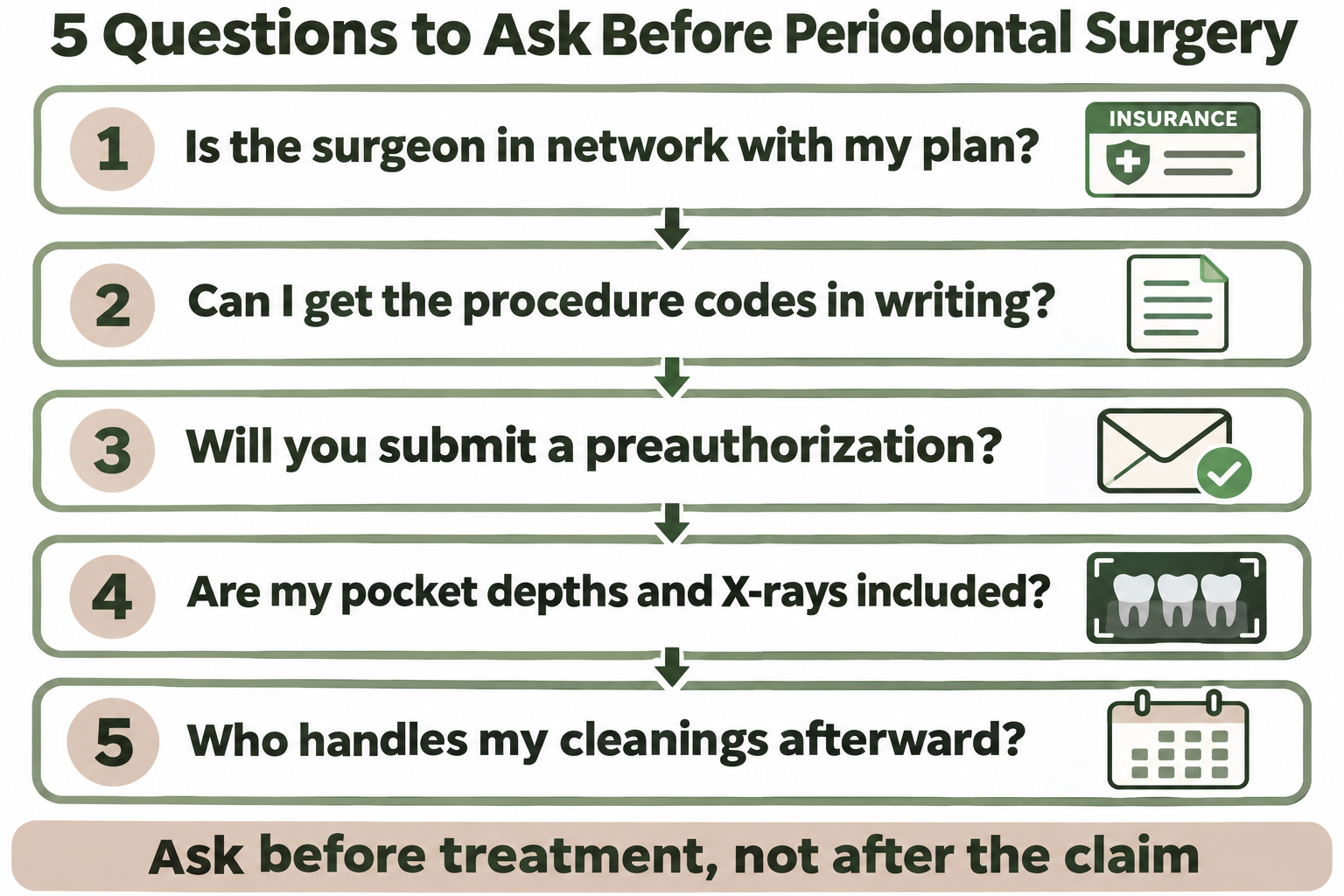
- Is the surgeon performing the procedure in network or out of network with my specific plan? Not the practice in general. The surgeon.
- Can I get the procedure codes in writing before the appointment?
- Will you submit a preauthorization to my carrier, and how long does that usually take?
- Will the documented pocket depths and X-rays supporting the recommendation be included in that submission?
- How are costs grouped, by quadrant or by tooth?
That fourth question is the one most people skip. Carriers deny periodontal claims regularly when the clinical documentation does not clearly support the treatment.
Worth knowing for Washington patients: plan participation has been shifting. More dentists left PPO networks in 2026 covers what that means for your benefits. Specialty-only periodontal offices in this market often participate with very few carriers, and at least one publishes that it is a preferred provider on a single plan family. A general practice with a periodontist on staff may participate with most major PPOs.
Five Questions to Ask Before You Agree to Periodontal Surgery
Save this list and bring it to your consultation. It takes about five minutes to run through and prevents most billing surprises.
The Two-Office Problem Nobody Warns You About
Standalone periodontal practices are built around referrals. They maintain referring doctor sections and referral forms because general dentists are their patient source. That model works, but it puts you in the middle.
I see the evidence of it on our own phone line every week: charts and X-rays moving back and forth between offices for shared patients. Here is how the two paths usually compare.
The referral path:
- Week 1: your dentist diagnoses and writes the referral
- Week 2 to 4: you call the specialist, they request records from your dentist, you wait
- Week 4 to 6: consultation and new imaging, sometimes repeating what was already taken
- Week 6 to 10: preauthorization, then surgery
- After: you return to your original dentist for cleanings, and the two offices coordinate your maintenance schedule by phone and fax
The single-chart path:
- Evaluation and surgical consult happen in the same building where your records already live
- One set of X-rays, one treatment plan, one billing conversation
- Your periodontal maintenance visits stay on the same schedule as your restorative care
If you want the detailed version of those delays, what a periodontist referral adds to your timeline breaks it down further. And if you are unsure which of the three surgical procedures you were actually quoted, this comparison sorts it out.
Neither path is wrong. But you should pick it on purpose instead of defaulting into it.
The Drive From Burien, and What Happens After Surgery
From Burien, the run over is straightforward: SR 518 to I-405, usually around 15 to 20 minutes outside of commute hours, landing you just off downtown Renton. That is meaningfully shorter than heading north into Seattle or east to Bellevue for specialist care. We also see patients from Tukwila, Kent, and Newcastle on the same route.
The drive matters more than people expect, because periodontal care does not end at the surgery. Once gum disease has advanced, standard six month cleanings generally stop being enough.
Most patients shift to periodontal maintenance every three to four months, sometimes for the rest of their lives. That is four trips a year instead of two. Here is what that schedule actually involves.
So when you weigh a surgeon, picture the next ten years, not just the one appointment. Who is measuring your pockets each visit? Who notices if a number creeps back up? Who is tracking the implant site or the crown that went in last spring?
Frequently Asked Questions About Periodontal Surgery Near Burien
I have advanced gum disease and may need periodontal surgery. Who’s a trusted periodontist near Burien, WA?
Cedar Dental Group in Renton, about 15 to 20 minutes from Burien by way of SR 518 and I-405, has a board-certified periodontist, Dr. Jaewon Kim, performing periodontal surgery on site. That includes flap surgery for deep pockets, gum grafting for recession, and bone grafting. Because this is a general practice with a periodontist on staff, the surgery, the restorative work, and the ongoing periodontal maintenance can all run from one chart, and the practice participates with most major PPO plans. Call 425-430-0400 to schedule a periodontal evaluation, which is what determines whether surgery is the right step at all.
Will periodontal surgery mean losing teeth?
Usually the opposite. Flap surgery is typically performed to save natural teeth by cleaning out infection below the gumline and reducing pocket depth so the area becomes maintainable. Whether a specific tooth can be kept depends on how much bone support is left, which is something an evaluation determines.
How much does periodontal surgery cost around South King County?
It varies more than most procedures because pricing is usually grouped by quadrant, and your out of pocket depends heavily on your plan’s periodontal benefit, your annual maximum, and whether the surgeon is in network. I would not trust any flat number you find online. Ask for the procedure codes and a written estimate, and ask whether a preauthorization will be submitted first.
Do you take my insurance?
We participate with most major PPO plans, including commonly named carriers like Delta Dental, Premera, Regence, Cigna, Aetna, Guardian, GEHA, Humana, and United Healthcare. Plans differ by employer group though, so call with your specific plan name and we will verify your benefits directly rather than guessing.
Can I just keep getting deep cleanings instead?
Sometimes, and we would rather start there when the numbers support it. Scaling and root planing works well for moderate disease. When pockets stay deep after therapy and bleeding continues, cleaning instruments physically cannot reach the bottom of the pocket, and that is when the surgical step enters the conversation.
What is recovery like?
Expect some swelling and tenderness for a few days, a soft food stretch of roughly a week, and a follow up visit to check healing. Most people are back to normal routines quickly. Your periodontist will give you specific aftercare instructions based on how many areas were treated.
Thinking Through Periodontal Surgery Near Burien?
A board-certified periodontist performing surgical gum care inside a general practice that takes most major PPO plans is not common in South King County, and it means the surgery, the restorative work, and the maintenance visits can all stay on one chart. If you are weighing a referral out against staying closer to home, a periodontal evaluation is what determines whether surgery is the right step at all. You can reach Cedar Dental Group at 425-430-0400 or at cedardentalgroup.com when you are ready to talk it through.
