
Direct Answer: In-office whitening changes shade the same day. Bonding is usually one visit. Veneers and crowns need lab time, so plan four to six weeks. Aligners take months, not weeks.
Most cosmetic questions I get in the fall start the same way. There is a date circled: a photo session, a wedding in December, a reunion. And a front tooth someone has quietly disliked for years suddenly has a deadline attached to it.
One person wrote in through our website about a chipped tooth and said it doesn’t hurt, it is just bothering them how it looks. That is an honest reason to call, and I treat it as a reasonable one.
So instead of starting with a wish list, I want to start with your calendar. Below is what actually fits a six-week window in Renton, what does not, and the one sequencing rule that trips up almost everybody who tries to combine treatments.
Work Backward From the Date, Not Forward From a Wish List
The useful question is not “what do I want done.” It is “what can be finished, healed, and looking settled by the day of the photos.”
Here is how the common options actually run:
- In-office whitening produces its change in a single visit of roughly 90 minutes. It is the only option that genuinely fits a two-week runway.
- Composite bonding on a small chip is often handled in one appointment, since the material is shaped in your mouth with no outside lab step.
- Porcelain veneers involve a consultation, tooth preparation, a lab fabrication step, and a separate fitting visit. A six-week window works only if the consult happens at the very front of it.
- Crowns follow a similar rhythm: exam and imaging, preparation, then placement once the restoration comes back.
- Clear aligner treatment with SureSmile runs on a digital scan, a 3D plan, and a series of trays. That is measured in months, and how many depends on how far the teeth need to move.
I say this to people every October: six weeks is a real window, but it is a window that closes from the front. Waiting three weeks to book the consult does not shrink the lab’s schedule.
Whitening First, Restorations Second. Most People Learn This Backward.
This is the single most useful thing in this article, so I will be blunt about it.
Porcelain and composite do not respond to whitening gel the way natural enamel does. A crown, a veneer, or a bonded repair is matched to whatever shade your surrounding teeth are on the day it is made.
So if you whiten after that work is finished, the restoration stays exactly where it is while everything around it gets lighter. Now you have a front tooth that is a visibly different color than its neighbors, and the fix is remaking the restoration, not re-whitening it.
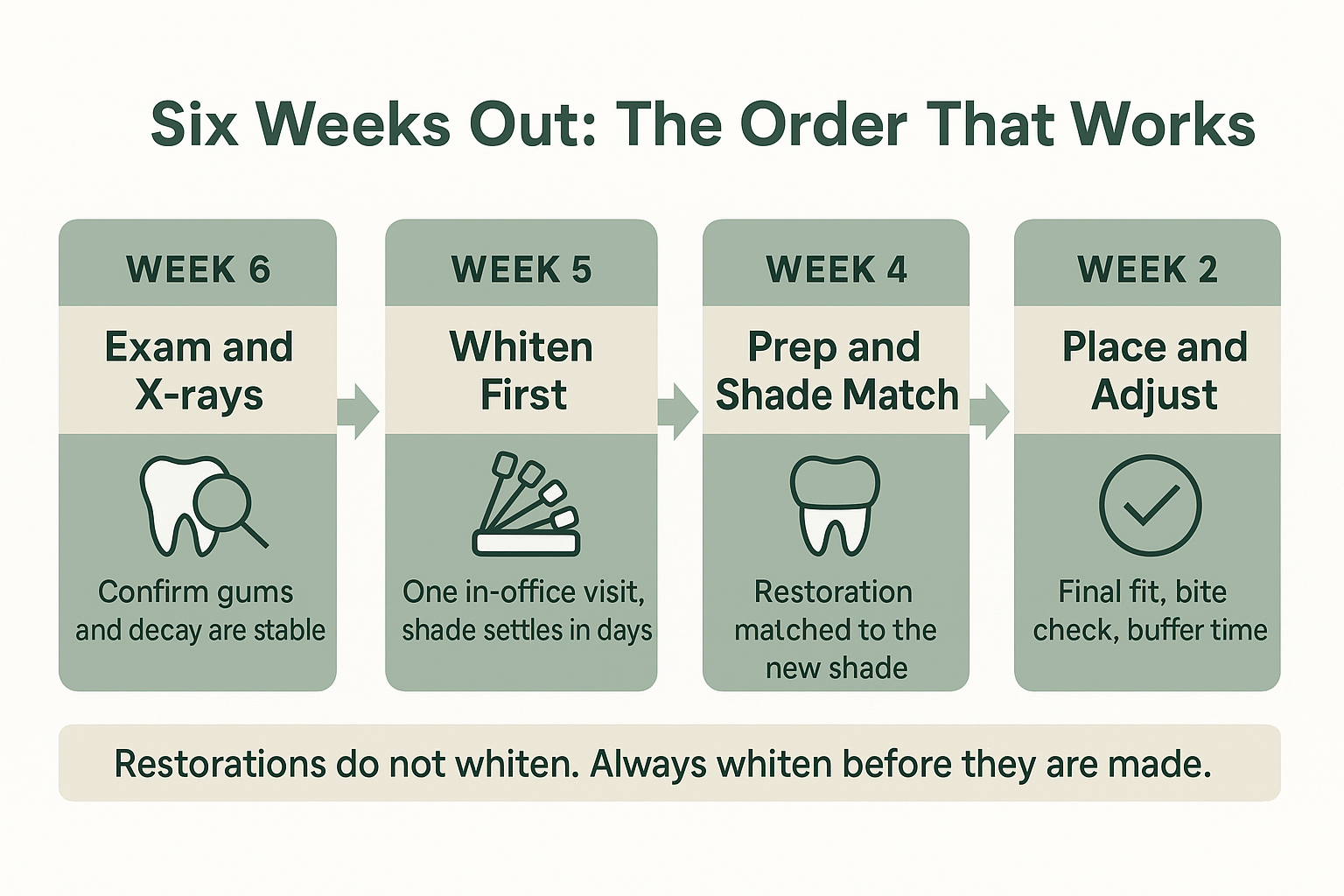
The order that works:
1. Whiten first and let the shade settle for a few days to about two weeks.
2. Match and make the restoration to that new, lighter shade.
3. Maintain from there.
The American Dental Association makes the same point about whitening and existing dental work, which is worth reading if you already have crowns or bonding up front.
If whitening is the piece you are weighing, what in-office results actually depend on covers who tends to get the most change and who gets less.
Realistic Lead Times for a Date on the Calendar
These are general ranges, not promises. Your own timeline depends on the exam findings and on lab turnaround.
| Treatment | Typical Visits | Realistic Lead Time Before Your Date |
|---|---|---|
| In-office whitening | 1 visit, about 90 minutes | Same day. Works with a 2-week runway. |
| Composite bonding, small chip | Usually 1 visit | 2 to 3 weeks is comfortable |
| Dental crown | Prep visit, then placement | 4 to 6 weeks, start early |
| Porcelain veneers | Consult, prep, fitting, plus lab time | 6 weeks minimum, consult at the front |
| Clear aligners (SureSmile) | Scan, digital plan, tray series | Months, not weeks |
A Six-Week Countdown That Actually Works
If you are six weeks out and combining whitening with a restoration, this is the order I would build the schedule around.
Cosmetic Work Sits on Top of Oral Health, So the Exam Comes First
No timeline is real until someone has looked at the tooth. That is not me stalling, it is that the findings change what can be done and how long it lasts.
Three things in particular shift the plan:
- Active decay under or beside the tooth you want fixed has to be handled before anything is bonded or veneered over it.
- An inflamed gumline makes shade matching and margins harder, and gum tissue that is bleeding will not hold a clean cosmetic result.
- Recession that has exposed root surface changes where a veneer can end, because root surface does not behave like enamel.
This is where the setup of a practice matters more than people expect. When a finding like that turns up here in Renton, the patient is not sent across town to a periodontist with a three-week wait, then back again.
Our board-certified periodontist sees patients in the same building, and so does our endodontist, so a surprise on the exam does not automatically blow up a six-week plan. One patient put it well in a review after a thorough first visit: “Having no toothache, I assumed I had no problems. Wrong!”
If the exam itself is the part you dread, how to tell if a practice is actually built for anxious patients is worth a read before you book anywhere.
Cost, Coverage, and Why Two Quotes Can Look So Different
I am not going to name a figure for your tooth, because I have not seen it. But I can tell you what drives the number.
Purely cosmetic treatment is elective and generally is not covered by dental insurance. Work that also restores a damaged tooth can fall partly under restorative benefits, depending on how your plan is written.
When two offices quote what sounds like the same procedure and the numbers are far apart, it usually comes down to:
- The material being used and which lab is fabricating it
- How much tooth structure is left and whether buildup is needed first
- Whether the estimate includes the exam, imaging, and follow-up adjustments
- What your plan classifies the work as, which changes your share
We post a current new patient exam with X-rays at $175, and specials change, so treat that as a starting point rather than a fixed rule. Everything else deserves a written estimate after an exam. If you have a quote from somewhere else, bringing it in is completely fair game, and what to bring to a second opinion walks through how to make that conversation useful.
One local timing note. Renton books out in October and November for a reason: open enrollment lands then, calendar-year maximums expire December 31, and between the 737 plant and the area’s health care employers, a large share of South King County is on a benefits-carrying schedule. If you want to spend down remaining benefits on restorative work, how to use PPO benefits before they reset covers that side of it.
And a scheduling reality: patients driving in from Kent, Tukwila, Newcastle, or south Seattle almost all want early morning or late afternoon. Those slots go first in the fall.
Sometimes the Honest Answer Is Less Work Than You Expected
People often arrive convinced they need veneers across the front six. Sometimes they do. Often they do not.
A single chip on one tooth may be a bonding appointment. Dullness from coffee and red wine may be whitening and nothing more. A tooth that looks out of line in photos may be an aligner conversation for next year rather than a rushed fix for this December.
One longtime patient wrote about Dr. Chu: “She is honest and will tell me that I don’t need something that previous dentists have pushed.” – Mike M.
That is the note I want to end on. Getting a straight read on how much work your smile actually needs is more valuable in a six-week window than any single procedure, because it tells you which appointments to book and in what order.
Frequently Asked Questions About Cosmetic Dental Timelines
I have two weeks until my photos. What can realistically be done?
In-office whitening is the honest answer. It changes shade in a single visit and needs no lab step. A very small chip might also be handled with bonding in one appointment, but that depends entirely on what the exam shows.
My front crown looks yellow next to my other teeth after I whitened. Can it be whitened too?
No. Porcelain and composite do not lighten with whitening gel. The crown is the shade it was made at, so the only way to match it to your new shade is to remake it. This is exactly why whitening goes first.
Will my insurance pay for any of this?
Usually not for purely cosmetic work. If the treatment also restores a broken or decayed tooth, part of it may fall under restorative benefits depending on your plan. The only reliable way to know is a written estimate with your plan verified, and that is worth doing before you commit to a timeline.
Can clear aligners straighten one crooked front tooth before the holidays?
Almost certainly not in six weeks. Aligner treatment starts with a digital scan and a planned series of trays, and the teeth move gradually for a reason. It is a good plan for next year’s photos, not this year’s.
Does a chipped tooth always need a veneer?
No. Plenty of chips are handled with composite bonding in one visit, which costs less and removes almost no tooth structure. Veneers make more sense when several teeth are involved or when shape and shade both need changing. An exam sorts this out quickly.
How long should I wait after whitening before getting a crown made?
Generally a few days to about two weeks, so the shade stabilizes before it gets matched. Build that pause into your countdown rather than stacking the appointments back to back.
Thinking About a Date on the Calendar?
If you are somewhere in that six-week window and want to know what is actually possible for your teeth, an exam and a written estimate are the place that starts. Cedar Dental Group sees patients from Renton, Kent, Tukwila, Burien, Newcastle, and south Seattle, and fall mornings and late afternoons tend to fill first. You can reach us at 425-430-0400 or at cedardentalgroup.com whenever you are ready to talk it through.
