

Direct Answer: An EOB is not a bill. Read it first, then ask the office for an itemized statement showing each code, the allowed amount, the plan payment, and your portion.
You sat in the chair, paid what the front desk quoted, and went home thinking the money part was finished. Then six weeks later an envelope shows up with a balance nobody warned you about, or a line that says the claim was denied.
I get these calls regularly, and I want to say the thing most people never hear out loud: the number you were quoted was an estimate, not a bill. An estimate is a forecast built on benefit information. The number only becomes final after your carrier processes the claim and applies its own allowed amount for that procedure code.
Here is my position after years of reading these with patients in Renton and across South King County. The gap almost always has a traceable reason behind it rather than a mistake, and you can find that reason yourself in about twenty minutes with two documents side by side. This guide walks the post-visit side of the timeline, starting the day the paperwork lands.
Why the Quote and the Final Bill Don’t Match
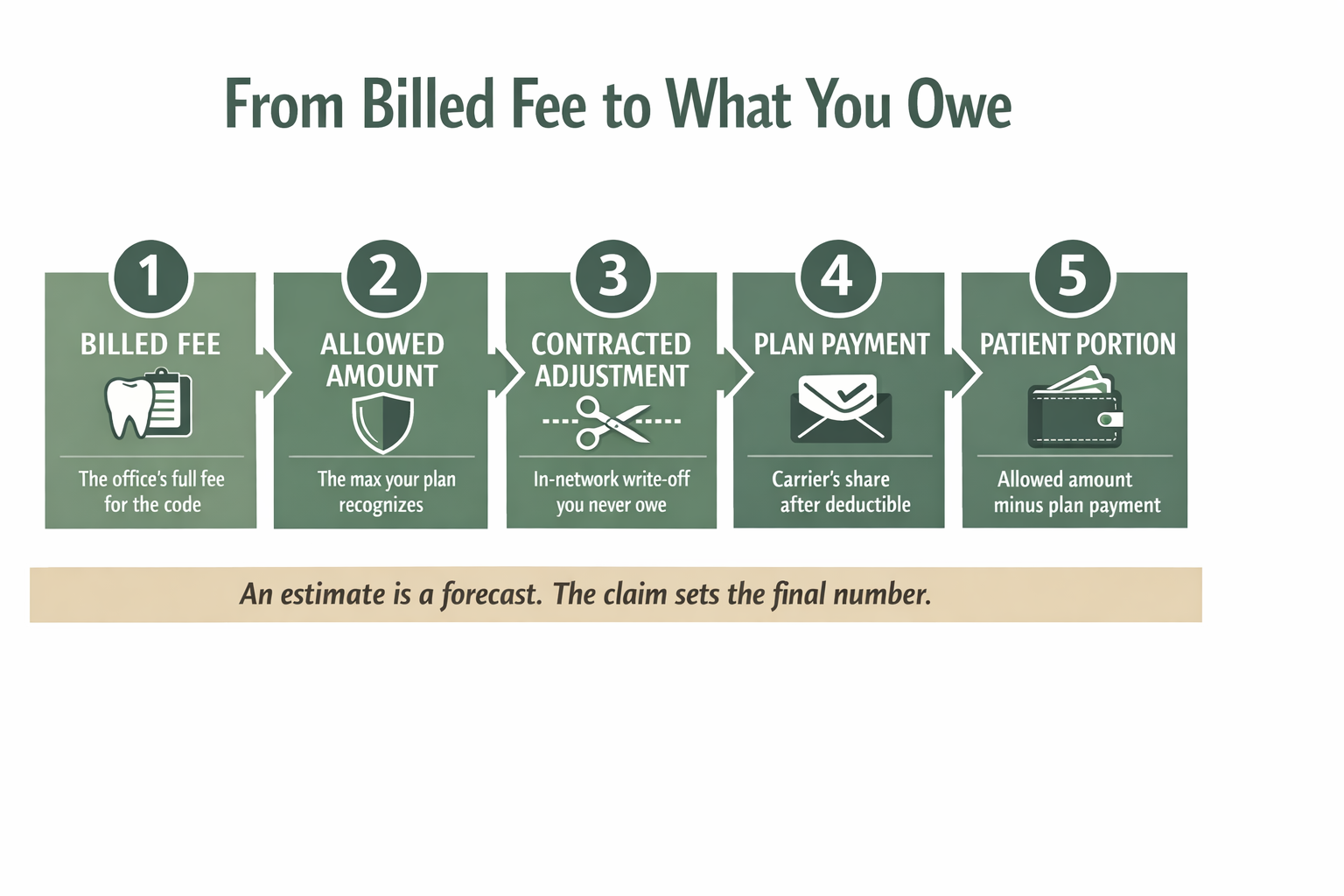
Five numbers decide what you owe, and they happen in order. Once you see the order, the bill stops looking arbitrary.
- Billed fee. The office’s full fee for that procedure code.
- Allowed amount. The maximum your specific plan agreed to recognize for that code.
- Contracted adjustment. The write-off between the billed fee and the allowed amount when the office is in network.
- Plan payment. The carrier’s share of the allowed amount, after your deductible and coinsurance percentage are applied.
- Patient portion. The allowed amount minus what the plan paid. That is your real number.
This matters more around here than people expect. Plenty of patients in Renton carry employer PPO coverage tied to large local employers, including the 737 plant down by the airport, and two plans from two different employers can set two different allowed amounts for the exact same code.
So the chairside estimate can be accurate and the final balance can still differ by a few dollars or a few hundred. One longtime patient recently spent several minutes on the phone with us over a balance under thirty dollars that came entirely from this gap. Nothing was wrong. It just was never explained in plain terms.
If you are comparing quotes between offices, this is the part that trips people up. The quoted range is not the comparison point. The patient portion after the claim processes is.
Step 1: Read the EOB First, Because It Is Not a Bill
The explanation of benefits usually arrives before the statement from the office. It comes from your carrier, it says something like “this is not a bill” in small print near the top, and most people glance at the bottom number and set it aside.
Read it line by line instead. Every EOB shows the same basic columns, even when carriers label them differently.
- Date of service
- Procedure code and a short description
- Submitted or billed charge
- Allowed amount
- Plan payment
- Patient responsibility
- A remark code or reason code, usually a letter and number combination
That remark code is the whole ballgame when something was denied or paid down. It maps to a written explanation, almost always printed on the back page or the last page in a legend nobody reads.
Find your code, find it in the legend, and write down what it says word for word. If you want a refresher on what the procedure codes themselves mean before any of this happens, we covered that in what the D-codes on your dental estimate mean.
What Each Line on the EOB Actually Means
Carriers use slightly different wording, but these are the six lines you are looking for and what each one is telling you.
| Line on the EOB | What it means | What to check |
|---|---|---|
| Submitted or billed charge | The office’s full fee for that code | Should match the fee on the itemized statement |
| Allowed amount | The maximum your plan recognizes for that code | Varies by plan, even for the same procedure |
| Contracted adjustment | The in-network write-off you never owe | Should not appear on your balance |
| Plan payment | What the carrier sent to the office | Zero here means denied or applied to deductible |
| Patient responsibility | Deductible, coinsurance, and non-covered amounts | Compare to what you already paid at the visit |
| Remark or reason code | Why the claim paid the way it did | Look it up in the legend on the last page |

Step 2: Ask for an Itemized Dental Bill
Most patients only ever see a total and a due date. You are entitled to see how that total was built, and asking for it is an ordinary request. We print these routinely. A short phone call or an email is all it takes, and nobody at the front desk treats it as a complaint.
Say something simple: “Can you send me an itemized statement for my visit on that date, with the insurance detail included?” That last part matters, because a plain ledger print sometimes shows only balances.
A complete itemized statement should show, on every single line:
- Date of service
- Procedure code and description
- Tooth number or quadrant, where it applies
- The office fee for that code
- What the plan paid
- The contracted write-off
- The remaining patient portion
Now set it beside the EOB and read them together, line for line. The allowed amounts should match. The plan payments should match. If a line on the statement has no matching line on the EOB, that procedure may never have been submitted, or it was submitted under a different code.
One more practical note. A patient asked us recently for paper statements by mail rather than an electronic link, purely so she could keep a physical file. That is a reasonable thing to request, and I would encourage it for anyone working through a disputed claim. Paper copies are easier to hold onto than a login you will forget.
The Five Numbers Behind Your Balance
This is the order every dental claim moves through, from the office’s fee to the number you actually owe.
Step 3: Find the Real Reason a Dental Insurance Claim Was Denied
Here is where people get upset, and usually at the wrong target. Most denials are plan design, not an error by the carrier or the office. Insurance acceptance is the single most common question we field on the phone, roughly one in five calls, and some of those callers were burned by a denial somewhere else first.
Match your reason code to one of these:
- Frequency limit. Your cleaning or X-ray set came sooner than the plan allows. Many plans count two cleanings per benefit year, some count them as “every six months to the day,” which is stricter than it sounds.
- Alternate benefit clause. The plan pays only toward the less expensive material or method, and you owe the difference. This is a common one on crowns and fillings.
- Missing documentation. The carrier wanted X-rays, periodontal charting, or a written narrative and the claim went out without them. Very fixable.
- Annual maximum already met. Nothing was wrong with the claim. The money was simply gone for the year.
- Waiting period. New plans often make you wait six to twelve months on major work.
- Missing tooth clause. The plan will not pay toward replacing a tooth that was already gone before coverage started.
We have had patients assume something was covered because it looked that way at the time, then learn later the claim was denied. A night guard is a classic example, since plans treat it as a covered appliance, an excluded one, or a frequency-limited one depending entirely on the contract.
A predetermination is the most reliable way to avoid this on major work. The office submits the planned treatment to the carrier before anything happens, and the carrier writes back with what it expects to pay. It is not a guarantee, but it turns a surprise into a known number. More on the structural side of this in how dental insurance works in Washington, and where it falls short.
Step 4: What to Do After a Denial, in Order
Work this sequence top to bottom. Most claims resolve at step two.
1. Find the denial reason code on the EOB and read the legend text exactly.
2. Call the office and ask whether the claim can be corrected and resubmitted with supporting X-rays, periodontal charting, or a narrative. Say the reason code out loud on the call. It saves everyone ten minutes.
3. File a written appeal with the carrier if the stated reason does not hold up. Appeals go to the plan, not the office, and most carriers set a filing deadline in the policy booklet. Put the date of service, the code, and your argument in one page.
4. Keep copies of everything. EOBs, itemized statements, and any coverage confirmation you were given in writing.
One Washington detail belongs here. A state law that took effect in 2025 bars dental-only plans from denying coverage for procedures solely on the basis that they were performed on the same day. You can read the enrolled bill text at the Washington State Legislature. If that is the only reason given on your EOB, it is not a valid basis by itself.
Timing also changes your strategy. Most Renton employer plans close the benefit year on December 31. A denial that lands in November gives you a short window to correct and resubmit before the annual maximum resets. The same denial arriving in January lands in a fresh plan year with a new deductible to satisfy, which is worth knowing before you plan the next phase of treatment. We walk through that calendar problem in what happens to unused dental benefits when the year ends.
Frequently Asked Questions About Denied Claims and Itemized Dental Bills
Can I request an itemized bill from my dentist?
Yes. Dental offices print these routinely, and a phone call or a short email is usually all it takes. Ask for the version that includes the insurance detail, not just the account ledger, so you can see the allowed amount and plan payment on each line.
Is an EOB a bill?
No. The explanation of benefits comes from your insurance carrier and reports how the claim was processed. It usually arrives before the statement from the office, and the dollar figure on it is an expectation of what you will owe, not a request for payment.
Can a dentist charge whatever they want?
Offices set their own fees, but when an office is in network with your plan, the contract caps what you can be charged for a covered procedure at the allowed amount. The difference gets written off. Out of network works differently, and that is usually where the larger gaps appear.
My claim was denied because two procedures were done on the same day. Is that allowed in Washington?
Not on its own. As of 2025, a dental-only plan in Washington may not deny coverage solely because procedures were performed on the same day. If that is the only reason listed, it is worth calling the office and then appealing in writing.
How long do I have to appeal a denied dental claim?
It depends on your plan, and the deadline is written in your policy booklet rather than set by one universal rule. Many carriers allow somewhere in the range of 180 days from the date on the EOB, but check your own documents and file sooner rather than later.
What if the balance is small? Is it worth the phone call?
Honestly, sometimes the answer is that the claim processed correctly and a small gap is simply the difference between the estimate and the allowed amount. But you should still be able to see how the number was built. That is a fair thing to ask for at any dollar amount.
Want help making sense of yours?
If you have an EOB in front of you that does not add up, our team can print an itemized statement, read the two documents through with you, or submit a predetermination to your carrier before major treatment starts. Transparency on cost is the thing patients around Renton mention most often in their reviews, including one who wrote, “They are transparent on the costs and offered many different payment options.” We accept most major PPO plans and offer Cherry and Sunbit payment arrangements for patients without coverage. Reach us at 425-430-0400 or at cedardentalgroup.com whenever you want a second set of eyes on the paperwork.
