
Direct Answer: A gum graft rebuilds receded gum tissue over exposed roots. Periodontal surgery cleans and reshapes deep infected pockets under the gumline. A bone graft rebuilds missing jawbone volume. Three different tissues, three different problems.
You walk out to your car off Hardie Avenue, start the engine, and realize you cannot repeat back what was just recommended. You heard the word graft. You think you also heard surgery. And you are not sure whether those were two things or one thing said two ways.
This happens in dental chairs all over Renton, and it is not a failure of attention. Gum grafting, periodontal surgery, and bone grafting are three separate procedures that treat three separate problems, and almost nobody hears all three names side by side until the day they are recommended one.
My position on this is simple: you should not agree to any of them until you can say out loud which tissue is being treated and why. Below I lay the three out plainly, show how the decision actually gets made from measurements, and walk through what the first week after each one tends to feel like.
Three procedures, three different problems
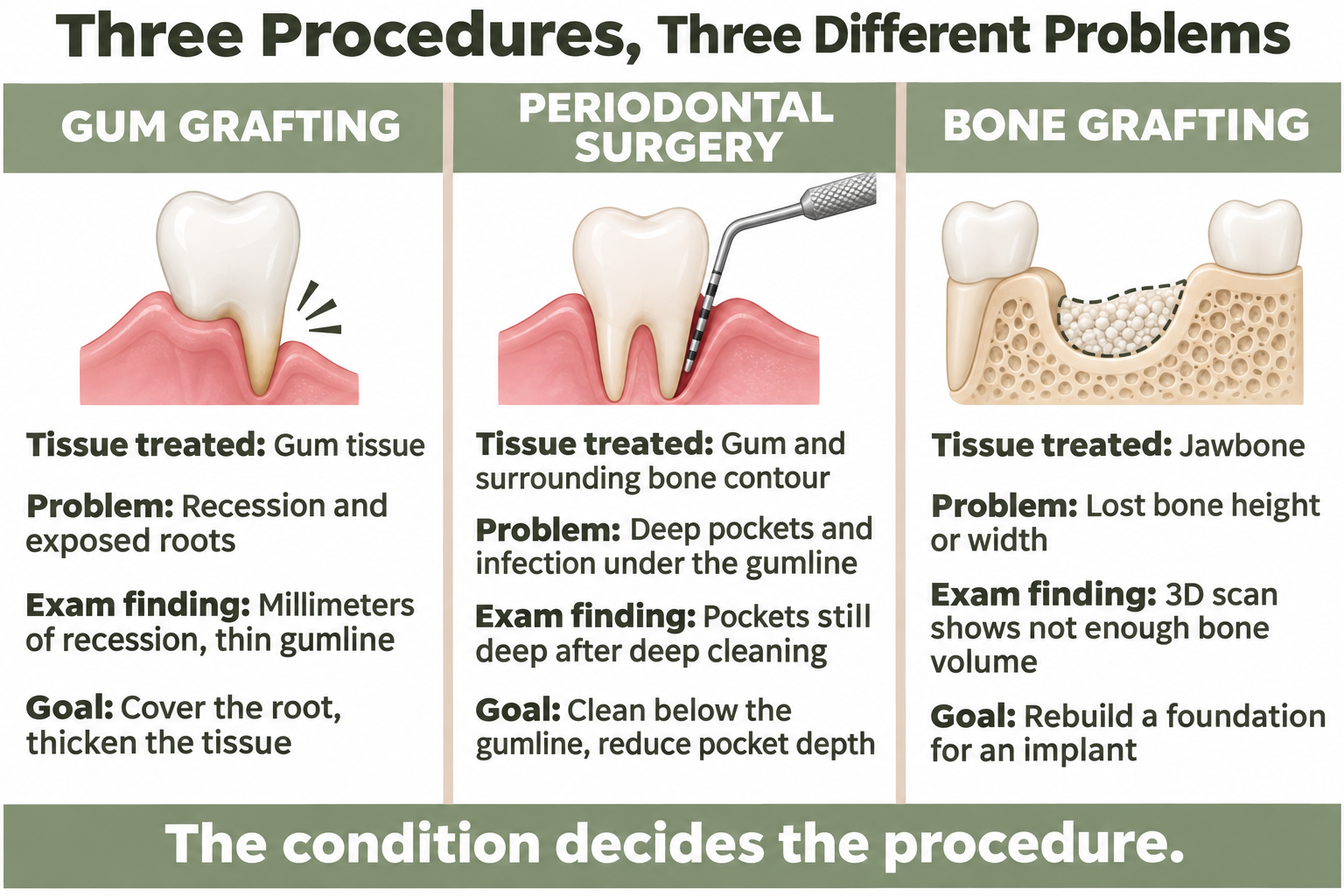
Here is the shortest honest version of each one. One sentence, one tissue, one problem.
- Gum grafting adds soft gum tissue back where it has pulled away, covering an exposed tooth root and thickening a thin gumline.
- Periodontal surgery opens and cleans deep pockets under the gumline where infection and buildup sit too far down for a cleaning instrument to reach, then reshapes the gum and bone contour before closing it.
- Bone grafting rebuilds jawbone volume that has been lost, usually after a tooth comes out or after gum disease has worked on the bone underneath.
The American Academy of Periodontology draws the same line on its patient page about surgical procedures: gum graft surgery covers an exposed root to limit further recession, while regenerative procedures use bone grafts or membranes to rebuild support that disease has taken away.
Soft tissue. Infection and pocket depth. Bone volume. If you only remember one thing from this article, make it that list. Write the three names in a column on your phone before your next visit and ask which column your situation falls in.
How the recommendation actually gets made
A periodontist is not choosing between these three by preference. Each one is pointed to by a different finding, and the findings come off a chart, not a hunch.
For recession and root exposure, the measurement is how many millimeters of root are showing and how thick the remaining gum tissue is. If the gumline keeps creeping and cold water makes you wince, that is soft tissue territory. We wrote more about that pattern in cold sensitivity and exposed roots.
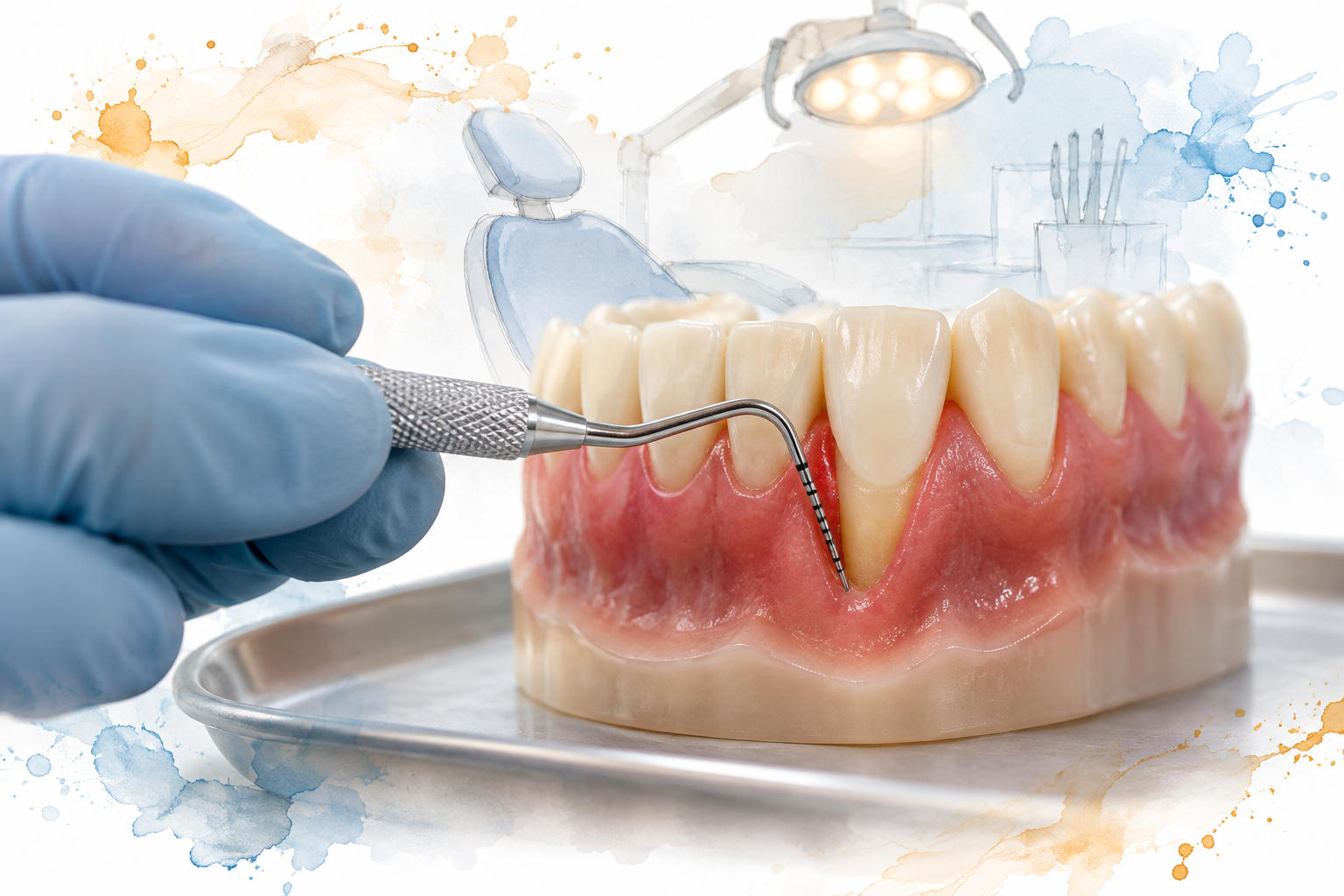
For pocket depth and attachment loss, the number that matters is how deep the probe goes around each tooth and whether those numbers moved after a deep cleaning. Pockets that stay deep and keep bleeding after scaling and root planing are the ones that get a surgical conversation. If you want to know what those numbers on the chart mean, we broke them down here, and here is what it means when deep cleaning was not enough.
For bone volume, the answer comes off imaging. A 3D scan shows the height and width of bone in the site, and if there is not enough to hold an implant steady, grafting comes into the plan before anything is placed.
The condition drives the recommendation. That is the whole logic.
Side by side: what each procedure treats
This is the table I wish more patients got handed on the way out. Healing windows are general patterns, and your own case can run shorter or longer.
| Procedure | What it treats | What the exam typically shows | General healing window |
|---|---|---|---|
| Gum grafting | Receded gum tissue and exposed tooth roots | Visible recession in millimeters, thin or fragile gum tissue, root sensitivity | Soft tissue comfort in roughly 1-2 weeks, tissue maturing over a few months |
| Periodontal surgery | Deep pockets, infection and buildup under the gumline, uneven gum and bone contour | Pocket depths that stayed deep and kept bleeding after scaling and root planing | Most soreness settles in about 1-2 weeks, gums continue tightening for weeks after |
| Bone grafting | Missing or thinned jawbone volume | 3D imaging showing not enough bone height or width to support an implant | Surface comfort in days to a week, bone rebuilding quietly over several months |
One page to keep in your phone
If you only save one thing before your next appointment, make it this breakdown of which tissue each procedure treats.
If you were told you need a graft first, the plan is not falling apart
This is the part that worries people most, and it is almost always a misread. When bone grafting shows up in a treatment plan, it is a foundation step, not a sign that something went wrong.
An implant needs enough bone around it to stay stable for years. If the scan shows the bone is thin, grafting comes first so the implant has something solid to sit in. Skipping that step is what creates problems later.
There are also two different bone grafting situations that get called the same thing, and nobody spells out the difference:
- Socket preservation happens at the same visit as an extraction. Graft material goes into the empty socket right away to hold the shape of the bone while it heals.
- Ridge augmentation happens later, as its own planned procedure, to rebuild width or height in an area where bone has already shrunk.
One is prevention at the time of the extraction. The other is reconstruction months or years afterward. If you are trying to picture where each step lands, we mapped out the implant timeline when a bone graft is part of the plan.
Seeing two procedures on a plan usually means the order was thought through, not that the number of problems doubled.
What the next week actually feels like
When people imagine recovery, they imagine the worst version of all three at once. They are genuinely different experiences, so here is each one on its own.
After a connective tissue gum graft, the tooth site itself is often the easier part. If tissue was taken from the roof of your mouth, that donor area is usually the spot that feels raw, and it tends to be most noticeable for about 3 to 5 days. Cool, soft foods help. Think yogurt, eggs, smoothies without a straw, and nothing crunchy or sharp against the site for roughly two weeks.
After flap surgery, expect some swelling and tenderness along the gumline for the first few days, with most people feeling close to normal inside one to two weeks. Gums may look different afterward because the tissue is sitting tighter against the tooth, and some added sensitivity is common while things settle. Soft foods and careful brushing away from the site for the window your provider gives you.
After a bone graft, the surface healing is often quicker than people expect, while the real work happens underneath over several months as bone rebuilds. You usually will not feel that part at all. The guidance is mostly about not disturbing the site: no poking at it, no hard chewing on that side, and following the rinse instructions exactly.
Across all three, you can ask to pause at any point. Comfort checks during treatment are something our patients mention often, and asking for a break mid procedure is normal, not an inconvenience.
Coverage and cost work differently for each one
These three are billed under different procedure codes, which means your plan can treat them very differently. One may be covered at a decent percentage while another is considered elective depending on why it was recommended.
The factors that move cost the most:
- How many teeth or sites are being treated in one visit
- Whether a gum graft uses your own donor tissue or a graft material
- The type and volume of grafting material needed for a bone graft
- Whether 3D imaging is part of the planning
- Whether the office is in network with your specific plan
Insurance is the first question for roughly one in five people who call us, and I understand why. It is the gate. Washington’s newer coverage rules also changed some of the math on what plans have to spend on care, which we covered separately, and we have a full breakdown of when a gum graft is covered and when it is not.
My advice: ask your own office for a written estimate with the procedure codes on it before you commit, and ask whether they will submit a pre-authorization. An honest number comes from an exam and your actual benefits, never from a web page.
Who performs the work, and why that changes the experience
In most general practices around Renton, all three of these mean a referral out to a separate specialty office, often in Bellevue, Seattle, or Tacoma. That means a second commute, a second set of new patient paperwork, and a second insurance check that may come back differently than the first.
At Cedar Dental Group, Dr. Jaewon Kim is a board-certified periodontist who performs gum grafting, periodontal surgery, and bone grafting inside the same office that handles the general and restorative work. The person diagnosing the condition and the person treating it are reading the same chart. We are also in network with most major PPO plans, which is worth checking before any referral, because that handoff is not automatic everywhere.
One patient put the diagnostic side of it this way in a review: “The first time I have ever had a proper dental screening with individual xrays of all teeth and a detailed gum assesment.” That is the part that should come before any of these three names get mentioned.
Frequently Asked Questions About Gum Grafts, Periodontal Surgery, and Bone Grafts
Can I need more than one of these at the same time?
Yes, and it is fairly common. Gum recession and deep pockets can show up in the same mouth, and bone grafting often sits alongside implant planning. Having two on your plan does not mean your situation is worse than you thought, it usually means different areas need different things.
Is periodontal surgery the same as a deep cleaning?
No. Scaling and root planing is a non-surgical deep cleaning that reaches under the gumline with instruments. Periodontal surgery is what gets considered when the pockets stayed deep and kept bleeding after that cleaning had a fair chance to work.
Do I have to have tissue taken from the roof of my mouth for a gum graft?
Not always. Connective tissue grafting uses tissue from beneath the surface of your own palate and tends to give strong, natural-looking coverage over an exposed root. There are other approaches depending on the site, so ask specifically which one is being planned for you and where the tissue is coming from.
How long after a bone graft can I get the implant?
It depends on the size of the graft and how your bone responds, and the window is usually measured in months, not weeks. A follow-up scan is what confirms the site is ready, rather than the calendar alone.
What happens if I want to wait and think about it?
Taking time to understand a recommendation is reasonable, and most of these decisions are not made in a single visit. Ask for the measurements in writing, ask what changes if you wait six months, and ask what the re-evaluation would look like. A good answer to those three questions tells you a lot.
Still not sure which one you were told you need?
If you left another appointment in Renton, Kent, or Newcastle with a recommendation you could not quite repeat back, bringing your chart and imaging to a second set of eyes is a normal thing to do. Our periodontal and general care sit under one roof here near downtown Renton, so the measurements and the treatment get discussed in the same conversation. You can reach us at 425-430-0400 or read more at cedardentalgroup.com whenever you are ready to ask questions.
