
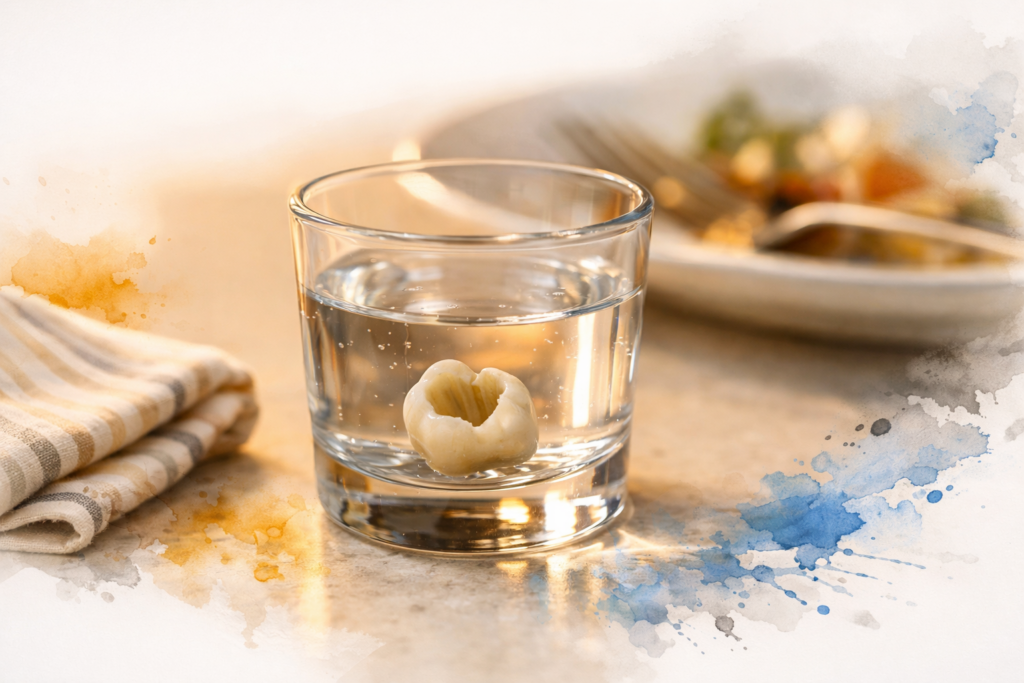
Direct Answer: A crown that comes off is usually a cement or structure problem, not a broken tooth. Keep the crown, rinse it, chew on the other side, and get seen within a day or two.
You were eating dinner, felt something hard that should not have been there, and spit a small white cap into your hand. No crack, no blood, and maybe no pain at all. Your first thought is usually the same one I hear on the phone: did I just break my tooth?
Almost always, the answer is no. A dental crown came off because the bond between the crown and the tooth gave out, or because something underneath the crown changed. The crown itself is often completely fine.
I want to walk you through three things: why this happens, what to do tonight before anyone can look at it, and what we actually check at the visit that decides between a quick recement and rebuilding the tooth. Most offices around Renton keep some room in the daily schedule for a loose crown, so this is not something that has to sit for a week.
Why a Dental Crown Comes Off in the First Place
A crown is a cap bonded over a tooth that has been shaped down to hold it. It does not grow onto the tooth. It is held by cement and by the shape of the tooth underneath, and both of those can change over years of chewing.
When a crown comes loose, it is usually one of four things:
- Cement washout. The cement layer slowly dissolves and wears at the margin where crown meets tooth. This is the most common and the least worrying cause.
- Decay at the margin. A new cavity forms right at the edge of the crown, undermines the seal, and the crown lifts off. The crown is fine. The tooth needs work.
- A failed core buildup. Many crowned teeth have a filling material built up underneath to give the crown something to grip. If that buildup fractures, the crown comes off with a chunk of it inside.
- A fracture in the remaining tooth. Less common, but real, especially on back teeth that have taken years of heavy bite force.
Look inside the crown. If you see something solid packed in there, that is often buildup material or tooth structure that came along for the ride. If it is hollow and clean, the cement most likely just let go.
A crown that comes off months after it was placed is a different conversation than one that lasted eleven years, and I would want to see that one sooner.
What to Do Tonight, Before Anyone Can Look at It
Most people call within a few hours of a crown coming out and get seen the next morning. So the real question is what to do between now and then.
Here is what I tell people over the phone:
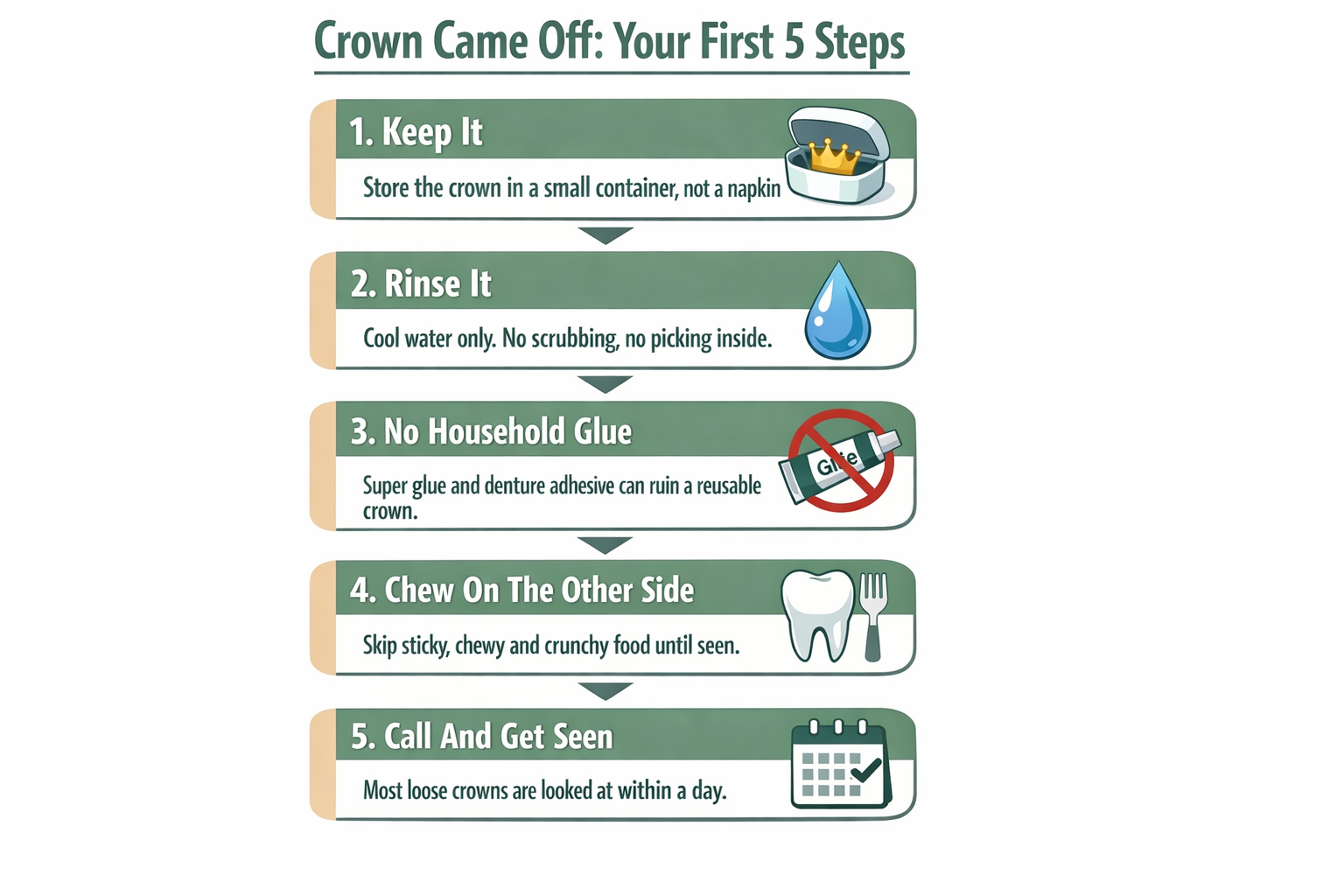
- Keep the crown. Put it somewhere you will not lose it. A pill container or a small zip bag beats a napkin on the counter. If we can reuse it, that saves you a lot.
- Rinse it gently under cool water and leave it dry. Do not scrub the inside with anything sharp.
- Never use household glue. No super glue, no epoxy, no denture adhesive. Those can ruin a crown that was otherwise reusable and can harm the tooth under it.
- Pharmacy temporary cement is a short bridge, not a repair. It can keep the crown seated for a night or two and protect the tooth from air and cold. It is not a fix, and it should not delay getting looked at.
- Chew on the other side and skip anything chewy, sticky, or crunchy until you are seen.
- Keep the area clean. Brush the exposed tooth gently and rinse with warm salt water. Plaque builds fast on a surface that has been covered for years.
If the tooth feels sharply cold, or air hurts when you breathe in, that is normal and not a sign of disaster. The prepared tooth under a crown has a lot of exposed dentin, and dentin is sensitive the moment it is uncovered. That feeling usually settles the second something covers it again.
The American Dental Association’s patient guidance on crowns says the same thing about bringing the crown with you, which is worth doing even if you are not sure it survived.
The First Few Hours, in Order
If you only remember five things from this article, make it these.
What We Check at the Visit: Recement or Rebuild
Almost nobody explains this part in advance, and it is the difference between a twenty minute appointment and starting a new crown. When you sit down, we are running a short list of checks, usually with an X-ray and a close look under magnification.
We are looking at four things:
- Is the crown itself intact? No cracks, no chipped porcelain, no distortion. A crown that came off clean is often perfectly reusable.
- Is the margin clean? We check the edge where the crown met the tooth for decay. Soft or stained tooth structure at that edge changes the plan.
- Is the buildup or post still sound? If the core underneath fractured, the tooth needs a new foundation before any crown goes back on.
- Has the tooth fractured, and how far down? A crack that stops above the gumline is usually manageable. One that runs below it is a different conversation.
A recement is a real outcome, not just the hopeful one. An intact crown sitting on a sound, clean tooth often goes right back on the same day.
Decay under the margin or a broken buildup means the tooth gets cleaned out and rebuilt first, and then we either reseat the original crown or make a new one depending on how the fit turns out after the rebuild.
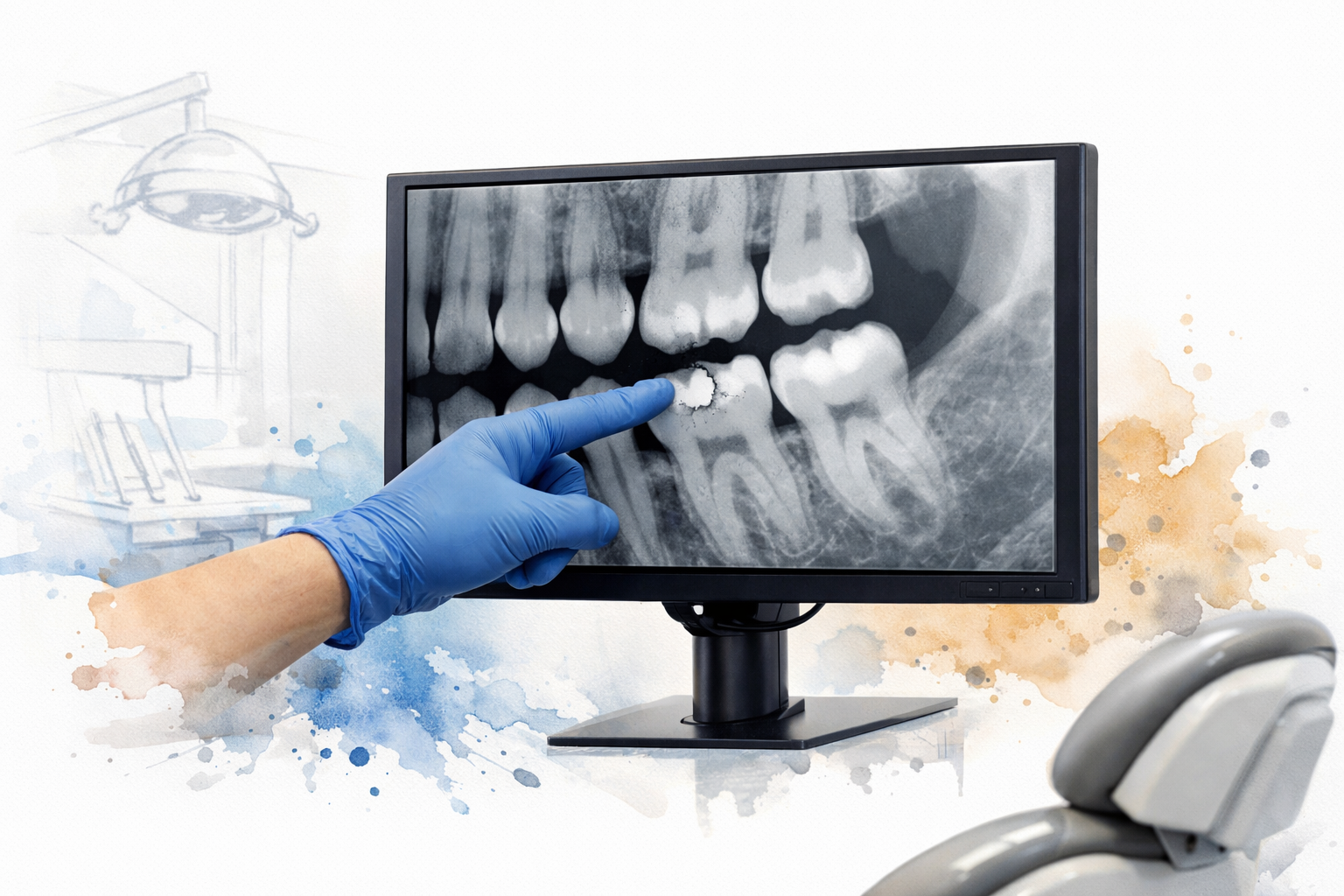
I would rather show you the X-ray and point at what I am seeing than hand you a plan with no explanation. That is the part patients tell us matters most, and it is also how you can tell whether a recommendation makes sense. If you are weighing a plan from somewhere else, our guide on getting a second opinion on a dental treatment plan covers what to bring.
What We Find and What It Usually Means
This is a general map, not a promise about your specific tooth. Every case gets looked at on its own.
| What we find | What it usually means | Likely next step |
|---|---|---|
| Crown intact, tooth clean, hollow crown | Cement simply washed out over time | Clean and recement, often same visit |
| Decay at the crown margin | A new cavity broke the seal | Remove decay, rebuild, then reseat or remake |
| Buildup material stuck inside the crown | The core under the crown fractured | New buildup, then crown fit is reassessed |
| Crack in the remaining tooth above the gumline | Tooth structure gave way under bite force | Rebuild and a new crown in most cases |
| Crack extending below the gumline | The tooth itself needs evaluation | Specialist evaluation before any restoration |
| Crown chipped, worn through, or distorted | The crown has reached the end of its service | New crown, impression or scan at the visit |
The Cost Question, Answered Honestly
You are probably already wondering whether this turns into a crown you did not budget for. I will not pretend there is one number, because the honest answer is that nobody can write an estimate before looking at the tooth.
What I can tell you is what moves the price:
- Whether the existing crown can be reused. A recement sits in a completely different range than a new crown.
- Whether a buildup or post is needed. That is a separate procedure with its own code and its own fee.
- The material of the replacement. Full zirconia, layered porcelain, and gold all price differently.
- Lab versus in-office fabrication. Outside lab work carries a lab fee that in-office milling does not.
We break that down further in our piece on what sits behind a crown’s price.
Then there is the coverage wrinkle most people never hear until the estimate comes back. Many dental plans limit how often they will pay toward replacing the same crown, usually measured as a set number of years since the original crown was placed, often somewhere in the five to eight year range depending on the plan. So the date your first crown went in genuinely affects what your plan contributes now.
If you are comparing offices, ask a front desk these four things:
- Is a recement attempt included in the exam fee, or billed separately?
- What is the code and fee if a buildup is needed?
- What is my plan’s replacement frequency limit on a crown, and when was my last one placed?
- What is left in my annual maximum this year?
Our walkthrough on checking what your plan will pay before you sit in the chair lays out how to get those answers from your insurer directly.
When the Tooth Underneath Is the Real Story
Sometimes a crown coming off is how a tooth quietly tells you something changed underneath. These are the cases where a new crown is not the answer by itself.
Pay attention if any of these are happening:
- A bad taste or smell coming from the area, which can point to decay or infection under the old crown.
- Swelling or a tender spot at the gumline near that tooth.
- Pain when you bite down on it, especially a sharp zing on release, which reads more like a crack than a loose cap.
- The crown came off a tooth that already had a root canal, and now something feels different than it used to.
None of that means you are losing the tooth. It means the tooth needs an evaluation before anyone decides what goes on top of it, and finding it early usually means more of the tooth can be kept.
This is also where having specialists in the same building changes the day. If the tooth turns out to need endodontic evaluation, or the gum and bone around it need a periodontist’s read, that assessment can happen here rather than becoming a referral and a three week wait. If you want background on how a crack is judged, our article on when a filling is enough and when it is not covers the same decision logic.
Frequently Asked Questions About a Crown That Came Off
Can I just glue my crown back on myself?
Please do not use household glue of any kind. Super glue, epoxy, and denture adhesive can permanently ruin a crown that was otherwise reusable, and they can damage the tooth under it. Pharmacy temporary cement is acceptable for a night or two as a stopgap, but it is not a repair and it should not replace getting looked at.
How long can I go with the crown off?
The tooth underneath is shaped down and unprotected, so it is vulnerable to chipping, shifting, and new decay. A day or two is usually fine. Weeks is when teeth start moving enough that the original crown no longer fits, which turns a recement into a new crown.
Why does my tooth hurt so much with cold air now?
The tooth under a crown has exposed dentin, which carries sensation straight to the nerve. That sharp response to cold and air is expected and usually stops as soon as the tooth is covered again. If you also have throbbing, swelling, or pain on biting, mention that when you call, because those point somewhere different.
Will my old crown fit after the tooth is rebuilt?
Sometimes yes, sometimes no. If only a small amount of decay is removed and the rebuild restores the original shape, the crown often seats correctly. If a large portion of the core is gone, the inside of the crown no longer matches the tooth and a new one fits better and lasts longer.
The crown came off a tooth that had a root canal. Is that worse?
Not automatically. Root canal treated teeth often carry a post and core, and the post can loosen over time without the root canal having failed. What matters is whether the root is still healthy and whether enough solid tooth remains above the gumline. That gets answered with an X-ray and an exam, not a guess. If you are curious why these teeth get crowned at all, we cover it in our piece on why a crown is recommended after a root canal.
My crown feels sensitive after it was put back on. Is that normal?
Mild sensitivity for a few days after recementing is common, especially to cold. It should fade. Sensitivity that builds instead of settling, or pain that lingers after cold, is worth a call.
Questions About a Crown That Came Loose?
Our Renton office sits near downtown and sees patients from Kent, Tukwila, Burien, and Newcastle, and one thing that makes a loose crown simpler here is that the follow-on care stays in the same building. Dr. Jaewon Kim is a board-certified periodontist and Dr. Joseph Dutner is a board-certified endodontist who serves as President of the American Board of Endodontics, so a tooth that turns out to need that kind of look does not mean a referral across town. As one patient put it, “Cassie and Dr. Chu took care of me again yesterday for the final placement of a crown and were very gentle and made sure I was as comfortable as possible.” If you have questions about your own situation, you can reach us at 425-430-0400 or at cedardentalgroup.com.
