
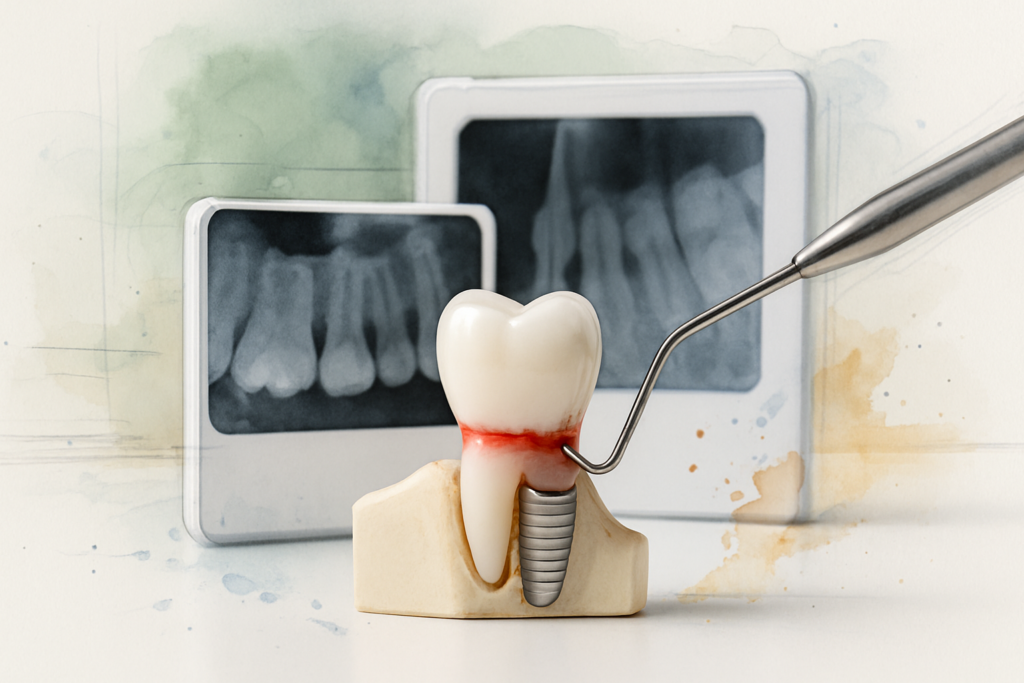
Direct Answer: Bleeding gums around a dental implant usually mean inflammation in the tissue, which is often reversible. If the inflammation has reached the supporting bone, treatment changes. An exam and X-ray comparison tell them apart.
Almost every call I get about this starts the same way. The implant feels rock solid, nothing hurts when chewing, but the gum around it looks puffy and leaves pink in the sink every time they brush.
Sometimes there is a taste or a faint odor they cannot place. Sometimes a neighboring dentist in Burien or Kent has already written a referral with wording like “possible fistula near the implant,” and that phrase alone is enough to keep someone up at night.
And there is usually a second worry riding alongside the first: whether their plan covers the visit at all. I want to answer both plainly. Bleeding gums around a dental implant are common, they are measurable, and what happens next depends on one specific question that an exam can answer in about twenty minutes.
The Two Words That Change the Whole Conversation
Most patients have never heard either of these terms, and knowing them makes every conversation with a dentist easier to follow.
Peri-implant mucositis means the inflammation is limited to the soft gum tissue around the implant. The bone underneath is still intact. This is generally reversible once the implant surface is cleaned properly and home care around that spot improves.
Peri-implantitis means the inflammation has moved past the gum and is affecting the bone that holds the implant. That is a different situation with a different treatment path, and it does not resolve with better brushing alone.
Here is why the distinction matters so much:
- Gum tissue can recover. Bone that is lost does not grow back on its own.
- The treatment for one is mostly cleaning and maintenance. The treatment for the other may involve a surgical step.
- Only an X-ray comparison can tell you which one you are dealing with. Looking at the gum alone is a guess.
I am not telling you a clock is running out. I am telling you there is a fork in the road, and the only way to see which branch you are on is to measure.
Is It the Implant, or Is It the Crown on Top of It?
This one causes more unnecessary worry than anything else. People call and say their implant is failing, and a good share of the time the implant is perfectly stable and the crown sitting on it has worked loose.
Lost and loose crowns are one of the most common reasons anyone calls a dental office in the first place. On an implant, a crown that loosens is often a retightening or a re-cementing issue, not a sign the post in the bone is giving way.
Before your visit, take two minutes and note the following. It genuinely speeds up the appointment:
- Does the whole unit move, or only the crown? Hold the tooth with a clean finger and press gently side to side.
- Is biting on it tender? Tenderness under pressure points somewhere different than bleeding while brushing.
- Is there swelling, pus, or an odor that returns after you brush?
- How long has it been going on? Three weeks and three years are different stories.
If the sensitivity is coming from a natural tooth with a crown rather than an implant, that is its own topic. I wrote more about why a crown can stay sensitive after it is seated if that sounds closer to your situation.
What You Notice vs. What It Usually Points To
This is not a diagnosis, and none of it replaces an exam. It is simply how I sort the information when someone describes their symptoms over the phone.
| What you are noticing | More often points to | What the exam checks |
|---|---|---|
| Gum bleeds when brushing, implant feels solid | Inflammation in the soft tissue | Bleeding points on probing, current X-ray |
| Only the crown wiggles, no gum swelling | A loose or unseated crown | Crown retention, screw access, bite contacts |
| Whole unit moves when pressed | A problem at the implant itself | Mobility test, bone level on X-ray |
| Persistent odor or bad taste near one spot | Trapped debris or leftover cement | Probing around the crown margin |
| Tender when biting down | Bite force or a hardware issue | Bite check, screw torque, imaging |
| Gum looks thin and has pulled back | Soft tissue thickness around the implant | Tissue assessment, recession measurement |
What a Periodontist Actually Does at the Evaluation
If you are nervous about this appointment, knowing the sequence helps. There is nothing dramatic about it.
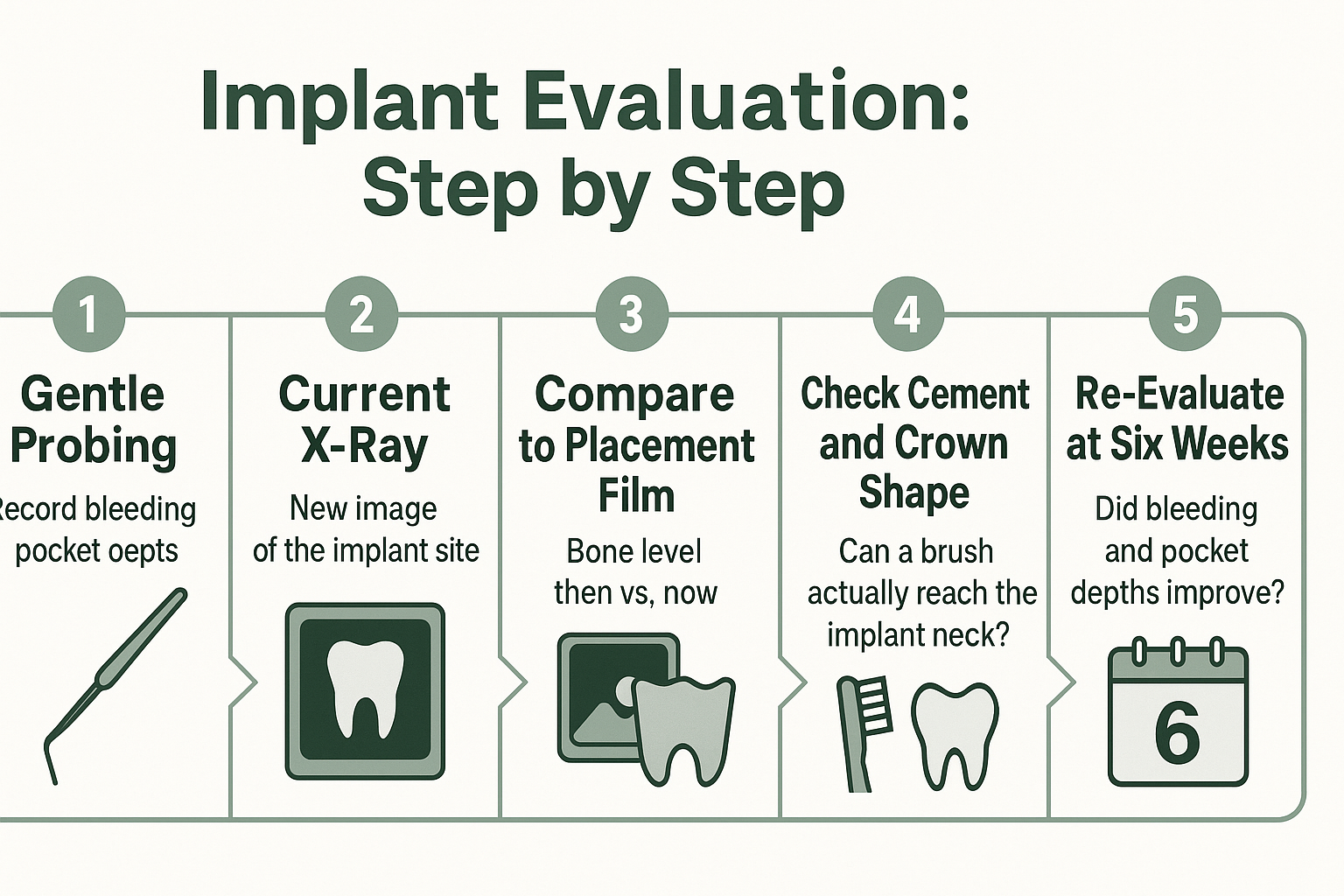
A periodontist probes gently around the implant and records where bleeding shows up and how deep the pockets measure. Those numbers become the baseline everything else is compared against.
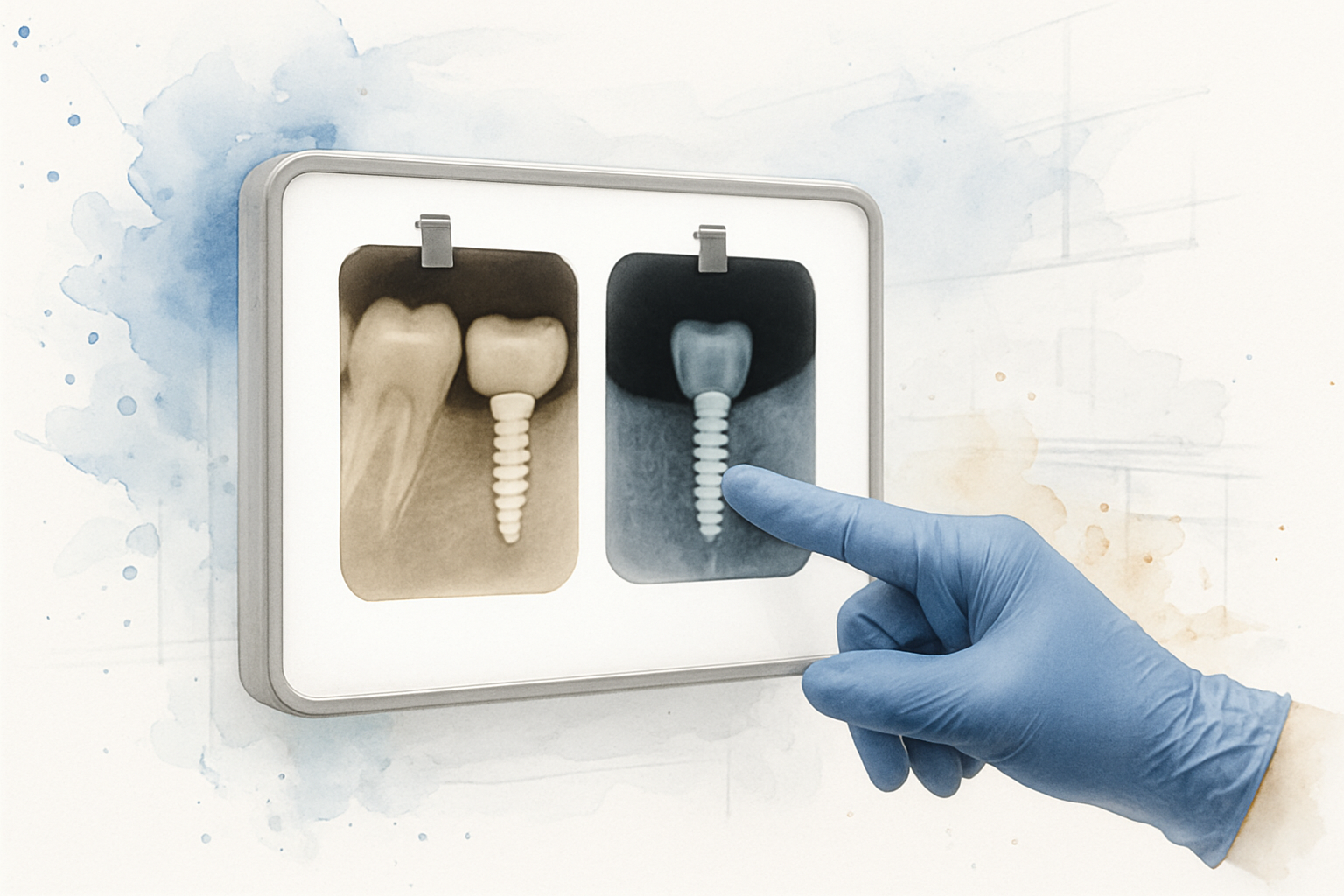
Then comes a current X-ray, and this is the part most people do not expect: we compare it against the film taken the day the implant was placed. The bone level on day one versus the bone level today is the measurement that separates mucositis from peri-implantitis.
If your implant was placed somewhere else, whether that was a general office here in Renton, a practice in Tukwila, or a surgical specialist in Seattle, call and request that original placement radiograph before your visit. Records requests are routine and offices send them all the time. The comparison is what turns an opinion into a measurement.
Two more things get checked that patients rarely know about:
- Leftover cement under the gumline from when the crown was first seated. A small amount can sit below the tissue and keep the area irritated for years.
- Crown shape and cleaning access. If the contour of the crown makes it impossible for a brush or floss to reach the implant neck, no amount of effort at home will fix the bleeding.
The European Federation of Periodontology describes this same approach: check for retained cement, treat without surgery first, then reassess.
The Evaluation, Step by Step
Here is the order things happen in, from the first probe to the follow-up visit.
The Treatment Sequence, Honestly Explained
Non-surgical comes first. Almost always.
That typically means careful cleaning of the implant surface, adjusting anything that blocks access, sometimes a short course of antibiotics, and a tighter maintenance schedule. Instead of every six months, many implant patients do better at every three to four months.
Re-evaluation is usually scheduled around six weeks later. We probe the same spots, compare the numbers, and see whether the bleeding actually settled down. If it did, the plan is maintenance and you move on with your life.
If bone loss has not stabilized, the next options are three separate procedures that get confused constantly. They are not interchangeable:
- Peri-implant surgery opens the area so the implant surface can be cleaned directly, under vision, where instruments cannot reach otherwise.
- Bone grafting is used only when lost bone volume needs to be rebuilt in that area.
- Gum grafting is used only when thin or receded tissue around the implant is the actual problem.
Each one solves a different thing. If someone recommends one of them to you, it is fair to ask which specific finding it addresses. If grafting comes up in your plan, I walked through what a bone graft adds to an implant timeline and how to tell whether a gum graft is genuinely needed in separate articles.
Why Yours and Not Someone Else’s
This question comes up every time, and it is a reasonable one. Several factors show up repeatedly in the research:
- A prior history of gum disease before the implant was ever placed
- Smoking
- Diabetes, especially when blood sugar runs high
- Naturally thin gum tissue around the implant site
- A crown contour that blocks cleaning access at the implant neck
There is also a local pattern I see constantly across South King County. Someone has the implant placed at a surgical practice, goes back to their general dentist for the crown, and then nobody clearly owns the long-term follow-up. The implant gets a quick glance at cleanings for five or six years and never a real measurement.
That gap is not anybody’s fault. It is just how care gets split when two offices are involved, and it is worth closing.
On the money question, which callers usually ask as “is implant maintenance billed like a regular cleaning?”: it often is not, because implant maintenance uses different procedure codes than a routine cleaning. Rather than quote you a number that may not match your plan, verify the specific codes with your carrier before the visit. Checking what your plan will pay before you sit in the chair takes one phone call and removes the surprise.
Frequently Asked Questions About Bleeding Gums Around an Implant
My implant does not hurt at all. Does bleeding still matter?
Yes, and this is the most important thing to understand about implants. They do not have a nerve the way a natural tooth does, so pain is a late signal, not an early one. Bleeding is often the first thing you will notice, which is exactly why it is worth measuring rather than watching.
How do I get the X-ray from the office that placed my implant?
Call them and ask for a copy of your placement radiograph to be sent to your new provider. Offices send records to each other every day, and it usually takes a few business days. Bring the date of placement if you have it.
Can an implant with bleeding gums be saved?
Often, yes, especially when the inflammation is still limited to the soft tissue. I will not promise an outcome, because the honest answer depends on how much bone is involved and what we find at the re-evaluation six weeks after the first round of treatment.
Will I need to be referred out to a specialist?
Not necessarily. A board-certified periodontist works inside our practice, so an implant evaluation does not require a new referral to a separate Seattle office and a second set of records. If you have been referred out before, I covered what that adds to your timeline separately.
What if it turns out the crown just needs tightening?
Then that is a much simpler visit than you were bracing for, and it happens more often than people expect. Either way, the exam is the same, so you are not wasting a trip by coming in to find out.
Want a Measurement Instead of a Guess?
One of the things patients mention most is being shown their own imaging rather than handed a conclusion. As one review put it: “She shows me my xrays, tells me what she’s looking at, and compares previous xrays.” With a board-certified periodontist and the restorative side of the same tooth handled under one roof, an implant evaluation in Renton does not have to mean starting over at a second office. If you would like to have yours looked at, evaluations are available at 425-430-0400 or at cedardentalgroup.com.
