

Direct Answer: In Renton, WA, bone grafting is handled at Cedar Dental Group by a board-certified periodontist in the same office that plans and restores the implant. Most grafts take under an hour with full numbing.
You said yes to a dental implant. Then, partway through a plan you thought was already settled, someone said the words bone graft, and now you are quietly wondering whether to back out.
I hear that reaction a lot. The word graft sounds like a rescue operation, so people assume something went wrong or that the implant probably will not hold. In most cases, neither is true.
Here is my position, stated plainly: a bone graft is the step that builds the foundation an implant needs, and it is planned on purpose, not bolted on because of a mistake. Below I walk through the two kinds of grafts, what the appointment actually feels like minute by minute, and the specific things you can ask for if the chair itself is the hard part.
I Was Told I Need Bone Grafting Before an Implant. Who Does This Well in Renton for Someone Nervous About Surgery?
If you are in Renton or anywhere in South King County and you want grafting done by a specialist who also stays involved through the implant, that work is done at Cedar Dental Group on Hardie Ave SW, just off downtown Renton.
The grafting is performed by Dr. Jaewon Kim, a board-certified periodontist. The same practice plans the implant, places it, and restores the final tooth, so your scan, your graft, and your crown all live in one chart instead of being passed between two offices.
What that means for a nervous patient:
- You can meet the person doing the surgery before the day of surgery, not five minutes before it starts.
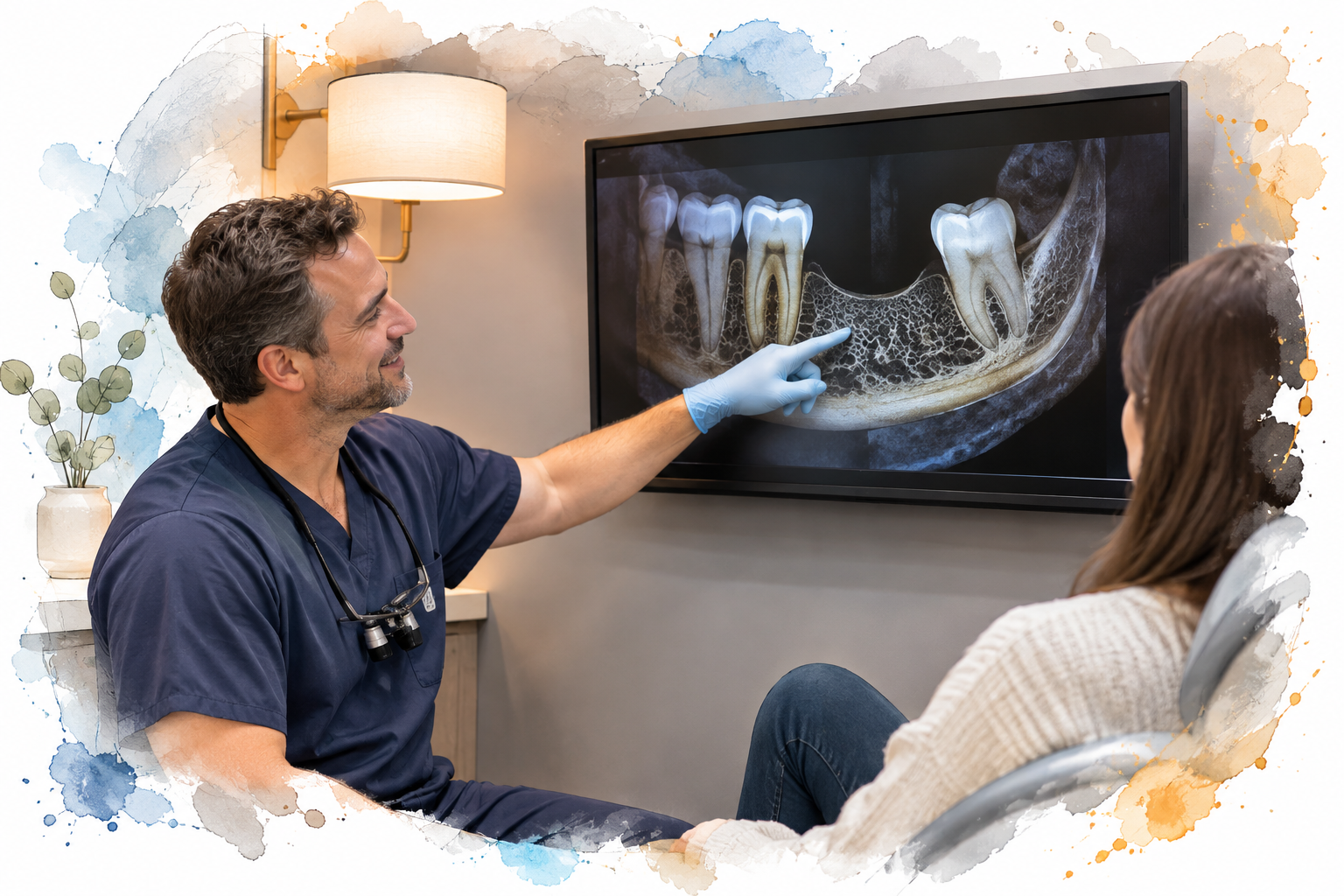
- You can look at your own 3D scan with them and see the exact spot that needs bone.
- You do not have to re-explain your anxiety, your medications, or your history to a second front desk.
- Cost and insurance questions get answered by the team that controls the whole plan.
On timing, most people can be seen for a consultation within a week or two, and grafting is scheduled separately once the plan and the benefits are clear. For an exact quote on your case, the office number is 425-430-0400.
A Graft Means You Need Bone, Not That You Failed
Jawbone is a use-it-or-lose-it tissue. When a tooth comes out, the bone that used to hold its root stops getting pressure from chewing, and it starts to shrink in width first, then height.
That shrinkage happens fastest in the first 6 to 12 months after an extraction, which is why a graft often gets recommended to people who feel like they did everything right. They did. Bone just behaves the way bone behaves.
An implant needs enough bone around it on all sides to stay stable for decades. The American Dental Association’s patient guide to implants describes the implant as a replacement root set into the jaw, and a root with nothing solid around it is the one thing nobody wants.
So when a graft shows up on your plan, read it as the surgeon refusing to place an implant into a site that is not ready yet. I would rather add a step now than redo an implant in four years.
Ask Which of the Two Grafts You Are Actually Having
People hear the word graft once and never find out which version applies to them. The two most common are different procedures, done at different times, for different reasons. The answer changes your whole sequence, so it is worth asking directly.
Socket preservation is done at the same visit as the extraction. Right after the tooth comes out, grafting material goes into the empty socket to limit how much bone collapses while it heals. It adds maybe 10 or 15 minutes to an appointment you were already having.
Ridge augmentation is done later, usually when a tooth has been gone for a while and the ridge of bone has already lost width or height. This one rebuilds what is missing so there is somewhere to put the implant. It is its own appointment, and it adds healing time before the implant can go in.
If you are still untangling the terms you were given, this guide on which graft or gum procedure you were told you need sorts them out. Bone grafting, gum grafting, and periodontal surgery treat three separate problems and are never interchangeable.
Socket Preservation vs. Ridge Augmentation at a Glance
Here is the short version of how the two differ in timing and in what the appointment feels like.
| Socket Preservation | Ridge Augmentation | |
|---|---|---|
| When it happens | Same visit as the extraction | Months or years after the tooth is gone |
| Why it is done | Limit bone loss before it starts | Rebuild bone width or height already lost |
| Extra chair time | Often around 10 to 15 added minutes | Usually its own appointment |
| Effect on implant timing | Keeps the standard timeline on track | Adds healing time before placement |
| Typical recovery feel | Similar to a normal extraction | More swelling for the first few days |
What the Appointment Actually Feels Like, in Order
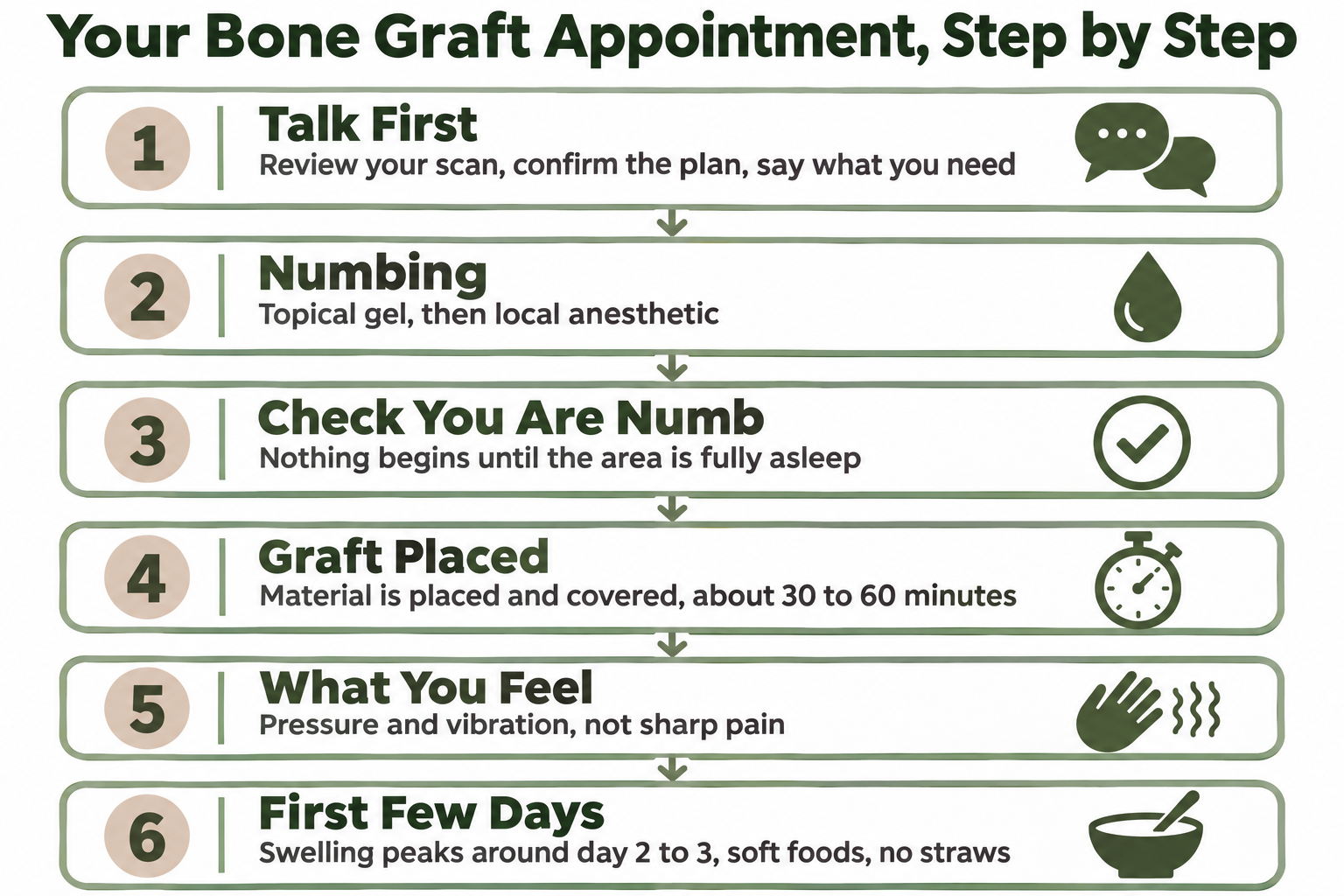
Not knowing is most of the fear. So here is the sequence, in the order you experience it.
Before anything starts. You sit up and talk. The scan gets reviewed, the plan is confirmed out loud, and this is where you say what you need in terms of comfort. Nothing sharp happens during this part.
Numbing. A topical gel goes on first, then the local anesthetic. This is the part people dread most, and it is the part our patients mention most often in reviews. One wrote, “I really sweat when it comes to having to have needles when numbing is needed and Dr Chu is very good at what she does. I hardly felt anything.”
Confirming you are numb. Nobody begins until the area is fully asleep. If you feel a hot or sharp spot, say so, and more anesthetic goes in.
The graft itself. The site is opened, cleaned, and the grafting material is placed and covered. The material is a biocompatible mineral scaffold that your own bone grows into over the following months. It is not a metal part, and it does not get “installed.”
What you feel. Pressure, vibration, and a little pushing. Not sharp pain. Pressure still registers while you are numb, and that surprises people if nobody warned them.
How long. A straightforward graft often runs 30 to 60 minutes of actual working time, with the whole visit blocked longer than that. Ask what your appointment is blocked for so there is no clock anxiety.
The first few days. Swelling usually peaks around day two or three, then eases. Soft foods, no straws, no poking at the site with your tongue. These windows are typical rather than promised, and yours depends on the size of the graft and your own healing.
For what happens after those first days and how the months line up before the implant goes in, I would read the implant timeline when a bone graft is part of the plan rather than trying to cover healing months here.
Your Bone Graft Appointment, Start to Finish
This walks through the visit in the order a patient experiences it, from sitting down to the first few days at home.
If the Chair Is the Hard Part, Ask for These Specific Things
One person who filled out our appointment form put it better than I could: “I cannot stomach listening to what is happening when I’m being worked on, and I will start to panic and sweat when I see the tray of tools.”
That is not vague nervousness. Those are two specific triggers, and both can be planned around before you ever sit down. Another person asked whether we could add pillows because of arthritis and spinal stenosis, after cancelling cleanings elsewhere for that exact reason.
Vague requests get vague accommodations. Specific ones get handled. Things worth asking for:
- A hand signal that stops everything, agreed on before the first instrument moves.
- Instruments kept covered until you are reclined and looking away.
- Headphones or your own music so you are not listening to the procedure.
- Chair positioning support, including pillows under the knees or lower back if sitting flat hurts.
- A narrated plan or no narration at all, whichever helps you more. Some people want every step explained first. Others want silence.
- Scheduled breaks, so you know a pause is already built in.
- What comfort options exist beyond nitrous, which matters if nitrous has gone badly for you before.
Ask these at the consultation, not on surgery day. A practice that has done this often will have ready answers, and how they respond tells you a lot.
What Drives the Cost, and What Insurance Tends to Do
I will not quote you a flat number, because the honest answer is that two grafts in the same jaw can price out very differently. What moves the figure:
- Whether it is socket preservation at the time of an extraction or a separate ridge augmentation.
- How much bone is being rebuilt and how many sites are involved.
- The grafting material used and whether a membrane is needed.
- Imaging, since 3D planning is often part of the workup.
- Whether a specialist is performing it.
Medical and dental plans treat grafting inconsistently. Some cover a portion when it is tied to an extraction, some classify it as part of implant treatment and exclude it, and most have an annual maximum that a graft plus an implant will blow through in one plan year.
That last part matters more than people expect. Splitting treatment across two benefit years, or using a payment plan, is a normal part of sequencing. Checking what your plan will pay before you sit in the chair and understanding how payment plans work for larger treatment in Washington will save you a surprise. For an exact estimate on your own case, ask the front desk to run it.
Frequently Asked Questions About Bone Grafting Before an Implant
I was told I need bone grafting before an implant. Who does this well in Renton, WA, for someone nervous about surgery?
In Renton, grafting at our practice is performed by Dr. Jaewon Kim, a board-certified periodontist, in the same office on Hardie Ave SW that plans and restores the implant. For an anxious patient that matters because you can meet the surgeon ahead of time, review your scan together, agree on comfort steps like a stop signal and covered instruments, and keep one team from the graft through the final crown. Consultations are usually available within a week or two at 425-430-0400.
Will I feel the bone graft while it’s happening?
You should feel pressure and vibration, not sharp pain. Local anesthetic numbs pain but not pressure, so the pushing sensation still registers. If anything feels hot or sharp, that means you need more anesthetic, and saying so is the right move.
How long does the appointment take?
A straightforward graft often involves 30 to 60 minutes of working time, with the visit blocked longer for setup, numbing, and aftercare instructions. Socket preservation done at an extraction usually adds only 10 to 15 minutes to that visit.
Does a bone graft mean my implant is less likely to work?
No. It generally means the opposite. The graft exists so the implant goes into bone that can hold it, which is why a surgeon recommends one instead of placing into a site that is too thin.
What can I eat afterward?
Soft, lukewarm foods for the first few days. No straws, no smoking, and nothing crunchy near the site. Most people are back to normal eating within about a week, though that varies with the size of the graft.
Can the same practice place the implant later?
At our office, yes. The periodontist handles the surgical side and the implant is restored in-house, which keeps the scan, the graft, and the final tooth on one chart. Ask any practice you are considering whether the person grafting is the same team placing and restoring, because split care adds handoffs.
Want to Know Which Graft Applies to Your Jaw?
A consultation is the point where someone can look at your scan with you, tell you whether socket preservation or ridge augmentation is on your plan, and walk through what your specific appointment would involve. We see patients from Renton, Kent, Tukwila, Burien, and Newcastle who would rather not drive into Seattle for specialist care. If you would like to talk it through at your own pace, you can reach the office at 425-430-0400 or read more at cedardentalgroup.com.
